Freedom251 › Database Backup Software
Databasement
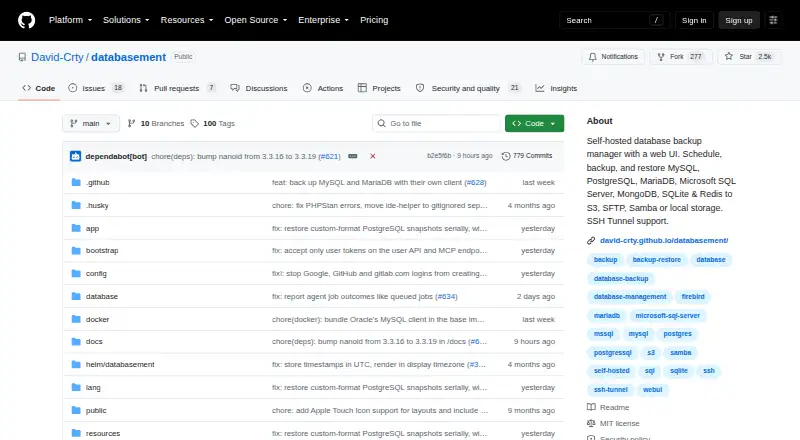
What Databasement is
Databasement is a self-hosted application for scheduling database backups and restoring snapshots. It supports MySQL, PostgreSQL, MariaDB, Microsoft SQL Server, MongoDB, SQLite, Firebird, Redis, and Valkey. Backup schedules can run daily or weekly, with time-based or GFS retention, and the project also lists custom backup frequency and point-in-time recovery. Destinations include local storage, S3-compatible storage, Azure Blob Storage, Samba/SMB, and SFTP/FTP. Backups can use AES-256 encryption with gzip or zstd compression.
Snapshots can be restored to compatible servers, and scheduled restores can refresh a target from the latest completed snapshot. Redis and Valkey backups are supported, but restores for those databases are unavailable. For private databases, SSH tunnels support password or key authentication through a bastion or jump server. Remote agents can handle databases in isolated networks by connecting outbound over HTTPS, creating a local dump, and sending it to storage.
The application includes organization and workspace separation, role-based access, OAuth/SSO, and optional two-factor authentication. OAuth providers include Google, GitHub, GitLab, and generic OpenID Connect providers. Failed-job alerts can be sent through Email, Slack, Discord, Telegram, Pushover, Gotify, or Webhook. Databasement offers a REST API and MCP server and can be deployed with Docker, Docker Compose, Kubernetes with Helm, or a native Ubuntu installation. It is free and MIT-licensed.
Who it suits
Databasement suits teams that want to host their own database backup and restore service across the supported database systems. Its remote connection options, multiple storage destinations, and team access controls also fit organizations managing private or isolated databases.
What it does well
- Supports nine database types, including MySQL and PostgreSQL.
- Daily or weekly schedules with time-based or GFS retention.
- Stores backups locally or in several remote storage types.
- SSH tunnels and remote agents cover private and isolated databases.
- Offers REST API, MCP server, and multiple deployment routes.
- Free and licensed under MIT.
What to know first
- Redis and Valkey restores are unavailable.
- Restore verification is not supported.
Limits
Redis and Valkey backups are supported, but restoring them is unavailable. Restore verification is not supported.
Getting started
- Open the Databasement project website on GitHub.
- Choose a deployment route: Docker, Docker Compose, Kubernetes with Helm, or native Ubuntu installation.
- Connect supported database servers, using SSH tunnels or remote agents where needed.
- Select backup storage and configure a daily or weekly schedule and retention policy.
- Set up alerts and team access controls as needed.
Verdict
Choose Databasement if you need a free, self-hosted service for scheduled database backups, varied storage destinations, and controlled restores. Look elsewhere if Redis or Valkey restore support or restore verification is required.
Questions
How much does Databasement cost?
Databasement is free, with a free plan and no free trial.
Which databases does it support?
It supports MySQL, MariaDB, PostgreSQL, Microsoft SQL Server, MongoDB, SQLite, Firebird, Redis, and Valkey.
Can it restore Redis or Valkey backups?
No. Redis and Valkey backups are supported, but restores are unavailable.
Where can backups be stored?
Options include local storage, S3-compatible storage, Azure Blob Storage, Samba/SMB, and SFTP/FTP.
Is Databasement open source?
Yes. It is licensed under the MIT License.
How can it be deployed?
Deployment options include Docker, Docker Compose, Kubernetes with Helm, and native Ubuntu installation.
Facts from Databasement's own pages
- Access control
- Team features include multi-tenant organizations, isolated workspaces, role-based access control, and OAuth/SSO. · github.com, 7 Oct 2026
- Alerts
- Job failure notifications are available through Email, Slack, Discord, Telegram, Pushover, Gotify, or Webhook. · github.com, 7 Oct 2026
- Automated backups
- Backups can run daily or weekly with time-based or GFS retention policies. · github.com, 7 Oct 2026
- Automation
- Databasement provides a REST API and MCP server for scripts, CI/CD pipelines, and AI assistant integrations. · github.com, 7 Oct 2026
- Backup scheduling
- Recurring backups can run daily or weekly, with time-based or GFS retention policies. · github.com, 7 Oct 2026
- Database support
- It supports MySQL, PostgreSQL, MariaDB, Microsoft SQL Server, MongoDB, SQLite, Firebird, and Redis/Valkey. · github.com, 7 Oct 2026
- Deployment
- Deployment options include Docker, Docker Compose, Kubernetes with Helm, and native Ubuntu installation. · github.com, 7 Oct 2026
- Encryption
- The project lists AES-256 encryption as a backup option, alongside gzip and zstd compression. · github.com, 7 Oct 2026
- Failure alerts
- Failed jobs can send notifications through Email, Slack, Discord, Telegram, Pushover, Gotify, or Webhook. · github.com, 7 Oct 2026
- Identity integrations
- OAuth providers include Google, GitHub, GitLab, and generic OpenID Connect providers. · david-crty.github.io, 7 Oct 2026
- License
- The project is open-source software licensed under the MIT License. · github.com, 7 Oct 2026
- License and security reporting
- Databasement is MIT-licensed, and its security policy directs vulnerability reports through GitHub private vulnerability reporting. · github.com, 7 Oct 2026
- Notable limit
- The repository's supported-version table lists Redis and Valkey restore as unavailable. · github.com, 7 Oct 2026
- Notable limitation
- Redis and Valkey backups are supported, but restoring them is not currently supported. · david-crty.github.io, 7 Oct 2026
- Purpose
- Databasement is a web application for managing database server backups, schedules, and restores. · david-crty.github.io, 7 Oct 2026
- Remote access
- SSH tunnels support connections to private databases through a bastion or jump server using password or key authentication. · github.com, 7 Oct 2026
- Remote agents
- Remote agents can back up databases in isolated networks by connecting outbound over HTTPS, dumping locally, and uploading to storage. · github.com, 7 Oct 2026
- Restore
- Snapshots can be restored across compatible servers, and scheduled restores can refresh a target from the latest completed snapshot. · github.com, 7 Oct 2026
- Security
- Encrypted backups use AES-256, and the application supports optional two-factor authentication. · david-crty.github.io, 7 Oct 2026
- Storage
- Backup storage options include local storage, S3-compatible storage, Azure Blob Storage, Samba/SMB, and SFTP/FTP. · github.com, 7 Oct 2026
- Team access
- The project lists multi-tenant organizations, isolated workspaces, role-based access control, OAuth/SSO, and optional two-factor authentication. · github.com, 7 Oct 2026
Where Databasement stands on Freedom251
- Database Backup Software#8 of 27