Freedom251 › Database Backup Software

Database Vault
What Database Vault is
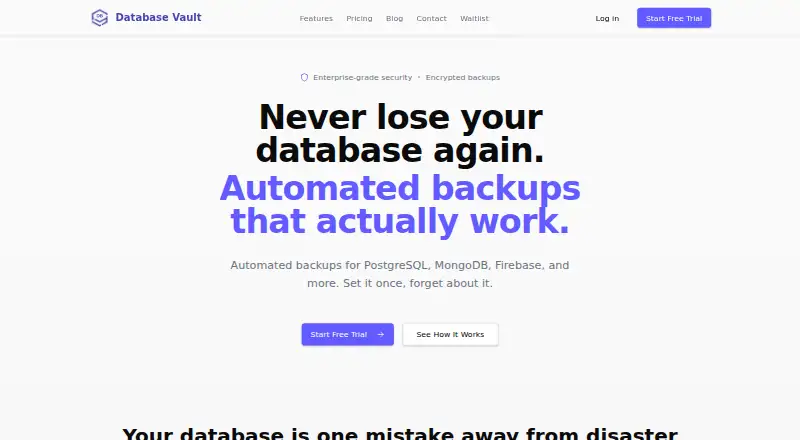
Database Vault is a cloud service for automated backups of PostgreSQL, MySQL, MongoDB, Firebase, and Supabase databases. Schedules can be hourly, daily, weekly, or custom. Users can review backup history and restore a point-in-time snapshot; the service also describes a one-click restore to a new database. It monitors failures, retries automatically, and provides notifications and operation logs, while its dashboard tracks backup frequency, storage usage, and success rates.
The service says it encrypts backups with AES-256 before storage and encrypts connection strings at rest without logging them. It uses Google Cloud Platform infrastructure, which it describes as SOC 2 Type II certified, and advertises a 99.9% uptime SLA for backup operations. The Free plan costs nothing and includes weekly backups, seven-day retention, 1 GB of total storage, a low-priority queue, and basic email notifications. Starter costs $9 a month and supports up to three databases; Pro costs $15 a month and supports up to ten. Plans can be canceled anytime, and backups remain accessible for 30 days afterward.
Who it suits
Database Vault suits solo developers, early-stage startups, agencies managing client databases, and engineering teams with multiple databases. The available plans range from a 1 GB free tier to paid tiers with higher database and storage limits.
What it does well
- Supports hourly, daily, weekly, and custom schedules.
- Automatic retries and notifications for backup failures.
- Point-in-time snapshots and restore to a new database.
- Pro includes 30-day retention and 50 GB storage.
What to know first
- Free plan is limited to 1 GB total storage.
- Free plan retains backups for seven days.
- Starter supports up to three databases; Pro up to ten.
Limits
The Free plan includes 1 GB total storage, seven-day retention, weekly automated backups, a low-priority queue, and basic email notifications. Starter costs $9 a month and supports up to three databases, 10 GB, daily backups, and seven-day retention; Pro costs $15 a month and supports up to ten databases, 50 GB, and 30-day retention.
Plans
| Plan | Billed and limits | Price |
|---|---|---|
| Free | Weekly automated backups · 7-day retention · 1 GB total storage · Low-priority backup queue · Basic email notifications | Free |
| Pro | Billed monthly · Up to 10 databases · Daily automated backups · Manual / instant backups · 30-day retention · 50 GB total storage · Normal-priority backup queue · Email and webhook notifications | $15 a month |
| Starter | Billed monthly · Up to 3 databases · Daily automated backups · 7-day retention · 10 GB total storage · Normal-priority backup queue · Email notifications | $9 a month |
As dbvault.io lists them, read 4 Oct 2026. The maker's own page has the final word.
Getting started
- Visit https://www.dbvault.io/.
- Use the web platform.
- Choose the Free plan or a paid plan; a free trial is also available.
- Set a backup schedule for a supported database.
- Review backup history and use the restore options when needed.
Verdict
Database Vault combines scheduled backups with monitoring and restore options for several database services. Compare storage, retention, and database limits with your needs before choosing a plan.
Questions
Is Database Vault free?
Yes. Its Free plan costs nothing and includes 1 GB of storage and seven-day retention.
What do the paid plans cost?
Starter costs $9 a month, billed monthly. Pro costs $15 a month, billed monthly.
Which databases does it support?
The listed databases are PostgreSQL, MySQL, MongoDB, SQLite, Firebase, and Supabase.
Which platforms can I use?
The listed platform is web.
Can I restore a point-in-time backup?
Yes. Users can restore a point-in-time snapshot, and the service describes a one-click restore to a new database.
Can I cancel a plan?
The service says plans can be canceled anytime. Backups remain accessible for 30 days after cancellation.
Facts from Database Vault's own pages
- Analytics
- The dashboard tracks backup frequency, storage usage, and success rates. · dbvault.io, 4 Oct 2026
- Cancellation
- The site says plans can be canceled anytime and backups remain accessible for 30 days after cancellation. · dbvault.io, 4 Oct 2026
- Encryption
- The site says backups use AES-256 encryption before storage and connection strings are encrypted at rest and never logged. · dbvault.io, 4 Oct 2026
- Infrastructure
- The site says it uses Google Cloud Platform infrastructure, which it describes as SOC 2 Type II certified. · dbvault.io, 4 Oct 2026
- Intended users
- The site presents the product for early-stage startups, agencies managing client databases, engineering teams with multiple databases, and solo developers or freelancers. · dbvault.io, 4 Oct 2026
- Limits
- The Free plan includes 1 GB total storage and 7-day retention; Starter supports up to 3 databases, and Pro supports up to 10. · dbvault.io, 4 Oct 2026
- Monitoring
- The service monitors backup failures, retries automatically, and offers notifications and detailed operation logs. · dbvault.io, 4 Oct 2026
- Product
- Database Vault provides automated cloud backups for PostgreSQL, MySQL, MongoDB, Firebase, and Supabase. · dbvault.io, 4 Oct 2026
- Recovery
- Users can view backup history and restore a point-in-time snapshot; the site also describes one-click restore to a new database. · dbvault.io, 4 Oct 2026
- Scheduling
- Backup schedules can be hourly, daily, weekly, or set to custom intervals. · dbvault.io, 4 Oct 2026
- Storage
- The service says it stores encrypted backups in Cloud Storage. · dbvault.io, 4 Oct 2026
- Uptime
- The site advertises a 99.9% uptime SLA for backup operations. · dbvault.io, 4 Oct 2026
Where Database Vault stands on Freedom251
- Database Backup Software#10 of 27