Freedom251 › Multi-Factor Authentication Software

CryptoPhoto
What CryptoPhoto is
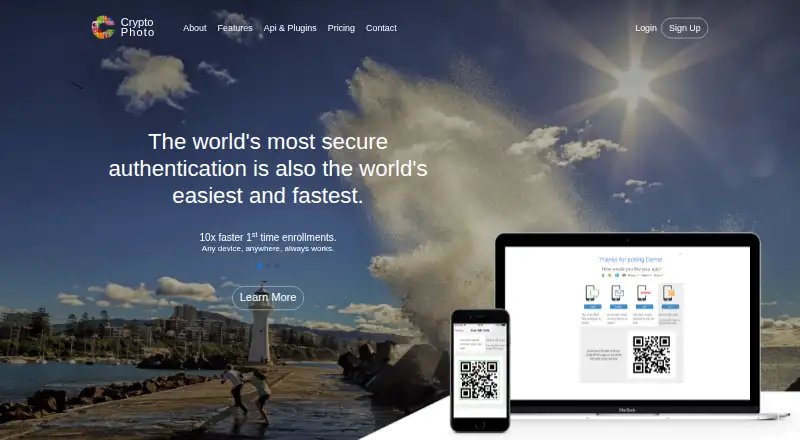
CryptoPhoto provides login authentication and transaction signing through mutual authentication. It offers a passwordless option and supports photo matching, biometrics, passphrases and cryptographic tokens. Users can approve sensitive actions with out-of-band transaction signatures, while authentication, signatures and key provisioning can require approval from multiple operators under a two-man rule. The maker describes CryptoPhoto as verifier impersonation resistant and compliant with NIST SP 800-63-3 AAL3. It says the system is designed to block phishing and social engineering. Customers can use shared cloud authentication or deploy virtual or physical appliances; the pricing page says each appliance can manage 100,000 user actions per second. Integration options include API libraries and code samples for Perl, PHP, Python, .NET and Java/J2EE, as well as a Linux PAM module. Listed platforms include Android, iOS, Linux, Windows, web, API and self-hosted. The maker also describes multiple-device support, self-service enrollment and recovery for lost devices. A free plan is listed, alongside per-use pricing of $0.04 per transaction signature and per-user pricing of $1 a year, per user and facility.
Who it suits
CryptoPhoto is aimed at organizations seeking authentication and transaction approval, including banking, government, enterprise, small business and critical infrastructure use cases. Its deployment choices and integrations may also suit cloud, hosting and developer use cases.
What it does well
- Supports passwordless authentication and multiple factors
- Transaction signatures can require multiple operators
- Offers cloud or customer-deployed appliances
- Includes API libraries and a Linux PAM module
What to know first
- Per-user pricing is $1 a year
- Per-use signatures cost 0.04 USD each
- Per-user pricing is per facility
Limits
Paid cloud pricing is $0.04 per transaction signature, with unlimited users. The per-user plan is $1 per user, per facility, per year, for 1–100,000 users; listed charges are authentication $1, transaction signatures $0.25, telephone authentication $1, in-person authentication $0.10, and cipher keys $0.10, with unlimited facility usage.
Plans
| Plan | Billed and limits | Price |
|---|---|---|
| Cloud-Pricing — Per-Use | Per transaction signature · unlimited users | $0.04, paid once |
| Per-User pricing | Per-user, per-facility, per-year · 1–100,000 users · authentication $1 · transaction signatures $0.25 · telephone auth $1 · in-person auth $0.10 · cipher keys $0.10 · unlimited facility usage | $1 a year |
As cryptophoto.com lists them, read 11 Oct 2026. The maker's own page has the final word.
Getting started
- Visit the CryptoPhoto website.
- Choose shared cloud authentication or deploy a virtual or physical appliance.
- Select the free plan or review the listed usage-based and per-user pricing.
- Integrate using API libraries or code samples, or the Linux PAM module.
- Use the secure self-service enrollment support.
Verdict
CryptoPhoto combines mutual authentication with transaction signing and offers cloud and self-hosted deployment choices. Review the listed pricing units and integration options to see how they fit your deployment.
Questions
Does CryptoPhoto have a free plan?
Yes, a free plan is listed.
How much does CryptoPhoto cost?
The Cloud-Pricing — Per-Use plan is $0.04 per transaction signature, with unlimited users. Per-User pricing is $1 per user, per facility, per year, for 1–100,000 users, with listed charges of $1 for authentication, $0.25 for transaction signatures, $1 for telephone authentication, $0.10 for in-person authentication, and $0.10 for cipher keys; facility usage is unlimited.
Which platforms does CryptoPhoto support?
The listed platforms are Android, iOS, Linux, Windows, web, API, and self-hosted.
Does CryptoPhoto support passwordless authentication?
Yes. The product offers an option to remove passwords while retaining its authentication approach.
Can customers deploy CryptoPhoto themselves?
Yes. Customers can use shared cloud authentication or deploy their own virtual or physical appliances.
What integrations are available?
The maker offers API libraries and code samples for Perl, PHP, Python, .NET, and Java/J2EE, plus a Linux PAM module.
Facts from CryptoPhoto's own pages
- Appliance capacity
- The pricing page says each appliance can manage 100,000 user actions per second. · vmcpsj.cryptophoto.com, 11 Oct 2026
- Deployment
- Customers can use shared cloud authentication or deploy their own virtual or physical appliances. · vmcpsj.cryptophoto.com, 11 Oct 2026
- Integrations
- The maker offers API libraries and code samples for Perl, PHP, Python, .NET, and Java/J2EE, plus a Linux PAM module. · vmcpsj.cryptophoto.com, 11 Oct 2026
- Multi-operator approval
- Authentication, transaction signatures, and key provisioning can require approvals from multiple operators under a two-man rule. · vmcpsj.cryptophoto.com, 11 Oct 2026
- Passwordless
- The product offers an option to remove passwords while retaining its authentication approach. · vmcpsj.cryptophoto.com, 11 Oct 2026
- Phishing defense
- The maker says CryptoPhoto's mutual authentication is designed to block phishing and social engineering. · vmcpsj.cryptophoto.com, 11 Oct 2026
- Privacy claim
- The maker says its sites, services, and apps do not store personal or client usage information. · vmcpsj.cryptophoto.com, 11 Oct 2026
- Product
- CryptoPhoto provides high-security login and transaction signing using mutual authentication. · vmcpsj.cryptophoto.com, 11 Oct 2026
- Recovery
- The maker describes support for multiple devices and secure self-service enrollment and lost-device recovery. · vmcpsj.cryptophoto.com, 11 Oct 2026
- Security standard
- The maker describes CryptoPhoto as compliant with NIST SP 800-63-3 AAL3 and verifier impersonation resistant. · vmcpsj.cryptophoto.com, 11 Oct 2026
- Transaction signing
- Users can approve sensitive actions with out-of-band transaction signatures. · vmcpsj.cryptophoto.com, 11 Oct 2026
- Who it serves
- The maker lists banking, government, enterprise, small business, cloud and hosting, critical infrastructure, websites, education, cryptocurrency, and developer use cases. · vmcpsj.cryptophoto.com, 11 Oct 2026