Freedom251 › Font Design Software

Counterpunch
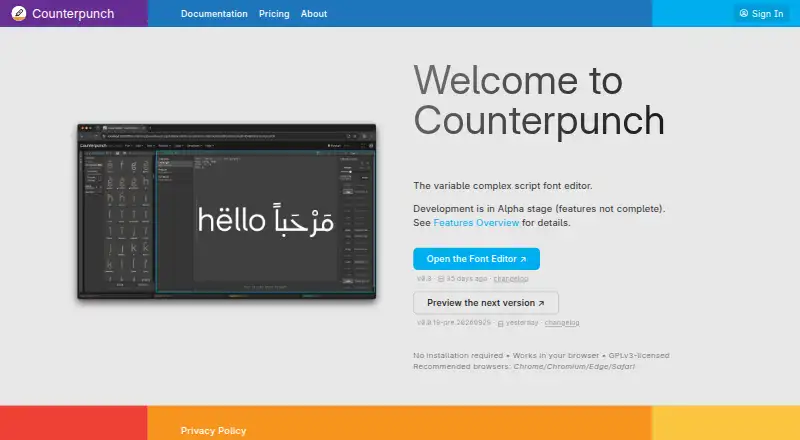
What Counterpunch is
Counterpunch is a browser-based font studio for designing and editing fonts, including fonts with complex-script shaping such as Arabic and Devanagari. The editor is in Alpha, so its features are still being developed. Users can edit components in place and inspect fonts with code-driven dynamic glyph filters. It includes a Python environment, and the maker describes user code as able to catch and repair broken scripts. Counterpunch is designed with variable-font dimensions such as weight, width, and custom axes in mind. Its AI assistant generates Python scripts that run locally rather than sending font data to AI servers. The editor is GPLv3-licensed and usable without registration. The maker says font projects remain on the user's device and data collection is minimal. The browser app supports macOS, Windows, and Linux, but is not optimized for mobile operating systems. Installing it as a Progressive Web App enables offline editing of fonts on disk, Python execution, and preview compilation; the assistant still requires a connection and signed-in account. The free editor omits the AI assistant. A Free Trial account includes 0.50 EUR in AI-agent credit each month, which does not accumulate.
Who it suits
Counterpunch suits font designers who want browser-based editing, complex-script shaping, scripting, and variable-font controls. It is intended for desktop operating systems rather than mobile use.
What it does well
- Supports Arabic and Devanagari shaping.
- GPLv3-licensed and usable without registration.
- Installed PWA supports offline editing and preview compilation.
- Font data and scripts stay on the user's computer.
What to know first
- The editor is in Alpha.
- Not optimized for mobile operating systems.
- Free editor does not include the AI assistant.
- The AI assistant requires a connection and signed-in account.
Limits
The Free plan provides font editor usage but excludes the AI assistant. The Free Trial plan includes €0.50 of AI-agent credit each month; it resets monthly, does not accumulate, and has no pay-as-you-go overage. The Basic plan costs €5 a month, includes AI-agent credit equal to half the subscription price, and allows pay-as-you-go after that credit runs out.
Plans
| Plan | Billed and limits | Price |
|---|---|---|
| Free | €0 forever · No account required · Editor use forever · AI assistant unavailable | Free |
| Free Trial | €0 forever · Registered account · €0.50 AI-agent credit monthly · Credit resets and does not accumulate · No overage | Free |
| Basic | €5 per month excl. VAT · Half subscription price included as AI-agent credit · Credit expires at billing-period end · Pay as you go after credit · Supports editor development | €5 a month |
As counterpunch.space lists them, read 15 Oct 2026. The maker's own page has the final word.
Getting started
- Open the Counterpunch website in a browser.
- Use the editor without registering, or create an account for the Free Trial plan.
- Install the browser app as a Progressive Web App for offline editing and previews.
- Use a desktop browser on macOS, Windows, or Linux.
- Sign in and connect to the network to use the AI assistant.
Counterpunch is a browser-based font editor for people who want to work directly with glyphs, scripts, and variable-font axes. It is best suited to desktop users comfortable with code and an Alpha-stage tool. Its local editing and offline PWA support are compelling; the developing editor and lack of AI in the free plan narrow its appeal.
Overview
Counterpunch brings font design and editing into a browser studio, with component editing, dynamic glyph filters, and an embedded Python environment. Support for bidirectional shaping in scripts such as Arabic and Devanagari gives it a practical focus beyond basic Latin glyph work. The editor is GPLv3-licensed and can be used without registration.
The maker says projects, edits, and scripts remain on the user's computer rather than being uploaded for editing or compilation, and describes data collection as minimal. That local-first approach is reinforced by its installable Progressive Web App: after installation, users can edit fonts on disk, run Python, and compile previews offline. The AI assistant is the exception: it requires a network connection and signed-in account.
Key features
Editing components in place and filtering glyphs through code-driven rules can suit detailed, repeatable font work. The Python environment adds room to automate or repair scripts, though that flexibility will matter most to users willing to work with code. The assistant generates Python scripts that run locally, keeping font data away from AI servers according to the maker.
Variable fonts are central to the design, with support for weight, width, and custom axes. That makes Counterpunch a more natural fit for projects built around variation than an editor focused only on static outlines. Its Alpha status means the feature set is still developing, so it is a less settled choice for workflows that depend on a mature editor.
Pricing
The Free plan costs nothing and provides font editing forever without an account, but excludes the AI assistant. It is the clearest fit for anyone who wants the core editor and local workflow without an account or subscription.
Free Trial costs nothing and requires a registered account. It includes €0.50 of AI agent credit each month; unused credit does not accumulate, and there is no pay-as-you-go overage. That suits someone who wants to try the assistant within a fixed monthly allowance.
Basic costs €5 a month, billed monthly, and includes AI agent credit equal to half the subscription price. Credit expires at the end of each billing period, and pay-as-you-go charges apply after it runs out. It is aimed at regular assistant users who can keep an eye on their credit; people who want predictable costs without overage should stay with Free or Free Trial and go without paid usage.
Platforms
Counterpunch supports web on macOS, Windows, and Linux through the browser app. It is not optimized for mobile operating systems, so font work on a phone or tablet is a poor fit. Installing the PWA makes core editing, Python, and preview compilation available offline, but AI assistance still needs a connection.
Who it's for
Counterpunch is strongest for desktop font makers who value variable-font work, complex-script shaping, programmable filters, or local editing. It is less suitable for mobile-first users, people who need a mature editor today, or anyone seeking shared editing: collaboration is not supported.
Pros and cons
- Pros: Local project handling and offline PWA editing keep font work on the user's device and available without a network connection.
- Pros: Bidirectional shaping, in-place component editing, and variable-font axes serve demanding font projects.
- Pros: The GPLv3 editor works without registration, and the free tier has no stated end date.
- Cons: Alpha status means the editor is still in development, which can be a concern for production-critical workflows.
- Cons: The AI assistant is excluded from Free and requires both a connection and signed-in account.
- Cons: No mobile optimization or collaboration limits where and with whom teams can work.
Alternatives
Font Design Software is a useful starting point for comparing the broader category. Choose FontBob if you want listed support across mobile and desktop platforms alongside drawing, spacing, previews, and OTF export on its free plan. FontMaker is another freemium alternative with broad platform support, though its free plan is limited to 26 characters.
Fontra is a strong alternative for readers seeking a free, open-source, browser-based, cross-platform tool with self-hosting. Choose Prototypo if a parameter-driven workflow and a free plan limited to one user and a narrow parameter range suit the project. Runebender is another free, open-source Alpha option, with a native editor and experimental browser build.
Birdfont may suit makers looking for a GPL font editor with TTF and monochrome SVG output, kerning, ligatures, alternates, and SVG import. Calligraphr is a better match for making a font from handwriting, with its free plan capped at one concurrent font, 75 characters per font, and two variants per character. FontForge is a free, open-source option for readers who prioritize source access and redistribution rights.
Verdict
Choose Counterpunch if you are a desktop font maker who wants variable-font support, complex-script shaping, and a local, scriptable workflow that can continue offline. Its registration-free free editor makes it easy to start, but Alpha status is the main reason to look elsewhere when stability matters more than its distinctive tooling.
Verdict
Counterpunch offers font editing with scripting and variable-font considerations, while keeping project data on the user's device according to the maker. Its Alpha status and mobile limitation are important to weigh, and AI assistance is not part of the free editor.
Questions
Is Counterpunch free?
Yes. The Free plan costs nothing and includes font editor usage forever, without requiring an account.
Does the Free plan include the AI assistant?
No. The Free plan excludes the AI assistant. The Free Trial plan includes €0.50 of AI-agent credit each month.
What does Counterpunch cost beyond the Free plan?
The Basic plan is €5 a month, billed monthly. It includes AI-agent credit equal to half the subscription price, with pay-as-you-go after the credit runs out.
Which platforms does Counterpunch support?
The browser app supports macOS, Windows, and Linux. It is not optimized for mobile operating systems.
Is Counterpunch open source?
The editor is GPLv3-licensed.
Can I use Counterpunch offline?
After installing it as a Progressive Web App, users can edit fonts on disk, run Python, and compile previews offline. The AI assistant requires a network connection and a signed-in account.
Facts from Counterpunch's own pages
- AI assistant
- The assistant generates Python scripts that run locally instead of sending font data to AI servers. · counterpunch.space, 9 Oct 2026
- AI assistant privacy
- The assistant generates Python that runs locally and the product says font data is not sent to AI servers. · counterpunch.space, 15 Oct 2026
- AI conversation limitation
- Assistant conversations are currently discarded when a new conversation is started and are not saved. · counterpunch.space, 15 Oct 2026
- AI operation controls
- The assistant can inspect fonts by default, while data-changing Python execution requires explicitly enabling editing. · counterpunch.space, 15 Oct 2026
- Alpha status
- The project identifies itself as alpha software with incomplete features. · counterpunch.space, 15 Oct 2026
- Browser operation
- The editor runs without installation or a desktop download. · counterpunch.space, 15 Oct 2026
- Company size
- LinkedIn lists Counterpunch Font Editor as a self-employed organization with one employee. · linkedin.com, 15 Oct 2026
- Complex-script shaping
- It provides bidirectional shaping aimed at Arabic, Devanagari, and other complex writing systems. · counterpunch.space, 15 Oct 2026
- Component editing
- Components can be edited directly in the context where they are used. · counterpunch.space, 15 Oct 2026
- Desktop support
- The documentation says the browser app supports macOS, Windows, and Linux, and is not optimized for mobile operating systems. · counterpunch.space, 9 Oct 2026
- Documentation maturity
- The repository rates documentation as partial and says screenshots are poor. · github.com, 15 Oct 2026
- Dynamic glyph filters
- Glyph-overview filters are programmable with code rather than limited to fixed controls. · counterpunch.space, 15 Oct 2026
- Editing
- Users can edit components in place and inspect fonts with code-driven dynamic glyph filters. · counterpunch.space, 9 Oct 2026
- Export limitation
- Binary export currently covers variable fonts, while static-instance export is not yet available. · github.com, 15 Oct 2026
- File handling
- The documentation says font data, edits, and scripts stay on the user's computer and are not uploaded for editing or compilation. · counterpunch.space, 9 Oct 2026
- Founded
- LinkedIn lists the Counterpunch Font Editor organization as founded in 2026. · linkedin.com, 15 Oct 2026
- Licence
- The editor is released as open source under GPLv3. · counterpunch.space, 15 Oct 2026
- Limit: early usability
- A TypeDrawers participant reported not understanding how to start a new font and managed only to open an existing one after two partial days of use. · typedrawers.com, 15 Oct 2026
- Limit: immature drawing and features
- The creator’s Reddit announcement says automatic OpenType features are missing and drawing tools remain very basic during alpha. · reddit.com, 15 Oct 2026
- Limit: mobile and browser dependence
- The creator states that mobile browsers are unsupported and that some other browsers lack essential disk-access capabilities. · reddit.com, 15 Oct 2026
- Local data architecture
- Font data, edits, and scripts stay on the computer and are not uploaded for editing or compilation. · counterpunch.space, 15 Oct 2026
- Maker headquarters
- Yanone’s studio, which develops Counterpunch, is based in Berlin, Germany. · yanone.de, 15 Oct 2026
- Maker identity
- Yanone’s site identifies Jan Gerner (Yanone) as Counterpunch’s principal engineer. · yanone.de, 15 Oct 2026
- Mobile limitation
- The documentation says Counterpunch is not optimized for mobile operating systems and recommends a desktop computer. · counterpunch.space, 15 Oct 2026
Where Counterpunch stands on Freedom251
- Font Design Software#1 of 33