Freedom251 › AI UI Design Generators

Coherent
What Coherent is
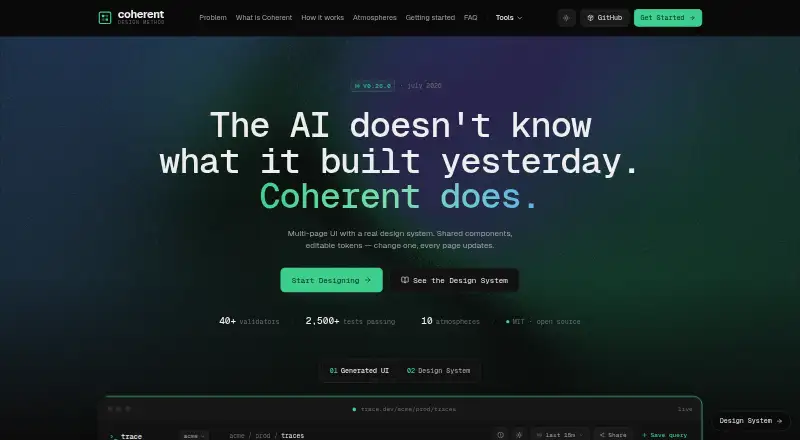
Coherent is an AI-assisted design method for creating multi-page products with shared components and a design system. It generates a Next.js project using Tailwind CSS and shadcn/ui, intended for prototypes, developer handoff, or frontend use. Shared components and editable tokens carry changes across pages, with design-system.config.ts as an editable configuration. Users can choose among 10 prebuilt atmospheres or define a design-system foundation. Coherent provides context files for Cursor, Claude Code, and other AI editors. It supports Anthropic Claude or OpenAI GPT using the user's own API key, with typical model costs estimated at $0.01–$0.03 per page. Its MCP server can validate code, read tokens, extract a design system from a URL, or apply a DESIGN.md file. DESIGN.md can also be imported, and tokens exported as W3C DTCG JSON, CSS variables, or Tailwind configuration. It is open source under the MIT license and has a free plan with unlimited projects and all 10 atmospheres. Full retrofit into an existing codebase and direct Figma token import are not supported yet.
Who it suits
Coherent suits founders building multi-page prototypes, designers who ship code, product teams preparing demos, and developers seeking a Next.js starting point with a design system.
What it does well
- Generates interconnected pages with shared components.
- Free plan includes unlimited projects and 10 atmospheres.
- Exports tokens as JSON, CSS variables, or Tailwind configuration.
- MCP server supports validation and token reading.
- API keys are stored locally; AI calls go directly to providers.
What to know first
- Full retrofit into an existing codebase is not supported yet.
- Direct Figma token import is not supported yet.
- Typical model costs are estimated at $0.01–$0.03 per page.
Limits
The free plan is listed as including unlimited projects, all 10 atmospheres, and 40+ validators with auto-fix. AI model use requires your own API key, and typical costs are estimated at $0.01–$0.03 per page.
Plans
| Plan | Billed and limits | Price |
|---|---|---|
| Open source | forever · Everything included · unlimited projects · all 10 atmospheres · 40+ validators with auto-fix · bring your own LLM key | Free |
As getcoherent.design lists them, read 3 Oct 2026. The maker's own page has the final word.
Getting started
- Visit https://www.getcoherent.design/.
- Use the free, open-source plan, which includes unlimited projects.
- Choose Linux, macOS, or Windows.
- Use your own Anthropic Claude or OpenAI GPT API key for AI generation.
- Start from one of the 10 atmospheres or define a design-system foundation.
Coherent is an open-source design tool for founders, designers and developers building a multi-page product that should carry through into code. Its strongest case is a new project shaped around shared components and tokens; teams retrofitting an existing codebase should look elsewhere.
Overview
Coherent generates connected product pages and a shared, editable design system as a Next.js project built with Tailwind CSS and shadcn/ui. The output can serve as a prototype, a developer handoff or a frontend starting point, making it more useful to teams moving toward implementation than to those seeking isolated mockups.
Shared components and tokens propagate changes across pages, with design-system.config.ts as the editable configuration. The MIT license and an open-source plan mean the workflow is not gated by project or atmosphere limits.
Key features
Pages built around one system
Coherent offers 10 prebuilt atmospheres and lets users define their own design-system foundation. Keeping pages tied to shared components and tokens can reduce inconsistency as a product grows. This is a practical advantage for multi-screen work, though it depends on starting within Coherent rather than importing an existing application wholesale.
Code and AI-editor context
The generated Next.js, Tailwind CSS and shadcn/ui project gives developers code to continue from, rather than only a visual artifact. Coherent adds project context for Cursor, Claude Code and other AI editors through .cursorrules and CLAUDE.md. It supports Anthropic Claude and OpenAI GPT with the user's own API key; typical model costs are estimated at $0.01–$0.03 per page. Those costs are separate from the free plan and depend on model use.
Agent and token workflows
Its MCP server lets AI agents validate code, read tokens, extract a design system from a URL or apply a DESIGN.md file. Coherent can also import DESIGN.md and export tokens as W3C DTCG JSON, CSS variables or Tailwind configuration. That makes it useful alongside other projects, even though full retrofit into an existing codebase is not supported. Direct Figma token import is also not supported, so teams relying on that route will need another workflow.
Local API-key handling
The project README says API keys are stored locally in .env, and AI calls go from the user's machine directly to the provider; Coherent has no servers. That is a relevant distinction for teams evaluating where model requests and credentials are handled.
Pricing
Open source: free, billed forever. The plan includes everything, unlimited projects, all 10 atmospheres, 40+ validators with auto-fix and bring-your-own-LLM-key access. There is no paid tier or free-trial transition to weigh against those limits. Users still supply their own model key and bear typical per-page model costs, so free software does not mean unlimited model usage at no cost.
The plan includes prompt-to-UI generation, design-system support, multi-screen generation and code export. It is a strong fit for individuals and teams willing to work with their own API provider; buyers seeking a managed, paid plan should consider other tools.
Platforms
Coherent is available for Linux, macOS and Windows. Its support channels are GitHub Issues for bugs and feature requests and GitHub Discussions for questions; issue responses usually arrive within 24 hours.
Who it's for
Coherent suits founders building multi-page prototypes, designers who ship code, product teams preparing demos and developers who want a Next.js starting point with a design system. It is a better match for a product being built from the ground up than for a team whose main task is adapting an established codebase or importing Figma tokens directly.
Pros and cons
- Pros: Shared tokens and components carry changes across pages, which helps keep a multi-page product coherent.
- Pros: Code export, AI-editor context and agent validation connect design work to implementation.
- Pros: The forever-free MIT-licensed plan includes unlimited projects, every atmosphere and validators with auto-fix.
- Cons: Full retrofit of an existing codebase is not supported, limiting its fit for teams with an established application.
- Cons: Direct Figma token import is unavailable, and users must bring an API key and pay their model provider's costs.
Alternatives
UXPin is worth considering for users who want a free plan with 2 prototypes and 50 AI credits after a 14-day trial, rather than Coherent's code-and-token workflow.
Paper may suit teams that prioritize unlimited viewers and editors and 100 weekly MCP tool calls on its free plan.
pen.dev offers a free plan capped at 5 Agent days per month, 25 image and SVG generations per month and one agent at a time; choose it if those limits suit your agent workflow.
Starry is another free-to-download option with no subscription required; its AI chat requires the user's own provider API key.
Figma Make offers a Starter plan with 150 AI credits per day and 500 per month, making it a relevant alternative for users comparing credit-based access.
Relume may fit a smaller site-building task: its free forever plan allows one project and one page, with read-only sharing and 30 Webflow and 30 React components.
UX Pilot is an alternative for teams seeking an enterprise API, SSO, team access controls and design-system integration on its Enterprise plan.
Visily offers a Starter plan with 300 AI credits per month, standard AI design and limited boards and elements; it is an option for users who prefer a monthly credit allowance.
For a broader set of tools in the category, browse AI UI Design Generators.
Verdict
Choose Coherent if you are starting a multi-page product and want connected design tokens, AI-assisted generation and exportable frontend code without a subscription. Its open-source plan is unusually complete for that purpose. Look elsewhere if your priority is retrofitting an existing application or bringing Figma tokens straight into the workflow.
Verdict
Coherent is aimed at building connected pages around a shared design system, with code output and token export options. Existing-codebase retrofit and direct Figma token import are not currently supported.
Questions
Is Coherent free?
Yes. Its Open source plan is listed as free, billed forever, with unlimited projects and all 10 atmospheres.
Which platforms does Coherent support?
Linux, macOS, and Windows.
Which AI models can it use?
It supports Anthropic Claude and OpenAI GPT with your own API key. Typical model costs are estimated at $0.01–$0.03 per page.
Is Coherent open source?
Yes. It is described as open source under the MIT license.
Can Coherent work with an existing project or Figma tokens?
Full retrofit into an existing codebase and direct Figma token import are not supported yet. It can import a `DESIGN.md` file and export tokens as W3C DTCG JSON, CSS variables, or Tailwind configuration.
How are API keys and AI calls handled?
The project README says API keys are stored locally in `.env` and AI calls go directly from your machine to the provider.
Facts from Coherent's own pages
- AI editors
- Coherent provides context for Cursor, Claude Code, and any AI editor through .cursorrules and CLAUDE.md files. · getcoherent.design, 3 Oct 2026
- AI models and cost
- It supports Anthropic Claude or OpenAI GPT using the user's own API key, and the site estimates $0.01–$0.03 per page in typical model costs. · getcoherent.design, 3 Oct 2026
- Atmospheres
- The site lists 10 prebuilt atmospheres and says users can define their own design system foundation. · getcoherent.design, 3 Oct 2026
- Design import/export
- Coherent can import a DESIGN.md file and export tokens as W3C DTCG JSON, CSS variables, and Tailwind configuration; direct Figma token import is not supported yet. · getcoherent.design, 3 Oct 2026
- Design system
- Shared components and editable design tokens propagate changes across pages, with a design-system.config.ts as the editable configuration. · getcoherent.design, 3 Oct 2026
- Existing projects
- Full retrofit into an existing codebase is not supported yet, though its extractor and MCP validation can be used alongside other projects. · getcoherent.design, 3 Oct 2026
- License
- The product is described as open source under the MIT license. · getcoherent.design, 3 Oct 2026
- MCP
- Its MCP server lets AI agents validate code, read tokens, extract a design system from a URL, or apply a DESIGN.md file. · getcoherent.design, 3 Oct 2026
- Output
- It generates a clean Next.js, Tailwind CSS, and shadcn/ui project that can be used as a prototype, developer handoff, or frontend. · getcoherent.design, 3 Oct 2026
- Security
- The project README says API keys are stored locally in .env and AI calls go directly from the user's machine to the provider; Coherent has no servers. · github.com, 3 Oct 2026
- Support
- The site directs bug reports and feature requests to GitHub Issues and questions to GitHub Discussions, and says issue responses usually arrive within 24 hours. · getcoherent.design, 3 Oct 2026
- What it does
- Coherent is an AI design method for multi-page products that generates interconnected pages with shared components and a growing design system. · getcoherent.design, 3 Oct 2026
- Who it is for
- The site names founders building multi-page prototypes, designers who ship code, product teams needing demos, and developers seeking a Next.js starting point with a design system. · getcoherent.design, 3 Oct 2026
Where Coherent stands on Freedom251
- AI UI Design Generators#1 of 22