Freedom251 › Game Memory Editors
Cheat Engine Linux
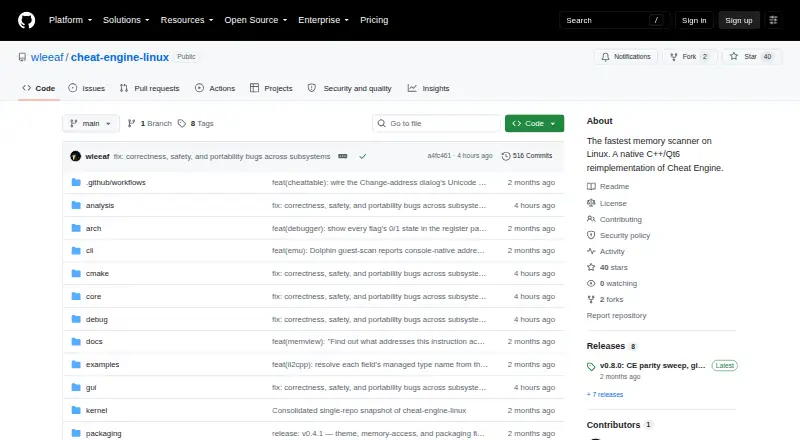
What Cheat Engine Linux is
Cheat Engine Linux is a free, open-source toolkit for Linux that scans process memory and provides debugging, disassembly, and trainer tools. Its intended uses are single-player games, reverse engineering, and learning. Scans can search numeric and string values, byte patterns, binary data, grouped values, or custom Lua expressions; pointer scanning and disk-backed scans are also available for large targets. Users can make typed memory edits, freeze values, set hardware or software breakpoints and watchpoints, step through execution, trace, and inspect registers and stacks. The application reads and writes Cheat Engine .CT tables and supports a broad Cheat Engine-compatible Lua API. Remote debugging features include ceserver and GDB-remote clients, while Unity tools browse Mono runtime class and field layouts and detect IL2CPP targets. Prebuilt .deb and AppImage packages are attached to releases. Attaching to a process with ptrace depends on elevated privileges or a permissive ptrace_scope; the README says the packages set cap_sys_ptrace so root is not required. The project describes itself as young and immature, with bugs, rough edges, and missing features. Its repository identifies the license as MIT.
Who it suits
It suits Linux users exploring single-player game memory, reverse engineering, or learning about debugging and process memory. The range of scanning, scripting, and remote debugging tools may also fit users who want Cheat Engine table compatibility on Linux.
What it does well
- Free and open source under the MIT license.
- Supports pointer scans and disk-backed scans for large targets.
- Includes hardware and software breakpoints, watchpoints, and tracing.
- Reads and writes Cheat Engine .CT tables.
- Release packages include .deb and AppImage builds.
What to know first
- The project describes itself as immature, with bugs and missing features.
- It is available for Linux only.
- Attaching with ptrace depends on privileges or ptrace_scope settings.
Limits
The free project is described as early and immature, with bugs, rough edges, and missing features. Process attachment using ptrace requires elevated privileges or a permissive ptrace_scope; the release packages set cap_sys_ptrace so root is not required.
Getting started
- Open the project's GitHub repository.
- Choose a release and download its .deb or AppImage package.
- Install or run the package for Linux.
- Check ptrace permissions or ptrace_scope when attaching to a process.
Verdict
Choose Cheat Engine Linux if you want a Linux toolkit for single-player game memory work, reverse engineering, or learning, with Cheat Engine table and Lua compatibility. Look elsewhere if you need a mature tool, since the project itself warns of bugs and missing features.
Questions
Is Cheat Engine Linux free?
Yes. It is free and open source under the MIT license.
Which operating system does it support?
Linux is the listed operating system.
How can I get it?
The README says prebuilt .deb and AppImage packages are attached to each release.
Can it use Cheat Engine tables?
Yes. It reads and writes Cheat Engine .CT tables and supports a broad compatible Lua API.
Does attaching to a process require root?
The README says the .deb and AppImage set cap_sys_ptrace, so root is not required, though ptrace permissions or ptrace_scope still matter.
What does the project recommend it for?
It is intended for single-player games, reverse engineering, and learning, rather than defeating multiplayer anti-cheat.
Facts from Cheat Engine Linux's own pages
- Cheat Engine compatibility
- The application reads and writes Cheat Engine .CT tables and supports a broad Cheat Engine-compatible Lua API. · github.com, 3 Oct 2026
- Debugger
- Debugger features include hardware and software breakpoints, watchpoints, conditional breakpoints, single-stepping, and break-and-trace. · github.com, 3 Oct 2026
- Downloads
- The README says prebuilt .deb and AppImage packages are attached to each release. · github.com, 3 Oct 2026
- Editing and debugging
- Features include typed memory edits, freeze modes, hardware and software breakpoints, watchpoints, single-stepping, tracing, and register and stack views. · github.com, 3 Oct 2026
- Intended use
- The project is built for single-player games, reverse engineering, and learning. · github.com, 3 Oct 2026
- Kernel helper
- An optional kernel helper uses CAP_SYS_ADMIN-gated ioctls through /dev/cecore, according to the README. · github.com, 3 Oct 2026
- License
- The repository identifies the project license as MIT. · github.com, 3 Oct 2026
- Linux privileges
- Attaching with ptrace requires elevated privileges or a permissive ptrace_scope; the installed .deb and AppImage set cap_sys_ptrace so root is not required. · github.com, 3 Oct 2026
- Maturity and scope
- The project describes itself as early and immature, with bugs and missing features, and says it is intended for single-player games, reverse engineering, and learning rather than defeating multiplayer anti-cheat. · github.com, 3 Oct 2026
- Memory scanning
- Its scanner supports numeric, string, byte-pattern, binary, grouped, and custom-Lua scans, plus pointer scanning and disk-backed scans for large targets. · github.com, 3 Oct 2026
- Optional kernel helper
- The optional kernel helper exposes explicit CAP_SYS_ADMIN-gated ioctls and does not hide modules, files, or sockets. · github.com, 3 Oct 2026
- Project status
- The README describes the project as young and immature, at v0.9.0, with bugs, rough edges, and missing features. · github.com, 3 Oct 2026
- Purpose
- Cheat Engine for Linux is a native C++20/Qt6 memory scanner, debugger, disassembler, and trainer toolkit. · github.com, 3 Oct 2026
- Release version
- The releases page lists v0.8.0 as its latest release. · github.com, 3 Oct 2026
- Remote debugging
- The platform features include ceserver and GDB-remote clients for remote or cross-device debugging. · github.com, 3 Oct 2026
- Remote tools
- The platform features include ceserver and GDB-remote clients for remote or cross-device debugging. · github.com, 3 Oct 2026
- Scanning
- Scanning supports multiple value types and comparisons, region filters, multithreaded disk-backed scans, and pointer scanning. · github.com, 3 Oct 2026
- Security
- The README says .CETRAINER loads are size-capped, Lua breakpoint conditions are sandboxed and execution-bounded, and shellExecute and unsafe file-write functions are default-denied. · github.com, 3 Oct 2026
- Support
- The README asks users to report issues, which it says drive the project forward. · github.com, 3 Oct 2026
- Unity tools
- A Mono dissector browses runtime class and field layouts, and IL2CPP targets are detected. · github.com, 3 Oct 2026
Where Cheat Engine Linux stands on Freedom251
- Game Memory Editors#7 of 23