Freedom251 › API Testing Tools

Bruno
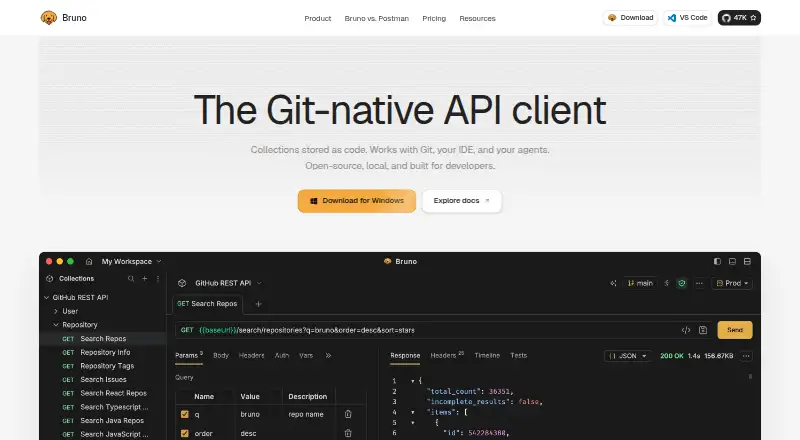
What Bruno is
Bruno is a Git-native API client for exploring and testing REST, GraphQL, gRPC, and WebSocket APIs. Collections are stored as plain-text files in a project repository, where teams can version and review them with Git. Testing tools include assertions, scripts, collection automation, scheduled runs, and CI/CD integration. Users can create and switch between multiple environments, use variables, and run JavaScript before requests or after responses. Bruno offers a desktop client, CLI, IDE extension, API documentation generator, and mock server using the same collection format. Collections can also become interactive HTML documentation with code samples and a live playground. Collections, environments, and secrets are stored on the user's device, and Bruno says it does not store user data in the cloud. However, startup includes an HTTPS license validation call that sends an IP address, license key, hashed device ID, and Bruno version; it says project data is not sent. The free Open Source plan includes two workspaces and five OpenAPI syncs per month. Pro costs $6 a month billed annually, and a 14-day Ultimate trial requires no credit card.
Who it suits
Bruno may suit developers who want API collections stored and reviewed with Git, plus scripting and automation tools. Its local storage model may suit users who prefer collections, environments, and secrets to remain on their device.
What it does well
- Supports REST, GraphQL, gRPC, and WebSocket APIs.
- Plain-text collections can be versioned with Git.
- Includes scheduled runs and CI/CD integration.
- Collections can become interactive HTML documentation.
- 14-day Ultimate trial requires no credit card.
What to know first
- Free plan includes two workspaces.
- Free plan includes five OpenAPI syncs per month.
- Startup license checks transmit identifying device and license details.
- Pro costs $6 a month billed annually.
Limits
The free Open Source plan includes two workspaces and five OpenAPI syncs per month. Pro includes unlimited workspaces but keeps the limit of five OpenAPI syncs per month; Ultimate includes unlimited OpenAPI syncs.
Plans
| Plan | Billed and limits | Price |
|---|---|---|
| Open Source | HTTP/REST/GraphQL/gRPC client · collection runner unlimited · 2 workspaces · public Git providers · 5 OpenAPI syncs/month | Free |
| Pro | billed annually · Unlimited workspaces · public and private Git providers · data-driven testing · report generation · Git push/branches/remotes · unlimited OpenAPI syncs | $6 a month |
| Ultimate | billed annually · Enterprise integrations · unlimited workspaces · secret-manager integration · license administration · audit logs · SSO · SCIM · AI governance · 24-hour support SLA | $11 a month |
As usebruno.com lists them, read 14 Oct 2026. The maker's own page has the final word.
Getting started
- Visit https://www.usebruno.com/.
- Choose the desktop app for Windows, macOS, or Linux, or use the CLI or IDE extension.
- Start with the free Open Source plan, or select a paid plan.
- Use the 14-day Ultimate trial if you want to try that plan; no credit card is required.
Bruno is an API client for developers who want requests, tests, and automation managed alongside project code. Its Git-based collections are a strong fit for repository-centered teams; the workspace and OpenAPI sync caps on the free plan, and annual billing on paid plans, are the main compromises.
Overview
Bruno stores API collections as plain-text files in a project repository, where teams can version and review changes through Git. Collections, environments, and secrets stay on the user’s device, and Bruno says it does not store user data in the cloud. This model suits teams that treat API work as part of the codebase, but is less suited to those who want a cloud-hosted workspace.
Local storage does not mean there is no outbound traffic: Bruno makes an HTTPS license-validation call at startup, sending the IP address, license key, hashed device ID, and Bruno version. Bruno says project data is not sent. The company states it is SOC 2 Type I certified and independently audited against AICPA Trust Services Criteria; it also describes role-based access and multi-factor authentication for internal systems, code reviews, dependency audits, and an incident response plan.
Key features
Bruno supports REST, GraphQL, gRPC, and WebSocket APIs. Assertions, test scripting, collection automation, scheduled runs, and CI/CD integration make it useful for repeatable checks as well as manual API exploration. Multiple environments, variables, and pre-request and post-response JavaScript scripts help adapt a collection to different setups.
The desktop client shares its collection format with a CLI, IDE extension, API documentation generator, and mock server. Collections can also become standalone interactive HTML documentation with code samples and a live playground. Integrations include Git providers and secret managers such as Vault, Azure Key Vault, and AWS. The breadth favors teams that want related API workflows to use one collection format; the free plan’s limited OpenAPI syncs may constrain teams that depend on syncing specifications.
Pricing
Bruno has a free Open Source plan, a 14-day Ultimate trial with no credit card required, and two paid plans billed annually. The annual term matters: the monthly figures below do not mean monthly billing.
| Plan | Price | What it includes |
|---|---|---|
| Open Source | free | 2 workspaces, 5 OpenAPI syncs/month, community support |
| Pro | $6 a month, billed annually | Unlimited workspaces, 5 OpenAPI syncs per month |
| Ultimate | $11 a month, billed annually | Unlimited workspaces, unlimited OpenAPI syncs, unlimited license admins |
Open Source is the practical starting point for individuals or small projects that can work within two workspaces and five monthly syncs. Pro removes the workspace cap, but keeps the same sync limit, so it is a better fit for teams needing more room without frequent specification syncs. Ultimate is the clearest fit for heavier sync use or teams that need unlimited license admins. The 14-day Ultimate trial lets prospective users evaluate that tier before choosing; paid subscriptions carry an annual billing commitment.
Platforms
Bruno offers desktop versions for Windows, macOS, and Linux, alongside an API client, IDE extension, and CLI. The combination supports both interactive desktop use and developer workflows built around the shared collection format.
Who it's for
Bruno is best for developers and teams that keep API definitions and testing work in Git-managed repositories, and want automation, documentation, and mock-server tools tied to those collections. Teams seeking a cloud-centered collaboration model, or users who need more than five monthly OpenAPI syncs without moving to Ultimate, should weigh other options.
Pros and cons
- Pro: Plain-text, Git-versioned collections make API changes reviewable alongside project code.
- Pro: Multiple protocols, scripting, scheduled runs, CI/CD integration, documentation, and mock-server tools cover a broad API workflow.
- Pro: Collections, environments, and secrets remain on the device rather than in Bruno’s cloud.
- Con: Startup license validation sends an IP address, license key, hashed device ID, and version, which may matter to privacy-conscious users.
- Con: Open Source is limited to two workspaces and five OpenAPI syncs per month; Pro raises workspace capacity but not the sync cap.
- Con: Both paid prices are billed annually, which is less flexible for users who prefer a monthly commitment.
Alternatives
Compare API Testing Tools or API clients if you want to survey the category. Choose Apidog if its time-unlimited free plan for four users or its web and self-hosted platforms better match your team. Postman is another freemium API client with web support and Native Git. Consider Hoppscotch for its forever-free plan, personal workspace, and web and self-hosted options. Insomnia may suit teams preferring a free Essentials tier with Git Sync projects for up to three users and a stated mock-server request allowance. Karate is worth considering when API testing needs to sit alongside browser and desktop UI automation. Keploy offers an open-source local record-and-replay core. Kreya may fit individuals who can work with request history limited to the latest request. Pact is an alternative if you want its open-source tooling.
Verdict
Choose Bruno if you want API collections, tests, and supporting tools to live in a Git-managed project rather than a cloud workspace. Its plain-text collections and broad automation workflow are the strongest reasons to pick it; look elsewhere if the startup license check, the free plan’s sync cap, or annual billing conflicts with your requirements.
Verdict
Bruno pairs API testing and automation with Git-friendly plain-text collections and companion tools. Project data is kept off its cloud, but startup license validation sends specified device and license details.
Questions
Is Bruno free?
Yes. The Open Source plan costs nothing and includes two workspaces and five OpenAPI syncs per month.
How much do paid plans cost?
Pro is $6 a month when billed annually. Ultimate is $11 a month when billed annually.
What platforms does Bruno support?
Desktop downloads are available for Windows, macOS, and Linux. Bruno also offers a CLI and IDE extension.
What API types can it handle?
Bruno supports REST, GraphQL, gRPC, and WebSocket APIs.
Does Bruno store collections in the cloud?
Collections, environments, and secrets are stored on the user's device. Bruno says project data is not sent to the cloud; its startup license validation call sends an IP address, license key, hashed device ID, and Bruno version.
Is there a free trial?
Yes. Bruno offers a 14-day Ultimate trial without requiring a credit card.
Facts from Bruno's own pages
- API documentation
- The docs generator creates standalone interactive HTML documentation with copy-ready examples that can be hosted independently. · usebruno.com, 14 Oct 2026
- API protocols
- The desktop client supports REST, GraphQL, gRPC and WebSocket APIs. · usebruno.com, 14 Oct 2026
- CLI
- The npm package @usebruno/cli runs collections and individual requests from the command line for automation and CI/CD. · github.com, 14 Oct 2026
- Collection format
- API collections are stored as plain-text files in the project repository for Git versioning and review. · usebruno.com, 30 Sept 2026
- Company name
- The terms identify the legal provider as Bruno Software, Inc. · usebruno.com, 14 Oct 2026
- Company size
- The 2025 company recap says the team grew from 6 to 23 people globally during 2025. · blog.usebruno.com, 14 Oct 2026
- Current release
- The changelog lists Bruno 4.2.1 dated September 30, 2026, including QuickJS path-resolution and module-loader security fixes. · usebruno.com, 14 Oct 2026
- Desktop availability
- The download page lists desktop versions for Windows, macOS, and Linux. · usebruno.com, 30 Sept 2026
- Docker
- Official Bruno CLI images are published for Docker Hub and GitHub Container Registry, with Alpine and Debian variants for amd64 and arm64 Linux. · github.com, 14 Oct 2026
- Documentation depth
- Official support links to documentation, GitHub issue tracking, email support and sales assistance; the public docs cover CLI, Docker, converters, Git, licensing and the VS Code extension. · usebruno.com, 14 Oct 2026
- Environments
- Users can create multiple environments, switch between them, use variables, and write pre-request and post-response JavaScript scripts. · usebruno.com, 30 Sept 2026
- External assessment
- Thoughtworks Technology Radar describes Bruno as an open-source desktop and CLI alternative with offline plain-text collections, Git sharing and an official VS Code extension. · thoughtworks.cn, 14 Oct 2026
- Founded
- The official 2025 recap says the product began four years earlier, indicating a 2021 inception. · blog.usebruno.com, 14 Oct 2026
- Founder
- The official team page identifies Anoop M D as founder and CEO, with Ryan Reynolds as co-founder and COO. · usebruno.com, 14 Oct 2026
- Free plan
- Yes · usebruno.com, 21 Sept 2026
- Funding news
- A Bruno announcement dated August 11, 2026 says the company had raised $3 million about a year earlier from Silverton Partners. · blog.usebruno.com, 14 Oct 2026
- Git-native collections
- Collections are stored as readable files in the filesystem so teams can version them with Git. · github.com, 14 Oct 2026
- GraphQL support
- Yes · usebruno.com, 21 Sept 2026
- Headquarters
- The official 2025 recap says Bruno opened a new headquarters in Bangalore. · blog.usebruno.com, 14 Oct 2026
- IDE extension
- Bruno provides an editor extension for VS Code, Cursor and Windsurf using the same collections as the desktop app. · usebruno.com, 14 Oct 2026
- Integrations
- The product lists Git providers, GitHub Actions, Docker, OpenAPI import and external secret managers including AWS Secrets Manager, Azure Key Vault, HashiCorp Vault and Google Secret Manager. · usebruno.com, 14 Oct 2026
- License
- The public Bruno repository is MIT licensed, while the company states that paid binary features are supplied from a private upstream repository. · github.com, 14 Oct 2026
- Limit: advanced features
- G2 reviewers report that some advanced Postman capabilities, automation and collaboration features are missing or less mature. · g2.com, 14 Oct 2026
- Limit: data-driven testing
- An independent review reports that data-driven requests are available only on a paid plan. · apichallenges.com, 14 Oct 2026
Where Bruno stands on Freedom251
- API Testing Tools#1 of 34
- Developer Tools#1 of 33
- API Development Tools#1 of 32
- Api 1#1 of 25
- API clients#2 of 38