Freedom251 › Keyword Clustering Tools

beserp Keyword Clustering
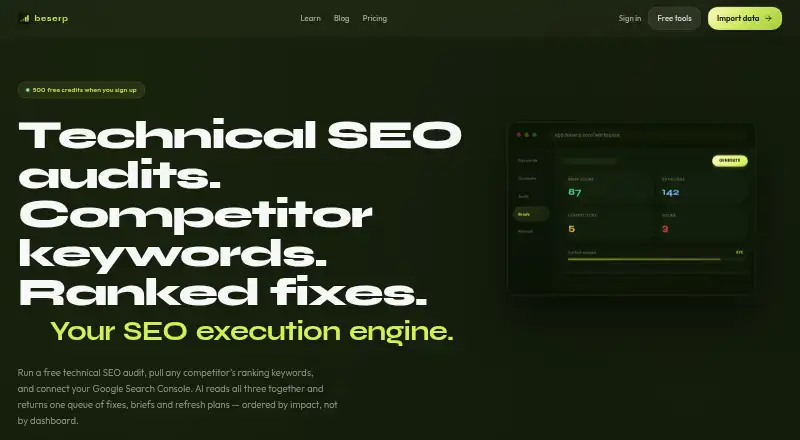
What beserp Keyword Clustering is
beserp Keyword Clustering turns keyword exports into a content plan organized by topic, search intent, page type, and priority. It accepts CSV, TSV, and XLSX files and can map keyword, volume, difficulty, CPC, and intent columns when present. Semantic grouping uses embeddings to identify topical similarity rather than relying only on shared words. Each cluster receives a dominant intent label and a suggested page type, such as a pillar, listicle, comparison, glossary, landing page, or product page. A 0–100 priority score combines search volume, intent strength, and inverse difficulty. Supported source exports include Semrush, Ahrefs, Moz, Google Keyword Planner, Google Search Console, Surfer, Lowfruits, and KeywordsPeopleUse, as well as plain CSV files with a keyword column. Results can be exported as a CSV or .ics content calendar, or sent to a paid project as a content brief. A run costs 43 credits, approximately $0.43, and signup credits cover 11 runs. There is no subscription, seat charge, or monthly credit reset; unused credits do not expire. Clustering without a project is described as stateless, with project saving optional.
Who it suits
The tool suits in-house SEO teams, freelance SEOs, content marketers, agencies, founders, and people building topical authority. It is especially relevant for turning keyword lists into prioritized content plans.
What it does well
- Accepts CSV, TSV, and XLSX files
- Groups by topic, intent, and page type
- Exports content calendars as CSV or .ics
- Credits do not expire
What to know first
- Each run costs 43 credits
- Paid project is needed to create content briefs
- No free trial is listed
Limits
The free signup plan includes 500 credits, and a clustering run costs 43 credits. Paid credit packs start at $10 for 1,000 credits; credits do not expire and have no monthly reset.
Plans
| Plan | Billed and limits | Price |
|---|---|---|
| Free signup credits | 500 credits · no card required · credits never expire | Free |
| Starter | 1,000 credits · About 4 Site Audit runs | $10, paid once |
| Agency | 12,000 credits + 2,000 bonus · About 48 Site Audit runs | $100, paid once |
| Standard | 2,750 credits + 250 bonus · About 11 Site Audit runs | $25, paid once |
| Pro | 5,750 credits + 750 bonus · About 23 Site Audit runs | $50, paid once |
As beserp.com lists them, read 7 Oct 2026. The maker's own page has the final word.
Getting started
- Open the beserp website.
- Sign up for the free plan; no card is required.
- Upload a CSV, TSV, or XLSX keyword file, or use a supported source export.
- Run the clustering process using 43 credits.
- Export the content calendar as CSV or .ics, or send a recommendation to a paid project.
beserp Keyword Clustering is a web-based tool that turns keyword exports into topic groups and content recommendations. It is best for SEO and content teams building a publishing plan from existing research. Its strength is connecting semantic clusters to intent, page type, and priority; its tradeoff is a 43-credit charge for each run.
Overview
Rather than leaving keyword research as a long list, beserp groups terms by topical similarity and turns those groups into a potential content calendar. Embedding-based grouping can connect related phrases that do not share the same words, which is useful when source exports contain varied wording. The tool supplies useful editorial signals, but its priority score and page suggestions should inform planning rather than dictate it.
Key features
Import and cluster research
Batch imports accept CSV, TSV, and XLSX files. When present, keyword, volume, difficulty, CPC, and intent columns can be mapped automatically. Supported exports include Semrush, Ahrefs, Moz, Google Keyword Planner, Google Search Console, Surfer, Lowfruits, and KeywordsPeopleUse, alongside plain CSV files with a keyword column. This range suits teams consolidating research from different sources.
Clusters receive a dominant search-intent label and a page-type recommendation, such as a pillar page, listicle, comparison, glossary, landing page, or product page. A 0–100 priority score combines search volume, intent strength, and inverse difficulty. Together, these outputs help turn research into editorial choices, while leaving room for a team’s own judgment about audience and business fit.
Planning and handoff
Users can export a content calendar as CSV or .ics, or send a recommendation into a paid project as a content brief. That gives the tool a practical route from keyword grouping to scheduling or brief creation. It also supports SERP analysis, though the supplied capabilities do not describe how that analysis changes the clustering recommendations.
The maker says a 10,000-keyword export is within capacity. For very large lists, the recommendation table emphasizes top-priority clusters, while per-keyword assignments remain downloadable. That balance makes large datasets workable, but the main table may not be the best place to inspect every opportunity at once.
Clustering without a project is described as stateless: uploaded CSV data is processed in memory and not persisted. Saving runs to a project is opt-in. Credits are held when a run starts and spent only when it returns a result; failed or cancelled runs automatically release the hold.
Pricing
There is no subscription, no seat charge, and no monthly credit reset; unused credits do not expire. The free signup plan costs nothing and includes 500 credits, with no card required. At 43 credits per clustering run, signup credits cover 11 runs, with some credits left over. This is a useful way to assess the workflow without committing to a recurring bill.
| Plan | Price | Credits | Best fit |
|---|---|---|---|
| Starter | $10, paid once | 1,000 credits | Occasional additional runs |
| Standard | $25, paid once | 2,750 credits + 250 bonus | Regular planning work |
| Pro | $50, paid once | 5,750 credits + 750 bonus | Higher-volume use |
| Agency | $100, paid once | 12,000 credits + 2,000 bonus | Agency-scale workloads |
These are one-time credit purchases, not recurring plans. The Starter tier offers the smallest paid top-up; higher tiers add larger balances and bonus credits, making them more suitable for repeated work. The plans also show approximate Site Audit run counts, but those do not describe Keyword Clustering capacity; the relevant cost for clustering is 43 credits per run.
There is no free trial, but the free signup credits provide a no-card way to begin. Since credits never expire, infrequent users can buy a smaller balance without facing a monthly reset. Conversely, teams running clustering often need to budget each batch against a finite balance.
Platforms
beserp Keyword Clustering runs on the web. CSV and .ics exports support handoff into other planning workflows.
Who it's for
In-house SEO teams, freelance SEOs, content marketers, agencies, founders, and people building topical authority are the intended audience. It is particularly well suited to people who already have keyword exports and want them shaped into a prioritized editorial plan. It is less compelling for someone who wants unlimited recurring runs or a subscription-based team allowance.
Pros and cons
- Pros: Embedding-based semantic grouping connects topical phrases beyond simple word overlap.
- Pros: Intent labels, page recommendations, and a transparent priority score take the output closer to a usable content plan.
- Pros: Broad file support, downloadable assignments, and CSV/.ics calendar exports accommodate research and planning handoffs.
- Pros: One-time credits do not expire, and failed or cancelled runs do not consume them.
- Cons: Each clustering run costs 43 credits, so high-volume use requires ongoing balance management.
- Cons: The main recommendation table focuses on top-priority clusters for very large lists, so reviewing the full output means using the downloadable assignments.
Alternatives
Keyword Clustering Tools is the broader directory category for comparing options. Absolute Cluster is worth considering for a free project-based workflow: its free plan includes one project, up to 1,000 keywords, SERP-based clustering, briefs, a roadmap, an internal linking map, exports, and one article draft. Cluster Army Keyword Clusterizer is a web-based free option for readers who want a no-cost alternative.
ContentGecko Keyword Clustering may suit readers who prefer a monthly paid plan; its free version clusters up to 200 keywords, while its paid plan is €19.90 a month and includes 50,000 keyword credits per month. Keyword Clustering offers a free web option with no subscription fees or premium tiers, up to 10,000 keywords per job, and a daily limit tied to the Keywords Everywhere plan. NeedMyLink Keyword Clustering Tool is another free web option, capped at 500 keywords per month, or 1,000 with email.
Pro SERP Cluster is a free web tool with CSV import and export and up to 500 keywords per run. RankYak Keyword Clustering Tool has a free tier and a free trial for readers considering a web or API option. SEO Algorithm Keyword Clustering offers a free stem-based option for up to 200 keywords without signup or credits, with separate SERP-based and AI semantic modes priced in credits.
Verdict
Choose beserp Keyword Clustering if you need to turn exported research into semantic topic groups, editorial recommendations, and a calendar without taking on a subscription. The no-expiry credits and free signup balance suit occasional or project-based work. Look elsewhere if your priority is unlimited or predictable high-volume clustering, or if you need the main interface to surface every cluster in a very large dataset.
Verdict
beserp Keyword Clustering combines semantic grouping with intent labels, page suggestions, and prioritization to help shape a content calendar. Its credit-based model has no subscription or expiry, but each run uses 43 credits.
Questions
Is beserp Keyword Clustering free?
Yes. Free signup credits provide 500 credits, with no card required. A run costs 43 credits, and the maker says signup credits cover 11 runs.
How much do paid plans cost?
One-time credit packs are listed at $10 for 1,000 credits, $25 for 2,750 credits plus 250 bonus credits, $50 for 5,750 credits plus 750 bonus credits, and $100 for 12,000 credits plus 2,000 bonus credits.
What file types can it import?
It accepts CSV, TSV, and XLSX files, including plain CSV files with a keyword column.
Which platforms does it support?
The listed platform is web.
What can I export?
Content calendars can be exported as CSV or .ics. A recommendation can also be sent to a paid project as a content brief.
Does a failed run use credits?
Credits are held when a run starts and spent only when it produces a result. Failed or cancelled runs return the hold automatically.
Facts from beserp Keyword Clustering's own pages
- Data handling
- The maker says clustering without a project is stateless: uploaded CSV data is processed in memory and not persisted, while saving runs to a project is opt-in. · beserp.com, 7 Oct 2026
- Dataset capacity
- The maker says it can cluster a 10,000-keyword export, with the recommendation table focusing on top-priority clusters for very large lists while per-keyword assignments remain downloadable. · beserp.com, 7 Oct 2026
- Exports and handoff
- Users can export a content calendar as CSV or .ics, or send a recommendation into a paid project as a content brief. · beserp.com, 7 Oct 2026
- Failed runs
- Credits are held when a run starts and spent only when it produces a result; failed or cancelled runs return the hold automatically. · beserp.com, 7 Oct 2026
- Imports
- It accepts CSV, TSV, and XLSX files and can automatically map keyword, volume, difficulty, CPC, and intent columns when present. · beserp.com, 7 Oct 2026
- Intended users
- The maker identifies in-house SEO teams, freelance SEOs, content marketers, agencies, founders, and people building topical authority as intended users. · beserp.com, 7 Oct 2026
- Intent and recommendations
- Clusters receive a dominant intent label and page-type recommendations such as pillar, listicle, comparison, glossary, landing page, or product page. · beserp.com, 7 Oct 2026
- No subscription
- The maker says it has no subscription, no seats, and no monthly credit reset; unused credits do not expire. · beserp.com, 7 Oct 2026
- Price per run
- A Keyword Clustering run costs 43 credits, shown as approximately $0.43; the page says signup credits cover 11 runs. · beserp.com, 7 Oct 2026
- Priority scoring
- Its 0–100 priority score combines search volume, intent strength, and inverse difficulty. · beserp.com, 7 Oct 2026
- Purpose
- Keyword Clustering turns keyword exports into a content plan grouped by semantic topic, search intent, page type, and priority. · beserp.com, 7 Oct 2026
- Semantic grouping
- The tool groups keywords by topical similarity using embeddings rather than only matching shared words. · beserp.com, 7 Oct 2026
- Supported sources
- The page lists exports from Semrush, Ahrefs, Moz, Google Keyword Planner, Google Search Console, Surfer, Lowfruits, and KeywordsPeopleUse, as well as plain CSV files with a keyword column. · beserp.com, 7 Oct 2026
Where beserp Keyword Clustering stands on Freedom251
- Keyword Clustering Tools#3 of 27