Freedom251 › Keyword Clustering Tools
Pro SERP Cluster
What Pro SERP Cluster is
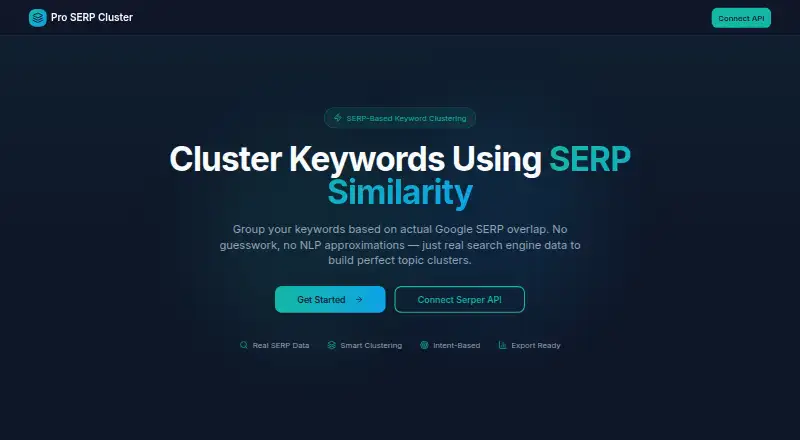
Pro SERP Cluster is a free web tool that groups keywords by overlap in actual Google search results. It uses SERP data to identify terms that share search intent, rather than NLP or embedding approximations. This can help reveal keywords competing for the same rankings and inform content consolidation. The tool also supports blog post optimization, pillar-page creation and content-gap analysis. Its topic clusters can be used for hub-and-spoke planning, topical-authority building and site architecture. Each run supports up to 500 keywords, and users can choose a target region, language and overlap threshold to set clustering strictness. Retrieving Google SERPs requires a Serper.dev API key, which is stored locally for the session only. Results can be exported as CSV, and the free plan includes CSV import and export. The product is built for professional SEOs planning content, building topic authority or addressing cannibalization. It is available on the web.
Who it suits
Pro SERP Cluster suits professional SEOs planning content, developing topic clusters or identifying competing keywords. It is web-based and supports runs of up to 500 keywords.
What it does well
- Free plan includes CSV import and export.
- Uses Google search result overlap for clustering.
- Supports region, language and overlap threshold settings.
- Exports cluster results as CSV.
- Serper.dev API key remains local for the session.
What to know first
- A Serper.dev API key is required to retrieve SERPs.
- Clustering runs are limited to 500 keywords.
Limits
The free plan supports up to 500 keywords per clustering run. Retrieving Google SERPs requires a Serper.dev API key.
Plans
| Plan | Billed and limits | Price |
|---|---|---|
| Free | up to 500 keywords per clustering run · CSV import/export | Free |
As proserpcluster.com lists them, read 30 Sept 2026. The maker's own page has the final word.
Getting started
- Visit the Pro SERP Cluster website.
- Connect a Serper.dev API key to retrieve Google SERPs.
- Import a keyword list from CSV or prepare up to 500 keywords for a run.
- Choose the target region and language.
- Set the overlap threshold and run clustering.
- Export the results as a CSV file.
Pro SERP Cluster is a web-based keyword grouping tool for SEO professionals who need search-intent evidence for content planning or cannibalization decisions. It suits focused research batches and teams comfortable supplying their own SERP data access. The main trade-off is a useful, no-cost workflow bounded by 500 keywords per run and a Serper.dev dependency.
Overview
The tool groups keywords according to overlap in actual Google search results. That puts observed rankings at the centre of the analysis instead of relying on NLP or embedding approximations, which is valuable when deciding whether several terms should share one page or receive separate coverage.
It is aimed at professional SEOs planning content, building topical authority, and resolving keyword cannibalization. Shared-result clusters can reveal terms competing for the same rankings, giving an editorial team a basis for consolidating pages or refining their roles. The same output can support blog optimization, pillar-page design, content-gap analysis, and hub-and-spoke site architecture.
Key features
SERP-based intent grouping
Pro SERP Cluster retrieves Google results through a connected Serper.dev API key, then groups terms by result overlap. This is a practical signal for shared search intent: keywords that repeatedly surface similar pages are stronger candidates for one content asset than terms that produce different result sets.
Clustering strictness is adjustable through an overlap threshold. A stricter setting can produce narrower, more defensible groups, while a looser setting can expose broader themes for early planning. Region and language controls let the same keyword list be evaluated in a defined search market rather than treated as universally interchangeable.
Cannibalization and content planning
When multiple keywords point toward the same ranking competitors, the resulting clusters can highlight potential cannibalization. That makes the tool useful for deciding where pages might be consolidated and for structuring pillar pages with supporting content. Content-gap analysis and topic-cluster planning extend the output into site architecture, although this remains a focused clustering product rather than a full SEO platform.
Batch workflow and export
CSV import supports batch uploads, and results can be exported as CSV for further work in spreadsheets or other planning systems. Each clustering run accepts up to 500 keywords. That is a workable size for a page group, campaign, or site section, but larger inventories must be divided into multiple runs.
API-key handling
You must connect a Serper.dev API key to retrieve Google SERPs. The key is stored locally for the session only, which limits persistence, but it also means SERP retrieval depends on an external account and its access.
Pricing
Pro SERP Cluster has one published plan:
| Plan | Price | Includes |
|---|---|---|
| Free | free | Up to 500 keywords per clustering run; CSV import and export |
There are no paid tiers or subscription terms in this plan. The trade-offs are operational rather than monetary: every run stops at 500 keywords, and SERP collection requires your Serper.dev API key. It is a strong fit for individual projects and teams with modest batches; agencies processing extensive keyword inventories will need to manage repeated runs.
Platforms
It runs on the web, so the workflow is accessible from a browser without a separate desktop installation.
Who it's for
Professional SEOs will get the clearest benefit when they need to map keywords to pages using current Google-result overlap, investigate possible cannibalization, or design topic hubs. Content strategists can use the region, language, and threshold controls to make clusters fit a target market. It is less suitable when you need an all-in-one SEO suite, automated large-scale processing beyond 500 keywords per run, or a workflow that does not involve a Serper.dev key.
Pros and cons
- Pro: Real Google SERP overlap ties clusters to observed ranking competition rather than semantic similarity alone.
- Pro: Region, language, and overlap-threshold controls make the grouping adaptable to a specific search context.
- Pro: Cannibalization checks, pillar-page planning, content-gap work, and hub-and-spoke architecture all use the same cluster output.
- Pro: The free plan includes CSV import and export, supporting practical batch workflows at no software cost.
- Con: A 500-keyword cap per run requires splitting larger research sets.
- Con: Google SERP retrieval depends on a Serper.dev API key, adding an external setup and access requirement.
Alternatives
For a broader content-planning package, Absolute Cluster offers a free 1,000-keyword project with content briefs, a roadmap, internal-linking maps, exports, and one article draft; choose it when those extras matter more than Pro SERP Cluster's narrower workflow.
beserp Keyword Clustering uses signup credits instead of a subscription, with 500 free credits that never expire and a 10.00 USD one-time 1,000-credit option.
Cluster Army Keyword Clusterizer is another free web keyword-clustering option.
ContentGecko Keyword Clustering has a free 200-keyword version and a 19.90 EUR-per-month paid plan with 50,000 keyword credits, making it worth considering for higher recurring volume.
Keyword Clustering has no subscription fees or premium tiers and supports up to 10,000 keywords per job, subject to the stated daily Keywords Everywhere limits.
NeedMyLink Keyword Clustering Tool is a free option capped at 500 keywords per month, expandable to 1,000 with email.
RankYak Keyword Clustering Tool provides a free plan and both web and API access.
SEO Algorithm Keyword Clustering offers free stem clustering up to 200 keywords, alongside separate credit-based SERP and AI-semantic modes.
For a wider shortlist, see Keyword Clustering Tools.
Verdict
Choose Pro SERP Cluster if you want a free, focused way to turn actual Google-result overlap into keyword groups for content structure and cannibalization work. Its strongest reason to choose it is the direct SERP grounding combined with useful market and strictness controls. Look elsewhere if 500-keyword runs are too small, you need integrated content-production features, or you do not want SERP retrieval tied to a Serper.dev API key.
Verdict
Pro SERP Cluster focuses on keyword grouping from actual search-result overlap, with settings for region, language and clustering strictness. Its 500-keyword run limit and required Serper.dev key are worth noting.
Questions
How much does Pro SERP Cluster cost?
The Free plan is listed as free.
What does the free plan include?
It supports up to 500 keywords per clustering run and CSV import and export.
Which platforms does it support?
The listed platform is web.
Does it require an API key?
Yes. Users connect a Serper.dev API key to retrieve Google SERPs. The key is stored locally for the session only.
Can results be exported?
Yes. Cluster results can be exported as a CSV file.
How does it group keywords?
It uses overlap among actual Google search results to identify keywords with shared search intent.
Facts from Pro SERP Cluster's own pages
- API integration
- Users connect a Serper.dev API key to retrieve Google SERPs. · proserpcluster.com, 30 Sept 2026
- API key storage
- The Serper.dev API key is stored locally for the session only. · proserpcluster.com, 30 Sept 2026
- Audience
- The product is built for professional SEOs planning content, building topic authority, or fixing cannibalization. · proserpcluster.com, 30 Sept 2026
- Cannibalization
- It identifies keywords competing for the same rankings so content can be consolidated. · proserpcluster.com, 30 Sept 2026
- Configuration
- Users can select a target region, language, and overlap threshold for clustering strictness. · proserpcluster.com, 30 Sept 2026
- Content planning
- It supports blog post optimization, pillar-page creation, and content-gap analysis. · proserpcluster.com, 30 Sept 2026
- Data source
- The tool uses real Google SERP data rather than NLP or embedding approximations. · proserpcluster.com, 30 Sept 2026
- Export
- Cluster results can be exported as a CSV file. · proserpcluster.com, 30 Sept 2026
- Input limit
- A clustering run supports up to 500 keywords. · proserpcluster.com, 30 Sept 2026
- Purpose
- Pro SERP Cluster groups keywords using overlap among actual Google search results. · proserpcluster.com, 30 Sept 2026
- Search intent
- SERP overlap is used to reveal shared search intent between keywords. · proserpcluster.com, 30 Sept 2026
- Topic clusters
- It groups keywords into topic clusters for hub-and-spoke content, topical-authority building, and site-architecture planning. · proserpcluster.com, 30 Sept 2026
Where Pro SERP Cluster stands on Freedom251
- Keyword Clustering Tools#11 of 27