Freedom251 › Workload Automation Software
Azkaban
What Azkaban is
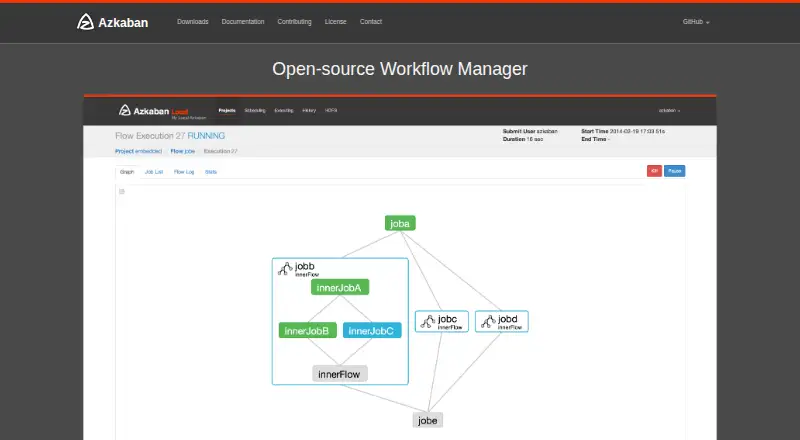
Azkaban is a self-hosted scheduler for batch workflows. It uses job dependencies to determine execution order and provides a web interface for maintaining and tracking workflows. Users can schedule flows or launch them through the Ajax API, and failed jobs can be retried automatically. Projects have workspaces, while email alerts can report workflow successes and failures. Other workflow controls include conditional flows, data triggers, and multiple executors. The documentation describes Solo Server and distributed Multi Executor Server deployments, with multiple-executor mode intended for most production environments. Azkaban lists job types for Hadoop Shell, Java, Hadoop Java, Pig, and Hive, and its official site says it works with any Hadoop version. Its API covers authentication, project management, flow execution, and execution-log retrieval. Security capabilities include authentication and authorization, user action tracking, and SLA alerting that can automatically kill jobs. The project is free and open source under the Apache-2.0 license. It requires Java 8 or higher. Plugins can extend the system with viewer pages, trigger methods, authentication and alerting methods, and job-type executors. The event-trigger plugin can start flows when Kafka events match configured patterns; its documented implementation supports Kafka's built-in String deserializer.
Who it suits
Azkaban suits teams that need to schedule and monitor dependency-based batch workflows on infrastructure they host themselves. Its Hadoop job types, deployment options, API, and plug-in system also suit teams building workflows around those tools and extending execution behavior.
What it does well
- Schedules flows and resolves job order through dependencies.
- Retries failed jobs and sends email alerts for successes and failures.
- Offers Solo Server and distributed multiple-executor deployments.
- API supports flow execution and execution-log retrieval.
- Apache-2.0 licensed and free to use.
What to know first
- Self-hosted deployment requires Java 8 or higher.
- Default XMLUserManager is not secure; production use calls for a suitable user manager.
- Solo Server does not use SSL by default.
- Kafka event triggers support only the built-in String deserializer.
Limits
Azkaban has no paid-plan quota or trial limit in the listed facts. The documented Kafka event-trigger implementation supports only Kafka's built-in String deserializer; Solo Server also has no SSL enabled by default.
Getting started
- Open the Azkaban website and use its source code or GitHub releases.
- Prepare an environment with Java 8 or higher.
- Follow the documentation to set up Solo Server or Multi Executor Server.
- Configure an appropriate user manager for production authentication.
- Create a project workspace, then schedule a workflow or launch a flow through the Ajax API.
Verdict
Choose Azkaban if you need a free, self-hosted scheduler with dependency-based workflows, retries, alerts, and a web UI. It is a stronger fit when your team can manage deployment and configure appropriate authentication; teams seeking a visual workflow builder will not find one here.
Questions
Is Azkaban free and open source?
Yes. It is free and licensed under Apache-2.0.
Where can Azkaban run?
It is self-hosted, with Solo Server and distributed multiple-executor deployment options. The documentation describes builds for Linux and OS X and requires Java 8 or higher.
Does Azkaban work with Hadoop?
The official site says it is compatible with any version of Hadoop. Listed job types include Hadoop Shell, Hadoop Java, Pig, and Hive.
Can workflows be started by events?
Yes. Azkaban supports data triggers, and its event-trigger plugin can launch flows when Kafka events match configured patterns. The documented implementation supports Kafka's built-in String deserializer only.
What authentication does Azkaban provide?
It ships with XMLUserManager, which the documentation says is not secure. The documentation recommends using a suitable user manager, such as LDAP, in production.
How can users get support?
Azkaban directs users to its Gitter community, mailing lists, and GitHub bug reporting.
Facts from Azkaban's own pages
- Advanced features
- The documentation lists multiple executors, conditional workflows, data triggers, and plug-in extensions from the web UI through job execution. · azkaban.readthedocs.io, 8 Oct 2026
- Alerts
- The product site lists email alerts for workflow failures and successes, plus SLA alerting and automatic killing. · azkaban.github.io, 8 Oct 2026
- API
- The documentation includes API operations for authenticating, managing projects, executing flows, and retrieving execution logs. · azkaban.readthedocs.io, 8 Oct 2026
- Authentication
- Azkaban ships with XMLUserManager, but its documentation says this default is not secure and recommends using a suitable user manager, such as LDAP, in production. · azkaban.readthedocs.io, 8 Oct 2026
- Deployment
- The documentation provides instructions for setting up Solo Server and Multi Executor Server deployments. · azkaban.readthedocs.io, 8 Oct 2026
- Deployment requirements
- The documentation says Azkaban requires Java 8 or higher and describes builds for Linux and OS X platforms. · azkaban.readthedocs.io, 8 Oct 2026
- Downloads
- The downloads page links to source code and GitHub releases and notes that Azkaban is under active development with frequent changes. · azkaban.github.io, 8 Oct 2026
- Execution modes
- Azkaban offers a solo-server mode and a distributed multiple-executor mode; the documentation describes multiple-executor mode as intended for most production environments. · azkaban.readthedocs.io, 8 Oct 2026
- Extensibility
- Plugins can add viewer pages, trigger methods, user authentication methods, alerting methods, and job-type executors. · azkaban.readthedocs.io, 8 Oct 2026
- Hadoop
- The official site says Azkaban is compatible with any version of Hadoop. · azkaban.github.io, 8 Oct 2026
- HTTPS
- The solo server does not use SSL by default, but the web server supports SSL socket connectors when configured with a keystore. · azkaban.readthedocs.io, 8 Oct 2026
- Integrations
- Documented job-type plugin examples include Hadoop ecosystem components, Pig, Hive, and VoldemortBuildAndPush. · azkaban.readthedocs.io, 8 Oct 2026
- Kafka triggers
- The event-trigger plugin can launch flows when Kafka events match configured patterns; the documented implementation currently supports Kafka's built-in String deserializer only. · azkaban.readthedocs.io, 8 Oct 2026
- License
- The project’s GitHub page identifies its license as Apache-2.0. · github.com, 8 Oct 2026
- Purpose
- Azkaban is a distributed workflow manager created at LinkedIn to manage Hadoop job dependencies and run jobs in sequence. · azkaban.readthedocs.io, 8 Oct 2026
- Scheduling
- Users can schedule workflows, and flows can also be launched through the Ajax API. · azkaban.readthedocs.io, 8 Oct 2026
- Security
- The official site lists authentication and authorization, user action tracking, and SLA alerting with automatic job killing. · azkaban.github.io, 8 Oct 2026
- Support
- The project directs users to its Google Group for help and lists Gitter and mailing lists as community channels. · github.com, 8 Oct 2026
- Web interface
- It provides a web UI to maintain and track workflows. · azkaban.github.io, 8 Oct 2026
- Workflow features
- Documented features include conditional workflows, data triggers, multiple executors, and retry support. · azkaban.readthedocs.io, 8 Oct 2026
Where Azkaban stands on Freedom251
- Workload Automation Software#8 of 24
- Workflow Orchestration Software#14 of 38