Freedom251 › IT Operations Management Software

AWS Systems Manager State Manager
Visit AWS Systems Manager State Manager Alternatives Pricing
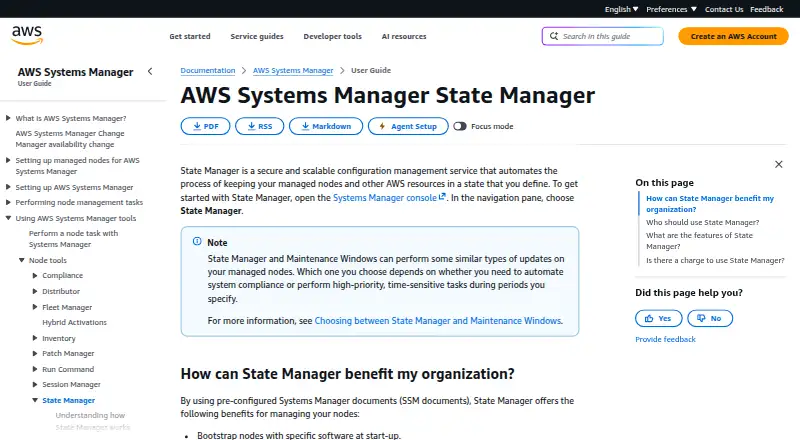
What AWS Systems Manager State Manager is
AWS Systems Manager State Manager automates maintaining a defined state for managed nodes and other AWS resources. AWS customers can use it to improve resource management and governance and reduce configuration drift. Associations specify the configuration to maintain, when to apply it, and which resources to target. They can run immediately or later and accept most standard cron and rate expressions, although association cron expressions cannot specify months.
Resources can be targeted by tags, AWS Resource Groups, individual node IDs, or all managed nodes in the current Region and account. For Linux, macOS, and Windows Server managed nodes, State Manager can bootstrap software, schedule agent updates, configure network settings, join nodes to a Microsoft Active Directory domain, and run scripts. Association output can be stored in Amazon S3, and State Manager is supported as an event type and target type in Amazon EventBridge rules. It is a cloud service with an agent-based model and supports drift detection, patch management, policy as code, and compliance reporting. There is no additional charge, though limits may apply. AWS follows a shared responsibility model: AWS protects cloud infrastructure, while customer responsibilities depend on the service, data, and requirements.
Who it suits
State Manager suits AWS customers who want to define and maintain configurations across managed nodes and other AWS resources. It can help teams manage software, settings, and configuration drift.
What it does well
- Targets resources by tags, groups, IDs, or account-wide scope
- Can schedule agent updates and configure network settings
- Supports drift detection and patch management
- Association output can be stored in Amazon S3
- No additional charge
What to know first
- Limits may apply despite there being no additional charge
- Association cron expressions cannot specify months
- Supported managed-node systems are Linux, macOS, and Windows Server
Limits
State Manager has no additional charge, though limits may apply. Association cron expressions do not support specifying months.
Plans
| Plan | Billed and limits | Price |
|---|---|---|
| AWS Systems Manager State Manager | No additional charge · Limits may apply | Free |
As docs.aws.amazon.com lists them, read 5 Oct 2026. The maker's own page has the final word.
Getting started
- Open the AWS Systems Manager State Manager documentation.
- Select the resources to manage using tags, AWS Resource Groups, node IDs, or all managed nodes in the current Region and account.
- Create an association defining the desired state, timing, and target resources.
- Choose immediate or delayed processing and, if scheduling, use a supported cron or rate expression.
- Use the association to bootstrap software, configure nodes, or run scripts on supported managed node platforms.
- Optionally store association run output in Amazon S3 or use State Manager with Amazon EventBridge rules.
AWS Systems Manager State Manager helps AWS customers keep managed nodes and other AWS resources in a defined configuration. It is best suited to teams governing AWS fleets and reducing configuration drift. Its strongest case is scheduled, repeatable maintenance without an additional State Manager charge; AWS-scoped targeting and a cron limitation make it a narrower fit for broader environments.
Overview
State Manager uses associations to specify the desired state of a resource, when to apply it, and which resources to target. That makes it a practical choice for ongoing configuration management within AWS, rather than a general-purpose way to manage infrastructure across unrelated environments.
Associations can run immediately or after a delay and accept most standard cron and rate expressions. The exception matters for calendar-driven work: cron expressions for associations cannot specify months. Targets can be selected by tags, AWS Resource Groups, individual node IDs, or all managed nodes in the current Region and account. Those options suit routine fleet-wide or group-level changes, but the Region-and-account boundary may complicate work spanning a wider estate.
Key features
On Linux, macOS, and Windows Server managed nodes, State Manager can bootstrap software, schedule agent updates, configure network settings, join nodes to a Microsoft Active Directory domain, and run scripts. These capabilities cover common setup and upkeep tasks, giving teams a way to apply consistent configurations instead of handling each node separately.
State Manager supports drift detection, patch management, policy as code, and compliance reporting. Associations can store run output in Amazon S3, and State Manager can serve as an event type and target type in Amazon EventBridge rules. Together, these functions suit AWS operations teams that want configuration work connected to their existing AWS workflows; they do not remove the need to account for the service's targeting and scheduling boundaries.
AWS follows a shared responsibility model: AWS protects the cloud infrastructure, while customer responsibilities vary with the service, data, and requirements. Systems Manager is assessed by third-party auditors under assurance programs including SOC, PCI, FedRAMP, and HIPAA. Those programs provide useful assurance context, but customers still need to understand and meet their own responsibilities.
Pricing
AWS Systems Manager State Manager — free. The free plan has no additional charge, though limits may apply. There are no paid tiers to weigh against the free offering in this plan structure. That makes State Manager an economical fit for AWS customers who can work within its limits; teams should still account for those limits when planning larger-scale use.
Platforms
State Manager is cloud-based and agent-based. Its supported managed-node platforms are Linux, macOS on Amazon EC2, and Windows Server. While the platform details also include web, the managed-node tasks described here are for those operating systems; macOS support is specifically tied to Amazon EC2.
Who it's for
State Manager is the right choice for AWS customers who want to reduce configuration drift and govern AWS resources through repeatable associations. It is especially relevant when teams need to schedule maintenance or apply scripts and standard settings across managed nodes. Look elsewhere if your environment requires targeting beyond the current AWS Region and account or calendar schedules that depend on selecting specific months.
Pros and cons
- Pros: No additional charge makes routine configuration maintenance accessible without a State Manager fee.
- Pros: Associations combine desired state, timing, and targeting, with options from individual node IDs to tags, Resource Groups, or all managed nodes in a Region and account.
- Pros: Node-management tasks cover software bootstrap, agent updates, network settings, directory joining, and scripts across supported systems.
- Cons: Association cron expressions cannot specify months, limiting some calendar-based schedules.
- Cons: Targeting all managed nodes is limited to the current Region and account, which is restrictive for broader coordination.
- Cons: Limits may apply despite the lack of an additional charge.
Alternatives
For teams comparing configuration-management options, the Configuration Management Tools, IT Operations Management Software, IT Configuration Management Software, and IT Automation Software lists provide broader starting points.
- CFEngine offers a free Community Edition under the GNU GPL with Linux support and community support; it also has a freemium model and free trial.
- Rudder is a freemium option with a free plan and free trial; its source code can be downloaded and modified under its open source licenses.
- Salt offers a free Salt Open Source plan under the Apache 2.0 license.
- config.XO has a free forever plan capped at one workspace, one admin user, one cloud connection, one hypervisor, three managed systems, and one API key.
- Google Cloud VM Manager may suit teams managing Google Cloud VMs: its plan is billed at $0.003 per hour per VM with an active OS Config agent after the free tier, per VM-hour, with a 100-VM monthly allowance per Cloud Billing account.
- OpenVox is a free, community-maintained option for agent/server or standalone use.
- pyinfra is a free, MIT-licensed option requiring Python 3.10 or later.
- Uyuni is free, open-source configuration and infrastructure management; hardware requirements depend on deployment and channel requirements.
Verdict
Choose AWS Systems Manager State Manager if you are an AWS customer seeking no-additional-charge, scheduled configuration management for supported managed nodes and resources. Its associations and node-maintenance tasks make it a focused fit for reducing drift within AWS. Choose another approach if you need month-specific cron scheduling, targeting beyond the current Region and account, or an environment outside its AWS-centered scope.
Verdict
State Manager provides configurable, scheduled maintenance for AWS resources and managed nodes at no additional charge. Account for its limits and the restriction on months in association cron expressions.
Questions
What does State Manager do?
It automates keeping managed nodes and other AWS resources in a state that you define through associations.
What does State Manager cost?
It has no additional charge. Limits may apply.
Which platforms are supported?
Supported managed node platforms are Linux, macOS on Amazon EC2, and Windows Server.
How can associations target resources?
They can target by tags, AWS Resource Groups, individual node IDs, or all managed nodes in the current Region and account.
Can associations be scheduled?
They support immediate or delayed processing and most standard cron and rate expressions. Association cron expressions cannot specify months.
Does State Manager work with other AWS services?
Association run output can be stored in Amazon S3, and State Manager is supported as an event type and target type in Amazon EventBridge rules.
Facts from AWS Systems Manager State Manager's own pages
- Associations
- Associations define the state to maintain on AWS resources, along with when to apply the configuration and which resources to target. · docs.aws.amazon.com, 5 Oct 2026
- Compliance
- Third-party auditors assess Systems Manager under multiple assurance programs, including SOC, PCI, FedRAMP, and HIPAA. · docs.aws.amazon.com, 5 Oct 2026
- Integrations
- State Manager supports storing association run output in Amazon S3 and is supported as an event type and target type in Amazon EventBridge rules. · docs.aws.amazon.com, 5 Oct 2026
- Node management
- It can bootstrap software, schedule agent updates, configure network settings, join nodes to a Microsoft Active Directory domain, and run scripts on Linux, macOS, and Windows Server managed nodes. · docs.aws.amazon.com, 5 Oct 2026
- Price limits
- State Manager has no additional charge, though limits may apply. · aws.amazon.com, 5 Oct 2026
- Purpose
- State Manager automates keeping managed nodes and other AWS resources in a state that you define. · docs.aws.amazon.com, 5 Oct 2026
- Scheduling
- Associations support immediate or delayed processing and most standard cron and rate expressions; cron expressions for associations do not support specifying months. · docs.aws.amazon.com, 5 Oct 2026
- Security
- AWS Systems Manager follows a shared responsibility model: AWS protects the cloud infrastructure, while customer responsibilities depend on the service and their data and requirements. · docs.aws.amazon.com, 5 Oct 2026
- Targeting
- Associations can target resources by tags, AWS Resource Groups, individual node IDs, or all managed nodes in the current Region and account. · docs.aws.amazon.com, 5 Oct 2026
- Who it is for
- AWS customers can use State Manager to improve management and governance of AWS resources and reduce configuration drift. · docs.aws.amazon.com, 5 Oct 2026
Where AWS Systems Manager State Manager stands on Freedom251
- IT Operations Management Software#1 of 26
- IT Automation Software#9 of 77
- Configuration Management Tools#5 of 26
- IT Configuration Management Software#6 of 27