Freedom251 › IT Automation Software

CFEngine
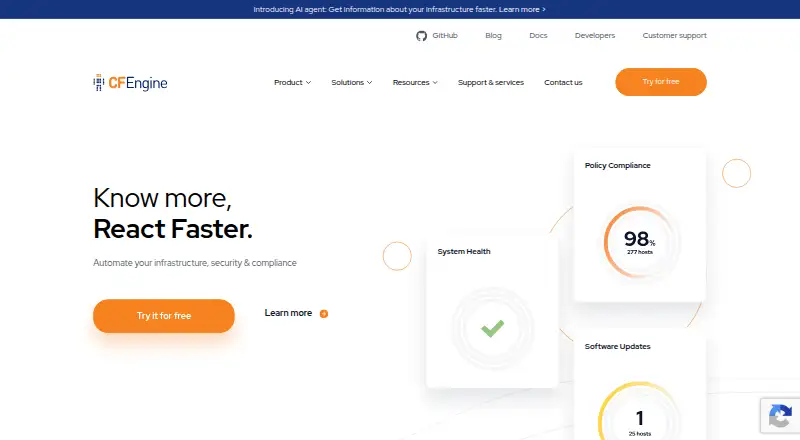
What CFEngine is
CFEngine automates infrastructure management by keeping systems aligned with defined security, compliance, and configuration requirements. Users write desired states in CFEngine’s domain-specific language; lightweight agents on managed devices work to bring actual configurations into line. By default, each agent contacts the CFEngine hub every five minutes. The software is designed for embedded devices, servers, cloud systems, and mainframes, including environments with tens or hundreds of thousands of nodes. The Enterprise edition adds Mission Portal, a web interface and reporting hub backed by SQL, along with REST APIs, compliance reports, policy analysis, alerts, inventory and change reporting, file-integrity monitoring, and performance monitoring. Dashboards can show real-time compliance and performance, with customizable alerts and shareable views. Enterprise inventory covers bare-metal servers, virtual machines, cloud instances, and IoT devices. Secure bootstrap uses mutual authentication, key exchange, and TLS encryption. Community Edition is free under GNU GPL for Linux with community support; Enterprise is free for up to 25 hosts, with other pricing available on request.
Who it suits
CFEngine suits teams that need policy-based configuration and compliance across Linux or Windows systems, from individual servers to very large fleets. Enterprise may fit organizations needing centralized reports, dashboards, and dedicated support.
What it does well
- Agents check hub compliance every five minutes by default.
- Designed to manage tens or hundreds of thousands of nodes.
- Enterprise includes compliance reports and policy analysis.
- Secure bootstrap uses mutual authentication and TLS encryption.
- Community Edition is free under GNU GPL.
What to know first
- Community Edition supports Linux.
- Enterprise pricing beyond 25 hosts is available on request.
Limits
Community Edition is free and supports Linux, with community support. Enterprise is free for up to 25 hosts; pricing beyond that is available on request.
Plans
| Plan | Billed and limits | Price |
|---|---|---|
| Enterprise free trial | no credit card required · up to 25 hosts · unrestricted trial features | Free |
| Community Edition | free to use · Linux support · community support · configuration management · autonomous agents | Free |
| Enterprise Edition | single price per license · Windows, AIX, Solaris and HP-UX · Mission Portal · REST APIs · reporting · alerts · dashboards · technical support | On request |
As cfengine.com lists them, read 14 Oct 2026. The maker's own page has the final word.
Getting started
- Visit the CFEngine website.
- Choose between Community Edition and Enterprise Edition.
- For Community Edition, use its Linux support and GNU GPL license.
- For Enterprise, start with up to 25 free hosts or request pricing.
- Deploy the self-hosted hub and agents on managed devices.
- Define desired infrastructure states in CFEngine’s domain-specific language.
Overview
CFEngine is a self-hosted infrastructure automation and configuration management platform built around policies that keep systems aligned with a desired state. Its agent-based approach and stated ability to handle very large fleets make it a strong fit for organizations managing diverse infrastructure at scale, though the Linux-focused free edition and custom-priced Enterprise tier create a meaningful divide.
Administrators write policies in CFEngine’s domain-specific language, and agents on managed devices work to bring actual configurations into line. Agents connect to the hub every five minutes by default, making CFEngine suited to ongoing enforcement rather than occasional configuration runs.
CFEngine covers infrastructure, security and compliance, with drift detection, patch management, policy as code and compliance reporting. Its stated reach spans embedded devices, servers, cloud systems and mainframes, including deployments of tens or hundreds of thousands of nodes.
Key features
Policy enforcement across a fleet
The desired-state model gives teams a way to define how infrastructure should look and have lightweight agents continually converge systems toward that policy. The five-minute default hub interval supports regular compliance checks; teams needing immediate, event-driven enforcement should not assume that interval provides it.
Enterprise reporting and controls
Enterprise adds the Mission Portal, which brings together dashboards, reporting, policy analysis, alerts and inventory. Dashboards can show real-time compliance levels and performance, and teams can create alerts and actions and share customized dashboards. Inventory reporting covers bare-metal servers, virtual machines, cloud instances and IoT devices.
The reporting hub uses an SQL database and exposes REST APIs. Enterprise also includes compliance, change and inventory reporting, file-integrity monitoring and performance monitoring. The API can use SQL to build custom reports from data held across globally distributed CFEngine database servers, giving organizations room to shape reporting around their own operational needs.
Security and policy resources
Secure bootstrap uses mutual authentication, key exchange and TLS-encrypted communication. CFEngine Build offers a catalogue of policies and modules from CFEngine, partners and the community, which can give teams a starting point for policy work. Enterprise support includes a dedicated team that answers questions, recommends practices and can prioritize requested feature development.
Pricing
CFEngine uses a freemium model. Community Edition costs nothing under the GNU GPL, supports Linux and comes with community support. It is the practical starting point for Linux-focused teams willing to rely on community help, but Windows support and Enterprise reporting capabilities are not part of its stated plan terms.
Enterprise Edition is custom pricing, with up to 25 hosts free and a single price per license without add-on or extra-functionality costs. That structure suits organizations that need the web portal, reporting and dedicated support and want licensing without separate feature charges. Organizations beyond the free host allowance need to request pricing; no trial duration or renewal terms are stated.
Platforms
CFEngine is self-hosted and agent-based. Community Edition is Linux-focused; the supported platforms include Linux distributions such as RHEL, Debian and Ubuntu, plus Windows. The broader platform listing also includes macOS, web and API, but the plan terms specifically identify Linux support for Community Edition, so buyers should confirm the relevant platform coverage for their intended edition.
Who it's for
CFEngine is best suited to infrastructure and security teams responsible for keeping a large or heterogeneous fleet compliant over time. Its policy model, recurring agent checks and broad scale target are relevant where configuration consistency matters across devices, servers and cloud systems. Enterprise is the clearer fit for organizations that need centralized dashboards, detailed reporting and dedicated support.
It is less compelling for a small team seeking a turnkey hosted service or broad reporting without moving to Enterprise: deployment is self-hosted, and the free Community Edition is Linux-focused and community-supported.
Pros and cons
- Pros: Designed for very large, mixed infrastructure, from embedded devices to mainframes, which makes it relevant beyond conventional server fleets.
- Pros: Policy enforcement, drift detection, patch management and compliance reporting address ongoing configuration and security work in one platform.
- Pros: Enterprise combines dashboards, inventory, alerts, integrity monitoring, APIs and dedicated support, with no add-on or extra-functionality charges stated.
- Cons: Community Edition is Linux-focused and relies on community support, limiting its fit for teams that need Windows coverage or vendor assistance at no charge.
- Cons: Enterprise pricing must be requested for deployments beyond 25 hosts, making cost planning less direct for larger organizations.
- Cons: Self-hosted deployment means the organization operates the management environment rather than using a hosted service.
Alternatives
For a broad comparison, browse Configuration Management Tools, IT Configuration Management Software and IT Automation Software.
Choose OpenDSC if you want a free option with support for Linux, macOS, Windows, web and API platforms. Puppet is another freemium alternative, with Enterprise offering 10 free nodes and an Advanced tier for custom-priced deployments. Consider Rudder if its downloadable, modifiable open-source code is a priority. Salt offers a free Apache 2.0-licensed option, while OpenVox is community-maintained and supports agent/server or standalone use.
config.XO may suit a small setup that fits its free plan’s limits of one workspace, admin user, cloud connection, hypervisor, three managed systems and one API key. Azure Machine Configuration is free for Azure resources, with an Arc resource plan priced at $6 a month and hourly-prorated billing. Radmind is another free option.
Verdict
Choose CFEngine if your priority is policy-based configuration enforcement across a large, varied fleet, and you can operate a self-hosted system. Its clearest advantage is the combination of broad scale with Enterprise reporting and security controls; look elsewhere if you need a hosted service, or if Linux-focused community support is not enough and custom Enterprise pricing is a poor fit.
Verdict
CFEngine combines policy-based configuration management with reporting and security controls, and is designed for a wide range of infrastructure scale. The free Community Edition is Linux-focused; Enterprise adds a web portal, extensive reporting, and support, with pricing beyond 25 hosts available on request.
Questions
Is CFEngine free?
Yes. Community Edition is free under GNU GPL. Enterprise is free for up to 25 hosts.
What does Enterprise cost beyond 25 hosts?
Pricing is available on request. Enterprise uses a single price per license, with no add-ons or extra functionality costs.
Which platforms does CFEngine support?
Listed platforms include Linux distributions such as RHEL, Debian and Ubuntu, as well as Windows. The platform list also includes macOS, web, API and self-hosted.
Is CFEngine self-hosted?
Yes. Its deployment model is self-hosted, and managed devices run agents that connect to the CFEngine hub.
What does Enterprise add?
Enterprise includes the Mission Portal, SQL-backed reporting, REST APIs, compliance and inventory reports, alerts, policy analysis, monitoring and dedicated support.
Who makes CFEngine?
CFEngine was founded in 2008 and is headquartered in Oslo, Norway.
Facts from CFEngine's own pages
- Alerts and actions
- Users can define event alerts and trigger custom actions or integrations when infrastructure changes occur. · cfengine.com, 14 Oct 2026
- API
- The Enterprise Hub exposes a REST API that also supports SQL-based queries for custom reports over distributed database data. · docs.cfengine.com, 14 Oct 2026
- Architecture
- The CFEngine agent runs on each managed device and connects to the CFEngine hub by default every five minutes to ensure configuration compliance. · cfengine.com, 1 Oct 2026
- Authentication and encryption
- Public-key authentication is mandatory; Community uses RSA-2048 authentication with Blowfish transfer encryption, while commercial editions use AES-256 and SHA-256 and cite FIPS 140-2 validation. · docs.cfengine.com, 14 Oct 2026
- Company profile
- LinkedIn lists Northern.tech as a privately held software company founded in 2008, headquartered in Oslo, with 51–200 employees. · linkedin.com, 14 Oct 2026
- Compliance reporting
- Enterprise provides customizable reports for internal and external compliance requirements. · cfengine.com, 14 Oct 2026
- Configuration management
- The system manages files, processes, packages, services, users, storage and other promise types. · docs.cfengine.com, 14 Oct 2026
- Dashboards
- Enterprise dashboards show compliance levels, performance, alerts and customizable shared views. · cfengine.com, 14 Oct 2026
- Desired-state automation
- Administrators describe desired states in CFEngine's policy language and local agents converge systems toward those states. · docs.cfengine.com, 14 Oct 2026
- Documentation depth
- Documentation includes getting-started guides, installation, policy tutorials, promise and function references, web UI material and API references. · docs.cfengine.com, 14 Oct 2026
- Documentation licensing
- CFEngine documentation is published as open source and accepts pull-request corrections. · docs.cfengine.com, 14 Oct 2026
- Enterprise interface
- Enterprise includes the Mission Portal web interface, a reporting hub with SQL database, REST APIs, compliance reports, policy analysis, alerts, inventory reporting, change reporting, file-integrity monitoring and performance monitoring. · cfengine.com, 1 Oct 2026
- Extensibility
- CFEngine Build supplies community and vendor policy modules that can be added through Mission Portal or command-line tools. · docs.cfengine.com, 14 Oct 2026
- External integrations
- Policies can consume JSON, YAML and CSV data and can use generated API data or CMDB exports as inputs. · docs.cfengine.com, 14 Oct 2026
- Founded
- 2008 · cfengine.com, 23 Sept 2026
- Headquarters
- Oslo, Norway · cfengine.com, 23 Sept 2026
- Installation method
- Community installation guides provide precompiled RPM and DEB packages for Ubuntu, Debian, Red Hat, CentOS and SUSE, plus the cf-remote installer. · docs.cfengine.com, 14 Oct 2026
- Inventory
- Inventory reporting collects detailed information across bare-metal servers, virtual machines, cloud instances and IoT devices. · cfengine.com, 1 Oct 2026
- Inventory reporting
- Enterprise collects infrastructure inventory from bare-metal servers, virtual machines, cloud instances and IoT devices. · cfengine.com, 14 Oct 2026
- Known issue
- The 3.27 documentation records a 3.26.0 Ubuntu hub installation hang when using cf-remote and gives manual-install workarounds. · docs.cfengine.com, 14 Oct 2026
- Legal maker
- CFEngine states that it is developed and maintained by Northern.tech AS. · cfengine.com, 14 Oct 2026
- Licence
- Community Edition is licensed under the GNU General Public License, while Enterprise uses a commercial licence. · cfengine.com, 14 Oct 2026
- Limit: documentation usability
- The same account said CFEngine had extensive documentation but that finding a practical learning path was difficult. · syslog.me, 14 Oct 2026
- Limit: learning curve
- UpGuard identifies CFEngine's specialized language and operating-system nuances as producing a steep learning curve. · upguard.com, 14 Oct 2026
Where CFEngine stands on Freedom251
- IT Automation Software#2 of 77
- Enterprise IT Management Software#1 of 30
- IT Configuration Management Software#1 of 27
- Configuration Management Tools#1 of 26
- Infrastructure Automation#1 of 24
- Orchestration / Provisioning Software#2 of 27
- Data Center Automation#3 of 22