AutoKeras
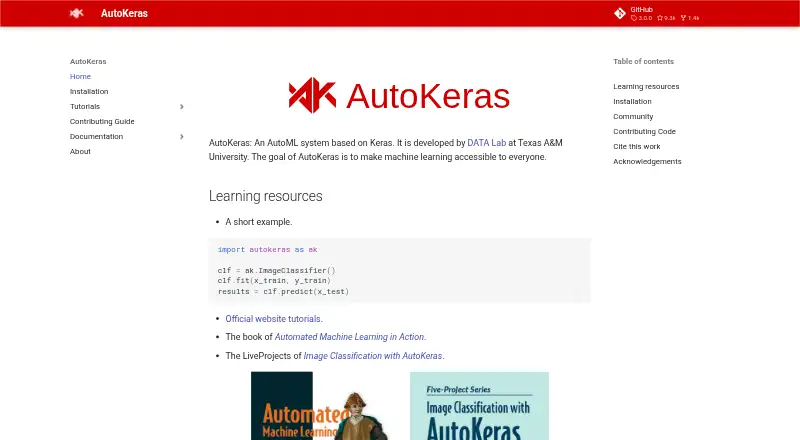
What AutoKeras is
AutoKeras is an open-source AutoML system based on Keras for building machine-learning models through code. It supports image and text classification and regression, as well as classification and regression for structured data. Its documentation includes a tutorial for multi-task or multimodal datasets. Users can assemble custom models from AutoKeras blocks while the system searches for detailed configurations. For image workflows, users can set architecture type, normalization, and data augmentation or let those choices be tuned automatically. AutoKeras can export the best model found as a Keras Model. The Python package is installed with pip and supports Linux, macOS, and Windows, including self-hosted use. The installation guide supports Python 3 and recommends PyTorch 2.3.0 or later with the PyTorch backend. By default, the final 20% of training data is used for validation, though users can choose another split or provide validation data. Model selection uses validation loss by default, with options to customize metrics and objectives. Runs can continue from prior directory contents when overwrite is set to false.
Who it suits
It suits developers and machine-learning practitioners who want code-based automated model search for image, text, or structured data tasks. Its self-hosted Python package is relevant to users comfortable with installation and configuration.
What it does well
- Supports image, text, and structured data tasks.
- Custom models can be assembled from AutoKeras blocks.
- Best model can be exported as a Keras Model.
- Validation metrics and objectives can be customized.
What to know first
- The workflow interface is code.
- Installation requires the Python package.
- PyTorch backend guidance recommends version 2.3.0 or later.
Plans
| Plan | Billed and limits | Price |
|---|---|---|
| AutoKeras | Python package installed with pip | Free |
| Open-source library | Install locally with pip · no hosted-service limits stated | Free |
As autokeras.com lists them, read 4 Oct 2026. The maker's own page has the final word.
Getting started
- Open the AutoKeras website and follow its pip installation instructions.
- Use a supported Linux, macOS, or Windows environment with Python 3.
- For the PyTorch backend, use the recommended PyTorch version 2.3.0 or later.
- Build a model using AutoKeras blocks and choose a supported task.
- Set a validation split or provide validation data if you do not want the default final 20%.
- Use GitHub Discussions to ask project questions.
Overview
AutoKeras is a free, open-source AutoML package for Python that searches for machine-learning models. It is best suited to developers and data practitioners who want to automate parts of model design while staying in code. Its central trade-off is clear: flexible model search without a software fee, but no graphical workflow.
Key features
The package covers image and text classification and regression, as well as classification and regression for structured data. That makes it a practical option for teams working across several common supervised-learning tasks. Documentation also describes multi-task and multimodal datasets, though using those workflows still means working with the package rather than a visual interface.
AutoKeras lets users build models from its blocks and automate the search for detailed configurations. In image workflows, architecture type, normalization and augmentation can be specified, or left for the system to tune. This is a useful middle ground between a rigid preset and fully manual model configuration, but it assumes familiarity with Python and machine-learning concepts.
The best model found can be exported as a Keras Model. Validation behavior is configurable: by default, the last 20% of training data is reserved for validation, and validation loss guides model selection. Users can choose a different split, supply validation data, and set custom metrics or objectives. For interrupted work, setting overwrite to false lets a run with the same code continue from the contents of its directory.
Pricing
AutoKeras is free: the package costs nothing and is installed with pip. There is no paid tier in the package plan, so the choice is whether a self-hosted Python workflow fits your needs, not which subscription level to buy.
The project provides pip installation instructions. Its installation guide supports Python 3 and recommends PyTorch version 2.3.0 or later when using the PyTorch backend. Those requirements make it a better match for users already prepared to manage a Python environment than for people seeking a managed, no-code setup.
Platforms
AutoKeras supports Linux, macOS and Windows, and is self-hosted. Its workflow interface is code, so users run the package in their own environment rather than through a web-based application.
Who it's for
Choose AutoKeras if you want no-cost automated model search for image, text or structured-data tasks and want to retain control over model components, validation and selection objectives. It is less suitable if you need a graphical workflow or do not want to work directly with Python. The project is developed by DATA Lab at Texas A&M University in collaboration with the keras-team for version 1.0 and above. Questions can be directed to GitHub Discussions.
Pros and cons
- Pros: Free and open source, with image, text and structured-data tasks supported in one Python package.
- Pros: Users can combine AutoKeras blocks with automated configuration search, then export the selected model as a Keras Model.
- Pros: Validation data and model-selection criteria can be customized, and runs can resume from existing directory contents.
- Cons: The code-first, self-hosted workflow is a poor fit for users who want a web interface or managed service.
- Cons: Working with the package requires a Python environment and familiarity with machine-learning workflows.
Alternatives
AutoML Software is a useful starting point if you want to compare a broader set of tools.
FEDOT, LightAutoML, MLJAR AutoML, AutoGluon and Auto-PyTorch are also free AutoML options. LightAutoML and MLJAR AutoML additionally offer web platforms, while FEDOT, AutoGluon and Auto-PyTorch share AutoKeras's Linux and self-hosted availability; Auto-PyTorch is listed for Linux only. These alternatives may suit you better if their platform mix or project licensing is a closer fit.
Amazon SageMaker Autopilot is a paid service with a free trial and API and web platforms, so consider it if you prefer those access modes to a self-hosted Python package. BigML and JADBio are freemium alternatives with free plans and trials; their listed plans include usage or project limits, making them worth considering if you want a service with defined free-tier boundaries.
Verdict
AutoKeras is a strong choice for Python users who want free, configurable AutoML across image, text and structured data. The ability to guide model construction and evaluation without giving up automated search is its main advantage. Look elsewhere if a web interface or managed workflow matters more than self-hosted code.
Verdict
AutoKeras provides automated search while leaving room to configure models and evaluation choices. It is a code-first package rather than a graphical workflow tool.
Questions
How much does AutoKeras cost?
AutoKeras is free and open source. Its listed plan costs nothing.
Which operating systems does it support?
The Python package supports Linux, macOS, and Windows, including self-hosted use.
What machine-learning tasks does AutoKeras support?
It supports image and text classification and regression, plus classification and regression for structured data. Its documentation includes a tutorial for multi-task or multimodal datasets.
Can I export a model from AutoKeras?
Yes. AutoKeras can export the best model it finds as a Keras Model.
How does AutoKeras choose a model?
It uses validation loss by default. Users can customize the metric or objective.
How do I install it and get help?
The project provides pip installation instructions for its Python package. It directs users to GitHub Discussions for questions.
Facts from AutoKeras's own pages
- Community funding
- Open Collective reports $2,065.59 raised and $205.67 disbursed for AutoKeras. · opencollective.com, 15 Oct 2026
- Community size
- Open Collective lists 32 contributors. · opencollective.com, 15 Oct 2026
- Company location
- The Texas A&M Engineering page identifies the institution in College Station, Texas. · engineering.tamu.edu, 15 Oct 2026
- Custom search spaces
- Users can connect built-in blocks or implement their own Block subclasses to customize the search space. · autokeras.com, 15 Oct 2026
- Deployment ecosystem
- The paper states exported models can be deployed through TensorFlow ecosystem tooling. · jmlr.org, 15 Oct 2026
- Documentation depth
- The documentation includes task tutorials, API reference pages, customization guidance, export instructions and an FAQ. · autokeras.com, 15 Oct 2026
- Funding
- Texas A&M reported that the project had been funded by DARPA through an AFRL contract. · engineering.tamu.edu, 15 Oct 2026
- Image classification
- The task API supports image-classification workflows. · autokeras.com, 15 Oct 2026
- Image features
- Image workflows can configure architecture type, normalization, and data augmentation, or leave choices to be tuned automatically. · autokeras.com, 4 Oct 2026
- Image regression
- The task API supports image-regression workflows. · autokeras.com, 15 Oct 2026
- Installation
- The official installation method is pip install autokeras, with Python 3 required. · autokeras.com, 15 Oct 2026
- Latest package release
- PyPI lists version 3.0.0 as released on November 12, 2025. · pypi.org, 15 Oct 2026
- Licence
- The source repository and package metadata specify Apache License 2.0. · github.com, 15 Oct 2026
- Limit: structured-data production fit
- The same Reddit discussion reported relying on boosted trees for tabular data and not finding neural-network success in production. · reddit.com, 15 Oct 2026
- Maintainer
- The package is developed by DATA Lab at Texas A&M University in collaboration with keras-team for version 1.0 and above. · autokeras.com, 4 Oct 2026
- Maker
- The package is developed by DATA Lab at Texas A&M University with Keras-team collaboration. · autokeras.com, 15 Oct 2026
- Model design
- Users can build custom models from AutoKeras blocks while letting the system search for detailed configurations. · autokeras.com, 4 Oct 2026
- Model export
- The best searched model can be exported as a Keras model. · autokeras.com, 15 Oct 2026
- Model selection
- AutoKeras uses validation loss by default to select the best model, and supports customized metrics and objectives. · autokeras.com, 4 Oct 2026
- Multimodal
- The documentation includes a tutorial for working with multi-task or multi-modal datasets. · autokeras.com, 4 Oct 2026
- Multi-modal learning
- AutoModel can combine different input types such as images and text. · autokeras.com, 15 Oct 2026
- Multi-task learning
- AutoModel can produce multiple prediction heads, including classification and regression outputs. · autokeras.com, 15 Oct 2026
- Notable news: 2019
- Texas A&M announced AutoKeras as an open-source machine-learning breakthrough on January 22, 2019. · engineering.tamu.edu, 15 Oct 2026
- Praise: accessible experimentation
- A Reddit user reported using AutoKeras during early experimentation because cloud AutoML services felt too complicated. · reddit.com, 15 Oct 2026
Where AutoKeras stands on Freedom251
- AutoML Software#1 of 30