Auto-PyTorch
What Auto-PyTorch is
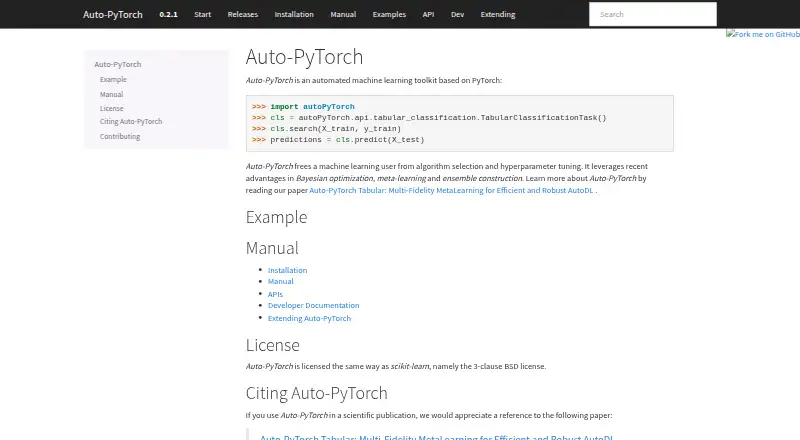
Auto-PyTorch is a free, self-hosted machine-learning toolkit that automates model selection and hyperparameter tuning using PyTorch. It searches pipeline configurations within a user-set budget, using Bayesian optimization, meta-learning, SMAC, and Hyperband; it can also optimize neural-network architecture and training settings. Documented tasks include tabular classification, tabular regression, and time-series forecasting. For tabular data, preprocessing can include imputation, categorical encoding, scaling, and feature processing, with related hyperparameters tuned during the search. It can form ensembles from models’ predictions on a validation set, with controls for ensemble size and candidate limits. Users can set estimator memory and total search-time limits. Parallel Bayesian optimization is supported through Dask.distributed, but workers need shared filesystem access to training data and models. Installation options include PyPI, manual setup, and a Docker image. The documented system requirements include Linux, Python 3.7 or later, a C++11-capable compiler, and SWIG 3.0; SWIG 4.0 or later is not supported. Forecasting needs additional dependencies. The project states that it uses the 3-clause BSD license.
Who it suits
It suits developers and machine-learning practitioners who can work in a Linux, self-hosted Python environment and want automated searches for tabular tasks or forecasting. Teams using parallel workers need shared filesystem access.
What it does well
- Automates model selection and hyperparameter tuning.
- Supports classification, regression, and forecasting.
- Allows memory and search-time limits.
- Provides a Docker image.
- Uses the 3-clause BSD license.
What to know first
- Requires Linux and specified compiler and SWIG versions.
- SWIG 4.0 or later is unsupported.
- Forecasting requires additional dependencies.
- Parallel workers need shared filesystem access.
Limits
The toolkit is free under the 3-clause BSD license. Forecasting requires dependencies beyond the base installation, and parallel workers require a shared file system; SWIG 4.0 or later is unsupported.
Plans
| Plan | Billed and limits | Price |
|---|---|---|
| Auto-PyTorch | 3-clause BSD license | Free |
As automl.github.io lists them, read 3 Oct 2026. The maker's own page has the final word.
Getting started
- Use the PyPI installation, manual Python environment, or Docker image.
- Prepare a Linux environment with Python 3.7 or later, a C++11-capable compiler, and SWIG 3.0.
- Set a memory limit for estimators and a total wall-time limit for model search.
- Choose a documented task: tabular classification, tabular regression, or time-series forecasting.
- For forecasting, install the additional dependencies.
- For parallel Bayesian optimization, configure Dask.distributed workers with shared file-system access.
Auto-PyTorch is a code-driven AutoML toolkit for automating model, preprocessing, and neural-network tuning with PyTorch. It best suits Linux-based Python users who want to run searches on their own infrastructure and control the compute budget. The trade-off is a demanding setup and no graphical workflow.
Overview
Auto-PyTorch searches machine-learning pipeline configurations instead of requiring every algorithm and parameter to be chosen manually. Bayesian optimization, meta-learning, SMAC, and Hyperband explore alternatives within a user-set budget, including neural-network architecture and training hyperparameters. Documented tasks are tabular classification, tabular regression, and time-series forecasting.
This is self-hosted software with a code workflow, not a hosted service. That suits engineers and researchers who need reproducible control over Python environments, storage, and runtime limits. It is a poor match for teams seeking a browser-based interface or turnkey deployment.
Key features
Automated pipelines and feature preparation
For tabular work, preprocessing is included in the search. The toolkit can tune imputation, categorical encoding, scaling, and other feature-preprocessing choices alongside model selection. That can remove substantial pipeline assembly, but users still need to define a sensible search and evaluate the resulting models rather than treat automation as a substitute for validation.
Forecasting support
Time-series forecasting is supported, extending the toolkit beyond classification and regression. Forecasting requires dependencies in addition to the base installation, so a forecasting project carries more environment setup than a tabular one.
Ensembling
Auto-PyTorch forms ensembles by selecting models according to predictions on a validation set. You can configure ensemble size and the number of candidate models considered. Those controls are useful when balancing accuracy against complexity and runtime, while validation quality remains important because ensemble choices depend on that holdout performance.
Budgets and parallel search
You can impose a memory limit for estimators and a total wall-time limit for the search, making resource use explicit on shared or limited machines. Parallel Bayesian optimization uses Dask.distributed. Multiple workers must access a shared file system containing training data and models, which adds an infrastructure requirement that single-worker runs avoid.
Python ecosystem
The documented integrations include PyTorch, scikit-learn transformers, Dask.distributed, and threadpoolctl. Installation is available through PyPI, a manual Python environment, or a Docker image. The project is developed by the AutoML Groups of the University of Freiburg and Hannover and accepts bug reports, documentation improvements, and feature proposals through its GitHub issue tracker.
Pricing
| Plan | Price | Includes |
|---|---|---|
| Auto-PyTorch | free | Free toolkit under the 3-clause BSD license |
There is no paid tier or free trial. The free release provides the full documented toolkit, while the practical costs are your own compute, storage, environment maintenance, and any extra forecasting dependencies.
Platforms
Auto-PyTorch is Linux and self-hosted. The installation requirements include Python 3.7 or later, a C++11-capable compiler, and SWIG 3.0.*. SWIG 4.0 or later is not supported, so environments that have already moved to newer SWIG releases may need adjustment. Docker is documented as another installation route, but it does not remove the Linux-oriented requirement.
Who it's for
Choose Auto-PyTorch if you are comfortable with Python code, Linux administration, and managing your own data and model artifacts. It is particularly suitable for teams that want automated tabular preprocessing, configurable ensembles, and explicit time or memory budgets while retaining control of the search process.
Look elsewhere if you need macOS or Windows support, a web interface, managed infrastructure, or a simpler installation. Parallel deployments also need shared storage, and forecasting adds dependency work.
Pros and cons
Pros
- Broad automated search: Bayesian optimization, meta-learning, SMAC, and Hyperband explore models, preprocessing, and neural-network settings within a defined budget.
- Useful pipeline controls: Tunable imputation, encoding, scaling, feature preprocessing, ensemble size, and candidate limits reduce manual assembly.
- Explicit resource management: Per-estimator memory and total wall-time limits help prevent unconstrained searches.
- No license charge: The toolkit is free under the 3-clause BSD license.
Cons
- Restrictive setup: Linux, a compiler, Python 3.7+, and specifically SWIG 3.0.* are required; SWIG 4.0+ is unsupported.
- Infrastructure overhead for parallelism: Dask workers need shared access to training data and models.
- Code-only operation: There is no hosted or graphical workflow for less technical users.
- Extra forecasting setup: Time-series use needs dependencies beyond the base installation.
Alternatives
FEDOT is a free BSD 3-Clause AutoML framework with API, Linux, macOS, self-hosted, and Windows support, making it a better fit for cross-platform deployments.
LightAutoML is a free Apache 2.0 Python library installable from PyPI and supports web as well as desktop platforms.
MLJAR AutoML offers a free MIT-licensed Python package plus a free web plan, useful when you want both code and browser access.
AutoGluon is a free Apache 2.0 Python library for users seeking another open-source library option across Linux, macOS, Windows, and self-hosted setups.
AutoKeras is a free pip-installed Python package suited to users focused on an alternative package-based AutoML workflow.
Amazon SageMaker Autopilot is a paid API and web service with a free trial, preferable when you want managed infrastructure and pay-as-you-go usage.
BigML is freemium, with a free plan capped at 16 MB per task, two parallel tasks, and one user, so it fits small hosted experiments rather than unrestricted self-hosting.
JADBio is freemium with a Basic plan limited to one seat, three projects, 50 MB uploads, 500 MB storage, and one model export; choose it for a managed, quota-based workflow.
For a broader directory, see AutoML Software.
Verdict
Auto-PyTorch is a strong choice for Linux-based Python practitioners who want free, configurable automated search across tabular and forecasting tasks, with control over preprocessing, ensembles, and resource limits. Look elsewhere if strict SWIG and Linux requirements, shared-storage parallelism, or the code-only experience will slow your work more than the automation helps.
Verdict
Auto-PyTorch offers automated search, preprocessing, and ensembling controls for several documented machine-learning tasks. Check the Linux and SWIG requirements first, and account for extra forecasting dependencies or shared storage when using parallel workers.
Questions
How much does Auto-PyTorch cost?
The listed plan is free, under the 3-clause BSD license.
What tasks does it support?
The documentation describes tabular classification, tabular regression, and time-series forecasting.
Which platforms does it run on?
The listed platforms are Linux and self-hosted. Installation requirements specify Linux.
Is Auto-PyTorch open source?
The project states that it is licensed under the 3-clause BSD license.
Who develops Auto-PyTorch?
The project says it is developed by the AutoML Groups of the University of Freiburg and Hannover.
How can I install it?
The project documents PyPI installation, manual installation in a Python environment, and a Docker image.
Facts from Auto-PyTorch's own pages
- Compatibility limit
- The installation documentation says SWIG 4.0 or later is not supported. · automl.github.io, 3 Oct 2026
- Data preparation
- For tabular tasks, its preprocessing includes imputation, categorical encoding, scaling, and feature preprocessing, with corresponding hyperparameters tuned during search. · automl.github.io, 3 Oct 2026
- Deployment
- The project provides a Docker image and can be installed from PyPI or manually in a Python environment. · automl.github.io, 3 Oct 2026
- Ensembling
- It builds ensembles by selecting among models based on their predictions for a validation set, and users can configure ensemble size and candidate limits. · automl.github.io, 3 Oct 2026
- Forecasting dependencies
- Time-series forecasting requires additional dependencies beyond the base installation. · automl.github.io, 3 Oct 2026
- Installation
- The installation documentation specifies Linux, Python 3.7 or later, a C++11-capable compiler, and SWIG 3.0.*, and also documents a Docker image. · automl.github.io, 3 Oct 2026
- Integration
- The documented ecosystem includes PyTorch, scikit-learn transformers, Dask.distributed, and threadpoolctl. · automl.github.io, 3 Oct 2026
- Integrations
- The documentation describes using Dask.distributed for parallel Bayesian optimization and sklearn column transformers for data preprocessing. · automl.github.io, 3 Oct 2026
- License
- The documentation states that Auto-PyTorch is licensed under the 3-clause BSD license. · automl.github.io, 3 Oct 2026
- Maker
- The GitHub project says Auto-PyTorch is developed by the AutoML Groups of the University of Freiburg and Hannover. · github.com, 3 Oct 2026
- Optimization
- It jointly optimizes neural network architecture and training hyperparameters for automated deep learning. · github.com, 3 Oct 2026
- Optimization methods
- It uses Bayesian optimization, meta-learning, and ensemble construction to search for models. · automl.github.io, 3 Oct 2026
- Parallel computing requirement
- When using multiple workers, the documentation says they must have access to a shared file system for training data and models. · automl.github.io, 3 Oct 2026
- Parallel processing
- It supports parallel Bayesian optimization using Dask.distributed, and parallel workers need access to a shared file system for training data and models. · automl.github.io, 3 Oct 2026
- Platform requirement
- The installation documentation lists Linux, Python 3.7 or later, a C++11-capable compiler, and SWIG 3.0 as system requirements. · automl.github.io, 3 Oct 2026
- Purpose
- Auto-PyTorch is an automated machine learning toolkit based on PyTorch that automates algorithm selection and hyperparameter tuning. · automl.github.io, 3 Oct 2026
- Resource controls
- Users can set a memory limit for estimators and a total wall-time limit for model search. · automl.github.io, 3 Oct 2026
- Search methods
- Its search process uses Bayesian optimization, meta-learning, SMAC, and Hyperband to explore pipeline configurations within a user-set budget. · github.com, 3 Oct 2026
- Support and contribution
- The project invites bug reports, documentation improvements, and feature contributions through its GitHub issue tracker. · automl.github.io, 3 Oct 2026
- Support and contributions
- The project invites bug reports and documentation contributions through its GitHub issue tracker and recommends contacting developers by opening an issue before starting feature work. · automl.github.io, 3 Oct 2026
- Supported tasks
- The toolkit supports tabular classification, tabular regression, and time series forecasting. · github.com, 3 Oct 2026
- What it does
- Auto-PyTorch is an automated machine-learning toolkit based on PyTorch that helps users automate algorithm selection and hyperparameter tuning. · automl.github.io, 3 Oct 2026
Where Auto-PyTorch stands on Freedom251
- AutoML Software#8 of 30