Freedom251 › Predictive Analytics Software
auto-sklearn
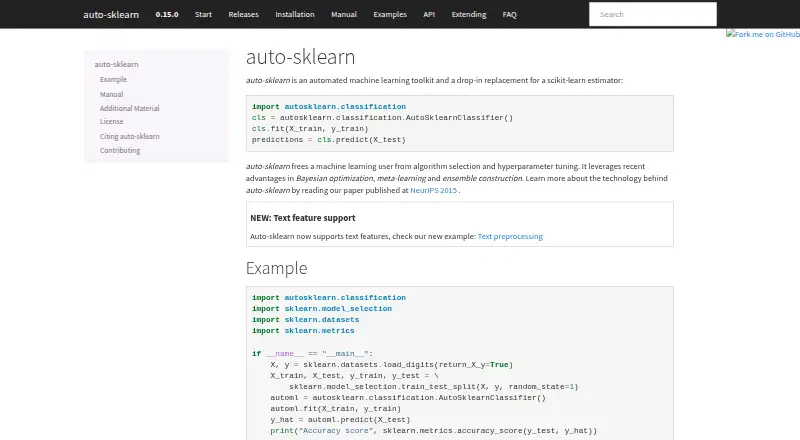
What auto-sklearn is
auto-sklearn automates fitting machine-learning models and building ensembles for classification and regression. Its Auto-sklearn 2.0 method chooses models, decides whether to use Successive Halving, and draws on portfolios for meta-learning. The fitted pipelines work with the scikit-learn API, making the tool relevant to teams already using that interface. Users can select metrics, define train-validation splits, set feature types, and inspect the search procedure. They can also extend the system by implementing and registering wrapper classes for classification, regression, and feature-preprocessing methods.
The project is free and open source. Its installation documentation covers pip, conda-forge, source, and Docker, and the listed plan requires Linux, Python >=3.7, and a C++11 compiler. auto-sklearn cannot run on Windows because it relies on Python’s Unix-only resource module; the project does not actively support macOS due to resource-limit and dependency issues. Users must set time and memory limits, and runs use one CPU core by default. Parallel workers need access to a shared file system for training data and models. The project is part of the Chair for Machine Learning at the University of Freiburg. It supports model evaluation and API access, and its deployment mode is batch.
Who it suits
auto-sklearn suits machine-learning practitioners who need automated model fitting for classification or regression and work in a Linux environment. It is also a fit for teams that use scikit-learn pipelines and want to customize metrics, splits, feature types, or preprocessing methods.
What it does well
- Automates model fitting and ensemble construction for classification and regression.
- Fitted pipelines are compatible with the scikit-learn API.
- Users can customize metrics, splits, and feature types.
- Search procedure can be inspected.
- Open-source software is free.
- Installation options include pip, conda-forge, source, and Docker.
What to know first
- Cannot run on Windows.
- macOS is not actively supported.
- Users must set time and memory limits.
- Parallel workers require a shared file system.
Limits
The free open-source plan requires Linux, Python >=3.7, and a C++11 compiler. Users must set time and memory limits; the default uses one CPU core, and parallel workers need a shared file system.
Plans
| Plan | Billed and limits | Price |
|---|---|---|
| Free open-source software | Linux required · Python >=3.7 · C++11 compiler required | Free |
As automl.github.io lists them, read 9 Oct 2026. The maker's own page has the final word.
Getting started
- Open the auto-sklearn website and documentation.
- Choose an installation route: pip, conda-forge, source, or Docker.
- Use a Linux system with Python >=3.7 and a C++11 compiler.
- Set time and memory limits for the run.
Verdict
Pick auto-sklearn if you need free, open-source automated fitting for classification or regression and can run it on Linux. Look elsewhere if you need Windows support or macOS support that the project actively maintains.
Questions
How much does auto-sklearn cost?
The listed Free open-source software plan costs nothing.
Is there a free plan or trial?
It is free and open source. There is no free trial.
Which platforms does it support?
The listed platforms are API, Linux, and self-hosted. It cannot run on Windows, and macOS is not actively supported.
Is auto-sklearn open source?
Yes. The pricing note identifies it as open source.
Who makes auto-sklearn?
The AutoML website identifies AutoML as a project of the Chair for Machine Learning at the University of Freiburg.
Does it support forecasting or time-series modeling?
No. Forecasting workflows and time-series modeling are both listed as unsupported.
Facts from auto-sklearn's own pages
- AutoML method
- Auto-sklearn 2.0 automatically selects models, decides whether to use Successive Halving, and uses portfolios for meta-learning. · automl.github.io, 9 Oct 2026
- Customization
- Users can customize metrics, train-validation splits, feature types, and inspect the search procedure. · automl.github.io, 9 Oct 2026
- Distributed runs
- Parallel auto-sklearn workers require access to a shared file system for training data and models. · automl.github.io, 9 Oct 2026
- Extensibility
- Users can add classification, regression, and feature-preprocessing methods by implementing and registering wrapper classes. · automl.github.io, 9 Oct 2026
- Install options
- The documentation describes pip, conda-forge, source, and Docker installation options. · automl.github.io, 9 Oct 2026
- macOS support
- The project says it does not actively support macOS because of resource-limit and dependency issues. · automl.github.io, 9 Oct 2026
- Maker
- The AutoML website identifies AutoML as a project of the Chair for Machine Learning at the University of Freiburg. · automl.org, 9 Oct 2026
- Resource limits
- Users must set time and memory limits, and auto-sklearn uses one CPU core by default. · automl.github.io, 9 Oct 2026
- Scikit-learn compatibility
- Its fitted pipelines are compatible with the scikit-learn API. · automl.github.io, 9 Oct 2026
- Security
- The opened product documentation describes time and memory resource limits but does not state security certifications or compliance claims. · automl.github.io, 9 Oct 2026
- What it does
- auto-sklearn automates machine learning model fitting and ensemble construction for classification and regression tasks. · automl.github.io, 9 Oct 2026
- Windows support
- The documentation says auto-sklearn cannot run on Windows because it relies on Python’s Unix-only resource module. · automl.github.io, 9 Oct 2026
Where auto-sklearn stands on Freedom251
- Predictive Analytics Software#6 of 37
- AutoML Software#5 of 30