Freedom251 › Daily Standup Software
AsyncUp
What AsyncUp is
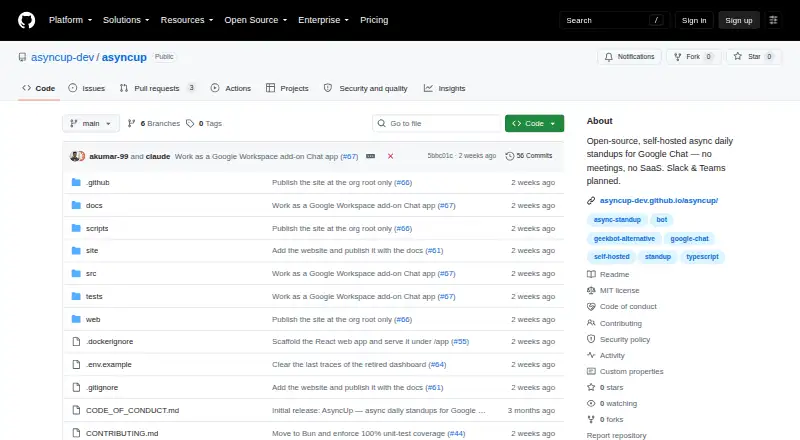
AsyncUp is a free, open-source tool for asynchronous daily standups in Google Chat. It runs in a Docker container that you host yourself, using embedded SQLite or a configurable PostgreSQL database. On each workday, it sends participants a direct message with three standup questions and a mood selection, then shares their responses in a dated thread in the team space. Teams can edit the questions and decide whether participation is required or optional. Participants can set their time zones, and an optional Google Calendar connection can mark people away when they have out-of-office events.
AsyncUp also keeps track of blockers. Teammates can acknowledge and update them, while reminders and escalation messages call attention to blockers that have gone stale. The web app includes Google sign-in, guided setup, standups, blocker tools, reports, team settings, and personal pages. Reports include chat trends, eight-week charts for participation, mood, and blockers, weekly digests, and CSV export. Organizations can use SAML 2.0 sign-in with Google Workspace, Okta, Entra, or OneLogin, and a SCIM 2.0 provisioning endpoint is included. Optional Calendar sync and outbound JSON webhooks are available; webhooks can send standup data to Sheets, Zapier, n8n, or another service. Google Chat is the supported chat adapter; Slack and Microsoft Teams are planned.
Who it suits
AsyncUp suits teams that use Google Chat and want asynchronous standups, customizable questions, and blocker follow-up. It can also fit organizations that want self-hosting, reporting, and SAML sign-in or SCIM provisioning.
What it does well
- Custom standup questions and mandatory or optional participants.
- Tracks blockers with acknowledgments, updates, nudges, and escalations.
- Reports include eight-week charts, weekly digests, and CSV export.
- SAML 2.0 sign-in and a SCIM 2.0 provisioning endpoint.
- Free, open-source deployment with SQLite or PostgreSQL.
What to know first
- Google Chat is the only supported chat adapter.
- Setup requires a Google Workspace domain, app configuration, and HTTPS host.
- Slack and Microsoft Teams are listed as planned integrations.
Limits
The free plan is open-source and self-hosted, with one container. The supported chat adapter is Google Chat; Slack and Microsoft Teams are planned.
Plans
| Plan | Billed and limits | Price |
|---|---|---|
| Free | open source · self-hosted · one container · forever free | Free |
As github.com lists them, read 15 Oct 2026. The maker's own page has the final word.
Getting started
- Use a Google Workspace domain.
- Configure the Google Chat app once.
- Prepare a host with an HTTPS URL for the container.
- Choose embedded SQLite or configure PostgreSQL.
- Open the web app and use Google sign-in and guided setup.
Overview
AsyncUp is an open-source, self-hosted tool for running asynchronous daily standups in Google Chat. It is best suited to teams already using Google Workspace that want standups, blocker follow-up, and reporting without adopting a hosted service.
Key features
On workdays, AsyncUp sends participants a direct message containing three standup questions and a mood selector, then collects responses in a dated thread in the team space. Teams can tailor the questions and decide whether participation is mandatory. That combination supports a consistent daily rhythm while leaving room to adapt prompts to the team.
Participants set their own time zones, and optional Google Calendar out-of-office sync can mark people away. Blocker tracking adds more than a place to report problems: teammates can acknowledge and update blockers, while nudges and escalation messages call attention to stale ones. This makes AsyncUp more useful for teams that need follow-through than a check-in bot that only gathers status.
The web app covers Google sign-in, setup, standups, blockers, reports, team settings, and personal pages. Reporting includes chat trends, eight-week charts for participation, mood, and blockers, weekly digests, and CSV export. Optional outbound JSON webhooks for each standup can pass data to Sheets, Zapier, n8n, or another service, giving teams a route to connect their own workflows without a built-in integration catalog.
For organizations, the project includes SAML 2.0 sign-in for Google Workspace, Okta, Entra, and OneLogin, along with a SCIM 2.0 provisioning endpoint. It runs in a Docker container with embedded SQLite or configurable PostgreSQL; the project says it can run on 1 vCPU and 512 MB. The project describes the software as having no telemetry and says its Google service-account key is encrypted at rest. These are useful design choices for teams that want control over deployment, though they still need to operate the host themselves.
Pricing
AsyncUp has one plan: Free, described as open-source, self-hosted, one container, and forever free. There is no free trial because the software is free. The plan avoids a per-seat subscription, but the tradeoff is operational: teams need a Google Workspace domain, must configure a Google Chat app once, and need a host for a small container with an HTTPS URL. The free plan is therefore most attractive to teams comfortable managing that setup, not to buyers who want a vendor-hosted service.
Platforms
AsyncUp is available as a web app and API, with self-hosted deployment. Google Chat is its supported chat adapter; Slack and Microsoft Teams are not supported. Teams committed to either of those platforms should choose another tool rather than rely on planned integrations.
Who it's for
AsyncUp fits Google Workspace teams that want customizable async check-ins, actionable blocker follow-up, and participation and mood reporting in a self-managed installation. Its SAML and SCIM options may also suit organizations that need centralized sign-in and provisioning. It is not the right choice for teams without a Google Workspace domain, those unwilling to host a container, or groups whose daily collaboration happens in Slack or Microsoft Teams.
Pros and cons
Pros
- Free, open-source, and self-hosted: there is no per-seat price, and teams choose SQLite or PostgreSQL for the deployment.
- Blockers have a follow-up path: acknowledgments, updates, nudges, and escalation DMs help keep reported issues from disappearing into a status thread.
- Useful reporting: eight-week charts, weekly digests, and CSV export support both routine review and further analysis.
- Organization controls: SAML 2.0 and SCIM 2.0 cover common sign-in and provisioning needs.
Cons
- Google Chat only: there is no supported Slack or Microsoft Teams adapter, which rules it out for teams centered on those platforms.
- Setup is an owner’s responsibility: the Google Chat app configuration, HTTPS host, and container require technical effort before the team can use it.
- No hosted option is offered: self-hosting gives teams control, but they also take on hosting and maintenance.
Alternatives
Daily Standup Software is the broader category directory for comparing standup tools. Choose asyncmate instead if a web-based freemium tool with a free plan and free trial better suits your evaluation; its free plan allows up to 10 active teammates. DailyBot is worth considering for teams seeking a freemium tool across API, extension, and web platforms; its free Starter plan allows one workspace and unlimited members, with up to 50 compiled check-in reports per organization each month.
DailyStand is another self-hosted option, with a free tier limited to one team, five members, and seven days of history, plus a $16 a month Pro plan. Consider DailyStandup if a web-based freemium service with AI summaries is a better match: its free plan allows five members, one team, and seven days of history, while Pro is $8 a month billed annually. Estimioo may fit teams that also need estimation sessions and retrospectives; its free plan caps participation at 10 people and five sessions per month.
Geekbot is an alternative to consider for teams evaluating a freemium standup tool with API and web platforms; its Basic — Standups plan is $2.50 a month on annual billing, priced per participant. Morgenruf is a closer fit for teams wanting another free, self-hosted option, or a hosted plan that is free for any number of people. Murmurd may suit smaller groups looking for web-based daily check-ins and weekly priorities; its free plan caps membership at five and includes basic escalations and email notifications.
Verdict
Choose AsyncUp if your team works in Google Chat, wants blocker follow-up and reporting alongside daily standups, and can manage a self-hosted container. Its strongest case is a useful, organization-aware workflow with no subscription cost. Look elsewhere if you need Slack or Microsoft Teams support, or if you want a hosted product that requires less setup.
Verdict
Choose AsyncUp if your team uses Google Chat and wants standups, blocker tracking, and reporting in a self-hosted tool. It is free and includes organization sign-in and provisioning options. Teams that need Slack or Microsoft Teams should look elsewhere for a supported chat adapter.
Questions
How much does AsyncUp cost?
The Free plan costs nothing. It is open-source and self-hosted, with one container, and is described as forever free.
Is there a free plan or trial?
There is a free plan. No free trial is offered.
Which chat platforms does it support?
Google Chat is the supported chat adapter. Slack and Microsoft Teams are listed as planned.
Can AsyncUp be self-hosted?
Yes. It runs in a Docker container with embedded SQLite or a configurable PostgreSQL database.
What integrations are available?
Optional Google Calendar out-of-office sync and per-standup outbound JSON webhooks are available. Webhooks can feed Sheets, Zapier, n8n, or another service.
Does it include organization sign-in and provisioning?
The project includes SAML 2.0 sign-in for Google Workspace, Okta, Entra, and OneLogin, plus a SCIM 2.0 provisioning endpoint.
Facts from AsyncUp's own pages
- Anonymous mood
- The anonymous-mood command hides individual mood identities and shows a team average in the wrap-up. · github.com, 15 Oct 2026
- API and extensibility
- The codebase exposes a JSON API, an MCP server for Claude Code and a ChatAdapter interface for adding chat platforms. · github.com, 15 Oct 2026
- Blockers
- Blockers detected from answers can be assigned to teammates, acknowledged, updated, resolved, nudged and escalated when stale. · github.com, 15 Oct 2026
- Current chat platform
- Google Chat is the supported chat adapter; Slack and Microsoft Teams are listed as planned. · github.com, 8 Oct 2026
- Customization
- Teams can customize standup questions and choose mandatory or optional participants. · github.com, 8 Oct 2026
- Custom questions
- Administrators can define different questions for each standup and turn the mood selector on or off. · github.com, 15 Oct 2026
- Deployment
- Installation uses Docker Compose, an HTTPS host and a Google Chat app endpoint at /chat/events. · github.com, 15 Oct 2026
- Developer runtime
- Development requires Bun 1.3 or newer and the repository supplies test, type-check, documentation and web-build scripts. · github.com, 15 Oct 2026
- Independent blocker feature
- EZToolset lists blocker tracking with teammate acknowledgments, updates and stale-item escalation. · eztoolset.com, 15 Oct 2026
- Independent deployment note
- EZToolset states that AsyncUp uses a Docker container with SQLite or configurable PostgreSQL and needs a Google Workspace setup with an HTTPS host. · eztoolset.com, 15 Oct 2026
- Independent directory score
- EZToolset lists AsyncUp at 7.7 and ranks it fifth among 24 daily-standup products. · eztoolset.com, 15 Oct 2026
- Independent platform listing
- EZToolset lists AsyncUp as available on the web, self-hosted and through an API. · eztoolset.com, 15 Oct 2026
- Independent pricing listing
- EZToolset describes AsyncUp as having a free plan and does not show a paid starting price. · eztoolset.com, 15 Oct 2026
- Independent product description
- EZToolset characterizes AsyncUp as an open-source, self-hosted Google Chat standup tool. · eztoolset.com, 15 Oct 2026
- Independent reporting feature
- EZToolset lists trends, eight-week charts, weekly digests and CSV export among AsyncUp’s reporting functions. · eztoolset.com, 15 Oct 2026
- Integrations
- It supports optional Google Calendar out-of-office sync and per-standup outbound JSON webhooks that can feed Sheets, Zapier, n8n, or another service. · github.com, 8 Oct 2026
- Leave handling
- Participants can use vacation and skip controls, while optional Google Calendar out-of-office synchronization marks people away automatically. · github.com, 15 Oct 2026
- License
- The repository is released under the MIT license. · github.com, 15 Oct 2026
- Limit: app availability
- The maker documents a web application and self-hosted service but no native Windows, macOS, Linux, iOS or Android application. · github.com, 15 Oct 2026
- Limit: chat coverage
- Slack and Microsoft Teams are roadmap items rather than currently supported adapters. · github.com, 15 Oct 2026
- Limit: hosting burden
- Users must provide a server or other HTTPS-capable host and configure a Google Chat app before teams can use the product. · github.com, 15 Oct 2026
- Limit: review evidence
- EZToolset presents directory metadata and a score but does not provide a customer-review count for AsyncUp. · eztoolset.com, 15 Oct 2026
- Participation rules
- A standup can distinguish mandatory from optional participants for reporting. · github.com, 15 Oct 2026
- Polls
- The poll command creates a live-updating card where users can vote, change votes and close results. · github.com, 15 Oct 2026
Where AsyncUp stands on Freedom251
- Daily Standup Software#1 of 24