Freedom251 › Knowledge Graph Software
Apache Jena Fuseki
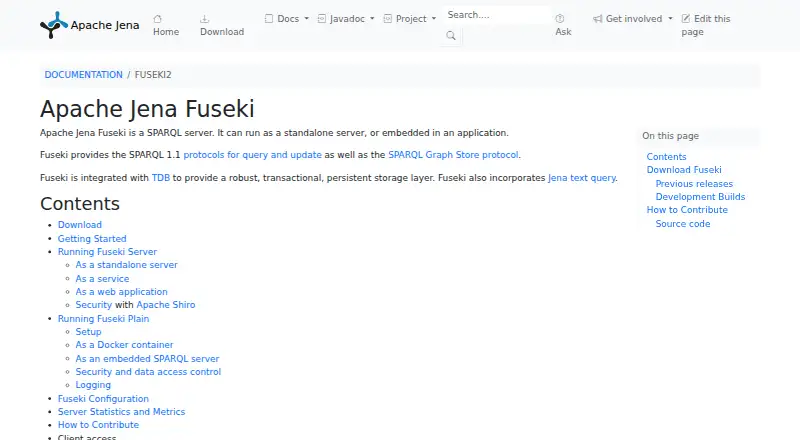
What Apache Jena Fuseki is
Apache Jena Fuseki is a SPARQL server for running data services on its own or within an application. It supports SPARQL 1.1 queries and updates, as well as the SPARQL Graph Store protocol. For persistent transactional storage it integrates with TDB, and it incorporates Jena text query. Deployment choices include a standalone server, operating-system service, embedded application, or web application in Apache Tomcat or Jetty. The download ZIP bundles the server and UI; the engine and UI are also offered as Maven artifacts, with a WAR file available. Fuseki Plain is a UI-free triple store that can also be embedded. The project provides a kit for Docker or Docker Compose, with mounted volumes needed to preserve databases after container removal. The web application uses Apache Shiro for security, and supports access control at server, dataset, endpoint, and graph levels; graph-level controls apply only to read-only datasets. Fuseki is free, self-hosted software under Apache License 2.0.
Who it suits
Fuseki suits developers building semantic web and linked data applications who need SPARQL services and deployment choices ranging from standalone to embedded. It also supports teams seeking access controls and persistent storage.
What it does well
- Supports SPARQL 1.1 query and update protocols.
- Integrates TDB for transactional persistent storage.
- Can run standalone, embedded, or as a web application.
- Offers native HTTPS and layered access controls.
- Free under Apache License 2.0.
What to know first
- Graph-level access control is limited to read-only datasets.
- Default setup leaves SPARQL endpoints open.
- Container databases need mounted volumes to persist.
Limits
The free plan is self-hosted software under Apache License 2.0. Graph-level access control applies only to read-only datasets, and container databases require mounted volumes to persist after container removal.
Plans
| Plan | Billed and limits | Price |
|---|---|---|
| Apache Jena Fuseki | Apache License 2.0 · self-hosted server | Free |
| Free and open source | self-hosted deployment · standalone, embedded, Docker or WAR options · no commercial support plan listed | Free |
As jena.apache.org lists them, read 1 Oct 2026. The maker's own page has the final word.
Getting started
- Open the Apache Jena Fuseki documentation website.
- Choose the ZIP distribution, Maven artifacts or WAR file, depending on the deployment route.
- Run Fuseki as a standalone server, operating-system service, embedded application, or web application in Tomcat or Jetty.
- For Docker or Docker Compose, use the project kit and mount database volumes for persistence.
- Configure web application security through Apache Shiro and shiro.ini.
Apache Jena Fuseki is a SPARQL server for serving and updating RDF datasets, either on its own or within a Java application. It suits teams building semantic web and linked-data services that want deployment flexibility and persistent TDB storage. Its strongest case is an open-source, self-hosted server with multiple SPARQL protocols; the key deployment cautions are open SPARQL endpoints by default and graph-level controls limited to read-only datasets.
Overview
Fuseki supports SPARQL 1.1 query and update protocols as well as the SPARQL Graph Store protocol. It combines these interfaces with TDB transactional persistent storage and Jena text query, making it a capable foundation for applications that need to store, query, and update graph data.
It is distributed as a ZIP containing the server and UI, as Maven artifacts for the engine and UI, and as a WAR. That range suits both operators who want a standalone service and Java teams that want to integrate SPARQL access into an application. Fuseki Plain removes the UI and can run embedded, which is useful when the server is an application component rather than a separately administered product.
Key features
Protocols and data
Support for SPARQL 1.1, federated queries, reasoning, RDF-star, and common RDF formats—including Turtle, TriG, N-Triples, N-Quads, and JSON-LD—covers a broad set of graph workloads. GeoSPARQL integrations in the source modules extend its fit to geospatial semantic-web projects.
Deployment and persistence
Fuseki can run as a standalone server, an operating-system service, an embedded application, or a web application in Apache Tomcat or Jetty. A Docker or Docker Compose build kit offers another route to deployment, but databases need mounted volumes to survive container removal. Operators who want a packaged service can use the ZIP; Java developers can embed Fuseki and continue accessing and updating datasets through their application.
Security
The web application uses Apache Shiro configured through shiro.ini, and Fuseki offers native HTTPS for data in transit. Access controls can be applied at server, dataset, endpoint, and graph levels, but graph-level control currently applies only to read-only datasets. More importantly, the default configuration restricts administration to localhost while leaving SPARQL endpoints open. A public or shared deployment therefore needs endpoint exposure considered explicitly, rather than assuming administrative restrictions also protect query access.
Pricing
Apache Jena Fuseki is free and open source under the Apache License, Version 2.0. Its Apache Jena Fuseki plan costs nothing and is a self-hosted server. There is no paid tier described; the tradeoff is that hosting and deployment are self-managed.
Platforms
Fuseki is available for Linux and Windows, through a web interface and API, and as self-hosted software. Its standalone, embedded, service, and servlet-container deployment choices make it a better fit for teams able to operate their own server than for buyers seeking a hosted service.
Who it's for
Fuseki is a strong fit for semantic-web and linked-data teams that need SPARQL query and update services, persistent RDF storage, and control over where the server runs. It also suits Java applications that need to expose SPARQL while working directly with their datasets. It is less suitable when graph-specific permissions must govern write access, or when an operator expects endpoints to be private by default without configuration work.
Pros and cons
- Pros: Multiple deployment modes, including embedded use, let teams fit Fuseki into either a standalone service or a Java application.
- Pros: SPARQL 1.1 query and update, Graph Store protocol, TDB persistence, and Jena text query provide a substantial data-service foundation.
- Pros: The free Apache-licensed plan avoids software license charges for self-hosted use.
- Cons: SPARQL endpoints are open in the default configuration, so deployment planning must address access before exposing the server.
- Cons: Graph-level access control is restricted to read-only datasets, limiting its use where permissions need to differ by graph during writes.
- Cons: Docker deployments need mounted volumes for persistence, adding an operational requirement beyond removing the container.
Alternatives
For a Java framework instead of a SPARQL server, consider Eclipse RDF4J; its latest release requires Java 25 or newer. Choose Fluree DB if native JSON-LD and SPARQL with local or self-hosted operation better matches the project. GraphDB is another free-plan option, with its free edition requiring a license for version 11 and later.
RDFox may fit a commercial evaluation, but its free evaluation license is limited to 30 days and non-commercial use. Stardog offers a free plan with a renewable one-year license, up to one million stored edges, and three databases. Tentris offers a community plan with single-core licensing and in-memory storage. AllegroGraph is worth considering if a free edition capped at five million triples fits the dataset. For hosted evaluation with limited resources, Dydra Basic use caps public accounts at five queries per second and one million statements per repository.
Browse more options in RDF Databases or Knowledge Graph Software.
Verdict
Choose Apache Jena Fuseki if you need a free, Apache-licensed SPARQL server that can run standalone or inside a Java application, with TDB persistence and flexible deployment. Its main advantage is that combination of protocol support and deployment control; look elsewhere if graph-level write permissions are essential, or plan carefully if endpoint access must be restricted, since endpoints are open by default.
Verdict
Apache Jena Fuseki combines SPARQL protocols with several deployment modes and TDB storage. Check the graph-level access-control limit and default endpoint exposure when planning a deployment.
Questions
How much does Apache Jena Fuseki cost?
The listed plan is free under Apache License 2.0.
Is Fuseki open source?
Yes. Apache Jena Fuseki is licensed under the Apache License, Version 2.0.
Where can Fuseki run?
It can run as a standalone server, operating-system service, embedded application, or web application in Apache Tomcat or Jetty. Its listed platforms include API, Linux, self-hosted, web and Windows.
Which SPARQL and RDF formats does it support?
Fuseki supports SPARQL 1.1 and the listed RDF formats Turtle, TriG, N-Triples, N-Quads and JSON-LD.
Can I use Fuseki without its UI?
Yes. Fuseki Plain runs as a triple store without a UI and can be embedded inside an application.
What access controls does Fuseki provide?
Access control is available at server, dataset, endpoint and graph levels, with native HTTPS for data in transit. Graph-level control applies only to read-only datasets.
Facts from Apache Jena Fuseki's own pages
- Access control
- Fuseki supports access control at server, dataset, endpoint, and graph levels and provides native HTTPS for data in transit. · jena.apache.org, 1 Oct 2026
- Access-control limit
- Graph-level access control currently applies only to read-only datasets. · jena.apache.org, 1 Oct 2026
- Audience
- Apache Jena describes Fuseki contributions as supporting semantic web and linked data applications. · jena.apache.org, 1 Oct 2026
- Authentication
- Fuseki Main supports password-file authentication using HTTP Basic or Digest authentication, with Digest as the default. · jena.apache.org, 15 Oct 2026
- Default security
- The default configuration restricts administrative functions to localhost while leaving SPARQL endpoints open. · jena.apache.org, 1 Oct 2026
- Deployment
- Fuseki can run as a standalone server, operating-system service, embedded application, or web application in Apache Tomcat or Jetty. · jena.apache.org, 1 Oct 2026
- Deployment modes
- The documentation covers standalone service execution, operating-system services, web applications in Tomcat or Jetty, plain server mode, Docker and embedded use. · jena.apache.org, 15 Oct 2026
- Distribution
- The download ZIP contains the Fuseki server and UI; the engine and UI are also available as Maven artifacts, and a WAR file is available. · jena.apache.org, 1 Oct 2026
- Docker
- The Docker package supplies a Dockerfile, docker-compose configuration and helper scripts for building Fuseki containers. · jena.apache.org, 15 Oct 2026
- Docker persistence
- Docker databases should be mounted outside the container so they survive container removal. · jena.apache.org, 15 Oct 2026
- Documentation and support
- Official documentation points users to the Jena users mailing list and email support lists. · jena.apache.org, 15 Oct 2026
- Embedded use
- An embedded Fuseki server lets a Java application provide SPARQL services while continuing to access and update its datasets. · jena.apache.org, 1 Oct 2026
- Extensibility
- Fuseki modules can be loaded from JARs with the JDK ServiceLoader or added programmatically through the server builder. · jena.apache.org, 15 Oct 2026
- GeoSPARQL
- The Fuseki source modules include integrations for GeoSPARQL. · jena.apache.org, 1 Oct 2026
- GeoSPARQL integration
- The distribution lists dedicated GeoSPARQL Fuseki and Fuseki GeoSPARQL module components. · jena.apache.org, 15 Oct 2026
- Java API
- An embedded server can be created with the FusekiServer Java builder and attached to an application dataset. · jena.apache.org, 15 Oct 2026
- Licence
- The Jena repository distributes the software under the Apache License, Version 2.0. · github.com, 15 Oct 2026
- License
- Apache Jena Fuseki is licensed under the Apache License, Version 2.0. · jena.apache.org, 1 Oct 2026
- Limit: community support
- One G2 reviewer says the project needs more community support. · g2.com, 15 Oct 2026
- Limit: compatibility
- A G2 reviewer reports that integration, version upgrades and compatibility can sometimes be difficult to manage. · g2.com, 15 Oct 2026
- Limit: large stores
- A G2 reviewer says Fuseki does not work well with very large triplestores and may lead users to commercial products. · g2.com, 15 Oct 2026
- Limit: learning curve
- G2 reviewers say users need a solid understanding of semantic-web technologies, APIs and graph concepts. · g2.com, 15 Oct 2026
- Limit: pricing information
- G2 states that pricing details are not currently available for Apache Jena. · g2.com, 15 Oct 2026
- Limit: setup complexity
- G2 reviewers report that downloading and initial setup can be difficult before becoming easier with practice. · g2.com, 15 Oct 2026
Where Apache Jena Fuseki stands on Freedom251
- Knowledge Graph Software#1 of 33
- RDF Databases#1 of 26