
AllegroGraph
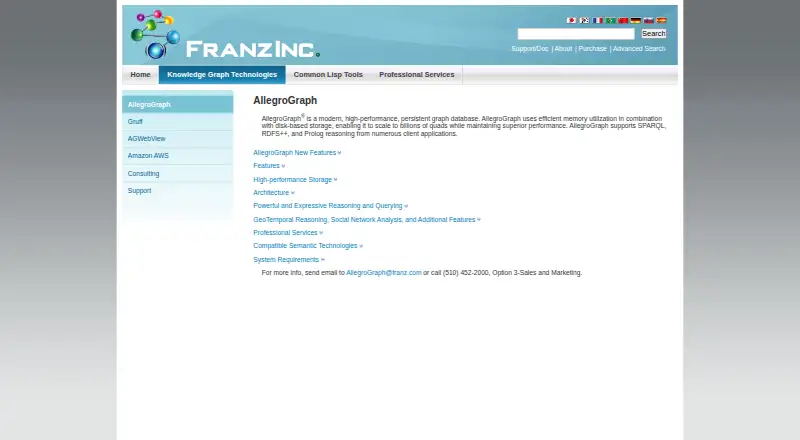
What AllegroGraph is
AllegroGraph is a persistent graph database that uses disk-based storage and is designed for datasets reaching billions of quads. It supports RDF triples and quads, generic graphs, and vectors, with SPARQL, RDFS++ reasoning, and Prolog. Other data capabilities include geospatial and temporal reasoning, social network analysis, native data types, and range queries. The product is described as ACID-compliant and includes online backups, point-in-time recovery, replication, and warm standby. It can integrate with large language models and store embedding vectors. Security controls include role-based permissions, repository access controls, security filters, and triple-level controls; authentication options include LDAP and OAuth/OIDC, with TLS for client connections. The security overview recommends third-party tools for encryption at rest. Clients include Java, Python, and Lisp, as well as REST and a browser-based WebView. AllegroGraph runs natively on x86-64 Linux, with documented Docker, virtual machine, and cloud deployment options. A free edition has no expiration date or license-key requirement and is limited to 5,000,000 triples.
Who it suits
AllegroGraph suits teams working with graph data that need reasoning, recovery, or vector capabilities. Its documented Linux, self-hosted, and cloud deployment options may fit different operating environments.
What it does well
- Supports SPARQL, RDFS++ reasoning, and Prolog
- Includes point-in-time recovery and replication
- Supports vector data and LLM integration
- Offers LDAP and OAuth/OIDC authentication
- Free edition has no expiration
What to know first
- Free edition is limited to 5,000,000 triples
- Encryption at rest calls for third-party tools
- Native server support is x86-64 Linux
Limits
The Free Edition allows a maximum of 5,000,000 triples. It has no expiration date and does not require a license key.
Plans
| Plan | Billed and limits | Price |
|---|---|---|
| Free Edition | No license key required; no expiration date · Maximum 5,000,000 triples | Free |
As agraph.franz.com lists them, read 30 Sept 2026. The maker's own page has the final word.
Getting started
- Visit the AllegroGraph website or use AllegroGraph Cloud.
- Choose the Free Edition, which requires no license key.
- Set up a server using a documented deployment option such as Linux, Docker, a virtual machine, or cloud.
- Connect with a Java, Python, or Lisp client, REST interface, or browser-based WebView.
Verdict
AllegroGraph combines graph querying and reasoning with recovery features, vector support, and multiple deployment options. Its free edition has a stated triple limit, and the security overview points users to third-party tools for encryption at rest.
Questions
Is AllegroGraph free?
Yes. The Free Edition costs nothing and has no expiration date or license key requirement.
What is the Free Edition's limit?
It allows up to 5,000,000 triples.
Which platforms and deployment options are supported?
The server runs natively on x86-64 Linux. Documentation also covers Docker, Windows Subsystem for Linux, virtual machines, and cloud providers; AllegroGraph Cloud is web-based.
What query and data models does AllegroGraph support?
It supports SPARQL, RDF triples and quads, generic graphs, and vectors. It also supports RDFS++ reasoning and Prolog.
Does AllegroGraph support vector search and AI integrations?
Yes. It supports vector search, can store embedding vectors, and supports integration with large language models.
Who makes AllegroGraph?
Franz provides AllegroGraph documentation and support topics for technical questions and bug reports.
Facts from AllegroGraph's own pages
- AI and vectors
- AllegroGraph supports integration with large language models and can store embedding vectors in a vector database. · agraph.franz.com, 30 Sept 2026
- Authentication and encryption
- The security overview lists LDAP and OAuth/OIDC authentication and TLS for client connections; it recommends third party tools for encryption at rest. · agraph.franz.com, 30 Sept 2026
- Client access
- Clients include Java, Python, and Lisp; AllegroGraph also provides a REST interface and browser based WebView. · agraph.franz.com, 30 Sept 2026
- Data analysis
- AllegroGraph supports geospatial and temporal reasoning, social network analysis, native data types, and range queries. · agraph.franz.com, 30 Sept 2026
- Deployment
- The server runs natively on x86-64 Linux; the maker also documents Docker, Windows Subsystem for Linux, virtual machines, and cloud provider options. · agraph.franz.com, 30 Sept 2026
- Founded
- 1984 · agraph.franz.com, 23 Sept 2026
- Headquarters
- Lafayette, California, USA · agraph.franz.com, 23 Sept 2026
- Hosted option
- AllegroGraph Cloud is described as a web-based platform for setting up AllegroGraph servers, and the downloads page advertises a free hosted version. · agraph.franz.com, 30 Sept 2026
- Integrations
- The documentation lists integrations with PoolParty, Cloudera Hadoop, MongoDB, Apache Solr, TopBraid Composer, Anaconda, and Racer. · agraph.franz.com, 30 Sept 2026
- Product
- AllegroGraph is a persistent graph database designed to scale to billions of quads, with disk-based storage and efficient memory utilization. · agraph.franz.com, 30 Sept 2026
- Query and reasoning
- It supports SPARQL, RDFS++ reasoning, and Prolog. · agraph.franz.com, 30 Sept 2026
- Security controls
- Security features include role based permissions, repository access controls, security filters, and triple level controls using attributes. · agraph.franz.com, 30 Sept 2026
- Support and documentation
- Franz provides AllegroGraph product documentation and lists technical questions and bug reports as support topics on its support page. · agraph.franz.com, 30 Sept 2026
- Transactions and recovery
- The product page describes AllegroGraph as ACID-compliant and lists online backups, point-in-time recovery, replication, and warm standby. · agraph.franz.com, 30 Sept 2026
Where AllegroGraph stands on Freedom251
- RDF Databases#4 of 26
- Multimodel Databases#6 of 26