Freedom251 › Game Voice Generators

Algebras AI Game Localization Agent
Visit Algebras AI Game Localization Agent Alternatives Pricing
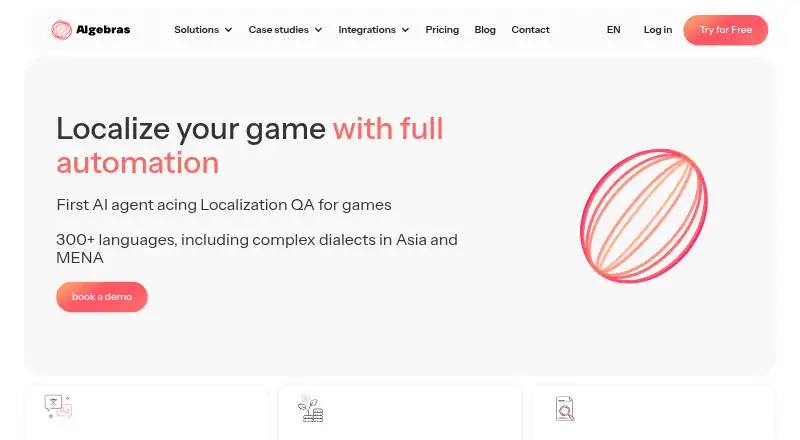
What Algebras AI Game Localization Agent is
Algebras AI Game Localization Agent helps game teams translate and check content for global releases. It translates into 322 languages and describes support for more than 1,000 dialects. Text checks include glossary extraction, context-aware translation, string-length validation, and layout checks. Audio and video workflows cover voice-to-text, voice-to-voice, text-to-voice, and lip-sync localization. Teams can connect workflows through Unity, Unreal Engine, an API, CLI, Google Sheets, or TMS tools; Gridly Integration and AlgebrasCLI are also listed. The product is aimed at game localization and marketing teams. Its free plan covers 0–1k words, and paid plans start at $15/mo. Usage is measured by words in completed translated output. Enterprise deployments can run on-premise or in air-gapped environments, with the maker describing secure API infrastructure and sensitive-data protection as enterprise security features. The CLI installation guide covers Windows, macOS, and Linux and requires Python 3.12 or higher.
Who it suits
It suits game localization and marketing teams handling text, audio, or video for multiple languages. Teams can use its listed game-engine connections and other workflow integrations.
What it does well
- Translates into 322 languages and supports over 1,000 dialects.
- Checks glossaries, string length, and layout.
- Supports voice and video localization workflows.
- Connects with Unity and Unreal Engine.
- Enterprise deployments can be on-premise or air-gapped.
What to know first
- The free plan covers 0–1k words.
- CLI installation requires Python 3.12 or higher.
- Some listed plans bill annually.
Limits
The free plan covers 0–1k words. Standard costs $15 a month, billed $150 per year, and includes 15k words/month, manual text input, and basic text translation; API access and glossaries are listed for Pro at $45 a month.
Plans
| Plan | Billed and limits | Price |
|---|---|---|
| Free | 0–1k translated words · basic translation | Free |
| Standard | $15/month or $150 per year · 15k words/month · 10 concurrent listeners · 2 listener-hours · manual text input · basic text translation | $15 a month |
| 10 Minutes | $15 total · 10 video-translation minutes · AI dubbing · multiple languages · downloadable translated video | $15, paid once |
| 240 Minutes | $240 total · 240 video-translation minutes · AI dubbing · multiple languages · downloadable translated video | $240, paid once |
| Pro | $45/month or $450 per year · 50k words/month · 50 concurrent listeners · 10 listener-hours · document upload · API access · glossaries · extended formats | $45 a month |
| Premium | $75/month or $750 per year · 100k words/month · 200 concurrent listeners · 25 listener-hours · API · glossaries · personal manager · custom integrations | $75 a month |
| 60 Minutes | $79 total · 60 video-translation minutes · AI dubbing · multiple languages · downloadable translated video | $79, paid once |
| Enterprise | Starts at $990/month; custom pricing · custom words and video minutes · full API · custom models · dedicated infrastructure · SLA support · private deployment options | $990 a month |
As algebras.ai lists them, read 21 Oct 2026. The maker's own page has the final word.
Getting started
- Visit https://www.algebras.ai/game-localization-agent.
- Choose the free plan or a paid plan for the listed word or video allowance.
- Connect a game workflow through Unity, Unreal Engine, API, CLI, Google Sheets, or a TMS tool.
- For CLI use, follow the installation instructions for Windows, macOS, or Linux and meet the Python 3.12 or higher requirement.
Algebras AI Game Localization Agent is a translation and localization tool for game text, audio and video. It suits game localization and marketing teams that need language coverage alongside checks for in-game text. Its broad workflow is a strength, though the plan limits and mix of monthly and one-time pricing make it important to match the purchase to the work.
Overview
The agent is built to help game teams adapt releases for international audiences. It translates into 322 languages and supports over 1,000 dialects, pairing translation with checks for string length and layout. That combination addresses a practical game-localization concern: translated copy must fit the interface as well as convey the intended meaning.
For text, the workflow includes automatic glossary extraction and context-aware translation. For audio and video, it offers voice-to-text, voice-to-voice, text-to-voice and lip-sync localization. The range is useful for teams coordinating several localization tasks; teams seeking only a voice generator may find the wider text and game workflow unnecessary.
Key features
Game text and workflow connections
Unity and Unreal Engine support, along with API, CLI, Google Sheets and TMS connections, gives teams several ways to fit the service into a game workflow. Gridly Integration and AlgebrasCLI are also identified as tools. The breadth matters most to teams handling recurring localization across projects; the CLI requires Python 3.12 or higher, a setup constraint for teams planning to use it.
Audio, video and enterprise controls
Video translation plans include AI dubbing in multiple languages and downloadable translated video. Security features include secure API infrastructure and sensitive data protection, while enterprise deployments can run on-premise or in air-gapped environments. Those deployment options suit organizations with tighter infrastructure requirements. Google Workspace data is not used to train or improve generalized or foundational AI/ML models.
Usage billing counts words in completed translated output, rather than tokens or characters. That makes translated word volume the relevant measure when estimating text plan capacity. The team typically replies to email within one business day.
Pricing
The free plan costs nothing and covers 0–1k words according to the pricing calculator. It gives teams a capped way to assess translation, but the limit is modest for a full game or an ongoing release pipeline.
Standard costs $15 a month, billed $150 per year. It includes 15k words per month, 10 concurrent listeners, 2 listener-hours, manual text input and basic text translation. This is the entry monthly plan for smaller volumes, but it lacks the API access, glossaries and document upload included at higher tiers.
Pro costs $45 a month, billed $450 per year. Its 50k words per month, 50 concurrent listeners and 10 listener-hours accompany API access, glossaries and document upload. Premium costs $75 a month, billed $750 per year, and raises those limits to 100k words, 200 concurrent listeners and 25 listener-hours; it adds a personal manager and custom integrations. Premium fits larger workflows that need more capacity and integration support, while Pro is the more measured step up from manual text input.
For video work, 10 Minutes is a one-time 15.00 USD purchase, 60 Minutes is 79.00 USD once, and 240 Minutes is 240.00 USD once. Each includes high-quality AI dubbing, multiple languages and a downloadable translated video. These purchases suit bounded video projects; they are separate from the monthly word plans.
Enterprise translation plans start at $990/month. Custom word volume, dedicated infrastructure, custom AI models, an SLA and priority support, a dedicated account manager and custom integrations target organizations that need tailored capacity and deployment. The plan has custom pricing.
Platforms
The service is available on API, Linux, macOS, web and Windows. CLI installation instructions cover Windows, macOS and Linux and require Python 3.12 or higher.
Who it's for
Game localization teams can use the text QA checks and game engine connections to manage translation across interface strings and related content. Game marketing teams can draw on the audio and video workflows for localized promotional material. Smaller teams can start within the free word cap or choose a monthly plan, while organizations requiring on-premise or air-gapped deployment have an enterprise path.
It is less compelling for someone who needs only a standalone speech tool or whose project requires more free volume than the 0–1k-word cap. The listed plan range separates text capacity from one-time video minutes, so buyers should choose based on the work they need to localize.
Pros and cons
- Pros: String-length and layout checks complement translation, helping game teams account for interface fit.
- Pros: Text, voice, dubbing and lip-sync workflows cover more of localization than text translation alone.
- Pros: Unity, Unreal Engine, API, CLI, Sheets and TMS connections offer several workflow entry points.
- Pros: Enterprise on-premise and air-gapped deployments address controlled infrastructure needs.
- Cons: The free plan's 0–1k-word allowance is too limited for substantial localization work.
- Cons: Standard is manual text input and basic translation; API, glossaries and document upload require Pro or Premium.
- Cons: Video minutes are sold as separate one-time purchases, so video budgeting differs from monthly text capacity.
- Cons: CLI users need Python 3.12 or higher.
Alternatives
For a broader game voice tool comparison, browse Game Voice Generators. Neocortex is another freemium option, with a free tier for two characters, two conversation flows and 200 monthly credits. Adobe Firefly offers a free plan with limited daily generations. Kokoro TTS is a free option with Apache-licensed, open-weight speech synthesis. Speechify has a free tier with 10 voices and a 1.5x maximum speed. Altered Studio offers a free plan and a free trial, with its free plan limited to noncommercial use. Convai has a free plan with a monthly interaction quota and one character session concurrency. AnnoMotion offers free credits and daily credits across its generators. Cantari offers a free tier with unlimited Kokoro and about 10 premium minutes per month.
Verdict
Algebras AI Game Localization Agent is a strong fit for game teams that want text translation checks and audio or video localization in one workflow, especially when engine integrations or controlled enterprise deployment matter. The principal reason to choose it is that breadth; the reasons to look elsewhere are the small free allowance, the feature gap between Standard and Pro, and separate video-minute purchases.
Verdict
Algebras AI combines game-oriented translation checks with audio and video localization workflows. Its free plan and integrations are relevant to teams assessing localization tools, while enterprise deployment options are listed for more controlled environments.
Questions
Is there a free plan?
Yes. The Free plan is priced at 0.00 USD and covers 0–1k words.
How much do paid plans cost?
Standard is $15 a month, billed $150 per year. Pro is $45 a month, billed $450 per year, and Premium is $75 a month, billed $750 per year. One-time video plans are $15.00 USD, $79.00 USD, and $240.00 USD for 10, 60, and 240 minutes respectively.
Which platforms are available?
The product lists API, Linux, macOS, web, and Windows. CLI installation instructions cover Windows, macOS, and Linux and require Python 3.12 or higher.
Which game tools can it connect to?
Listed options include Unity, Unreal Engine, API, CLI, Google Sheets, and TMS tools. The maker also lists Gridly Integration and AlgebrasCLI.
What does the free plan limit?
It covers 0–1k words. Usage is counted by words in completed translated output.
Does it offer enterprise deployment options?
Enterprise deployments support on-premise and air-gapped environments. Enterprise translation plans start at $990/month; the listed plan includes custom word volume, dedicated infrastructure, custom AI models, SLA and priority support, a dedicated account manager, and custom integrations.
Facts from Algebras AI Game Localization Agent's own pages
- Agent harness
- The harness works inside Claude Code, Codex, Cursor, Windsurf and GitHub Copilot, with a standalone MCP server listed as coming. · algebras.ai, 21 Oct 2026
- API authentication
- All documented API endpoints require an API key supplied in the X-Api-Key header. · docs.algebras.ai, 21 Oct 2026
- API endpoints
- The public API documents health, language-list and text-translation endpoints, including POST /translation/translate. · docs.algebras.ai, 21 Oct 2026
- Audio and video
- The game page describes voice-to-text, voice-to-voice, text-to-voice, and lip-sync localization. · algebras.ai, 11 Oct 2026
- Benchmark claims
- Algebras reports 81%+ fluency, 85% COMET and 95%+ terminology consistency in its Asian and MENA benchmark claims. · algebras.ai, 21 Oct 2026
- CLI formats
- The open CLI supports JSON, YAML, TypeScript, Android XML, iOS strings, PO, HTML, ARB, XLIFF, Java properties, CSV and XLSX files. · github.com, 21 Oct 2026
- CLI installation
- The CLI is installed from GitHub with pip or pipx rather than from PyPI. · docs.algebras.ai, 21 Oct 2026
- CLI licence
- The public algebras-cli repository is licensed under the MIT License. · github.com, 21 Oct 2026
- CLI platforms
- Installation instructions cover Windows, macOS and Linux, with Python 3.12 or newer required in the current documentation. · docs.algebras.ai, 21 Oct 2026
- Company founding
- LinkedIn lists the company as founded in 2024 and headquartered in San Francisco. · linkedin.com, 21 Oct 2026
- Company size
- LinkedIn lists Algebras as privately held with 2–10 employees. · linkedin.com, 21 Oct 2026
- Enterprise deployment
- The maker says enterprise deployments support on-premise and air-gapped environments. · algebras.ai, 11 Oct 2026
- Funding and launch
- Startup.network says Algebras was backed by 500 Global, launched in June, and had signed 10 contracts at the time of its listing. · startup.network, 21 Oct 2026
- Game engines
- The gaming page lists Unity and Unreal Engine readiness. · algebras.ai, 21 Oct 2026
- Game integrations
- The maker lists Unity, Unreal Engine, API, CLI, Google Sheets, and TMS tools as ways to connect a game workflow. · algebras.ai, 11 Oct 2026
- Glossaries
- AI-powered glossaries are used to keep terminology consistent across regions and projects. · algebras.ai, 21 Oct 2026
- Google data handling
- Algebras says Google Workspace API data is used only for requested functionality and is not used to train generalized AI models. · algebras.ai, 21 Oct 2026
- Harness limitation
- The coding-agent installation does not dub video; dubbing and lip sync remain separate platform products. · algebras.ai, 21 Oct 2026
- Headquarters
- Dover, Delaware, United States · algebras.ai, 28 Sept 2026
- Independent desktop listing
- WebCatalog lists a Mac and Windows desktop wrapper and describes Algebras as an open-source Next.js localization tool. · webcatalog.io, 21 Oct 2026
- Language coverage
- The game agent advertises translation into 322 languages, including difficult Asian and MENA languages. · algebras.ai, 21 Oct 2026
- Languages
- The game page says it translates into 322 languages and describes support for over 1,000 dialects. · algebras.ai, 11 Oct 2026
- Limit: CLI review pairing
- The CLI documentation says review currently fails to pair identical filenames stored in separate language directories. · docs.algebras.ai, 21 Oct 2026
- Limit: security verification
- Gridinsoft gave algebras.ai a 72/100 trust score and flagged unavailable SSL information as a negative signal. · gridinsoft.com, 21 Oct 2026
Where Algebras AI Game Localization Agent stands on Freedom251
- Game Voice Generators#1 of 45