Freedom251 › Container Monitoring

Agrafa
What Agrafa is
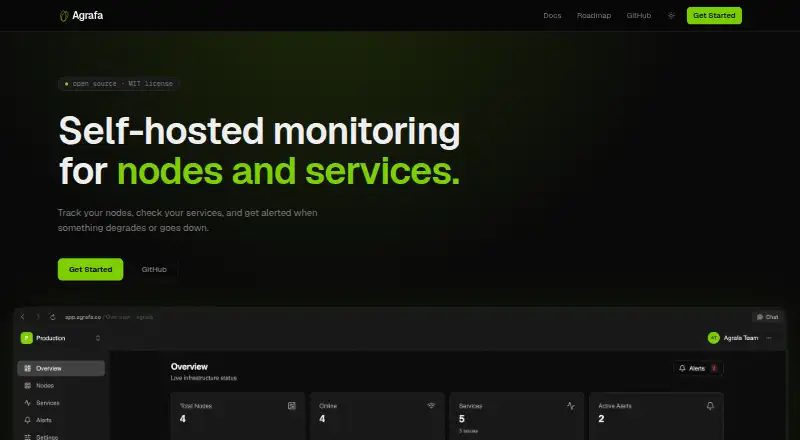
Agrafa is open-source, self-hosted monitoring software for nodes and services. It reports CPU, memory, disk, and heartbeat status from connected nodes, and checks URLs or host-and-port targets over HTTP and TCP. Alert rules can notify users when a service is degraded, unhealthy, or crosses a threshold, with email notifications configured in Instance Settings. The node agent sends metrics and heartbeats outbound to the Agrafa server, so monitored machines need no inbound ports for that connection. Installation starts a dashboard and API on ports 8080 and 8081 by default. The dashboard, API, checks, and agents run on infrastructure controlled by the operator, with monitoring data staying inside that setup according to the site. Agrafa supports Linux, a web dashboard, and self-hosted Docker Compose deployment under the MIT license. It is aimed at small deployments, personal infrastructure, and side projects. Service history, latency tracking, incident tools, status pages, container monitoring, and historical insights remain planned.
Who it suits
Agrafa suits operators of small deployments, personal infrastructure, or side projects who want self-hosted node and service checks. It fits teams that prefer keeping monitoring components on infrastructure they control.
What it does well
- Monitors CPU, memory, disk, and heartbeat status
- Checks HTTP and TCP targets
- Sends threshold and health alerts by email
- Agent requires no inbound ports
- Runs under the MIT open-source license
What to know first
- Service history and latency tracking are upcoming
- Container monitoring is planned, not current
- Slack and Telegram integrations are only planned
- Security fixes target the latest released version
Verdict
Agrafa provides focused, self-hosted checks and alerting for nodes and services, with outbound agent connections and operator-controlled infrastructure. Its roadmap status matters if you need historical, container, or expanded notification features now.
Facts from Agrafa's own pages
- Agent connection
- The agent sends outbound requests to the Agrafa server, so monitored machines do not need inbound ports open. · agrafa.co, 9 Oct 2026
- Alerts
- Alert rules can notify when a service becomes degraded or unhealthy, or a rule threshold is crossed. · agrafa.co, 9 Oct 2026
- Data control
- Agrafa runs on infrastructure the user controls, and its site says monitoring data stays inside that setup. · agrafa.co, 8 Oct 2026
- Deployment
- The installer starts the dashboard and API, available by default on ports 8080 and 8081. · agrafa.co, 8 Oct 2026
- Email notifications are configured from Instance Settings. · agrafa.co, 9 Oct 2026
- Hosting
- The dashboard, API, checks, and agents run on infrastructure controlled by the operator. · agrafa.co, 9 Oct 2026
- Integrations
- Slack and Telegram alert integrations are listed as planned for the next release. · agrafa.co, 9 Oct 2026
- Intended users
- The project README describes Agrafa as monitoring for small deployments, personal infrastructure, and side projects. · github.com, 9 Oct 2026
- License
- Agrafa is open source under the MIT license. · agrafa.co, 9 Oct 2026
- Limits
- Service history and latency charts are listed as upcoming, and container monitoring is planned for later. · agrafa.co, 9 Oct 2026
- Node monitoring
- It reports CPU, memory, disk usage, and heartbeat status from connected nodes. · agrafa.co, 9 Oct 2026
- Notifications
- Email notifications are configured from Instance Settings. · agrafa.co, 8 Oct 2026
- Planned features
- Service history and latency tracking, incident tracking, status pages, container monitoring, and historical operational insights are listed as upcoming or later roadmap items. · agrafa.co, 8 Oct 2026
- Purpose
- Agrafa is self-hosted monitoring software for nodes and services. · agrafa.co, 9 Oct 2026
- Security reporting
- The security policy asks users to report vulnerabilities by email and says reports are aimed to be acknowledged within three business days. · github.com, 9 Oct 2026
- Security updates
- Security fixes are provided for the latest released version, while older versions may not receive updates. · github.com, 9 Oct 2026
- Service checks
- It supports HTTP and TCP checks for URLs and host:port targets. · agrafa.co, 9 Oct 2026
- Support
- The project invites issue reports and focused pull requests for contributions. · github.com, 9 Oct 2026
- Vulnerability support
- The security policy asks users to report vulnerabilities by email and says Agrafa aims to acknowledge reports within three business days. · github.com, 8 Oct 2026
Where Agrafa stands on Freedom251
- Container Monitoring#11 of 49