Freedom251 › Payment Hub Software

AccessPay
What AccessPay is
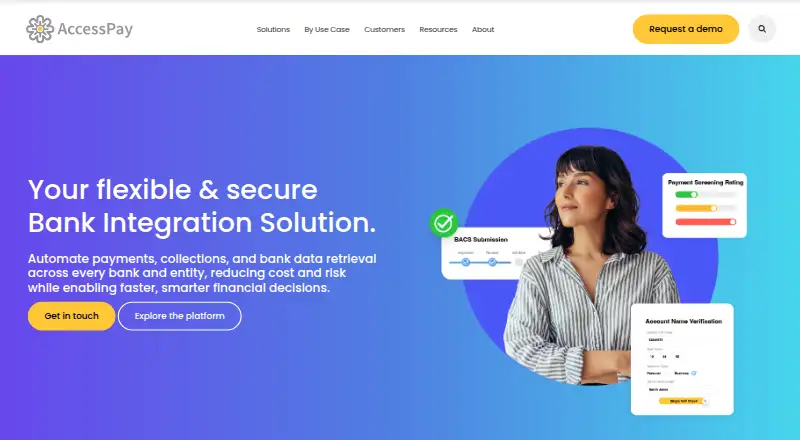
AccessPay connects business finance and back-office systems to banks to automate payments, collections, and bank statement retrieval. It supports Bacs, Faster Payments, CHAPS, SWIFT, SEPA, and Direct Debit collections, and describes connectivity to more than 11,000 banks worldwide. Finance applications can connect through SWIFT, Host-to-Host, EBICS, sFTP, or API, with integrations for ERP, payroll, and other back-office systems. Its file transformation engine handles formats such as CSV, Standard18, and PAIN, along with less common formats. Fraud and error controls include payment screening, beneficiary checking, sanctions screening, and Confirmation of Payee capabilities. Security features listed include masked and encrypted transaction data, MFA or SSO, user access controls, segregation of duties, and audit trails. The company says the platform does not cap transaction count or value, though payment schemes may set value limits. Pricing is on request and based on estimated annual transaction volumes, users, and required configurations and workflows. Initial setup carries a one-time professional services fee of 25%, and bank fees are separate.
Who it suits
It suits finance and treasury teams connecting back-office systems with banks, from small charities to large companies. Organizations without a Bacs Service User Number can use AccessPay as a bureau for Bacs payments.
What it does well
- Supports six listed payment channels
- Connects finance applications with more than 11,000 banks worldwide
- Offers payment, beneficiary, and sanctions screening
- Lists MFA or SSO, access controls, and audit trails
- 24/7 support is available
What to know first
- Pricing is available on request
- Initial setup has a one-time professional services fee of 25%
- Bank fees are separate
- Payment schemes may impose transaction value limits
Limits
AccessPay says its platform does not cap transaction count or value, but payment schemes may set their own transaction value limits. The annual subscription price is based on estimated annual transaction volumes, number of users, and required data configurations and submission workflows; bank fees are separate.
Plans
| Plan | Billed and limits | Price |
|---|---|---|
| AccessPay platform subscription | Flat annual subscription; price based on estimated annual transaction volumes, number of users, and required data configurations and submission workflows. One-time professional services fee of 25% for initial setup; bank fees are separate. · No platform transaction fees · No transaction count or value cap stated, subject to payment scheme limits | On request |
As accesspay.com lists them, read 30 Sept 2026. The maker's own page has the final word.
Getting started
- Visit the AccessPay website.
- Contact AccessPay for pricing based on transaction volumes, users, and required configurations and workflows.
- Plan for the one-time professional services fee for initial setup.
- Connect finance applications through a supported route such as SWIFT, Host-to-Host, EBICS, sFTP, or API.
- Choose the required payment channels and file formats for your workflows.
Overview
AccessPay links business finance systems with banks to automate payments, collections and bank statement retrieval. It is best suited to finance and treasury teams that need multiple payment schemes and bank connections in one service. Its breadth and payment controls are compelling, but custom annual pricing and setup costs make it a considered enterprise purchase rather than a straightforward low-cost option.
Key features
AccessPay supports Bacs, Faster Payments, CHAPS, SWIFT, SEPA and Direct Debit collections, connecting finance applications to more than 11,000 banks worldwide. That range can help teams manage varied domestic and international payment workflows through one connection layer, though scheme-level transaction value limits still apply.
Integrations span ERP, payroll and other back-office systems, with SWIFT, Host-to-Host, EBICS, sFTP and API connection methods. The file transformation engine handles formats including CSV, Standard18, XLS, XML, PAIN, Pain.001 v3, Pain.008 v2, Pacs.008, DSV, fixed-width, DTA and PF-DTA. This flexibility is useful when systems and banking partners use different formats; approval workflows and payment validation add controls before submission.
Fraud and error safeguards include payment screening, beneficiary checking, sanctions screening and Confirmation of Payee capabilities. Transaction data is masked and encrypted, while login options include MFA or SSO alongside user access controls, segregation of duties and audit trails. The stated certifications include ISO 27001, ISO 27701, ISO 22301, ISO 9001, ISO 20000, PCI-DSS, Cyber Essentials, Cyber Essentials Plus, and SOC 2 Type I and Type II.
AccessPay says its support team is available 24/7, responding within one business day or within 15 minutes for critical-priority issues. Implementation can take four to twelve weeks; the company also reports onboarding a council within four weeks. That can suit organizations prepared for a structured rollout, but it is not an instant switch-on service.
Pricing
The AccessPay platform subscription has custom pricing and is billed as a flat annual subscription. The price is based on estimated annual transaction volumes, user count, and required data configurations and submission workflows, so organizations should scope those needs before comparing costs. A one-time professional services fee of 25% applies for initial setup, and bank fees are separate.
There are no platform transaction fees, and AccessPay says it does not cap transaction count or value. That may suit high-volume teams seeking predictable platform charges, but it does not remove limits imposed by payment schemes or the separate costs of banks and implementation. A Bacs bureau option is available to customers without a Service User Number, with AccessPay handling Bacs payments on their behalf.
Platforms
AccessPay is available through web and API platforms and uses cloud deployment. That combination is aimed at finance operations integrating payment workflows with business systems, rather than users seeking a mobile app.
Who it's for
AccessPay is designed for finance and treasury teams, with customers described as ranging from small charities to FTSE companies. It is most suitable where multiple banks, payment rails, file formats or approval requirements make a connected platform worthwhile. Teams with simple payment needs or limited appetite for annual subscription and setup costs may find its breadth unnecessary.
Pros and cons
- Pros: Broad payment scheme and bank connectivity can consolidate varied payment workflows.
- Pros: File transformation, validation and approval workflows address practical integration and control needs.
- Pros: Fraud screening, access controls and audit trails support oversight of sensitive payment processes.
- Cons: Custom annual pricing, a 25% initial setup fee and separate bank fees complicate budgeting.
- Cons: Implementation may take four to twelve weeks, so organizations needing immediate deployment should look elsewhere.
- Cons: Scheme-level value limits remain even though the platform itself does not cap transaction count or value.
Alternatives
For businesses focused on collections, compare the Direct Debit Processing Software category; teams evaluating payment orchestration can browse Payment Hub Software. Those prioritizing bank connections can also review Bank Connectivity Software.
Powens is a paid API option with a free trial, Android, iOS and web platforms, and custom API plans; it may suit teams wanting to evaluate an API service before buying. Razorpay e-Mandate is another paid option with Android, API, iOS and web platforms.
Bottomline Internal Threat Management is a paid web-based enterprise fraud and insider-risk solution, a more focused alternative when that risk is the priority. Cashfree eNACH offers paid API and web access with mandate-creation and per-presentation charges plus a separate platform fee, making it a more mandate-centered option.
ClearDebit is a paid API and web alternative. InterPay + DDMS is a paid web option with tailored consultation for pricing. Debit Success is a paid API and web alternative. Squarepay has a free plan and web access, so it may be worth considering for readers seeking a freemium option.
Verdict
Choose AccessPay if your finance or treasury operation needs broad bank connectivity, multiple payment rails and strong workflow controls in a single cloud platform. Its key advantage is the combination of connection breadth, format handling and payment safeguards; its main drawback is the custom annual commitment, setup charge and rollout effort. Organizations with narrower payment needs or a preference for transparent, lightweight pricing should compare alternatives first.
Verdict
AccessPay brings multiple payment rails, bank connections, and payment controls together for finance and treasury workflows. Its subscription price depends on the requested configuration, and setup and bank fees are additional considerations.
Questions
How much does AccessPay cost?
Pricing is on request. The platform subscription is billed as a flat annual subscription based on estimated annual transaction volumes, users, and required configurations and workflows. A one-time professional services fee of 25% applies for initial setup; bank fees are separate.
Which payment types does AccessPay support?
It supports Bacs, Faster Payments, CHAPS, SWIFT, SEPA, and Direct Debit collections.
Which platforms are available?
AccessPay is listed for web and API, and its deployment option is cloud.
Can AccessPay handle Bacs payments for an organisation without a Service User Number?
Yes. The company offers a bureau option to handle Bacs payments on behalf of customers without a Service User Number.
What security certifications does AccessPay list?
Its FAQ lists ISO 27001, ISO 27701, ISO 22301, ISO 9001, ISO 20000, PCI-DSS, Cyber Essentials, Cyber Essentials Plus, and SOC 2 Type I and Type II.
Facts from AccessPay's own pages
- Bacs bureau option
- Customers without a Service User Number can use AccessPay as a bureau to handle Bacs payments on their behalf. · accesspay.com, 30 Sept 2026
- Bank connectivity
- AccessPay says its platform connects finance applications with more than 11,000 banks worldwide. · accesspay.com, 30 Sept 2026
- Certifications
- The FAQ lists ISO 27001, ISO 27701, ISO 22301, ISO 9001, ISO 20000, PCI-DSS, Cyber Essentials, Cyber Essentials Plus, and SOC 2 Type I and Type II certifications. · accesspay.com, 30 Sept 2026
- File formats
- Its file transformation engine supports common payment formats including CSV, Standard18, and PAIN, as well as less common formats. · accesspay.com, 30 Sept 2026
- Founded
- 2012 · accesspay.com, 28 Sept 2026
- Fraud controls
- Fraud and error controls include payment screening, beneficiary checking, sanctions screening, and Confirmation of Payee capabilities. · accesspay.com, 30 Sept 2026
- Headquarters
- Manchester, United Kingdom · accesspay.com, 28 Sept 2026
- Implementation
- The company says implementation can take as little as four to twelve weeks and reports onboarding a council within four weeks. · accesspay.com, 30 Sept 2026
- Integrations
- AccessPay describes integrations with ERP, payroll, and back-office systems and supports SWIFT, Host-to-Host, EBICS, sFTP, and API connections. · accesspay.com, 30 Sept 2026
- Limits
- AccessPay says it does not cap transaction count or value, though payment schemes may set their own transaction value limits. · accesspay.com, 30 Sept 2026
- Payment types
- The platform supports Bacs, Faster Payments, CHAPS, SWIFT, SEPA, and Direct Debit collections. · accesspay.com, 30 Sept 2026
- Security
- AccessPay says transaction data is masked and encrypted and lists MFA or SSO login, user access controls, segregation of duties, and audit trails. · accesspay.com, 30 Sept 2026
- Support
- AccessPay says its support team is available 24/7, with responses within one business day or 15 minutes for critical priority issues. · accesspay.com, 30 Sept 2026
- What it does
- AccessPay connects business finance and back-office systems to banks to automate payments, collections, and bank statement retrieval. · accesspay.com, 30 Sept 2026
- Who it is for
- AccessPay describes its customers as finance and treasury teams, with examples ranging from small charities to FTSE companies. · accesspay.com, 30 Sept 2026
Where AccessPay stands on Freedom251
- Payment Hub Software#2 of 23
- Direct Debit Processing Software#5 of 22
- Bank Connectivity Software#23 of 71