Recommended Free Tools
Screenshots are useful for reviewing how an Android app looks, but they should not be an AI agent’s only way to interact with the app—or the sole evidence that a functional test passed. For behavior checks, use actions and explicit assertions against UI state; keep screenshots as visual artifacts for debugging and review.
Why screenshot-only testing is a weak test contract
A screenshot gives an agent pixels to interpret. It does not, by itself, define what the app is supposed to do or reliably establish that the expected outcome occurred. A visually plausible screen may still conceal a wrong value, an incomplete operation, or a control that does not work.

As an Amazon Associate I earn from qualifying purchases.
Build functional checks around a clear sequence: perform an action, wait for the relevant UI state, and assert the expected result. Keep screenshots alongside those checks so people can inspect layout and diagnose failures. This is a test-design distinction, not a claim that every screenshot-driven agent fails or that framework selectors never break.
Free tools Windows power users keep installed
One-click scans. No signup required.
Choose Espresso or UI Automator by the test boundary
The practical choice is whether the test can stay within the app’s UI and codebase or must cross into system UI, another app, or other windows. Android Developers describes Espresso as a concise UI testing framework whose calls synchronize with the app UI and developer-defined idling resources. The documentation is aimed at developers familiar with the codebase, while noting that Espresso can also be used for black-box testing. Espresso documentation
#1 Best Overall

- telephone cable tester with On/Off and hangup buttons.FSK/DTMF dual system Caller ID.
- telephone wire cable testing FSK/DTMF dual system Caller ID.
- Easy for the lineman to check your telephone line fault.
- Come with Three type of line plug,easily connect to the phone line.
- This set offers Last number redial, On/Off and hangup buttons, so the lineman can check your telephone line fault.
Android Developers describes UI Automator as testing an app from outside its process. Its documentation covers testing release builds with minification, system-level interactions, and multi-window scenarios. The modern 2.4 API adds predicate-based element finding, explicit waiting and state management, accessibility window nodes, and screenshot/reporting capabilities. That API is marked as under development; the documentation checked on 2026-10-07 showed 2.4.0-alpha05 as an example dependency, not a stable-release recommendation. Check the current guide and dependency before adopting it. UI Automator documentation
| Question | Espresso | UI Automator |
|---|---|---|
| Where does the test operate? | Within the app’s UI; suited to teams familiar with the app codebase. | Outside the app process; useful for system UI, other windows, and release-build testing. |
| How is synchronization handled? | Test calls wait for the app UI to be at rest and developer-defined idling resources to be idle. | The modern 2.4 API provides explicit waiting and state-management capabilities. |
| What maintenance issue should you consider? | Keep checks tied to the app’s intended UI behavior and state. | Use the current official guidance; the modern API is under development and may change. |
Neither framework is universally better. Choose based on app-process access, whether the scenario crosses into system UI or other windows, whether you need to test minified release behavior, and how you will keep checks aligned with the app’s UI semantics.
Rank #2

- Best app to test the android phones.
- Check Sensors, Hardware, Network, Display, GPS, Camera, ecc...
- Simple graphics and lightweight
Use AI-guided testing for exploration, not as an automatic pass/fail oracle
Firebase’s App Testing agent is a Gemini-powered preview that accepts natural-language test goals. Test cases can be stored in YAML or in the Firebase console, broken into steps, and paired with assertions about what should be visible at the end. Results can include issues, screenshots, actions taken, and an agent view of elements detected using accessibility information. After a successful run, the agent can cache and replay actions while checking assertions; if replay fails, it falls back to AI actions. Firebase App Testing agent documentation
The feature’s documented constraints matter when deciding what to trust. As of Firebase documentation checked on 2026-10-07, a run times out after five minutes, and supported actions are tap, text entry, directional swipe, long press, drag-and-drop, back, and wait. Repeated runs may take different actions while following the same instructions. Firebase says complex tasks do better when divided into shorter steps; scrolling and counting can be unreliable, and apps using FLAG_SECURE appear blank to the agent.
The same documentation listed a default preview quota of 200 tests per month per Firebase project, with each test-case/device combination counted as a test. This is a preview feature, not a service guarantee: Firebase states that preview releases have no SLA or deprecation policy and may receive limited or no support. Verify the current status, quota, and limitations in Firebase’s documentation before relying on them.
Make a natural-language test easier to inspect
- Break a long goal into short steps rather than asking the agent to complete a complicated journey in one instruction.
- State the visible end condition for each step, especially where navigation or the correct screen could be ambiguous.
- Use hints when needed to clarify navigation, and inspect the action history, detected elements, screenshots, and assertion results after a run.
- Treat exploratory output as a way to find issues or generate leads. Put critical behavior behind explicit, repeatable checks.
Run authored tests across devices—and keep screenshots as artifacts
Firebase Test Lab runs instrumentation tests that your team writes with Espresso or UI Automator on physical and virtual devices. It provides the execution environment and device coverage; it does not define the behavior your test should verify. Firebase’s guide, checked on 2026-10-07, describes maximum test durations of 45 minutes on physical devices and 60 minutes on virtual devices. Firebase Test Lab instrumentation test guide
Rank #4

- USB 5 Pin PCB test board.Micro for Andriod phone micro pin test.for iPhone PCB test board
- It is a small diagnostic tool, for iPhone or Android cell phone U2, battery or dock plug detection
- You can disassemble free testing, quick and easy to find mobile phone problems
- Easy to use,directly plug to the USB charging port of your phone.With this board,you can do test work without opening a mobile phone
- PCB Board Size: 30 x 27 mm.The package includes:3 x PCB Test Board
Screenshots can remain part of this workflow. Firebase documents processing AndroidX ScreenCapture output with its screenshot processor so the images appear with test results. That makes screenshots useful evidence for visual review and debugging without treating a picture as a substitute for functional assertions.
The Tool Desk
Outbyte PC Repair FREEClear out junk files and repair common Windows errorsFree Scan →Outbyte Driver Updater FREEScan for outdated or missing drivers - takes under a minuteDriver Scan →Physical Android devices are an optional target when real hardware matters to the app’s coverage. The cited guidance supports running tests on physical devices, but it does not establish that every team needs to buy a device or endorse a particular phone model.
Best Value
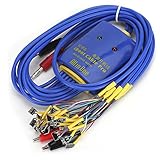
- New upgrade, multi-level , using for Android/IOS connecting wire mode(18+5+1).
- New upgrade, multi-level , using for Android/IOS connecting wire mode(18+5+1).
- Anti-burn , over-voltage and over-current . When voltage exceeds 4.7V, output will automatic disconnected to effectively prevent phone from burning out due to over-voltage and will automatic started when the current exceeds 3A.
- Battery buckle for , can used as long as the battery base matches with flat cable buckle.
- Made of high quality plastic material, sturdy, and long service life.
A practical workflow for agent-assisted Android testing
- Define the result first. Write down the user goal and the concrete UI state that would count as success.
- Put critical behavior in an instrumentation test. Use Espresso when the test belongs within the app UI and codebase; use UI Automator when it must cross the app boundary, work with system UI, or cover other windows.
- Use AI exploration in short phases. Give each phase a clear action and visible end-state assertion. Add a hint when a navigation choice is unclear.
- Run on relevant targets. Use emulator or physical-device targets that match the coverage your app needs, then inspect results, logs, and screenshots.
- Separate visual review from functional pass/fail. Use screenshot comparisons to assess rendering and layout; base behavior decisions on actions and explicit state assertions.
Google’s Android Developers Blog described configuring a device in Android Emulator so the Android Studio agent can test an app, along with agent workflows for unit testing and bug fixing, in a post published 2026-05-19. That guidance is specific to Google’s documented Android Studio environment; it does not establish that every coding agent has the same capabilities. Android developer tools: what’s new
Quick Recap
Product prices and availability are accurate as of the date/time indicated and are subject to change. Any price and availability information displayed on Amazon at the time of purchase will apply.




