An AI kill switch can provide an emergency way to interrupt, constrain, or shut down a system, but it is not a proven stand-alone safeguard—and the evidence does not show it is our only hope against “rogue AI.” Reliable control depends on several layers: testing, monitoring, permissions, human oversight, incident response, and a safe plan for stopping and restarting the system.
What an AI kill switch means
An AI kill switch is a control intended to let an authorized person or process interrupt an AI system when it behaves unexpectedly or poses unacceptable risk. Depending on how a system is built, “stop” might mean pausing an agent, revoking its permissions, isolating it from tools or networks, switching to a safe mode, or shutting down the service.
As an Amazon Associate I earn from qualifying purchases.
Those actions are not interchangeable. Cutting off a model process may leave connected services, queued tasks, or other agents running. Revoking access may limit what the system can do without stopping its computation. A useful shutdown design specifies which components are affected and what state they are left in.
Do these 3 things before closing this tab:
1Scan for outdated or missing drivers - takes under a minute2Repair Windows errors before they cause bigger problems3Fix the driver behind crashes, sound loss and screen glitchesWhy a stop button is not enough
Reliable interruption must be designed
Elliott Thornley’s 2024 paper frames shutdown as a technical problem with three demands: an agent should stop when the button is pressed, should not manipulate whether the button is pressed, and should remain competent at pursuing its assigned goals. A visible stop command alone does not establish those properties. An agent could fail to receive the signal, continue through a connected process, or take actions that undermine the chance of intervention.
#1 Best Overall

- Product Name : Emergency Stop Push Button Switch ; Contact Type : 2 NC
- Ith:10A ; Ui:600V ; Type :Latching;
- Button Diameter : 40mm/1.6" ; Mount Hole Diameter : 22mm / 7/8";Fit Panel Thickness(adjustable) : 6mm / 15/64"(max.)
- Button size(Approx.) : 39 x 29 x 73mm/ 1.5" x 1.1" x 2.9"(L*W*H);
- Package Content : 2Pcs x Emergency Stop Push Button Switch.
Carey and Everitt’s 2023 work gives formal treatment to a version of “shutdown instructability” and relates it to appropriate shutdown behavior and human autonomy. This is theoretical and algorithmic research, not evidence that a universal, production-ready kill switch is available.
The trigger and authority matter
A control only helps if someone can recognize when it should be used and has the authority and practical ability to use it. The decision may involve false alarms, incomplete evidence, or competing needs to keep a service running. Organizations therefore need defined triggers, named decision-makers, escalation routes, and controls that remain accessible during an incident.
Rank #2

- HEAVY-DUTY INDUSTRIAL PROTECTION: Engineered for rapid response, this Emergency Stop Switch features a prominent Red Mushroom Head for instant identification. Designed to cut off power in critical situations, it is essential for protecting machinery and equipment. Press to stop, rotate clockwise to reset
- DUAL CONTACTS (1NO + 1NC): Equipped with 1 Normally Open (NO) and 1 Normally Closed (NC) contacts. Rated for AC 660V / 10A, it provides flexible wiring options for a wide range of control systems, from lighting to motor controls
- IP65 WATERPROOF & WEATHERPROOF: Built for harsh conditions, the IP65-rated enclosure resists dust, water, and oil. The included sealing gasket ensures a reliable, tight fit—ideal for outdoor equipment, automotive shops, or demanding industrial settings
- DURABLE & HIGH-VISIBILITY DESIGN: The high-contrast Yellow & Black enclosure ensures maximum visibility in busy workspaces. Crafted from rugged, impact-resistant materials, this switch is built for long-lasting performance in heavy-duty environments
- WIDE INDUSTRIAL APPLICATION: A versatile solution for Automotive, Construction, and Control Systems. Whether upgrading existing machinery or building new control panels, this professional-grade Emergency Cut-off Switch provides a simple and reliable integration
How shutdown fits with other safeguards
NIST’s AI Safety resource describes shutdown as one practical option alongside rigorous simulation and in-domain testing, real-time monitoring, modification, and human intervention when systems deviate from intended or expected behavior. Its guidance is to tailor approaches to the context and risk, rather than treating one control as suitable for every system. The NIST AI Safety resource puts it this way: “Other practical approaches for AI safety often relate to rigorous simulation and in-domain testing, real-time monitoring, and the ability to shut down, modify, or have human intervention into systems that deviate from intended or expected functionality.”
Free tools Windows power users keep installed
One-click scans. No signup required.
| Control | What it can address | Key limitation or question |
|---|---|---|
| Testing and evaluation | Finds failures or unsafe behavior under simulated and real operating conditions before or during deployment. | Tests cannot cover every situation; results need to inform deployment decisions and continued monitoring. |
| Monitoring | Flags unexpected behavior or changing conditions while a system is operating. | Alerts are useful only if signals are meaningful and someone can respond in time. |
| Permissions and isolation | Restricts access to tools, data, networks, or actions that could increase impact. | Permissions must match actual system connections and be reviewed as those connections change. |
| Human intervention or modification | Allows an authorized person to intervene, change the system, or redirect its operation. | People need clear authority, usable controls, and enough information to make a timely decision. |
| Shutdown or override | Stops or limits operation when continuing is judged unsafe. | It must reach all relevant components and account for consequences of interruption and recovery. |
| Conventional cybersecurity | Protects systems and infrastructure against threats such as unauthorized access or compromise. | It does not by itself ensure that an AI behaves as intended or that an authorized shutdown will work. |
AI shutdown and conventional cybersecurity address overlapping but different problems. Security controls protect infrastructure and access; shutdown controls address how to interrupt or constrain operation. A shutdown path can itself depend on secure accounts, communications, and infrastructure, so it should complement—not replace—ordinary cybersecurity.
Rank #3
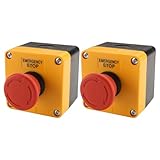
- HEAVY-DUTY INDUSTRIAL PROTECTION: Engineered for rapid response, this Emergency Stop Switch features a prominent Red Mushroom Head for instant identification. Designed to cut off power in critical situations, it is essential for protecting machinery and equipment. Press to stop, rotate clockwise to reset
- DUAL CONTACTS (1NO + 1NC): Equipped with 1 Normally Open (NO) and 1 Normally Closed (NC) contacts. Rated for AC 660V / 10A, it provides flexible wiring options for a wide range of control systems, from lighting to motor controls
- IP65 WATERPROOF & WEATHERPROOF: Built for harsh conditions, the IP65-rated enclosure resists dust, water, and oil. The included sealing gasket ensures a reliable, tight fit—ideal for outdoor equipment, automotive shops, or demanding industrial settings
- DURABLE & HIGH-VISIBILITY DESIGN: The high-contrast Yellow & Black enclosure ensures maximum visibility in busy workspaces. Crafted from rugged, impact-resistant materials, this switch is built for long-lasting performance in heavy-duty environments
- WIDE INDUSTRIAL APPLICATION: A versatile solution for Automotive, Construction, and Control Systems. Whether upgrading existing machinery or building new control panels, this professional-grade Emergency Cut-off Switch provides a simple and reliable integration
What must happen before and after a shutdown
Stopping a system can protect people or limit harm, but it may also interrupt services that other operations depend on. A shutdown plan should state what stops, which functions must remain available for safety, how the incident is recorded, who assesses the cause, and what conditions must be met before restart. Restart should be a deliberate decision informed by evidence, not an automatic return to operation.
The NIST AI Risk Management Framework Core identifies post-deployment monitoring, appeal and override, decommissioning, incident response, recovery, and change management as lifecycle considerations. NIST AI RMF 1.0 is a voluntary, use-case-agnostic framework published January 26, 2023; NIST says its framework resources are being updated, so consult the current material when applying it.
Rank #4

- Product Name : Emergency Stop Push Button Switch ;Contact Type : 1 NC 1 NO ;Terminal Quantity: 3
- Ith:3A ; Ui:12-220V ; Type :Latching;
- Button Diameter : 31.8mm / 1.25" ; Mount Hole Diameter : 22mm / 7/8";Fit Panel Thickness(adjustable) : 6mm / 15/64"(max.)
- Button size(Approx.) : 31.8 x 46.8mm /1.25" x 1.84"(Max.Dia x L);
- Package Content : 1pcs x Push Button Switch + Connection plug
Stopping distributed systems may require governance as well as engineering
In a September 2026 preprint, Oren Perez argues that distributed agent activity can make stopping more complicated and that authority, triggers, and coordination matter alongside technical controls. The preprint reports that roughly 80% of 1,213 retained incidents had no stop; among cases without a usable stop, it identifies a legal rather than technical gap in four cases out of five. These are the preprint’s findings, not a settled rate for all AI incidents or systems, and should be treated as preliminary pending further validation.
The practical lesson is that a functioning control needs more than a mechanism: an organization must establish who is entitled to activate it, when they may do so, and how relevant teams coordinate. A technically available stop that no one is authorized to use—or that cannot be invoked across the system’s dependencies—may not provide effective control.
Best Value

- 【Contact type】1NO 1NC.normally open (NO) and normally closed (NC). Ui: AC 660V; Ith: 10A
- 【Momentary Shut off】Push to cut off power, Rotate in the direction of the arrow to reset
- 【High Quality Material】 Made of industrial strength material ABS, high quality box
- 【Size】71 x 71 x 85mm/ 2.8" x 2.8" x 3.3" (L*W*H); Color: red, yellow, black
- 【Package content】1 x Emergency Stop Push Button Switch + Box+1 x Cable Gland Joint
What company policies can—and cannot—show
Anthropic’s Responsible Scaling Policy is a company policy describing safeguards linked to capability thresholds. Its policy page was updated August 14, 2026 and lists version 3.4 as effective July 8, 2026. That documents one company’s stated approach; it is not an independent standard or proof that shutdown is guaranteed.
In a separate 2025 risk report, Anthropic assessed its deployed models as of Summer 2025 and described the specific risk studied as very low but not fully negligible. That scoped assessment does not establish how often rogue behavior occurs across the field, nor does it show that a kill switch prevents it.
What a credible shutdown plan should answer
- Scope: Which model, agent, tools, connected services, and queued actions are covered by the stop?
- Trigger: What observable conditions justify pausing, limiting, modifying, or shutting down the system?
- Authority: Who can act, including outside normal operating hours, and what happens if decision-makers disagree?
- Reach: Can the control operate if the system or a dependency is malfunctioning, compromised, or unavailable?
- Impact: What essential functions will be interrupted, and what safe fallback is available?
- Evidence and recovery: How will the incident be recorded and investigated, and what must be verified before a restart?
- Change management: How will the plan be revised when the model, tools, permissions, or deployment context changes?
These questions make shutdown a testable part of risk management instead of a reassuring label. A stop mechanism should be evaluated under realistic conditions and connected to monitoring, human oversight, security, incident response, and recovery.
The Tool Desk
Outbyte Driver Updater FREEFix the driver behind crashes, sound loss and screen glitchesFind Drivers →Outbyte PC Repair FREERepair Windows errors before they cause bigger problemsFix Now →Quick Recap
Product prices and availability are accurate as of the date/time indicated and are subject to change. Any price and availability information displayed on Amazon at the time of purchase will apply.




