AI and the industrial Internet of Things (IoT) work together when connected sensors and controls collect information about machines and processes, and analytics use that information to help people or automated systems decide what to do. The useful question is not whether a factory needs AI, but which operational problem it should address, what data can support a response, and what happens if that response is late or wrong.
How do AI and IoT work together in manufacturing?
Industrial IoT connects physical equipment to systems that can monitor or control it. Sensors measure conditions such as vibration, temperature, force, or position; actuators can change a physical condition in response to a command. Data may be processed on the device, at a nearby edge server, or in a remote cloud environment.



As an Amazon Associate I earn from qualifying purchases.
AI can analyze IoT data to recognize patterns, estimate likely future conditions, or recommend a response. For example, vibration readings from a machine can be examined for changes that may indicate developing wear. The sensor supplies observations; the model interprets them; maintenance staff or a validated control system decide what action follows.
This is a system-level relationship, not a plug-and-play pairing. NIST defines industrial AI in relation to a particular industrial need and the capabilities and limitations of the system where it is used. It cautions that an AI system’s performance has no meaning apart from its impact on the system and its users. A model that scores well on a dataset may still be unsuitable if the data are unrepresentative, the machine differs from those used to develop it, or the proposed action disrupts production.
#1 Best Overall
How is AI used in industrial operations?
Applications differ in the decision they support and the consequences of an error. The following are established areas of smart-manufacturing work, not guarantees that every site will benefit from deploying them.
- Condition monitoring: Combine sensor readings with operating context to identify changes in an asset or facility and alert staff.
- Predictive maintenance: Estimate equipment condition or maintenance needs so teams can investigate and plan work before a fault causes disruption.
- Quality and process improvement: Analyze process measurements and inspection results to identify patterns associated with variation or defects, then help operators investigate causes.
- Production planning: Use operational data to support scheduling and resource decisions as constraints or production conditions change.
- Robotics and autonomous systems: Apply sensing and analytics to automate or assist tasks. A NIST MEP example describes a manufacturer’s aim to shift less-enjoyable work to a robot and give employees more opportunity to do preferred tasks; that is the manufacturer’s perspective, not a measured productivity result.
- Digital twins: Connect models of equipment or processes with operational data to support analysis of performance and possible changes.
- Supply-chain and logistics optimization: Analyze data across operations to support decisions about material movement, logistics, and production coordination.
- Energy and material use: Smart-manufacturing projects announced by the U.S. Department of Energy in 2023 included AI, machine learning, and robotics for integration, automation, and optimizing energy and material use. Demonstration sectors included cement, chemical, food, and steel manufacturing.
NIST’s 2026 smart-manufacturing AI roadmap also covers advanced sensing, additive and laser-based manufacturing, sustainable manufacturing, and research directions such as physics-informed, generative, semantic, and explainable AI. These are areas of application or development, not evidence that a single approach is ready or appropriate for every plant.
Can AI predict machine failures?
AI can support estimates of changing machine condition or maintenance need when relevant measurements and operating context are available. That is not the same as knowing exactly when a machine will fail. A warning may indicate an anomaly or rising risk; it does not prove a fault will occur, identify its cause on its own, or guarantee enough time to prevent it.
Do these 3 things before closing this tab:
1Scan for outdated or missing drivers - takes under a minute2Repair Windows errors before they cause bigger problems3Fix the driver behind crashes, sound loss and screen glitchesMachine-specific measurement matters. NIST’s Augmented Intelligence for Manufacturing Systems (AIMS) work aims to combine integrated metrology, physics-based models, and AI to monitor and predict machine and process performance. Its examples include thermal drift, cutting forces, vibration, and tool displacement. NIST also notes that generic AI models may not fit specific machines and that obtaining relevant process measurements can be difficult.
For a vibration-monitoring pilot, first establish which asset and failure modes matter, what signal can be collected reliably, and how operating state affects that signal. Then decide what constitutes an alert, who investigates it, and how the team will distinguish useful warnings from false alarms. A monitoring system should not directly trigger safety-critical action unless its authority, reliability, validation, and fallback behavior have been established for that use.
Where should industrial data be processed: on the device, at the edge, or in the cloud?
All three placements are possible. There is no universal best architecture: choose based on the process’s latency and connectivity needs, existing controls, data governance, cybersecurity, and the consequence of a delayed or incorrect decision.
| Design | Where processing happens | Potential fit and trade-offs |
|---|---|---|
| On-device | At the sensor or other connected device. | Can suit a narrowly scoped task close to the measurement. Check device computing limits, available model updates, machine integration, and what happens when a reading or output is wrong. |
| Edge | At a nearby server or gateway. | Can keep analysis near equipment when a response needs to be timely or connectivity to remote services is constrained. Assess how the edge system connects to existing sensors and controls, is maintained, and behaves if it loses network access. |
| Cloud | In remote data-center infrastructure. | Can support centralized analysis of data from connected operations. Assess network dependence, latency, access controls, data governance, and the operational effect of a service or connection interruption. |
These are design considerations, not claims that one placement is inherently more secure, reliable, or accurate. Map data flows and decision authority before connecting analytics to production controls, and define a safe fallback for loss of communication or an out-of-range output.
What are the benefits of IoT sensors in a factory?
Sensors can make operating conditions visible where they were previously unmeasured or only checked periodically. Connected readings can help teams notice changing equipment conditions, compare process behavior, and give analytics a more timely view of operations. NIST describes factory vibration sensing as one example and identifies affordable monitoring of tool-tip force and vibration as a manufacturing need.
A sensor is useful only if its measurements are fit for the decision. Before buying or installing an industrial vibration sensor, confirm its measurement range, mounting requirements, environmental rating, machine compatibility, data interface, and integration requirements. The sources cited here do not establish a particular model, certification, interface, or suitability for a specific machine.
Rank #4

- NOTE: Compatible Only with FALA IOT monitors and Y-splitters, exclusive FALA IOT ecosystem integration
- Length: 16.4 feet ( 5 meters), flat cable type. Custom lengths and special features available
- Ultra-wide Monitoring Range: The digital temperature probes & sensors measures extreme temps from -40°F to 248°F with lab-accurate ±0.6°F precision
- Anti-slip Design: Stays securely in place for uninterrupted monitoring. It'll work well through vibrations, handling, and harsh work environments
- High Quality: The premium stainless steel probe is waterproof & rust-proof for reliable performance in farming, cold chain, refrigerator, labs, drying box, constant box and industrial use, etc.
Connectivity also expands the number of systems and pathways that must be governed and protected. Treat cybersecurity as part of the design: identify which devices communicate, restrict access to operational data and controls, and coordinate changes with the people responsible for plant systems.
Independent reader supportYour contribution helps us test, update, and keep practical guides available for everyone.What are the challenges of implementing AI in manufacturing?
Manufacturing data are often distributed across machines, stages, sensors, controls, and operator workflows. NIST identifies complex industrial data and integration with heterogeneous sensing and control systems as persistent challenges, particularly in connected multi-stage processes. A model can only help with the conditions its inputs represent; inconsistent measurements, missing context, or equipment differences can undermine its outputs.
The Tool Desk
Outbyte Driver Updater FREEScan for outdated or missing drivers - takes under a minuteDriver Scan →Outbyte PC Repair FREEClear out junk files and repair common Windows errorsFree Scan →- Data and measurement: Check sensor placement, calibration and measurement traceability, data gaps, timestamps, and whether operating conditions are captured. Relevant process measurements may be difficult to obtain.
- Integration: Determine how the proposed system will exchange information with existing equipment, controls, maintenance workflows, and production software without creating unsafe or fragile dependencies.
- Trust and reliability: Decide how outputs will be explained, verified, monitored for change, and challenged by operators. False alarms consume attention; missed events can leave a real risk unaddressed.
- Human authority and skills: Involve operators, maintenance teams, and control-system specialists in defining the problem and reviewing outputs. Training and workforce capability are part of implementation, not a final handoff.
- Cybersecurity and governance: Set rules for access, data use, system updates, and connections between operational technology and other networks.
- Safety and fallback: Specify who or what may act on a result, the boundaries of that authority, and how the process returns to a safe state when data or analytics are unavailable or suspect.
For manufacturers that need implementation guidance, NIST’s Manufacturing Extension Partnership (MEP) describes Industry 4.0 strategy, AI readiness, training, and implementation support through its National Network. DOE’s 2023 announcement also describes CESMII as supporting smart-manufacturing adoption through sensors, analytics, platforms, and controls.
Best Value
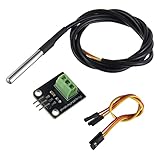
- Temperature sensor supply voltage: 3.0V ~ 5.25V
- Operating temperature range:-55 ℃ to +125 ℃ (-67 ℉ to +257 ℉)
- Provides from 9-bit to 12-bit Celsius temperature measurements
- Adapter module is equipped with a pull-up resistor, and directly connects to the GPIO of the Raspberry Pi without an external resistor
- Use this adapter module kit to simplify connecting the waterproof temperature sensor to your project
How should manufacturers measure the ROI of predictive maintenance?
Evaluate the monitoring system against a defined operational baseline, not a generic promise of savings. NIST’s system-level evaluation guide notes that the value of a prevented event is difficult to prove and that imperfect monitoring can itself create costs and risks. A useful assessment therefore includes both the investment and the consequences of alerts that are false, missed, or acted on too late.
- Set the system boundary. Name the assets, process stages, users, and decisions included. Record how the relevant operation performs before the pilot.
- Define the decision and outcome measures. Choose measures tied to the problem, such as maintenance workload, unplanned interruption, quality, energy or material use, and response time. Select only measures relevant to the use case.
- Track the full cost. Include sensing and integration, data preparation, deployment, staff time, maintenance, verification, and the cost of changing existing workflows.
- Account for risk and error. Record false alarms, missed events, unnecessary inspections or interventions, and any safety or production consequences. Separate observed results from events the system merely predicted it might prevent.
- Compare like with like. Note changes in production conditions, equipment, staffing, or maintenance practice during the evaluation. Report the pilot result for its tested system and conditions rather than treating it as a forecast for the whole factory.
- Decide whether to expand. Scale only if measured system-level impact justifies ongoing cost and risk, and if the integration, staffing, and fallback arrangements remain workable.
NIST’s 2021 guide recommends evaluating condition-monitoring investments through risk and investment analysis. Separately, a 2025 NIST study estimated a 10–20-fold return from federal research investment in IoT infrastructure; that estimate concerns federal research, not factory-level ROI or the expected return for an individual manufacturer.
Quick Recap
Product prices and availability are accurate as of the date/time indicated and are subject to change. Any price and availability information displayed on Amazon at the time of purchase will apply.




