In a 2024 blind study at the University of Reading, 94% of GPT-4-written assessment submissions went undetected by markers, and the AI submissions earned higher marks on average than real student work. The result came from five undergraduate psychology modules at one UK university—not a test of professors everywhere or of every AI tool.
What did the University of Reading study find?
The researchers reported three distinct results for the GPT-4 submissions in their study:


As an Amazon Associate I earn from qualifying purchases.
- Detection: 94% of the AI submissions were not detected by the academic markers.
- Marks: The AI submissions received about half a grade boundary higher on average than real student submissions.
- Across-module comparison: There was an 83.4% chance that the AI submissions would outperform a random selection of the same number of real student submissions across modules. This is a comparison of equal-sized groups, not a claim that 83.4% of individual AI answers beat every student.
The authors summarized the detection result in the paper’s abstract: “Overall, we found that 94% of AI submissions verged on being undetectable, even though we used AI in the most detectable way possible.” That statement describes the submissions and markers in this study.
How was the experiment conducted?
Researchers used GPT-4 to answer real assessment questions from five undergraduate psychology modules spanning different years of study in the University of Reading’s School of Psychology and Clinical Language Sciences. They created 33 student accounts and submitted fully AI-written work through the university’s examination system. The markers did not know the experiment was taking place.
The assessments included short-answer questions, for which students selected four of six prompts and wrote up to 200 words per answer, and essay questions requiring a single essay of about 1,500 words. The researchers describe the work as a blind test in a real examination process.
Can professors tell if an answer was written by AI?
This study shows that the markers in this particular assessment setting usually did not identify the submitted GPT-4 work as AI-generated. It does not establish a general ability—or inability—among professors to recognize AI writing. “Professors” is shorthand here for the unaware markers who assessed work in one university’s psychology program.
Rank #2
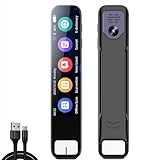
- 【Effortless Digitization】Easily convert physical books, documents, and handwritten notes into clear, searchable digital files with the AI Smart Pen Scanner.
- 【Learning Support】Utilize the built-in camera to scan printed or handwritten content for AI-guided explanations and concept breakdowns—available offline for uninterrupted access.
- 【Multilingual Navigation】View translations in over one hundred languages on the 3.5-inch display—simply scan foreign text for instant understanding.
- 【AI Productivity Assistant】Engage with an advanced AI interface via the AI Smart Pen Chat to gather information, enhance writing, and brainstorm ideas for your projects.
- 【Wireless Transfer】Sync recordings securely to your devices through WiFi, linking them with relevant scanned materials for easy review.
The experiment measured whether these submissions were detected in the university’s process. It was not a broad survey of instructors or a controlled comparison across universities, subjects, or assessment formats.
Free tools Windows power users keep installed
One-click scans. No signup required.
Did ChatGPT get better grades than students?
GPT-4-generated submissions in the study received higher marks on average than real student submissions, by about half a grade boundary. The reported 83.4% figure adds a separate comparison: across modules, the AI work had an 83.4% chance of outperforming an equal-sized random sample of student submissions. Neither result means every AI answer scored higher than every student answer.
What the findings do—and do not—show
The results are evidence that the assessment setup tested was vulnerable to undetected AI-written work. Their reach is limited to one UK university’s BSc Psychology program, five modules, GPT-4, and the questions and marking context used in the experiment.
- The study does not establish the same detection rate or marks in other universities, disciplines, or assessment designs.
- It tested GPT-4-generated answers, not every AI model or later model generation.
- It examined fully AI-written submissions, not student work edited or substantially rewritten by a person.
- It did not evaluate commercial AI detectors, so it cannot establish how reliable those products are.
- It was not a general “Turing Test” of whether people can distinguish AI from human writing; it tested detection within a particular institutional assessment process.
How did the university respond?
The University of Reading said the project informed its work on AI in research, teaching, learning, and assessment, and that updated advice had been issued to staff and students. Elizabeth McCrum, the university’s Pro-Vice-Chancellor for Education and Student Experience, said: “It is clear that AI will have a transformative effect in many aspects of our lives, including how we teach students and assess their learning.” That is the university’s comment on the implications, not a finding measured by the experiment.
Quick Recap
Best Value
- 【Effortless Digitization】Transform physical books, documents, and handwritten notes into clear, searchable digital files using the AI Pen scanner
- 【Learning Support】Scan the printed/handwritten content of Chat Pen with the built-in camera for AI-guided explanations, solution steps, and concept breakdowns—functionality available offline for continuous access
- 【Multilingual Navigation】Using Chat Pen Scanner view translations for over one hundred languages directly on the 3.5-inch display—simply scan foreign text
- 【 AI Productivity Assistant】 Access an advanced AI interface directly from the AI Smart Pen Chat . Obtain information through AI Smart Pen Chat Math, refine writing, explore topics, or brainstorm ideas to support your projects and learning
- 【Wireless Transfer】Securely sync recordings to your devices via WiFi and associate them with relevant scanned materials for review
Rank #4

- Use scikit-learn to track an example ML project end to end
- Explore several models, including support vector machines, decision trees, random forests, and ensemble methods
- Exploit unsupervised learning techniques such as dimensionality reduction, clustering, and anomaly detection
- Dive into neural net architectures, including convolutional nets, recurrent nets, generative adversarial networks, autoencoders, diffusion models, and transformers
- Use TensorFlow and Keras to build and train neural nets for computer vision, natural language processing, generative models, and deep reinforcement learning
Product prices and availability are accurate as of the date/time indicated and are subject to change. Any price and availability information displayed on Amazon at the time of purchase will apply.




