ADATA’s XPG GAMMIX S70 and S50 Lite target two very different corners of the PCIe 4.0 SSD market. The S70 is built to chase high-end throughput with a faster controller, aggressive specs, and a substantial heatsink, while the S50 Lite aims to bring Gen4 branding and solid everyday performance to a lower price point.
For gamers, creators, and PC builders, the real question is not just which drive posts the bigger sequential numbers, but which one delivers better value once thermals, sustained writes, random performance, endurance, warranty coverage, and street pricing are factored in. A fast SSD can look great on a spec sheet, but game load times, large project transfers, and long write sessions often reveal the more practical choice.
As an Amazon Associate I earn from qualifying purchases.
ADATA XPG GAMMIX S70 And S50 Lite Specs Compared
The XPG GAMMIX S70 and XPG GAMMIX S50 Lite both target PCIe 4.0 M.2 systems, but they sit in very different performance tiers. The S70 is ADATA’s higher-end drive, built to push early PCIe 4.0 platforms close to their limits with a flagship-class controller, higher sequential throughput, and stronger sustained write behavior. The S50 Lite is the more affordable option, still using a PCIe 4.0 interface, but with specifications that are closer to a fast PCIe 3.0 flagship than a top-end Gen4 SSD.
| Specification | XPG GAMMIX S70 | XPG GAMMIX S50 Lite |
|---|---|---|
| Form factor | M.2 2280 | M.2 2280 |
| Interface | PCIe 4.0 x4, NVMe | PCIe 4.0 x4, NVMe |
| Controller class | High-end 8-channel Gen4 controller | Entry-level Gen4 controller |
| NAND | 3D TLC NAND | 3D TLC NAND |
| DRAM cache | Yes | Yes |
| Advertised sequential read | Up to around 7,400 MB/s | Up to around 3,900 MB/s |
| Advertised sequential write | Up to around 6,400 MB/s | Up to around 3,200 MB/s |
| Capacities commonly available | 1TB and 2TB | 512GB, 1TB, and 2TB |
| Heatsink | Large preinstalled aluminum heatspreader | Thin low-profile heatspreader |
| Warranty | 5 years | 5 years |
The biggest specification gap is sequential bandwidth. The GAMMIX S70 is rated for roughly double the write speed of the S50 Lite and nearly double the read speed, depending on capacity. That matters most in workloads that can actually feed a fast NVMe drive: large video exports, disk-to-disk copies from another high-speed SSD, game capture files, virtual machine images, and workstation scratch storage. In lighter desktop use, both drives still feel extremely responsive because application launches and OS tasks depend more on latency and random performance than headline read speed.
#1 Best Overall
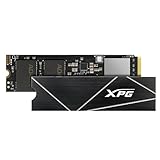
- R/W speed up to 7,400/6,800MB/s for PC/laptop
- Ultra-fast PCIe Gen4 x4 interface
- Compliant with NVMe 1.4
- Work with PS5, ROG Ally X
- Read speed up to 6,300MB/s for PS5
Capacity also affects the comparison. The S50 Lite is often easier to find in smaller and cheaper configurations, making it attractive for budget gaming builds that need a secondary drive for a Steam, Epic, or Game Pass library. The S70 makes more sense at 1TB or 2TB, where its higher-end controller and stronger write ratings can be used more effectively. Buyers should also check the exact model and capacity-specific endurance rating, because total bytes written typically scales upward with larger drives.
Both SSDs include features expected from modern NVMe drives, including SLC caching, LDPC error correction, AES encryption support on many retail listings, and a five-year warranty. The S70’s more aggressive hardware package gives it a clear specification advantage, but it also demands better airflow and more physical clearance around the M.2 slot. The S50 Lite’s thinner design is easier to fit under motherboard shields or in compact systems, though its lower ceiling means it is competing on price as much as performance.
Design, Controller, NAND, And Heatsink Differences
The XPG GAMMIX S70 and S50 Lite may both use the M.2 2280 form factor and PCIe 4.0 x4 interface, but they are built for different tiers of the market. The S70 is ADATA’s higher-performance drive, designed around a more aggressive controller and a larger cooling solution. The S50 Lite targets mainstream PCIe 4.0 buyers who want faster-than-PCIe-3.0 speeds without paying flagship SSD prices or dealing with oversized heatsinks.
Controller and flash configuration
The GAMMIX S70 uses the Innogrit IG5236 controller, an 8-channel PCIe 4.0 controller aimed at high-throughput NVMe drives. This controller gives the S70 the headroom needed for very high sequential reads and writes, while also helping with heavier mixed workloads such as large project transfers, game library moves, and scratch-disk activity. It is paired with 3D TLC NAND and DRAM cache, which helps maintain responsiveness when the drive is handling sustained writes or a large number of small file operations.
The S50 Lite uses the Silicon Motion SM2267 controller, a more modest 4-channel PCIe 4.0 design. It also uses 3D TLC NAND and includes DRAM, so it is not a bare-minimum budget SSD, but its controller is tuned for efficiency and affordability rather than maximum bandwidth. In practice, this means the S50 Lite can still feel quick in everyday desktop use, game loading, and normal file transfers, but it does not have the same parallelism or sustained throughput potential as the S70.
| Feature | XPG GAMMIX S70 | XPG GAMMIX S50 Lite |
|---|---|---|
| Controller | Innogrit IG5236 | Silicon Motion SM2267 |
| Controller channels | 8-channel | 4-channel |
| NAND type | 3D TLC NAND | 3D TLC NAND |
| DRAM cache | Yes | Yes |
| Cooling design | Large integrated aluminum heatsink | Thin heatspreader |
| Best fit | High-end desktops and heavy workloads | Mainstream builds and value-focused upgrades |
Heatsink design and system compatibility
The most visible difference is cooling. The GAMMIX S70 ships with a substantial aluminum heatsink that gives the drive a tall, angular profile. This design is useful because high-end PCIe 4.0 controllers can generate a fair amount of heat when pushed through long sequential writes or repeated benchmark loops. In a desktop motherboard with open M.2 clearance, the S70’s heatsink can help delay thermal throttling and keep performance more consistent. The trade-off is compatibility: it may not fit under motherboard-integrated M.2 shields, compact mini-ITX layouts, laptops, or some console-style enclosures.
The S50 Lite takes the opposite approach with a slim heatspreader. It is easier to install under motherboard covers and in tighter systems, and it draws less power than the S70 under load. That makes it more flexible for compact desktops and general upgrades. Its thinner cooling solution is also more appropriate for the controller’s lower heat output, though it still benefits from decent case airflow. For builders choosing between the two, the S70 feels like a performance part that expects proper cooling space, while the S50 Lite feels like a practical drop-in PCIe 4.0 upgrade for systems where cost, clearance, and balanced behavior matter more than peak numbers.
What’s actually slowing this PC down?
Pick the symptom - the matching free tool is one click away.
PCIe 4.0 Benchmark Performance: Sequential And Random Speeds
In synthetic PCIe 4.0 testing, the XPG GAMMIX S70 sits in a clearly higher performance class than the S50 Lite. The S70 is built to compete with flagship Gen4 drives, so its peak sequential throughput is the headline figure: reads can reach around 7,400 MB/s and writes around 6,400 MB/s on the 2TB model under ideal conditions. The S50 Lite is still a Gen4 SSD, but it behaves more like an enhanced midrange drive, with rated sequential reads up to roughly 3,900 MB/s and writes up to around 3,200 MB/s depending on capacity.
That gap shows up immediately in CrystalDiskMark-style sequential tests. Large-block reads favor the S70 heavily, especially on platforms with a full PCIe 4.0 x4 M.2 slot connected directly to the CPU. Moving from the S50 Lite to the S70 can nearly double peak read bandwidth, which matters for benchmark scoring, heavy media transfers, and scratch-disk workloads involving very large files. The S50 Lite, however, still lands well above typical PCIe 3.0 limits and can feel extremely quick in everyday use when compared with older NVMe drives.
| Benchmark Area | XPG GAMMIX S70 | XPG GAMMIX S50 Lite |
|---|---|---|
| Sequential read performance | Flagship PCIe 4.0 class, up to about 7.4 GB/s | Entry-to-mid Gen4 class, up to about 3.9 GB/s |
| Sequential write performance | Very strong, especially on higher capacities | Good, but closer to high-end PCIe 3.0 territory |
| Random read responsiveness | Excellent queue-depth scaling | Solid for gaming and desktop workloads |
| Random write performance | Higher peak IOPS and stronger sustained behavior | Competitive at lighter loads, weaker under pressure |
Random performance is more nuanced. At high queue depths, the S70’s controller and faster flash allow it to pull ahead by a wide margin, producing higher read and write IOPS in demanding benchmarks. This is the type of result that benefits workstation users dealing with parallel tasks, virtual machines, large project folders, or heavy content creation pipelines. The S50 Lite is not slow, but its random results are less aggressive, and it does not scale as strongly when the workload becomes more intense.
At low queue depths, the difference is smaller than the sequential numbers suggest. Game launches, Windows boot behavior, application startup, and general desktop snappiness often rely on small random reads where latency and firmware tuning matter as much as peak bandwidth. In those situations, both drives feel responsive, and the S50 Lite can deliver much of the perceived NVMe experience at a lower cost. The S70 still has the better ceiling, but the advantage is most visible when the system is pushing enough data to use its extra bandwidth.
Windows Errors? Fix Them Before They Spread
Repair common Windows errors and clear accumulated junk for a smoother, more stable PC - no reinstall needed.Free scan · no reinstallCrashes, No Sound, or Screen Glitches?
Random freezes, missing sound and display glitches usually trace back to one bad driver. Find and replace yours safely.Free scan · under a minuteCapacity also affects benchmark results. Larger versions of both drives usually perform better because they have more NAND dies available for parallel access and larger dynamic SLC cache behavior. A 2TB S70 is the strongest configuration for peak numbers, while lower-capacity S50 Lite models may show reduced write speeds once cache behavior and NAND layout are factored in. For benchmark-focused buyers, the S70 is the obvious winner; for users chasing a practical PCIe 4.0 upgrade without paying flagship prices, the S50 Lite remains fast enough to avoid feeling like a budget compromise in lighter workloads.
Real-World Gaming, File Transfer, And Workload Results
Benchmark charts make the XPG GAMMIX S70 look like the clear performance drive, and in heavy desktop use that advantage does show up. The S70 is the better fit when the task involves moving large amounts of data quickly, such as copying a 100GB game folder, exporting a large video project, unpacking a compressed archive, or working with high-resolution media files. Its stronger controller and higher-end PCIe 4.0 implementation give it more headroom when reads and writes happen at the same time, which is where cheaper Gen4 drives often start to feel closer to fast PCIe 3.0 models.
Rank #2

- Imagine it, achieve it instantly The LEGEND 860 boasts a sequential read/write speed of 6,000/5,000MB per second, 3 times faster than standard PCIe Gen3 SSDs and 10 times faster than SATA SSDs, and it is fully backward compatible with current PCIe 3.0 platforms. This drive provides excellent output for mid-to-high-end productions such as film and television animation, machine learning, and product modeling!
- The LEGEND 860 utilizes a PCIe 4.0 transmission interface and can be installed in the PS5 as an expansion hard drive to alleviate PS5 storage insufficiency issues. Not only does the LEGEND 860 fit perfectly into the PS5'a drive slot, it also provides a smooth and no-lag gaming experience while enjoying triple A masterpieces.
- Beyond Elite LEGEND 860 utilizes a SLC cache algorithm and HMB (Host Memory Buffer) technology to take advantage of caching and adopts LDPC (Low Density Parity Check Code) error correction mechanism to ensure the accuracy of data transmission and file security.
In gaming, the gap is smaller. Game launch times, level loads, shader cache reads, and asset streaming are rarely limited by peak sequential throughput alone. A fast PCIe 3.0 SSD, the S50 Lite, and the S70 can all feel very similar once a game is installed. In titles such as open-world RPGs, large shooters, and racing games, the S70 may shave a few seconds from initial loading or map transitions, but it does not transform the experience in the same way that moving from a hard drive to any NVMe SSD does. For a gaming-first build, the S50 Lite still delivers the snappy desktop response and low latency most players expect.
Where the S70 feels faster
- Large game library transfers: moving Steam, Epic, or Xbox app folders between drives favors the S70, especially with files that total hundreds of gigabytes.
- Content creation: editing 4K footage, handling RAW photo batches, and rendering scratch files benefit from the S70’s higher sustained write capability.
- Archive extraction: unpacking large ZIP, RAR, or 7z files is quicker when the SSD can handle simultaneous reads and writes without dropping as sharply.
- Direct-to-drive capture: recording high-bitrate gameplay or production footage is safer on the S70 when long sustained writes are expected.
The S50 Lite is more appealing in lighter real-world workloads. Windows boot, app launches, browser cache activity, Discord, game clients, and common productivity software do not push a PCIe 4.0 SSD hard enough to expose the full gap. It also works well as a secondary game drive, where read-heavy behavior dominates after installation. If the workload is mostly downloading games, launching them, and occasionally moving a folder, the value model is fast enough that the extra spend on the S70 may be better used for a larger capacity, more RAM, or a faster GPU.
The Tool Desk
Outbyte Driver Updater FREEFix the driver behind crashes, sound loss and screen glitchesFind Drivers →Outbyte PC Repair FREERepair Windows errors before they cause bigger problemsFix Now →For creators and power users, consistency matters more than a single peak number. The S70 is the drive to choose if the system regularly handles video timelines, virtual machines, large project folders, or repeated copy jobs. The S50 Lite is the practical pick for mainstream gaming PCs and budget PCIe 4.0 builds where responsiveness matters but workstation-grade throughput is not required. In day-to-day use, both drives feel modern and quick; the S70 earns its premium when the workload is large, sustained, and write-heavy.
Thermals, Power Efficiency, And Sustained Performance
The XPG GAMMIX S70 and S50 Lite behave very differently once heat and long writes enter the picture. The S70 is the faster drive, but its high-end PCIe 4.0 controller also draws more power and produces more heat under heavy load. ADATA pairs it with a substantial aluminum heat spreader, and that cooler is not just cosmetic: during extended transfers, the S70 benefits from direct airflow or a motherboard M.2 heatsink to keep peak speeds from dipping sooner than expected.
In a typical gaming PC with reasonable case airflow, the S70 generally stays well within safe operating limits during game launches, level loads, and normal desktop use. The drive can get warm during large installs, 4K video dumps, or repeated benchmark passes, especially if it sits under a graphics card. When temperatures climb high enough, the controller reduces performance to protect the NAND and controller. That throttling is most visible in long sequential writes, where the S70 may start extremely fast, then settle into a lower sustained rate after its SLC cache is exhausted and thermals build.
The S50 Lite is easier to cool. Its PCIe 4.0 x4 interface does not translate into flagship-class throughput, but the less aggressive controller helps it run cooler and use less power in everyday workloads. For small-form-factor systems, laptops that support M.2 2280 drives, or compact builds with limited airflow, the S50 Lite’s lower heat output can be an advantage. It may not win peak-speed charts, but it is less demanding from a cooling standpoint and less likely to turn the area around the M.2 slot into a hotspot during mixed workloads.
Do these 3 things before closing this tab:
1Fix the driver behind crashes, sound loss and screen glitches2Clear out junk files and repair common Windows errors3Scan for outdated or missing drivers - takes under a minuteSustained behavior under heavy writes
- XPG GAMMIX S70: Best suited to workloads that benefit from very high burst and sustained PCIe 4.0 bandwidth, provided the drive has adequate cooling.
- XPG GAMMIX S50 Lite: Better suited to lighter creator work, gaming libraries, and general PC use where efficiency and price matter more than maximum write endurance under pressure.
- Thermal sensitivity: The S70 needs more attention to heatsink fitment and airflow; the S50 Lite is more forgiving in cramped systems.
- Long transfers: Both drives slow after cache saturation, but the S70 maintains a higher performance ceiling when cooled properly.
Power efficiency also affects platform choice. On a desktop, the S70’s higher draw is rarely a concern if the motherboard heatsink is decent. In a book or compact workstation, that extra power can mean more fan activity and slightly shorter battery life during storage-heavy tasks. The S50 Lite’s lower performance comes with a practical efficiency benefit, making it a sensible pick when the drive will spend most of its time launching games, loading projects, and moving moderate-size files rather than ingesting hundreds of gigabytes at once.
For sustained performance, the S70 is the stronger drive, but only when the system supports it thermally. Builders chasing high-speed scratch-disk use, large media transfers, or frequent game capture writes should treat cooling as part of the purchase. The S50 Lite is not as fast, yet its cooler and more efficient behavior makes it easier to recommend for mainstream gaming rigs where consistency, low heat, and lower cost are more valuable than headline throughput.
Pricing, Warranty, And Value Versus Competing SSDs
Street pricing is where the ADATA XPG GAMMIX S70 and S50 Lite separate most clearly. The GAMMIX S70 was built to compete with top-tier PCIe 4.0 drives, so it makes the most sense when it is priced below premium models such as the Samsung 980 Pro, WD Black SN850/SN850X, Seagate FireCuda 530, and Corsair MP600 Pro XT. If it sits close to those drives, the decision becomes less obvious, because several rivals offer stronger software ecosystems, broader retail availability, or more consistently documented component sourcing. At a discount, though, the S70 delivers the kind of high-end sequential throughput and strong mixed-workload behavior that still feels appropriate for a performance gaming or creator PC.
The GAMMIX S50 Lite plays a different role. It is not trying to beat flagship PCIe 4.0 SSDs in peak bandwidth; instead, it targets buyers who want a Gen4-capable drive without paying flagship money. That puts it against value-oriented models such as the Crucial P3 Plus, WD Black SN770, TeamGroup MP44L, Silicon Power UD90, and budget Phison E21T-based drives. In that crowd, the S50 Lite is most attractive when it undercuts faster DRAM-less competitors by a useful margin or when bundled with a motherboard, laptop, or sale promotion. If it is priced too close to newer midrange drives like the SN770 or Solidigm P44 Pro, its older performance profile is harder to justify.
Free tools Windows power users keep installed
One-click scans. No signup required.
Both drives typically carry a five-year limited warranty, which is competitive for consumer NVMe SSDs. Endurance ratings vary by capacity, but the S70 generally has the stronger write-endurance positioning, making it a better fit for users who regularly move large project folders, record gameplay footage, edit video, or maintain scratch/cache workloads. The S50 Lite still offers enough endurance for a gaming library, boot drive, school machine, or general desktop build, but it is less compelling for write-heavy production use. As always, the warranty is limited by either the time period or the total bytes written rating, whichever comes first.
| Drive | Best Value Scenario | Main Competing Class | Buyer Fit |
|---|---|---|---|
| ADATA XPG GAMMIX S70 | Discounted below flagship PCIe 4.0 SSDs | Samsung 980 Pro, WD Black SN850X, FireCuda 530 | High-end gaming, content creation, large transfers |
| ADATA XPG GAMMIX S50 Lite | Clearly cheaper than newer midrange Gen4 drives | WD SN770, Crucial P3 Plus, TeamGroup MP44L | Budget gaming builds, boot drives, mainstream PCs |
For value-focused builders, capacity pricing matters more than the badge on the box. A 2TB S50 Lite at a steep discount can be more useful than a faster 1TB flagship drive if the system mainly stores modern games, media, and applications. Conversely, a 1TB or 2TB S70 becomes the better buy when the premium over the S50 Lite is modest, because it provides more headroom for sustained transfers, heavier multitasking, and future GPU-direct storage workloads. The S70 also pairs better with high-end desktops where the rest of the platform is already tuned for performance.
Against today’s SSD market, the S70 should be judged as a performance deal, while the S50 Lite should be judged as a capacity deal. Choose the S70 when it is meaningfully cheaper than the fastest Gen4 competitors but still close in real-world responsiveness. Choose the S50 Lite when the price per gigabyte is low enough to outweigh its weaker peak performance. For most gamers, the cheaper drive at the larger capacity will often feel better day to day; for creators and power users, the S70’s higher ceiling is worth paying for when the sale price is right.
Rank #3

- Blazing-Fast PCIe Gen5 Performance – Enjoy ultra-high speeds with up to 14,000MB/s read and 12,000MB/s write, delivering next-level performance for gaming, content creation, and demanding workloads.
- Next-Gen NVMe 2.0 Interface – Built on the latest PCIe Gen5 x4 and NVMe 2.0 protocols, ensuring maximum bandwidth and future-proof storage compatibility.
- High-Endurance DRAM Cache – Features onboard DRAM caching for accelerated system responsiveness and better sustained speeds during heavy data loads.
- Available in 1TB, 2TB, and 4TB Capacities – Choose the size that fits your needs with ample room for games, media, and productivity files. Read speed up to 6,500MB/s for PS5
- Reliable and Durable – Thermal throttling protection, and S.M.A.R.T. monitoring for dependable long-term performance.
Which ADATA XPG SSD Should You Buy?
The better buy depends on whether you need peak PCIe 4.0 throughput or simply want a fast NVMe drive at a lower cost. The ADATA XPG GAMMIX S70 is the performance pick: it is built for users who move large files, edit high-bitrate video, compile big projects, or want one of the faster Gen4 drives for a high-end desktop. The XPG GAMMIX S50 Lite is the value pick: it gives you a clear step up from PCIe 3.0 SSDs in many systems, but without the premium pricing, larger heatsink, or higher power draw of the S70.
Recommended Free Tools
Gamers should look closely at capacity and price before paying extra for the S70. In today’s games, load times are usually constrained by game engines, decompression, CPU performance, and platform behavior as much as raw sequential bandwidth. The S70 can be quicker in synthetic tests and heavy asset transfers, but the S50 Lite is already responsive enough for a game library drive, especially at 1TB or 2TB. If the price gap lets you buy a larger S50 Lite instead of a smaller S70, the bigger drive is usually the smarter gaming purchase.
Best fit by user type
- High-end gaming PCs: Choose the S70 if you want a premium boot and game drive for a PCIe 4.0 desktop with good airflow, especially if pricing is close to other flagship Gen4 SSDs.
- Mainstream gaming builds: Choose the S50 Lite if you want fast load times, good everyday responsiveness, and more capacity per dollar.
- Content creators: Choose the S70 for 4K/6K video work, large photo catalogs, scratch-disk use, and frequent transfers of hundreds of gigabytes.
- Laptops and compact PCs: Choose carefully. The S50 Lite’s lighter thermal demands can make it easier to live with, while the S70 needs enough cooling clearance and airflow to maintain its best speeds.
- Budget PCIe 4.0 upgrades: Choose the S50 Lite when the goal is a modern Gen4 platform drive without paying flagship SSD money.
The S70 is the drive to buy when sustained performance matters. Its stronger controller, higher sequential ceiling, and more aggressive design make it better suited to write-heavy workloads and large project movement. If you regularly clone drives, copy game capture footage, export large media files, or run demanding workstation tasks, the S70’s extra performance is not just a benchmark number; it can reduce waiting time and keep the system feeling faster under pressure. Its heatsink is also part of the package, so it is best used in desktops where the added height is not an issue.
The S50 Lite makes more sense when value, capacity, and broad compatibility matter most. It still delivers the low-latency feel people expect from NVMe storage, and it is fast enough for Windows, applications, game libraries, and general productivity. It will not match the S70 in heavy sequential workloads, but many users will rarely create conditions where that difference changes the experience. For a balanced build, the money saved can go toward a better GPU, more RAM, or a larger SSD capacity, all of which may have a bigger practical impact.
If both drives are close in price at the same capacity, buy the XPG GAMMIX S70. It has the stronger performance profile and gives high-end PCIe 4.0 systems more headroom. If the S50 Lite is meaningfully cheaper, or if it lets you step up from 1TB to 2TB within the same budget, buy the XPG GAMMIX S50 Lite. For most gamers and everyday PC builders, the S50 Lite is the more sensible value choice; for creators, enthusiasts, and users who routinely push storage hard, the S70 is the SSD worth paying extra for.
Quick wins for a faster PC:
Fix the driver behind crashes, sound loss and screen glitchesFind Drivers →Repair Windows errors before they cause bigger problemsFix Now →Frequently Asked Questions
Is the ADATA XPG GAMMIX S70 noticeably faster than the S50 Lite in games?
In most current games, the S70 will not feel dramatically faster than the S50 Lite for loading screens or level transitions. The S70 has much higher peak PCIe 4.0 bandwidth, but many games still do not fully use that extra speed. If your main use is gaming, the S50 Lite is usually the better value unless the price gap is small.
Which drive is better for video editing, large file transfers, and creator workloads?
The GAMMIX S70 is the better choice for heavy creator workloads because it offers stronger sequential performance and better sustained throughput. Large 4K/8K video files, project exports, and frequent file transfers benefit more from the S70’s higher-end controller and faster NAND configuration. The S50 Lite can handle casual editing, but it is less ideal for long, write-heavy sessions.
Do the S70 and S50 Lite need motherboard heatsinks?
The S70 benefits more from strong cooling because high-end PCIe 4.0 drives can get hot during sustained transfers. If your motherboard has an M.2 heatsink, use it, especially for the S70. The S50 Lite typically runs cooler, but airflow and a heatsink can still help maintain consistent performance in compact or high-temperature builds.
Are the ADATA XPG GAMMIX S70 and S50 Lite good choices for a PS5?
The GAMMIX S70 is the more suitable PS5 option because its performance better matches Sony’s recommended speed range for storage expansion. It should be used with a compatible low-profile heatsink that fits inside the PS5’s M.2 bay. The S50 Lite is a PCIe 4.0 drive, but its lower performance makes it a less ideal pick for PS5 use.
Which SSD should I buy if the S70 costs only a little more than the S50 Lite?
If the S70 is only slightly more expensive, it is usually worth paying extra for the higher performance ceiling and better suitability for demanding workloads. It gives more headroom for future games, DirectStorage-style asset streaming, and large file work. If the S50 Lite is significantly cheaper, it remains the smarter buy for budget gaming and everyday PC builds.
Bottom Line
The ADATA XPG GAMMIX S70 is the better pick if you want top-tier PCIe 4.0 throughput for heavy game libraries, large file transfers, content creation, and a high-end build where performance matters more than price. Its speed and stronger thermal design make it the more compelling enthusiast drive, especially if your workload can actually use the extra bandwidth.
The XPG GAMMIX S50 Lite is the smarter value choice for most gamers and mainstream PC builders, delivering a noticeable step up from PCIe 3.0 without the premium cost of flagship Gen4 SSDs. Choose the S70 for maximum performance, but buy the S50 Lite if you want the better balance of speed, capacity, and price.
Quick Recap
Product prices and availability are accurate as of the date/time indicated and are subject to change. Any price and availability information displayed on Amazon at the time of purchase will apply.




