Recommended Free Tools
The 6.0L Power Stroke is the higher-output, more technically complex engine; the 7.3L is the larger-displacement, simpler design. For a used-truck buyer, neither is automatically the better choice: the vehicle’s exact engine, configuration, maintenance history, condition, and intended work matter more than a generation-wide reputation.
At a glance: 6.0L vs. 7.3L Power Stroke
| Comparison | 7.3L Power Stroke | 6.0L Power Stroke |
|---|---|---|
| Ford-listed model years | 1994–2003 | 2003–2007 |
| Displacement and valves | 444 cubic inches; two valves per cylinder | 365 cubic inches; four valves per cylinder |
| Factory output reported by MotorTrend | 210 hp and 425 lb-ft in 1994 configurations, rising to as much as 275 hp and 525 lb-ft in later configurations | 325 hp; 560 lb-ft for 2003–2004 and 570 lb-ft for 2005–2007 configurations |
| Design emphasis | Older, less complex design | Variable-geometry turbocharger, exhaust gas recirculation (EGR), and second-generation fuel injection technology |
Ford lists both engines in 2003, so the model year alone does not establish which engine a particular truck has. Check the vehicle itself and its documentation. The year ranges and technology description come from Ford’s Power Stroke history; the displacement, valve counts, and output figures are reported in MotorTrend’s 2020 engine comparison.

As an Amazon Associate I earn from qualifying purchases.
Which engine makes more power?
The 6.0L has the higher factory output in the cited comparison. MotorTrend reports 325 hp and 560 lb-ft for 2003–2004 6.0L configurations, and 570 lb-ft for 2005–2007 configurations. For the 7.3L, it reports 210 hp and 425 lb-ft in 1994 configurations, increasing in later configurations to 275 hp and 525 lb-ft.
These are published ratings by year and configuration, not measurements from a particular used truck. Actual output depends on the vehicle and its condition; do not assume every truck within a model-year range has identical specifications or performance.
#1 Best Overall
How do their designs differ?
7.3L: larger displacement and a simpler design
The 7.3L displaces 444 cubic inches and uses two valves per cylinder, according to MotorTrend. It is the older of the two engines and is commonly valued for its less complex design. That relative simplicity can be an appealing ownership characteristic, but it does not prove that any particular 7.3L is in good condition or will be inexpensive to maintain.
6.0L: more output and additional systems
The 6.0L displaces 365 cubic inches and uses four valves per cylinder. Ford says it introduced variable-geometry turbocharger technology, an exhaust gas recirculation system, and an advanced second-generation fuel injection system. These systems are part of the engine’s more modern design and are relevant when assessing maintenance and repair needs; their presence alone is not evidence that a specific truck has a fault.
Rank #2

- 🚗【NOTE】: When your beloved car's wiring harness,wire breakage, Aging and poor contact of connectors,breakage,need to change it. Car compatibility is for reference, please also confirm your part OEM number. Please order with confidence.
- 🚗【Application】: Fits for 2002-2003 F250 F350 7.3L V8 Power-Stroke Diesel Engine Wiring Harness.
- 🚗【High Quality】: Made of high-quality materials and clever design, and rigorously tested and verified to ensure long-term stable operation and high reliability.
- 🚗【Features】: High reliability, stable performance, easy installation, fast response, high temperature resistance, long service life, and can better meet your needs.
- 🚗【NOTE】: Car compatibility is for reference, please also confirm your part OEM number. Please order with confidence.
Which is better for a used-truck buyer?
Choose based on the individual truck and what you need it to do, rather than treating online reputation as a reliability statistic. MotorTrend’s comparison describes the 7.3L favorably for durability, but that is a qualitative editorial assessment. The available evidence does not establish a controlled comparative failure rate, expected service life, or universal lifecycle-cost winner for either engine.
The Tool Desk
Outbyte Driver Updater FREEFix the driver behind crashes, sound loss and screen glitchesFind Drivers →Outbyte PC Repair FREERepair Windows errors before they cause bigger problemsFix Now →Quick Recap
Best Value

- PERFECT FIT FOR FORD 6.7L POWER STROKE: Spelab intake manifold direct replacement for factory intake manifold. Fits for ford 6.7L power stroke diesel engines, model years 2011 2012 2013 2014, and 2017 2018 2019. Includes a complete installation kit for hassle-free installation.
- INTEGRATED CAST ALUMINUM STRUCTURE — BUILT TO LAST: Unlike the fragile factory manifold—which is prone to cracking due to thermal cycling—this manifold by Spelab, designed specifically for the Ford 6.7L engine, is precision-cast from high-quality aluminum. Capable of effectively withstanding the extremely high temperatures, severe vibrations, and diverse environmental conditions found within the engine compartment.
- EASY INSTALLATION: Original factory (OE) mounting holes ensure precise fit and can be installed directly.
- ULTIMATE CHOICE FOR HEAVY-DUTY OFF-ROAD TOWING: Designed for demanding conditions, such as towing heavy trailers (e.g., RVs, equipment haulers, or livestock trailers) and driving on long, steep grades.
- DESIGNED FOR A SUPERIOR DRIVING EXPERIENCE: The Spelab intake manifold is perfectly compatible with a wide range of intake systems. Our goal is to provide you with an enhanced driving experience.
Rank #4
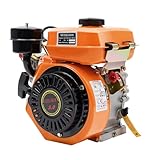
- Diesel Engine: 196 cc displacement, four-stroke, 2.2 kW power, 3000 rpm; powerful performance, suitable for heavy-duty tasks; 3-liter (126.8-ounce) fuel tank supports extended operation without frequent refueling, ideal for use on farms or in workshops.
- Single-cylinder air-cooled diesel engine: Equipped with a forced air cooling system; Ventilation slots help reduce temperature and extend engine lifespan; a low-noise muffler creates a comfortable working environment.
- 3 HP diesel engine: Features a high-end aluminum alloy construction; shot-blasted and powder-coated for a smooth, durable finish; excellent rust resistance; equipped with a threaded flow diesel system and single-valve fuel injection, ensuring low emissions and stable operation.
- Manual starting mechanism: Features a simple recoil starter system for easy engine startup; Ergonomically designed throttle lever; pressure relief cap for easy starting; air filter with paper filter element for thorough filtration and easy maintenance.
- Wide range of applications: 4-cylinder, fuel-efficient diesel engine with a fuel consumption rate of ≤280 g per kWh; suitable for micro tillers, water pumps, grinders, plate compactors, small tractors, concrete mixers, and more.
Rank #3
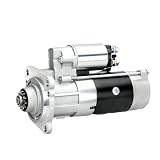
- VEHICLE FITMENT - Fits Ford (1994-2001) trucks and vans, including F-250, F-350 Super Duty, E-350, E-450, F-450, F-550, and Excursion models with 7.3L V8 Diesel Power Stroke engine applications. Verify fitment via Amazon Confirmed Fit or Product Images
- Replaces OEM part numbers: 16652, 17578N, Ford F4TZ-11002-A, F4TZ-11002-ARM, F5TU-11000-AA, F5TU-11000-AB, F5TU-11000-AD, Mitsubishi M008T50071, M008T50072, Valeo TM000A19101
- 3.6kW PLGR starter, 12V, CW rotation, and 12-tooth pinion gear, delivering strong cranking power and reliable engine starts for Ford diesel trucks, vans, and heavy-duty applications
- 100% tested for voltage stability, and cranking performance, ensuring reliable operation and meeting or exceeding OEM standards before shipment
- Includes a 1-year manufacturer warranty covering manufacturing defects. Contact seller via Amazon for support
- Consider the 6.0L if its higher cited factory output suits your needs and the specific truck’s condition and service history check out.
- Consider the 7.3L if you prefer the older, simpler design and find a well-maintained example that fits your intended use.
- For either engine, verify the exact engine and configuration, review service records, and have the vehicle’s current condition assessed before buying.
What to verify before buying
- Identify the engine. Because Ford lists both generations for 2003, confirm the engine in the actual vehicle rather than relying on the model year. Check its identification and documentation.
- Match the specifications to the truck. Compare the vehicle’s year and configuration with the published figures; generation-level ratings do not establish an individual truck’s output or condition.
- Review maintenance records and inspect the vehicle. Look for evidence of work performed and have the truck evaluated for its present condition. A reputation attached to a generation cannot substitute for this check.
- Diagnose faults before ordering parts. If a 6.0L EGR cooler is a concern, verify the fault and check fitment by VIN, model year, and exact application. An NHTSA-hosted catalog lists EGR cooler and related kit categories with different application details; it is not a repair directive or proof that every 6.0L needs replacement. See the NHTSA-hosted parts catalog.
Product prices and availability are accurate as of the date/time indicated and are subject to change. Any price and availability information displayed on Amazon at the time of purchase will apply.




