What’s actually slowing this PC down?
Pick the symptom - the matching free tool is one click away.
No—not on that evidence alone. A leaf certificate can be current and match a hostname while a client still cannot build and accept a certification path to a trust anchor. Checking the leaf and validating the chain are different checks, and a successful result applies only to the validator and configuration that produced it.
What the leaf certificate tells you—and what it does not
The leaf is the endpoint certificate presented for the service: it binds a public key to an identity such as a hostname. A leaf-focused monitor can report fields such as its expiration date or identity, depending on what the monitor checks. Those observations do not, by themselves, establish that the certificate can be linked through suitable intermediates to a certificate authority the client trusts.

As an Amazon Associate I earn from qualifying purchases.
Path validation evaluates a sequence of certificates in relation to a trust anchor. RFC 5280 describes the target certificate as the end of a prospective path and the trust anchor as an input to validation. The path must satisfy applicable checks at the time of validation; it is not enough for the leaf alone to be unexpired. RFC 5280, Section 6
In practical terms, an endpoint may present a leaf and one or more intermediate certificates, while the client supplies its own trust anchors. A missing or unsuitable intermediate, an untrusted root, or a policy or purpose mismatch can prevent acceptance even when the leaf looks fine.
#1 Best Overall

- ENDLESS POWER FROM SOLAR ENERGY: Just 45 minutes of direct sunlight powers the camera for a full day of use, while the built-in battery lasts up to 180 days on a single charge during cloudy days. Solar charging requires temperatures above 32°F.△
- EASY WIRE-FREE INSTALLATION: Place the Tapo SolarCam C402 KIT where you need it without relying on nearby outlets. Install the camera and solar panel together or separately using the included 13 ft cable for flexible placement.
- PRIORITIZE WHAT MATTERS: Set activity zones to monitor specific areas for motion or people. Free person and motion detection helps reduce unwanted alerts and notifies you when activity is detected.
- VERSATILE VIDEO STORAGE: Store footage locally via a microSD card (up to 512GB)* or via cloud with a Tapo Care cloud subscription. Tailor your security to suit your needs, whether indoor or outdoor, you have the storage option you need.
- FULL-COLOR 1080P, DAY AND NIGHT: See clearly in low light with a large-aperture lens and built-in spotlights. Capture full-color night vision up to 30 ft away to monitor for possible intruders or motion.
Presented certificates are not the same as a verified chain
A TLS server sends certificates during the handshake, but seeing that list is not proof that a particular client can validate it. OpenSSL documents that s_client -showcerts displays the certificates sent by the server, in the order sent; its documentation warns, “It is not a verified chain.” OpenSSL s_client documentation
This distinction matters when interpreting monitoring output. A report that records the leaf—or even lists every certificate the server sent—answers what was observed. A path-validation result answers whether a defined validator accepted the certificates under its rules and trust configuration.
Rank #2

- Enhanced Visual Experience: Immerse yourself in clear and vibrant visuals with the JINSWY 10.1-inch mini monitor. Featuring a 1024×600 resolution, 16:9 aspect ratio, 300 cd/m² brightness, and a 500:1 contrast ratio, it delivers sharp images and balanced colors for everyday viewing. Designed for practical display performance, it offers reliable clarity for work, monitoring, and entertainment.
- Versatile Video Inputs: Equipped with HDMI, VGA, BNC, AV, and USB ports, this small HDMI monitor is compatible with Raspberry Pi, DSLR cameras, PCs, DVDs, TV boxes, Xbox, Nintendo Switch, CCTV systems, car backup cameras, video switchers, FPV setups, and more. Easily turn it into a mini TV by connecting it to a TV box. Perfect for use as a security camera monitor or as part of a small computer monitor setup.
- Portable & Durable Design: JINSWY mini monitor features a slim, lightweight profile with a durable plastic shell, built to withstand everyday use. Measuring 9.92 × 6.5 × 1.34 inches, it is compact enough for mobile, embedded, or space-limited environments — ideal for applications ranging from backup cameras to security systems, and more. This VGA monitor is designed for long-lasting performance across various setups.
- Flexible Installation Options: Mount the portable small computer monitor on the wall using a standard VESA 75 mount (not included) or set it up on a desk with the included adjustable stand. The included remote controller allows for easy operation within a range of 10 meters, adding convenience and flexibility to your setup.
- Wide Range of Applications: Suitable for various uses including home security systems, vehicle displays, Raspberry Pi projects, office multitasking, and entertainment setups. Whether used as a mini monitor, small HDMI monitor, security camera monitor, or VGA monitor, it adapts seamlessly to different environments and needs.
What a meaningful path check needs to define
A useful verification check makes its assumptions explicit rather than treating “valid” as universal. RFC 5280 makes the trust anchor an input to the algorithm. OpenSSL likewise documents verification in terms of a configured trust store and the intended certificate purpose. Its options documentation describes its own implementation; other TLS stacks may use different settings or behavior. OpenSSL verification options
Recommended Free Tools
- Trust store: Which roots or trust anchors does the checker use? A path accepted with one store may not be accepted with another.
- Hostname and purpose: Does the check verify the target hostname and that the certificate is suitable for the intended server use?
- Time and options: When was validation performed, and what verification options or policies were enabled?
- Result handling: Does the tool report verification success or failure, or merely show certificates observed during the handshake?
For OpenSSL, the verification-options documentation says that, unless partial-chain mode is enabled, successful verification requires either only the root certificate or an uninterrupted chain to a root in the trust store. This is OpenSSL-specific behavior, not a universal rule for every TLS client.
Rank #3

- 17inch LED Security Monitor, Ultra fine pixel pitch for close viewing in surveillance applications,170 °viewing angle for fewer restrictions on your range of vision
- CCTV monitor:With multiple ports: HDMI, AV, 3.5mm Audio Input/Output and VGA. perfect for connecting with CCTV monitor and DVR system. Also works for PC, DVD Box and MP5 etc..
- Functions: This security monitor screen comes with 2 built-in speakers. With built-in USB port media player. It can play movies or videos simply by USB disk. Great for Home/Office/Store Surveillance Camera STB, DVR, NVR, PC, DVD Player.
- Package Included & Best Service: 17inch CCTV security monitor x1,Power Adaptor x 1, Remote Control x 1,Manual x 1. DOA or within 30 days free money back, or unconditional replacement within 1 Year. Should you have any problem please feel free to contact us, we always stand behind the products.
- monitor for security cameras
How to check what the endpoint sends and whether OpenSSL accepts it
Use separate observations for the server’s presented certificates and the validator’s decision. For example, OpenSSL’s s_client can show the certificates sent by the server and, with verification configured, test the connection. The exact trust-store path depends on the host and OpenSSL installation, so specify the one intended for the check.
- Choose the connection context. Record the hostname, port, and (where relevant) the address or monitoring vantage point. Use the hostname for SNI and hostname verification.
- Inspect the presented list. Run
openssl s_client -connect example.com:443 -servername example.com -showcerts. This displays what the server sent; it does not, on its own, establish that the list forms a trusted path. - Run verification with the intended trust store. For example, use
openssl s_client -connect example.com:443 -servername example.com -verify_hostname example.com -verify_return_error -CAfile /path/to/trust-store.pem. Provide a trust file appropriate to the environment; OpenSSL’s available options and defaults can vary by installation. - Retain the outcome and context. Keep the verification result or error with the observation time, endpoint, hostname, and trust-store identity. A failed verification is actionable evidence; a successful result describes that particular check.
OpenSSL’s test utility can display verification errors and continue unless -verify_return_error is used. Enabling that option makes verification errors stop the connection rather than allowing a probe to appear successful after reporting an error. Consult the OpenSSL s_client options for the version installed in your environment.
Rank #4
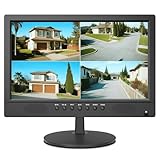
- 16inch LED Security Monitor, Ultra fine pixel pitch for close viewing in surveillance applications,170 °viewing angle for fewer restrictions on your range of vision
- CCTV monitor:With multiple ports: HDMI, AV, 3.5mm Audio Input/Output and VGA. perfect for connecting with CCTV monitor and DVR system. Also works for PC, DVD Box and MP5 etc..
- Functions: This security monitor screen comes with 2 built-in speakers. With built-in USB port media player. It can play movies or videos simply by USB disk. Great for Home/Office/Store Surveillance Camera STB, DVR, NVR, PC, DVD Player.
- Package Included & Best Service: 15.6inch CCTV security monitor x1,Power Adaptor x 1, Remote Control x 1,Manual x 1. DOA or within 30 days free money back, or unconditional replacement within 1 Year. Should you have any problem please feel free to contact us, we always stand behind the products.
- monitor for security cameras
Account for different client trust stores
If your service has materially different client populations, validate against trust stores or client-like environments that represent those populations. This follows from the fact that trust anchors are inputs to validation, not a universal property of the endpoint. No single remote probe can establish acceptance by every possible device, operating system, application, or configured trust store.
Check revocation separately from expiry
A certificate’s date fields do not report whether it has been revoked. Revocation checking is a distinct part of certificate assessment, and its coverage depends on the validator and the policy you configure. The SNIA TLS Specification v2.2 says TLS clients and servers shall validate certificates according to RFC 5280 Section 6 and that revocation status of each certificate in the certification path should be checked. That is the requirement stated by this specification; it does not mean every application or deployment automatically checks revocation for every certificate.
Document whether your monitoring checks revocation, which certificates it covers, and what happens when status cannot be determined. Do not treat a leaf-expiry alert—or a successful path check without an explicit revocation policy—as proof that every certificate in the path has current, checked revocation status.
What to expect from certificate monitoring
Separate monitoring into two records: what the endpoint presented and whether a defined validator accepted a path. Capture the endpoint, port, SNI or hostname, observation time, and relevant vantage point where the system supports them. For the validation record, retain the trust-store context, hostname and purpose checks, result, and error. This makes it possible to distinguish a certificate-list change from a validation failure, and to understand precisely what a green status means.
Quick Recap
Product prices and availability are accurate as of the date/time indicated and are subject to change. Any price and availability information displayed on Amazon at the time of purchase will apply.
Do these 3 things before closing this tab:
1Repair Windows errors before they cause bigger problems2Scan for outdated or missing drivers - takes under a minute3Clear out junk files and repair common Windows errors
