Recommended Free Tools
Greasy food residue usually means wash water, detergent, heat, or cycle completion is falling short—not that the dishwasher simply needs more detergent. Start by confirming the cycle finished, then clean the filter, clear and test the spray arms, reload so water can reach every soiled surface, and verify that fresh automatic-dishwasher detergent is dispensed correctly. Only after those checks should you investigate incoming-water temperature or arrange service.
First identify the residue. A slippery coating or visible food is a wash-performance problem. White haze, chalky spots, gritty deposits, or dishes that are clean but wet point toward minerals or drying instead. Those symptoms can overlap, but they require different fixes.
As an Amazon Associate I earn from qualifying purchases.
Identify what is actually left on the dishes
Run a finger over the surface after the cycle and look at the color and texture of the residue. Do not assume every film is grease.
Do these 3 things before closing this tab:
1Clear out junk files and repair common Windows errors2Fix the driver behind crashes, sound loss and screen glitches3Repair Windows errors before they cause bigger problems| What you see or feel | Most useful starting path | Why |
|---|---|---|
| Oily or slippery food residue, visible grease, or stuck-on soil | Check water coverage, filter, spray arms, loading, detergent, and incoming-water temperature | These conditions determine whether soil is removed and carried away |
| White film, chalky spots, or gritty mineral deposits | Check water hardness, rinse-aid settings, and buildup on the dishwasher | Minerals can leave deposits even when food soil was removed |
| Clean dishes that are wet or show drying marks | Check rinse aid and the drying-related settings in the manual | Rinse aid helps water run off during the final rinse; it is not a substitute for wash pressure or detergent |
| Residue appears only after an interrupted cycle | Confirm the cycle completed and look for an error indication | An incomplete fill, drain, or heating phase can leave normal detergent and soil behind |
Whirlpool describes rinse aid as a way to help water run off dishes during the final rinse and improve drying, so it is most relevant to spots, filming, and wetness rather than a blocked spray arm or heavy food grease. See its rinse-aid guidance.
#1 Best Overall

- HELPS POWER AWAY SMELLS created by odor causing bacteria, foggy limescale and mineral deposits hiding deep inside the dishwasher’s pump, filter, tub, valve, drain, washer arms and recirculation hoses to help optimize appliance performance.
- USE WITH OR WITHOUT DISHES. Unlike other brands, affresh dishwasher cleaner is safe to use while running a full load.
- TRUSTED BY APPLIANCE EXPERTS. Backed by over 100 years of appliance innovation, affresh is the dishwasher cleaner brand recommended by Whirlpool, Maytag, KitchenAid, Amana, and JennAir.**
- SAFER FOR PEOPLE. SAFER FOR PLANET. Affresh dishwasher cleaner is EPA Safer Choice Certified and is septic safe.
- NO MESSY POWDERS OR LIQUIDS. Affresh tablets are clean, convenient and powerful.
How a dishwasher removes grease
Cleaning depends on several parts working together. The appliance fills with water, heats it according to its program, mixes in automatic-dishwasher detergent, pumps the solution through rotating spray arms, filters loosened soil, drains the dirty water, and repeats rinsing and (on many models) drying. A failure or obstruction at any point can leave oily soil.
Water has to hit the soiled face of each item with enough coverage and pressure. Bowls nested together, a pan blocking an arm, or a utensil covering the detergent dispenser creates a dry or weakly washed area. A filter packed with food can restrict circulation or return debris to the tub. Detergent that is damp, old, lumpy, or intended for hand washing may dissolve poorly or create suds instead of useful cleaning action. Incoming water that is too cool can also reduce performance.
GE summarizes the interaction this way: “There are four important factors for getting good wash performance in all areas of your Dishwasher: loading the dishes, water temperature, detergent, rinse aid.” This is manufacturer guidance, not an independent performance study; the full GE wash-performance guidance gives the model-specific details.
Windows Errors? Fix Them Before They Spread
Repair common Windows errors and clear accumulated junk for a smoother, more stable PC - no reinstall needed.Free scan · no reinstallCrashes, No Sound, or Screen Glitches?
Random freezes, missing sound and display glitches usually trace back to one bad driver. Find and replace yours safely.Free scan · under a minuteFix greasy dishes in this order
Work from checks that are visual, reversible, and free to perform toward measurements and service. Stop if your owner’s manual gives a different procedure, warns against a step, or requires a technician.
Rank #2

- Wide Compatibility - ACTIVE Dishwasher Cleaner is suitable for Most Residential or Commercial Automatic Dishwashing Units. Compatible with GE, Bosch, Frigidaire, LG, Samsung, Whirlpool, Kitchenaid, Kenmore, Maytag, Amana models, all styles including plastic & stainless steel. To ensure proper cleaning, we recommend to monitor your dishwasher during cycle. If you see any foam or water leaking from the machine, stop dishwasher and allow foam and water to drain before continuing
- Deep Descaling Formula - Make your dish washing appliance shine. Removes hardwater, lime, scale, grime, grease, stain and more with a simple citric acid powder diswasher cleaning agent. Removes gunk spot and can help prevent clog and clear out foam in jet, tubes, and filter area.
- Fresh Odor Eliminator - Dual action freshener booster tablet for smelly dishwashers. ACTIVE Dishwasher cleaner's Natural Lemon-citrus Scent leaves your dishwaser smelling and looking good.
- Monthly Maintenance Solution - Keep your dishmachine cleaned with ACTIVE kitchen cleaning supplies. Use single or 2 treatment tabs per month. Place pod inside empty disheasher, run a self clean or regular dishwash to restore your machine. If extra cleaning is needed, always perform two separate cleaning cycles with a single tablet each, adding more cleaner can result in excess foam that effects function.
- Bulk 24 Count Kit - Contains 24 ACTIVE Dishwasher Cleaning Tablets - You're set for a year or more. That's our Best Value Promise - Compare to product with less tablet or single-use liquids.
1. Confirm that the cycle completed
- Check whether the control shows a completed cycle, an error code, or an interrupted-cycle indication.
- Look for standing water or detergent still sitting in the dispenser. Those signs can indicate a fill, drain, latch, or program interruption rather than a simple loading mistake.
- If the machine stopped unexpectedly, correct the condition described for your model before judging wash quality again.
Do not keep adding detergent to dishes from an incomplete cycle. A second dose can make residue and oversudsing worse.
2. Clean the filter according to the owner’s manual
Filter construction and removal methods vary. Read the manual for your exact model before twisting, lifting, or disassembling anything. Bosch’s guidance says to remove and wash the filter with soap and a soft brush under running water, while also directing owners to the manual for the removal procedure. Its dishwasher cleaning guidance also recommends checking the spray-arm openings.
- Remove the lower rack if the manual says to do so.
- Take out only the filter parts the manual identifies as removable.
- Rinse away loose food, then wash the filter with dishwashing detergent and a soft brush if that is approved for your model.
- Inspect the sump area for food debris. Clear it only when the manual permits access and tells you how to do it safely.
- Reinstall every filter piece and lock it fully. A loose or missing filter can allow debris into the circulation system.
A filter that looks clean at the top can still have grease or fine particles trapped in its mesh. Hold it under running water and inspect the openings from both sides.
Quick wins for a faster PC:
Repair Windows errors before they cause bigger problemsFix Now →Scan for outdated or missing drivers - takes under a minuteDriver Scan →3. Inspect and free the spray arms
- With the dishwasher empty or safely loaded, turn each spray arm by hand. It should rotate without hitting a rack, pan, or utensil.
- Look for food particles, labels, or mineral deposits blocking the small holes.
- Clean openings only with the method approved by the manual. Do not enlarge holes with a sharp object or force a part that is not designed to come off.
- After loading, turn the arms again to verify that no item blocks their path.
Blocked openings reduce the spray pattern. A single large pan can also shield an entire row of dishes even when the arm itself is clean.
Rank #3

- Cascade Dishwasher Cleaner helps eliminate odors and remove limescale buildup and grease to reveal a fresher, cleaner machine
- Simply toss it in your empty dishwasher and run a cycle—just like Cascade ActionPacs
- Use once a month to help keep your machine sparkling
- Recommended by Cascade Detergent
- For best results, use with Cascade Dishwasher Detergent and Cascade Power Dry Rinse Aid
4. Reload for water access
Angle dirty surfaces down and inward toward the spray pattern, as Whirlpool explains in its food-residue troubleshooting guidance. Leave space between items so water can reach them.
- Do not nest bowls, cups, or measuring spoons.
- Keep plates separated rather than pressed together.
- Place heavily soiled faces toward the center and downward where the spray can reach them.
- Keep tall pans, cutting boards, and utensils from blocking an arm or the detergent cup.
- Do not cover the dispenser with a plate, pan handle, or utensil.
- Use the rack positions and loading diagrams in the model manual; rack geometry differs substantially.
Overloading can cause both greasy patches and apparently random dirty spots because the blocked items receive little or no wash water.
5. Check the detergent and dispenser
Use detergent labeled for automatic dishwashers, not hand-dish soap. Incorrect soap can create excessive suds, interfere with spraying, and leak from the appliance. Whirlpool’s dishwasher cleaning guidance warns that more detergent is not automatically better and that too much can create a film.
The Tool Desk
Outbyte PC Repair FREERepair Windows errors before they cause bigger problemsFix Now →Outbyte Driver Updater FREEFix the driver behind crashes, sound loss and screen glitchesFind Drivers →GE advises discarding old or lumpy detergent because it may not dissolve and can leave gritty residue. Store powder, tablets, or pods dry and follow both the detergent label and appliance instructions. A practical check is:
Rank #4

- Powerful Deep Cleaning Descaler - Break down stubborn limescale, hard water stains, calcium deposits, grease, and odor-causing residue with a citric-acid powered formula that targets hidden buildup in spray arms, filters, pumps, and internal components.
- Lemon Citrus Deodorizer Freshness – Acts as a powerful dishwasher deodorizer that neutralizes trapped food particles and odor-causing residue, leaving behind a light lemon citrus scent and a fresh, clean interior.
- 12 Month Maintenance Solution - Includes 24 tablets for a full year of monthly dishwasher care. Regular use helps active cleaning performance, improve water flow, and support better wash results over time.
- Safe for All Dishwashers - Compatible with all major brands and models, including stainless steel interiors. Septic-safe, non-corrosive, and designed for residential and commercial machines.
- Easy One-Step Use – Simply place one tablet in the detergent dispenser and run a normal or hot cycle on an empty machine for best results. For heavy buildup, use two tablets in separate cycles.
- Open the dispenser after the cycle and see whether its door could open fully.
- Look for detergent stuck in the cup or clumped on the door.
- Confirm that the product is intended for automatic dishwashers.
- Use the dose specified for the water hardness, soil level, and model instructions; never increase it simply because one load was dirty.
- If you change products, run a normally loaded test load rather than changing detergent and loading pattern at the same time.
Detergent cannot compensate for water that never reaches the dishes. Fix physical access and circulation first.
6. Check incoming-water temperature safely
Water temperature matters because detergent and grease removal depend on adequate heat. The correct target belongs to the appliance manual and the household’s water-heater safety requirements. GE’s cited guidance specifies incoming water of 120–150°F and suggests measuring the nearest faucet with a candy or meat thermometer. Some Whirlpool manuals specify at least 120°F. Treat those as manufacturer/model instructions, not a universal setting for every dishwasher.
- Find the temperature requirement in the dishwasher manual.
- Run the faucet nearest the dishwasher until the water is hot.
- Collect the water and measure it with a suitable kitchen thermometer, following safe handling practices.
- Compare the reading with the model’s instruction. Do not raise the water heater beyond a safe household setting just to chase one dirty load.
If hot water reaches the faucet but the dishwasher still performs poorly, the appliance may have a heating, fill, pressure, or control problem. That requires model-specific troubleshooting rather than an arbitrary temperature increase.
7. Distinguish rinse-aid problems from grease problems
Fill the rinse-aid dispenser and set its dosage only as the manual directs when the complaint is spotting, filming, or wet dishes. Rinse aid helps the final rinse sheet off the surface; it does not clear a clogged filter, restore spray pressure, or dissolve food that was never washed.
Best Value
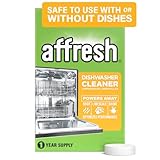
- HELPS POWER AWAY SMELLS created by odor causing bacteria, foggy limescale and mineral deposits hiding deep inside the dishwasher’s pump, filter, tub, valve, drain, washer arms and recirculation hoses to help optimize appliance performance.
- USE WITH OR WITHOUT DISHES. Unlike other brands, affresh dishwasher cleaner is safe to use while running a full load.
- TRUSTED BY APPLIANCE EXPERTS. Backed by over 100 years of appliance innovation, affresh is the dishwasher cleaner brand recommended by Whirlpool, Maytag, KitchenAid, Amana, and JennAir.**
- SAFER FOR PEOPLE. SAFER FOR PLANET. Affresh dishwasher cleaner is EPA Safer Choice Certified and is septic safe.
- NO MESSY POWDERS OR LIQUIDS. Affresh tablets are clean, convenient and powerful.
If dishes are visibly greasy, return to the filter, spray-arm, loading, detergent, and water-temperature checks. If they are clean but wet with water marks, rinse aid and the drying instructions are the better path.
8. Use a dishwasher cleaner only for buildup
Whirlpool recommends periodic dishwasher cleaning and says a cleaner can help with buildup. Use a product compatible with your model and follow its label. A cleaner is optional maintenance for internal residue; it is not a guaranteed cure for blocked spray openings, low fill, weak circulation, a failed heater, or a drainage fault. Apply it after the inspection steps, not instead of them.
Independent reader supportYour contribution helps us test, update, and keep practical guides available for everyone.When hard water is the real culprit
Hard water leaves minerals, not food grease. GE and Whirlpool associate hard water with spots, grit, and mineral deposits. A white or cloudy film that wipes differently from oil should move your troubleshooting toward water hardness and buildup.
What’s actually slowing this PC down?
Pick the symptom - the matching free tool is one click away.
- Confirm that the residue is mineral-like rather than slippery food soil.
- Check the dishwasher manual for approved settings or cleaning methods for hard water.
- Use rinse aid when the manual recommends it for spotting and drying.
- Test water hardness before considering a softener or other major equipment change.
A water softener is a conditional remedy only when hardness is confirmed and the applicable appliance and household guidance support it. It is not a default fix for greasy dishes. Do not use a hardness solution to explain food remaining on plates when spray coverage or detergent is still in question.
For mineral-related troubleshooting, see GE’s film and residue guidance. That page also identifies a 15–120 PSI water-pressure range for the guidance it covers; pressure figures are model-specific service/use information, so verify that your dishwasher uses the same requirement before treating the range as applicable.
Compare the main fixes by symptom and evidence
| Intervention | Best match | Evidence or measurement | Compatibility caution |
|---|---|---|---|
| Filter cleaning | Food particles, recurring greasy soil, debris in the tub | Visible contamination on the filter or sump | Removal and cleaning method must come from the exact manual |
| Spray-arm inspection | Dirty areas that line up with blocked openings or blocked rotation | Arm does not turn freely or holes contain debris | Use only the manual-approved cleaning method |
| Reloading | Soil on shielded, nested, or tightly packed items | Items touch, overlap, or block the detergent cup or arm | Rack layout and loading limits vary by model |
| Fresh, correctly dosed detergent | Undissolved, lumpy, or incorrectly used detergent; food soil after a normal cycle | Clumps in the dispenser, wrong product, or dosing outside instructions | Follow both detergent-label and appliance directions |
| Thermometer check | Persistent poor cleaning after mechanical and loading checks | Measured faucet temperature compared with the model requirement | GE cites 120–150°F for its guidance; some Whirlpool manuals cite at least 120°F |
| Rinse aid | Spots, film, or wet dishes after soil is removed | Clean dishes with drying or water-mark complaints | Not a primary treatment for food grease or poor spray coverage |
| Dishwasher cleaner | Visible internal buildup or maintenance cleaning | Residue inside the tub or on components | Optional maintenance; cannot repair a supply, pressure, heater, or drain fault |
| Water-hardness testing or softening | Confirmed mineral deposits and hard-water symptoms | Hardness test and appliance guidance | Do not buy or install as a default grease solution |
Signs the problem needs model-specific service
Arrange manufacturer support or qualified appliance service when greasy dishes continue after the filter, spray-arm, loading, detergent, and temperature checks, or when the machine shows a fault. Persistent poor cleaning can involve water fill, circulation pressure, heating, drainage, a sensor, or another failed component. The available manufacturer guidance does not establish one universal number of failed cycles or a single service threshold for every model.
- The dishwasher repeatedly stops, reports an error, or never reaches completion.
- Spray arms do not rotate freely even with correct loading.
- There is little or no water movement, unusual pump noise, or standing water after the cycle.
- Detergent remains dry because the dispenser does not open or water does not reach it.
- Incoming water meets the model requirement but wash results remain poor.
- Leaks, burning smells, electrical symptoms, or damaged components appear.
Have the model and serial information ready and describe exactly which checks you performed. Avoid dismantling pumps, heaters, wiring, or sealed circulation components unless the manufacturer explicitly provides a safe owner procedure.
Quick Recap
Prevent the residue from returning
- Scrape heavy food from dishes as the manual recommends, without treating pre-rinsing as a substitute for correct loading.
- Keep the filter clean using the model’s stated maintenance method and interval.
- Inspect spray-arm openings whenever a load develops a repeated dirty pattern.
- Load with space between items and keep the detergent dispenser and arms unobstructed.
- Store detergent dry, replace product that has become old or lumpy, and dose it according to the label and appliance guidance.
- Use rinse aid for spotting or drying complaints rather than as a grease cure.
- Check incoming water temperature only against the exact model instruction and safe household limits.
- Use a dishwasher cleaner when the manual or visible buildup indicates maintenance is appropriate.
- Test for hard water before considering a softener or other major change.
A concise decision path
- If the residue is oily food, confirm the cycle completed.
- Clean the filter using the owner’s manual.
- Check every spray arm for free rotation and blocked holes.
- Reload so dirty surfaces face the spray and no item blocks the arms or dispenser.
- Verify fresh automatic-dishwasher detergent, a functioning dispenser, and the instructed dose.
- Measure incoming faucet temperature only when the model guidance calls for it; GE’s cited guidance uses 120–150°F, while some Whirlpool manuals specify at least 120°F.
- If the issue is mainly white film, spots, or wetness, shift to rinse aid and hard-water checks.
- Escalate to manufacturer guidance or qualified service if poor cleaning persists or a fault appears.
Product prices and availability are accurate as of the date/time indicated and are subject to change. Any price and availability information displayed on Amazon at the time of purchase will apply.

