Blue mechanical switches can feel tiring because each key combines a tactile bump, an audible click and a relatively firm spring. Those events may encourage a typist to press harder, bottom out the key or use more force than necessary. However, no cited source proves that blue switches cause fatigue, and no switch is guaranteed to solve discomfort. The useful question is which combination of force, feedback, travel, sound and typing technique suits your hands.
Compare the published specifications carefully: CHERRY lists 50 cN actuation force for its current MX2A Blue, while HP lists 60 cN operating force for Cherry MX Blue. Those are different measurements and may refer to different product specifications. A switch tester lets you compare blue with linear red and non-clicky tactile brown before changing a full keyboard.
As an Amazon Associate I earn from qualifying purchases.
What happens when you press a blue switch?
A blue switch is a clicky, tactile mechanical switch. The key does not simply move straight down against a spring. As you press, the mechanism creates a noticeable resistance change (the tactile event), then produces a click as the stem moves through the switching mechanism. CHERRY describes its MX2A Blue as providing “tactile and audible feedback.”
On CHERRY’s design, the stem has two parts. After the tactile point, the white component strikes the blue stem as it moves downward, triggering the click. That creates two sensations at once: your finger feels a bump and your ears hear a sharp confirmation. Some typists find those signals helpful because they can release the key without pressing all the way down. Others repeatedly push through the bump or bottom the key against the housing, turning every keystroke into a more forceful event.
#1 Best Overall
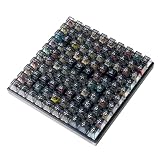
- Test 100 Switches in One Tool: The Keychron Switch Tester 100 Max Edition includes a curated 100-switch collection: 27 Keychron, 31 Gateron, 40 Kailh, and 2 Huano switches. It’s the definitive solution for comparing tactile, linear, and clicky feels side-by-side.
- Upgraded with 12 Hall Effect Magnetic Switches: Includes 12 magnetic Hall effect switches (4 Keychron + 8 Gateron), making it an ideal Hall effect switch tester for exploring rapid trigger, adjustable actuation, and modern HE keyboard switch technology.
- Realistic Keyboard-Like Structure: Built with a steel plate, acoustic foam, bottom case, and silicone foot pads to better simulate real keyboard feel during switch evaluation. (Note: No PCB; cannot connect to devices.)
- Black Transparent ABS Keycaps Included: Comes with black transparent ABS keycaps, and each keycap is printed with its corresponding switch name for quick identification and consistent testing, making sound, travel, and feedback evaluation easier.
- Ergonomic Two-Stage Kickstand: Features an adjustable two-stage kickstand that offers multiple typing angles. This ensures a stable, comfortable, and realistic testing experience that mirrors your actual desk setup.
Click, bump and spring force are separate factors
“Blue” does not describe one single sensation. A switch has at least three characteristics that matter during a long session:
- Force: how much pressure is needed to move the key and reach actuation.
- Feedback: the tactile bump that signals movement through the switching point.
- Sound: the click generated by the mechanism, which can make each press feel more pronounced even when your fingers are applying the same force.
Travel also matters. A 2023 Brno University of Technology thesis lists Cherry MX Blue at 2.2 mm of pre-travel and 4 mm of total travel. Pre-travel is the distance before actuation; total travel is the full downward movement available. If you press through the entire 4 mm on every key, you are doing more mechanical work than someone who releases soon after actuation.
Why might blue switches feel tiring?
The most defensible explanation is mechanical rather than medical: a firm, clicky, tactile key can demand a movement pattern that does not match your typing style. The available sources identify force, bump position, travel and typing style as contributors to switch feel, but they do not establish that blue switches cause fatigue after a set number of hours.
What’s actually slowing this PC down?
Pick the symptom - the matching free tool is one click away.
Rank #2

- Wide Kailh Variety: Discover 35 curated Kailh mechanical switches arranged in a plate. This comprehensive sampler lets you instantly compare classics like Box Red, White, Brown, and Jade alongside performance variants like Super Speed Silver, Box Heavy, and Silent series in one compact kit.
- Hands-On Feel Testing: Feel the difference firsthand—each switch sits securely in a holder, so you can push, hear, and judge actuation characteristics precisely rather than relying on videos or spec sheets alone.
- Use Your Own Keycaps: Swap in your favorite keycaps to test dialed-in aesthetics and compatibility. This flexibility helps you understand how each switch performs visually and tactually in your actual typing setup.
- Portable & Accessible – Lightweight switch sampler lets you easily explore Kailh’s lineup at your desk or share with friends, offering a convenient way to enjoy the mechanical keyboard hobby.
- Image-Based Layout Guide: The premium base is left unlettered for a sleek, minimalist desk aesthetic. No physical manual is included—please refer directly to our high-definition color layout chart in the product images to easily identify and track each switch during your testing.
You may be using more force than the switch requires
Many people bottom out a key even after it has already actuated. On a blue switch, the tactile bump and click occur before the bottom of the stroke. Continuing downward adds impact and noise without improving the electrical signal. If you type with a heavy hand, the repeated impact can make a session feel laborious, particularly when you are entering large amounts of text.
This is a plausible explanation, not a measured diagnosis. The sources do not provide a laboratory comparison showing that blue switches create more finger fatigue than red or brown switches, nor do they identify a force threshold that predicts discomfort.
The tactile bump can conflict with your rhythm
A tactile switch briefly resists movement at the bump. A typist who naturally uses a light, fast stroke may appreciate that cue. Someone who prefers a uniformly smooth key may instead push harder to get past it. The 2023 thesis distinguishes linear switches, which lack a tactile event, from tactile switches, which have a bump, and clicky switches, which add an audible click. That distinction explains why two switches with similar travel can feel very different.
Rank #3

- Try before you buy – MonsGeek x Akko acrylic 16-key switch tester - With a wide range of different switches including tactile and linear and clicky key switches from 3 different brands for users to test at minimal cost.
- Durability – Not only is our tester affordable, but it's also built to last. Based on laboratory durability tests, our switch has an approximate lifespan of 60 million keystrokes.
- Simple and easy to use – Try out our switch tester and find the perfect mechanical keyboard switch for your needs! Simply test each switch and use keycap puller to easily switch between them.
- Compact and portable – Small enough to fit in your pocket, our switch tester is perfect for on-the-go testing. Try it out today and elevate your typing experience
- Compatibility – Akko CS switches and the other switches come with MX style structure so they would fit most keycap sets with (X) cross stem. Note: switch opener is not included.
The click can make effort feel more conspicuous
Sound does not prove that your fingers are working harder, but a loud click makes every press noticeable. During a long session, the repeated acoustic feedback can become distracting or fatiguing, especially in a quiet room or shared workspace. It can also encourage a typist to alter their rhythm or press deliberately to reproduce the click. Those are individual responses; no prevalence figure is established for them.
Do these 3 things before closing this tab:
1Repair Windows errors before they cause bigger problems2Scan for outdated or missing drivers - takes under a minute3Clear out junk files and repair common Windows errorsYour typing technique may amplify the effect
Switch feel depends on how you use the key. A person who releases at actuation may experience less travel than someone who bottoms out. A typist who keeps their fingers tense, strikes keys from a height or uses inconsistent finger angles may notice a firm switch more than a relaxed typist. The evidence supports treating typing style as a major variable, not assuming that the switch alone explains every tired feeling.
How firm is a blue switch?
Published force numbers are easy to misread because manufacturers and explainers may use different terms and generations. Keep the model and measurement attached to each figure.
Rank #4

- 𝐓𝐢𝐩𝐬! 𝐓𝐡𝐢𝐬 𝐩𝐫𝐨𝐝𝐮𝐜𝐭 𝐜𝐨𝐧𝐭𝐚𝐢𝐧𝐬 𝟐𝐩𝐜𝐬 𝐦𝐚𝐠𝐧𝐞𝐭𝐢𝐜 𝐬𝐰𝐢𝐭𝐜𝐡𝐞𝐬 𝐚𝐧𝐝 𝟏𝟖𝐩𝐜𝐬 𝐦𝐞𝐜𝐡𝐚𝐧𝐢𝐜𝐚𝐥 𝐤𝐞𝐲𝐛𝐨𝐚𝐫𝐝 𝐬𝐰𝐢𝐭𝐜𝐡𝐞𝐬. 𝐌𝐚𝐠𝐧𝐞𝐭𝐢𝐜 𝐬𝐰𝐢𝐭𝐜𝐡𝐞𝐬 𝐚𝐫𝐞𝐧'𝐭 𝐜𝐨𝐦𝐩𝐚𝐭𝐢𝐛𝐥𝐞 𝐰𝐢𝐭𝐡 𝐦𝐞𝐜𝐡𝐚𝐧𝐢𝐜𝐚𝐥 𝐤𝐞𝐲𝐛𝐨𝐚𝐫𝐝𝐬.
- 𝐏𝐥𝐞𝐚𝐬𝐞 𝐜𝐡𝐞𝐜𝐤 𝐞𝐚𝐜𝐡 𝐬𝐰𝐢𝐭𝐜𝐡’𝐬 𝐬𝐩𝐞𝐜𝐬 𝐨𝐧 𝐭𝐡𝐞 𝐬𝐞𝐜𝐨𝐧𝐝 𝐢𝐦𝐚𝐠𝐞.
- GATERON Switch Tester features 20 carefully selected switches, each offering distinct tactile and acoustic feedback. This tool helps users experience various switches to find the one that best suits their typing style. Ideal for both first-time buyers and enthusiasts looking to explore different switch types.
- Switch Tester contains 20 switches that provide a smooth typing experience and superior sound. Each switch is different, so purchase it to experience the feel of other switches and help you choose the type of switch you like. You can also buy it back as a collection.
| Specification | Published figure | What it means |
|---|---|---|
| CHERRY MX2A Blue actuation force | 50 cN | CHERRY’s current MX2A Blue product specification for the force at actuation. |
| HP listing for Cherry MX Blue operating force | 60 cN | HP’s listed operating-force figure for Cherry MX Blue; it is not the same metric as CHERRY’s MX2A actuation figure. |
| 2023 Brno University of Technology thesis listing for Cherry MX Blue | 60 cN | A thesis specification that also lists 2.2 mm pre-travel and 4 mm total travel. |
These values should not be averaged into a single “true” blue-switch force. Actuation force and operating force can be defined differently, and MX Blue specifications may differ from the current MX2A generation. When comparing a keyboard, identify the exact switch model and the manufacturer’s measurement.
What can you compare instead?
Three familiar switch types illustrate the trade-offs. They are alternatives to test, not proven fatigue treatments.
The Tool Desk
Outbyte PC Repair FREERepair Windows errors before they cause bigger problemsFix Now →Outbyte Driver Updater FREEFix the driver behind crashes, sound loss and screen glitchesFind Drivers →| Switch | Feedback and motion | Published force | What to notice while testing |
|---|---|---|---|
| Cherry MX Blue / MX2A Blue | Tactile with an audible click | CHERRY lists 50 cN actuation for MX2A Blue; HP lists 60 cN operating force for Cherry MX Blue. | Whether the bump, click and spring resistance fit your normal stroke; whether you release after actuation or bottom out. |
| Cherry MX Red | Linear, with a smooth press and no tactile bump or click | HP lists 45 cN operating force. | Whether a smooth key lets you use less force, or instead causes accidental presses because there is no tactile cue. |
| Cherry MX Brown | Tactile without a click, according to CHERRY | HP lists 55 cN operating force. | Whether you want a bump for confirmation but less click noise; the slightly different force may or may not suit you. |
A lower listed force does not guarantee comfort. Red may feel easier to press but can require more control if you tend to rest heavily on keys. Brown removes the click but retains a bump, so it will not feel linear. Your keycaps, keyboard plate, layout and typing habits also affect the result, which is why a switch comparison is more informative than a specification alone.
Best Value

- Base Material:Acrylic
- Thickness:About 10MM
- Cutting Process:Laser Cutting
- Colorway:Transparent Acrylic
- With Base, easy to test switch feeling
Use a switch tester before replacing a keyboard
HP recommends trying a switch tester. Treat it as a short-listing tool, not a prediction of how your hands will feel after an eight-hour session. A tester may contain different generations or variants, so check the actual switch names and whether they match the keyboard you are considering.
- Confirm the samples. Look for the exact blue, red and brown models you intend to compare. “Blue” or “red” by itself is not enough to identify a manufacturer or generation.
- Test the same finger motion. Type a few lines, then press each sample repeatedly with the force and speed you normally use. Do not intentionally type lightly just to make a switch seem easier.
- Separate the sensations. Note the force at the start, the tactile bump, the click, and whether you naturally press to the bottom. Write down what feels distracting or effortful.
- Check noise in your real environment. A click that seems acceptable alone may be too prominent in a shared office or during calls. Sound is part of the experience even though it is not a measure of finger force.
- Try a sustained sample. Short presses reveal the mechanism; a longer typing sample reveals whether you tense your fingers, bottom out or change your rhythm. The tester still cannot guarantee long-session comfort.
- Verify compatibility before buying. Check the switch mounting style, electrical contacts, hot-swap support and keyboard layout. A tester’s switch may not fit or be electrically compatible with every keyboard.
Ways to reduce the tiring feeling without assuming the switch is the cause
Start with observations rather than immediately buying a replacement. During a normal session, notice whether discomfort appears only when you bottom out, only with a particular finger, or only when the click becomes distracting. That distinction helps you decide whether to compare force, tactile feedback or sound.
- Practice releasing at actuation. On a blue switch, the bump and click provide a confirmation point. Try stopping the downstroke there instead of striking the housing, if that feels natural.
- Compare a quieter tactile option. A brown switch preserves a tactile cue without the click. It is a way to isolate the sound and click mechanism from the bump, not a guarantee of relief.
- Compare a linear option. A red switch removes both the bump and click. If the smooth stroke lets you relax, it may be a better match; if you make accidental presses, the absence of feedback may be a drawback.
- Keep the comparison fair. Test similar keycap profiles and layouts when possible. A different keyboard angle, keycap shape or stabilizer can change the feel independently of the switch.
- Track when symptoms start. Record the session length, task, switch type and whether you were bottoming out. This is a personal observation log, not a medical test, but it can reveal a repeatable pattern.
What is and is not established about fatigue?
No cited source supplies a statistic for how many typists experience fatigue from blue switches. There is also no controlled long-session comparison here demonstrating that clicky switches produce more finger fatigue than linear or non-clicky tactile switches. An individual GamesRadar reviewer reported no fatigue during a 13-hour test of a softer-feeling Cherry MX 3.1 keyboard, but that was one person’s experience with a different keyboard and was not a controlled switch comparison.
CHERRY’s claim of more than 50 million keystrokes for MX Blue concerns durability: it says the switch can reach that number without loss of quality. Durability does not measure comfort, muscle effort or fatigue. Likewise, a force specification describes a mechanical characteristic; it does not predict how every typist will respond.
When a switch change is not the right answer
If typing produces persistent pain, numbness, tingling, weakness or symptoms that continue away from the keyboard, do not treat switch shopping as a diagnosis or treatment. Stop or reduce the provoking activity and seek advice from a qualified health professional or occupational-ergonomics specialist. The available switch specifications cannot determine the cause of those symptoms.
For ordinary tiredness without persistent symptoms, a switch tester and a careful comparison of blue, red and brown can help you make a personal choice. The best result is the switch that lets you type with the least unnecessary force and tension while providing feedback you can use.
Quick Recap
A practical decision guide
- Keep blue if you value the tactile and audible confirmation, can release near actuation and do not find the sound or bump distracting.
- Try brown if you want a tactile cue but suspect the click or its noise is the main annoyance.
- Try red if you prefer a continuous, smooth press and can control accidental activation without a bump.
- Test before buying whenever possible, because force figures and switch names do not capture typing style, bottoming-out habits or long-session comfort.
Product prices and availability are accurate as of the date/time indicated and are subject to change. Any price and availability information displayed on Amazon at the time of purchase will apply.
Free tools Windows power users keep installed
One-click scans. No signup required.

