For houseplants in the Northern Hemisphere, a south-facing window is usually the brightest, while a north-facing window usually gets the least direct sun. East-facing windows tend to receive morning sun and west-facing windows afternoon sun. But there is no best direction for every plant: choose by the light the plant actually gets at its position, not by the compass direction alone.
How the four window directions compare
These are general patterns for the Northern Hemisphere, not guaranteed light levels. The University of Maine explains the usual sun exposure by orientation, while Iowa State Extension cautions that direction is only one part of the picture.
As an Amazon Associate I earn from qualifying purchases.
| Window direction | Typical light | What to consider |
|---|---|---|
| South | Usually the brightest exposure, with direct sun for the longest part of the day, according to Missouri Extension. | Offers more options for plants that need strong light. If summer sun is too strong for a particular plant, move it farther from the glass or filter the light. |
| East | Generally receives morning sun. | Can suit plants that tolerate moderate light or some direct sun. The actual intensity depends on placement and outdoor shade. |
| West | Generally receives afternoon sun, which may be more intense and warmer than morning sun. | Can suit plants that use stronger light; sensitive plants may do better farther from the window or behind a sheer curtain. |
| North | Generally receives the least direct sun in the Northern Hemisphere. | May suit plants that tolerate lower light, but nearby trees or buildings, window size and plant distance can make the spot dimmer still. |
These directional patterns reverse south of the equator. Latitude, local climate and the surrounding landscape also affect exposure, so readers outside the Northern Hemisphere should judge the sun at their own windows and consult local horticultural guidance.
What’s actually slowing this PC down?
Pick the symptom - the matching free tool is one click away.
Match the plant to the light at its spot
Check the plant’s stated light needs, then consider how much light reaches the leaves where you plan to put it. UConn Extension offers these practical placement examples; they are starting points, not guarantees for every home, season or window:
#1 Best Overall

- Plant Pots / Flower Pots - Invest in a beautiful garden to harvest the seeds of love, with the set of pots for indoor or outdoor plants
- Multiple Sizes – This nursery plant pots indoor comprises multi-size pots – Extra Large (7” W x 5.9” H), Large (6.6” W x 5.4” H), Medium (6” W x 5” H), Small (5.3” W x 4.4” H), and Extra Small 4.8”W x 4” H. Also comprises of matching saucers.
- Impeccable Febrication - Make the pots ideal for both original and fake plants comprises of reinforced PP plastic. The hassle-free decorative flower pots contain drainage plugs, to preserve the life of your exquisite plants.
- Space Saving - Take time to smell the roses and revel in the art of planting with the indoor planter. The minimalist design is convenient and optimizes storage space, while enhancing the aesthetics of your home/office décor.
- Ideal For Decor or Christmas Gifts For Women –The pots for indoor plants is a great gift idea for all gardening enthusiasts for occasions like Earth Day, World Environment Day, National Forest Week, New Year, Housewarming, birthdays and Christmas.
- Low-light plants: Somewhat back from a north-facing window.
- Medium-light plants: Near a north-facing window, or a few feet back from an east- or west-facing one.
- High-light plants: In front of an east- or west-facing window, or up to five feet from a south-facing window.
Light falls quickly as you move away from a window. Iowa State Extension notes that a spot more than a few feet from even a bright window may be too dim for successful growth. A larger window usually admits more light than a small one, and a place just to the side of the window can be much darker than it appears.
Direct and indirect light: what the terms mean
Direct light reaches the plant when sunlight falls on its leaves. Bright indirect light is bright enough to cast a distinct shadow, but direct sun does not hit the leaves, according to Iowa State Extension. A plant can therefore be near a bright window but out of the sunbeam, or receive softened light through a sheer curtain.
Rank #2

- 【Practical Size Combo】-These plastic planters indoor combines with 6 different sizes, 8 inch 7inch 6.5 inch 6 inch 5.5 inch 5 inch which are suitable for planting most small and medium-sized home office plants.Ideal gift,Carbonfree Certified.
- 【Durability, Light weight, Sturdiness】-Made of durable recyclable plastic, solid plastic plant pots protect plants and soil. Premium polypropylene planters feel sturdy in hand but not too heavy. Thick sidewalls 4mm in size keep everything in place. These planters are perfect gardening gift for your mom, your father, your sister or your friends who are plant lover.
- 【Intriguing Design】-A simple modern aesthetic and clean matte finish planters indoor plants bringing out a minimalistic styled. representation for any home/office decor without any sense of violation.
- 【Excellent Drainage Holes】-These flower pots for plants come with multiple drainage holes in the bottom. The holes and watering lip provide an air circulation system for the plant roots.
- 【Self Watering For Bottom】- I really like how big the bottom tray is to catch all the extra water. They come with a string to put at the bottom of the pots if you want to do bottom watering. A separate reservoir completely separates the plant growth environment from the water storage environment.
Not every south- or west-facing window will scorch plants. If direct summer sun is excessive for a specific plant, Maryland Extension recommends moving it farther from the window or using a light shade such as a sheer curtain.
Windows Errors? Fix Them Before They Spread
Repair common Windows errors and clear accumulated junk for a smoother, more stable PC - no reinstall needed.Free scan · no reinstallCrashes, No Sound, or Screen Glitches?
Random freezes, missing sound and display glitches usually trace back to one bad driver. Find and replace yours safely.Free scan · under a minuteQuick Recap
Best Value

- 🌿 【Self-Watering Pots with Water Level Indicator】 Designed for busy plant lovers, our 8/10/12 self-watering pots feature a built-in ABSORBENT COTTON WICK SYSTEM that automatically draws water from the detachable bottom tray. The TRANSPARENT WATER LEVEL WINDOW WITH MEASUREMENT MARKINGS lets you monitor hydration at a glance, ensuring no overwatering or underwatering. Perfect for indoor/outdoor plants, this system keeps soil evenly moist for up to 7-10 days—ideal for vacations or hectic schedules.
- 💧【Planters with Drainage & Detachable Trays】 Each plastic plant pot includes a REMOVABLE SAUCER TRAY and strategic DRAINAGE HOLES to promote healthy root development. The plastic large pot for plants promotes airflow and efficient water flow, while the leak-proof design protects floors. Easy to clean and refill, these planters for indoor plants with drainage simplify maintenance for herbs, succulents, or tropical foliage.
- 🛡【Durable Plastic Construction】Crafted from premium HIGH-TEMPERATURE-RESISTANT PLASTIC, these lightweight yet sturdy self-watering flower pots with stand harsh sunlight, rain, and indoor humidity without cracking or fading. Use them safely in gardens, balconies, or living rooms—their sleek design blends seamlessly into modern decor while lasting seasons.
- 🌿【Effortless Indoor/Outdoor Versatility】 From large indoor planters for fiddle-leaf figs to compact outdoor outdoor self-watering pots for patio herbs, this set adapts to any space. The neutral minimalist style complements farmhouse, urban, or bohemian themes. Bonus: The WATER LEVEL INDICATOR and SPILL-PROOF TRAYS make these plastic flower pots indoor/outdoor ideal for renters or pet owners.
- 🌱【Smart Design for Strong Root Development】 Unlike traditional pots, our self-watering planters deliver water directly to roots through absorbent cotton wicks, promoting consistent hydration and nutrient uptake. The ELEVATED BASE AND BREATHABLE DESIGN prevent soggy soil, ensuring robust growth for large indoor plants like monstera or palms. With this thoughtful design, your plants thrive with minimal maintenance.
Rank #4

- 🌿 【Self-Watering Pots with Water Level Indicator】 Designed for busy plant lovers, our 8/10/12 self-watering pots feature a built-in ABSORBENT COTTON WICK SYSTEM that automatically draws water from the detachable bottom tray. The TRANSPARENT WATER LEVEL WINDOW WITH MEASUREMENT MARKINGS lets you monitor hydration at a glance, ensuring no overwatering or underwatering. Perfect for indoor/outdoor plants, this system keeps soil evenly moist for up to 7-10 days—ideal for vacations or hectic schedules.
- 💧【Planters with Drainage & Detachable Trays】 Each plastic plant pot includes a REMOVABLE SAUCER TRAY and strategic DRAINAGE HOLES to promote healthy root development. The plastic large pot for plants promotes airflow and efficient water flow, while the leak-proof design protects floors. Easy to clean and refill, these planters for indoor plants with drainage simplify maintenance for herbs, succulents, or tropical foliage.
- 🛡【Durable Plastic Construction】Crafted from premium HIGH-TEMPERATURE-RESISTANT PLASTIC, these lightweight yet sturdy self-watering flower pots with stand harsh sunlight, rain, and indoor humidity without cracking or fading. Use them safely in gardens, balconies, or living rooms—their sleek design blends seamlessly into modern decor while lasting seasons.
- 🌿【Effortless Indoor/Outdoor Versatility】 From large indoor planters for fiddle-leaf figs to compact outdoor outdoor self-watering pots for patio herbs, this set adapts to any space. The neutral minimalist style complements farmhouse, urban, or bohemian themes. Bonus: The WATER LEVEL INDICATOR and SPILL-PROOF TRAYS make these plastic flower pots indoor/outdoor ideal for renters or pet owners.
- 🌱【Smart Design for Strong Root Development】 Unlike traditional pots, our self-watering planters deliver water directly to roots through absorbent cotton wicks, promoting consistent hydration and nutrient uptake. The ELEVATED BASE AND BREATHABLE DESIGN prevent soggy soil, ensuring robust growth for large indoor plants like monstera or palms. With this thoughtful design, your plants thrive with minimal maintenance.
Rank #3
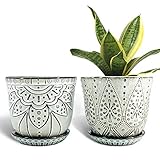
- 【With Drain Holes and Mesh Pad】:Large drain holes are good for draining, and with leak-proof mesh pads, it keeps soil from running away, suitable for orchids, succulents, cacti, other flowers and green plants, perfect for home decoration.
- 【Removable Trays】:There are two methods to place saucer, which can be changed at will, not only suitable for planting plants, but also more ornamental value.
- 【Makes Gift】:It's the perfect suitable present for your relatives and friends, they make great birthday gifts, anniversary gifts, Housewarming gifts, Thanksgiving or Christmas gifts and more!
- 【Size & Package】:Pot Top Dia:5.9"/15cm (can match a 5 inch inner pot), Pot Bottom Dia:3.15"/8cm, Pot H:5.15"/13.1cm; Saucer Top Dia:4.92"/12.5cm, Saucer Bottom Dia:3.74"/9.5cm, Saucer H:0.86"/2.2cm. Package: contains 2 ceramic flower pots, 2 ceramic saucers and 2 mesh pads(NOT INCLUDE PLANT)
- You are covered with excellent product quality and great customer service. The pot with tray has been packaged and prepared carefully to prevent any damage during transit. If there is any issue or question, please contact us, and we will get back to you very quickly with a full satisfying resolution.
Account for changing light and surrounding conditions
- Distance and position: Light drops quickly farther from the glass; a position beside the window may receive substantially less light than one in front of it.
- Window size: Larger windows generally admit more light than smaller ones.
- Obstructions: Buildings and trees can block sunlight. Illinois Extension notes that leafy trees may shade a window in summer and let more light through after their leaves fall.
- Season and weather: The sun’s angle changes over the year, and weather and the surrounding landscape affect how much light reaches a room.
- Duration as well as intensity: These are different aspects of exposure. Illinois Extension says 14–16 hours of light can be sufficient in low-light conditions; that is guidance for those conditions, not a schedule required by every plant.
A practical way to choose a spot
- Check the plant’s light requirement. Use its care information as a guide to whether it needs low, medium or high light.
- Observe the intended spot. Note when direct sunlight reaches it and whether the sunbeam lands on the leaves.
- Use direction as a starting clue. In the Northern Hemisphere, south is usually brightest, east gets morning sun, west gets afternoon sun, and north generally receives the least direct sun.
- Adjust for the room. Account for distance from the glass, window size, trees or buildings, and seasonal changes.
- Consider supplemental lighting only if needed. If natural light remains inadequate, artificial lighting is an option; it is not a universal requirement. Maine Extension discusses artificial lighting for houseplants.
Product prices and availability are accurate as of the date/time indicated and are subject to change. Any price and availability information displayed on Amazon at the time of purchase will apply.

