The Tool Desk
Outbyte Driver Updater FREEFix the driver behind crashes, sound loss and screen glitchesFind Drivers →Outbyte PC Repair FREEClear out junk files and repair common Windows errorsFree Scan →Jet ranks first for most serious scrollers, Hegner is the premium choice, and DeWalt offers the strongest value among widely available models. That verdict combines a March 2026 specification survey with WOOD Magazine’s September 2020 hands-on test—not a standardized test of every brand. The middle of the ranking changes with your priorities: price, throat depth, interior-cut access, bevel work, vibration, and local service can matter more than the badge on the arm.
The list below therefore treats “worst to best” as a decision aid, not an objective league table. Models within the same tier may swap places for a beginner, production shop, or buyer who can only find a particular saw locally.
As an Amazon Associate I earn from qualifying purchases.
What this ranking measures
A scroll saw’s brand reputation is less useful than the design details you handle on every cut. The ranking weighs the following factors:
Outdated Drivers Are Slowing You Down
One free scan finds every outdated or missing driver and matches the right update for your exact hardware.Free scan · exact hardware matchWindows Errors? Fix Them Before They Spread
Repair common Windows errors and clear accumulated junk for a smoother, more stable PC - no reinstall needed.Free scan · no reinstall- Cutting capacity: throat depth is the approximate reach from the blade to the rear frame; cut depth is the material thickness the arm can clear. They are separate limits.
- Blade workflow: plain-end (pinless) compatibility, tensioning, and how easily the arm lifts for interior cuts.
- Cutting feel: vibration, smoothness, and how aggressively the saw removes material. The only direct observations here come from WOOD Magazine’s 2020 test.
- Bevel setup: whether the table or arm tilts and the usable angle range.
- Practical ownership: table construction, dust collection, stand or foot-control provisions, price, and the likelihood of finding parts or a replacement machine.
The March 2026 Central New York Woodworkers Association survey is a broad specification snapshot. It does not report controlled cutting trials, reliability statistics, or market share. WOOD Magazine’s test, published September 29, 2020, graded a small group after hands-on use by professional scroller Jenny Boles. Those grades are useful observations from that date, not permanent brand scores.
#1 Best Overall
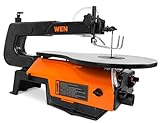
- Unique side panel flips open for easy-access blade changes
- Variable speed goes from 550 to 1600 strokes per minute
- Spacious 16-by-10-inch table bevels up to 45 degrees for angled cuts
- Cuts wood up to 2 inches thick with a 16-inch throat depth
- Features a thumb screw blade adapter for tool-free blade changes, a cast iron base, an air pump, a dust port, a foot lock clamp, and three 5-inch blades
Availability and prices can change quickly. A model appearing in a survey does not guarantee that a retailer has stock, and the approximate prices below are not quotations.
Benchmark models and published test results
| Model | March 2026 survey price | Throat / cut depth | Table and blade details | Bevel arrangement | WOOD Magazine 2020 grade |
|---|---|---|---|---|---|
| DeWalt DW788 | About $250–$450 (survey approximation) | 20 in / 2 in | Cast-iron table; pinless blades | Tilting table | B– |
| Delta 40-694 | About $550 (survey approximation) | 20 in / 2 in | Cast-iron table; pinless blades | Survey records tilt; consult manual for operating range | B– |
| Jet JWSS-22B | About $1,170–$1,230 (survey approximation) | 22 in / 2 in | Cast-iron table; pinless blades | Arm tilt, 40° left / 45° right | A |
| Hegner Multimax 22 | About $2,000 (survey approximation) | 22 in / 2⅝ in | Cast-iron table; survey lists pinless compatibility | Check the specific version’s manual | Not tested in that comparison |
These figures come from the March 2026 survey unless a cell says otherwise. Always confirm the manual for the exact edition sold in your region, especially for maximum stock thickness and bevel limits.
Scroll saw brands ranked from worst to best
14. Bauer — lowest-cost entry point
The 22-inch Bauer model in the March 2026 survey is listed at roughly $280, placing it at the inexpensive end of the market. That price can make it attractive for occasional fretwork or a first machine when the alternative is no saw at all.
Quick wins for a faster PC:
Scan for outdated or missing drivers - takes under a minuteDriver Scan →Repair Windows errors before they cause bigger problemsFix Now →It ranks last because the available evidence is specification-only: there is no controlled cutting grade in the cited comparison and no detailed hands-on report establishing its vibration, blade-change access, or long-term service record. Treat it as a budget experiment. Before buying, verify that the local store can supply plain-end blades, clamps, and replacement parts, and test the arm for play and the table for squareness if purchasing in person.
13. WEN — feature list before proven workflow
WEN appears in the 2026 market map, but the supplied sources do not provide a directly tested model, a named price, or a detailed vibration assessment. That makes it difficult to justify a higher position against models with documented hands-on results.
A WEN machine can still suit light hobby use when its speed control, throat size, and blade system match your projects. Read the owner’s manual before assuming that a blade holder accepts every pinless blade; compatibility is model-specific. For intricate interior cuts, give extra weight to whether the upper arm stays raised while you thread the blade.
12. Rikon — a reasonable option when support is nearby
Rikon is included in the 2026 survey’s model range, yet the cited material does not include a WOOD Magazine grade or a model-specific price and specification block. Its placement reflects limited comparative evidence rather than a finding that every Rikon saw performs poorly.
Put a Rikon higher on your personal list if a nearby dealer stocks blades and parts, offers service, and lets you inspect the table and arm. Put it lower if you must order every consumable and cannot verify the exact blade clamps or bevel mechanism before purchase.
Rank #2

- INTEGRATED LED WORKLIGHT—Allows greater visibility at a variety of angles
- INTEGRATED DUST REMOVAL SYSTEM—Keeps cut line free of debris for accurate cuts
- ELECTRONIC VARIABLE SPEED CONTROL—Provides greater cutting control with a variety of materials
- TILTING 16 IN. X 10 IN. WORK TABLE—Tilts 0–45 degrees for precise cuts
- ON-TOOL BLADE STORAGE—Easily access additional blades
11. Grizzly — broad choice, uneven evidence
The ranking article discusses Grizzly as an option family, while the 2026 survey maps models across several tiers. The January 2024 market survey cautioned that quality varies and that not every listed saw was recommended for serious scrolling; that warning should not be applied automatically to every newer model.
Grizzly therefore belongs in the middle-lower tier. Compare the individual model, not just the logo: check throat and cut depth, table material, speed range, dust port, and whether the arm or table tilts. A well-supported model can be a sensible workshop purchase, but the sources do not establish one universally superior Grizzly design.
10. King Industrial — capable specifications, sparse testing
King Industrial appears in the 2026 survey’s model map, with practical fields such as blade compatibility, tilt, and dust collection recorded for surveyed machines. No cited hands-on test supplies a grade or vibration observation for the brand.
Do these 3 things before closing this tab:
1Repair Windows errors before they cause bigger problems2Fix the driver behind crashes, sound loss and screen glitches3Clear out junk files and repair common Windows errorsThat puts King Industrial ahead of the least-documented budget options when its local dealer network is strong, but behind brands with direct comparative results. Ask for the exact manual and parts policy. A saw that looks impressive on paper is less useful if a broken clamp or switch leaves the machine idle for weeks.
9. Seyco — specialist positioning without a common test baseline
Seyco is represented in the 2026 survey, but the available evidence does not include a directly comparable price, test grade, or published cutting-feel observation. Its position is consequently provisional.
For a specialist buyer, the important checks are straightforward: confirm the throat and maximum stock thickness for the exact model, identify the required blade length and end style, and determine whether the table or arm handles your intended bevel work. Do not infer reliability from the survey’s inclusion alone.
8. Delta 40-694 — solid mid-tier capacity
The Delta 40-694 has a 20-inch throat, 2-inch cut depth, cast-iron table, and pinless-blade compatibility in the March 2026 survey, at an approximate $550 price. Those specifications provide useful capacity for furniture parts and larger patterns without moving into premium pricing.
WOOD Magazine graded it B– in the 2020 comparison. That is a respectable but not leading result, and it reflects that test sample and date. Delta uses a tilting table, so confirm the angle scale and locking method before committing to frequent bevel work. It is a sensible middle choice when you want a substantial table and 20-inch reach but cannot justify a premium machine.
Rank #3

- Dust port adapter keeps line-of-sight clear and work space clean
- Auto tensioning quick-change mechanism for easy accessory change and optimal blade tensioning
- Detachable coping function for handheld use to take the tool to the work piece
- Variable-speed control for optimal cutting in a variety of materials
- Fast-clamp base attaches to various tables, benches and surfaces
7. DeWalt DW788 — the value benchmark
The DeWalt DW788 is the easiest model to recommend when budget and broad familiarity matter. The 2026 survey lists about $250–$450, a 20-inch throat, 2-inch cut depth, cast-iron table, and pinless blades. Check current price and stock because the survey range is an approximation, not a standing offer.
In WOOD Magazine’s hands-on test, the DW788 cut smoothly with little vibration, although the tester found it more aggressive than the Jet. The upper arm did not stay raised during blade changes or interior cuts, which can make pattern threading slower and more awkward. That limitation is model-specific workflow information, not a claim about every DeWalt tool.
Choose it for general fretwork, stack cutting within its capacity, and a large installed user base. Before buying, verify that the included clamp arrangement suits your preferred plain-end blades and that replacement parts are available in your region.
6. Excalibur — excellent design potential, check availability
Excalibur’s EX-21K earned an A– in WOOD Magazine’s 2020 test, placing it among the strongest performers in that comparison. The ranking article also highlights availability concerns. Those points can both be true: a well-regarded design is not a practical purchase if you cannot obtain the machine, blades, or service.
Place Excalibur higher when a legitimate local or regional source confirms stock and support. Inspect the arm-lift action, blade tensioning, bevel arrangement, and dust connection on the exact version. Because the hands-on grade is from 2020, do not assume that a later or differently distributed model is identical.
5. Pégas — precision-oriented specialist choice
Pégas is positioned as a specialist brand in the ranking coverage and appears in the 2026 survey’s model map. The supplied material does not provide a single Pégas model’s price, throat, or independent test grade, so its fifth-place position is based on specialist positioning rather than a controlled score.
It may appeal to experienced scrollers who already know which blade system and table geometry they prefer. For everyone else, compare the exact machine against the documented Jet, DeWalt, Delta, and Hegner figures rather than paying a premium for a name alone. Confirm parts, blade length, and service before ordering.
4. Hawk — serious-shop contender when configured correctly
Hawk models are included in the 2026 specification survey, which records practical differences among machines such as tilt, dust ports, and blade compatibility. The cited sources do not include a direct WOOD Magazine grade or a complete model-by-model price table for Hawk.
Rank #4
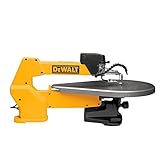
- 20 in. Variable-Speed Scroll Saw
That evidence supports a serious-shop shortlist, not an unconditional recommendation. A Hawk can earn this tier when its exact model offers the throat depth, arm access, speed control, and table size your work requires. Ask the seller how quickly clamps, switches, and drive components can be replaced; serviceability is especially important for a machine used every day.
3. Hegner — premium capacity and build ambition
The Hegner Multimax 22 is listed at about $2,000 in the March 2026 survey, with a 22-inch throat and 2⅝-inch cut depth—greater cut-depth capacity than the 2-inch figures listed for the Jet, DeWalt, and Delta examples. Its cast-iron table and premium price put it in a different tier from entry and mid-range saws.
Hegner ranks just below Jet for most buyers because the evidence here does not include a comparable hands-on grade, and the price is difficult to justify for occasional use. It is a logical candidate for production work or thick-stock projects when the additional capacity, dealer support, and long-term parts access are worth the investment. Confirm the exact bevel design and included accessories for your market before purchase.
Recommended Free Tools
2. Jet — best documented all-round performer
Jet’s 22-inch JWSS-22B received an A in WOOD Magazine’s 2020 comparison, the highest grade in that test. The tester reported little to no vibration even at high speed, and praised the blade-changing and tensioning systems. The arm lifts 10 inches, improving access when you thread a blade through an interior opening.
The March 2026 survey lists the JWSS-22B at approximately $1,170–$1,230, with a 22-inch throat, 2-inch cut depth, cast-iron table, pinless blades, and arm tilt from 40 degrees left to 45 degrees right. The arm-tilt design keeps the workpiece flat for bevel cuts, which can be more comfortable than tilting a large panel on a table. Those figures are survey-time approximations; verify current stock, price, and the manual for the exact edition.
Jet is the strongest general recommendation when smooth running, interior-cut access, and bevel workflow matter more than the lowest purchase price.
1. Hegner or Jet? The best choice depends on the job
There is no honest single winner for every reader. Jet is the best-supported all-round pick in the evidence because it combines the top 2020 hands-on grade with useful 2026 specifications and a comparatively practical price for a premium saw. Hegner is the best capacity-first choice when 2⅝-inch cutting depth and premium construction justify roughly $2,000.
If you want a strict worst-to-best order based on documented performance and buyer value, use this sequence: Bauer, WEN, Rikon, Grizzly, King Industrial, Seyco, Delta, DeWalt, Excalibur, Pégas, Hawk, Hegner, then Jet. The first five positions are the least certain because the cited sources contain limited controlled testing for those brands; the upper positions have stronger direct evidence.
Best Value

- Stens replacement parts have become a favorite among lawn and landscape professionals thanks to exceptional performance.
Throat depth versus cut depth: the specification buyers confuse
Throat depth is the approximate horizontal reach from the blade to the rear frame. A 20-inch throat generally gives more room for wide patterns than a 16-inch machine. Cut depth is the maximum material thickness the arm can clear below the upper assembly. A deeper rating helps with thicker stock but does not make the machine’s throat longer.
The DeWalt DW788 illustrates the difference: the survey lists 20 inches of throat and 2 inches of cut depth. Hegner’s Multimax 22 is listed with the same 22-inch class of reach as Jet but a 2⅝-inch cut-depth figure. Treat both as manufacturer or survey specifications, not permission to exceed the manual’s operating limits. Blade type, wood density, feed rate, and the condition of the machine affect what cuts cleanly in practice.
Blade changes and interior cuts: the workflow test
For fretwork, you repeatedly drill a starter hole, remove or loosen one blade end, thread the blade through the workpiece, and retension it. The arm’s behavior matters as much as motor power.
What’s actually slowing this PC down?
Pick the symptom - the matching free tool is one click away.
- Jet’s tested arm lifted 10 inches, and the tester praised its changing and tensioning systems.
- The DeWalt DW788’s upper arm did not stay raised during changes or interior cuts, so you may need one hand to hold it while threading the blade.
- WOOD Magazine reported that the saws in its comparison accepted plain-end blades. Verify this in the manual before buying blades for any model outside that test.
When examining a saw, raise the arm, release tension, and simulate threading a blade through a small interior opening. This quick check reveals more about your daily workflow than a brochure’s motor rating.
Bevels, tables, vibration, and dust
Bevel mechanism
Tilting the arm keeps a large panel flat while the blade angles through it; tilting the table moves the workpiece instead. The survey records both arrangements. Jet’s JWSS-22B uses arm tilt with a 40-degree-left/45-degree-right range, while DeWalt’s DW788 uses a tilting table. Neither arrangement is universally superior: arm tilt can simplify large work, while a familiar tilting table may be faster for occasional small bevels.
Vibration and cutting aggressiveness
WOOD Magazine found little to no vibration from the Jet 22-inch model even at high speed. The DeWalt also cut smoothly with little vibration but felt more aggressive to the tester. These are observations from one 2020 comparison, not laboratory measurements or permanent brand characteristics. A rigid stand, correct blade tension, and a balanced workpiece can change the feel substantially.
Table and dust control
Cast-iron tables are listed for the DeWalt, Delta, Jet, and Hegner examples. A heavy table resists movement, but the stand and floor still matter. The 2026 survey records dust-port availability by model; connect a compatible extractor where practical and confirm the port diameter before buying an adapter. A dust port does not replace eye protection or a properly fitted respirator when cutting dusty materials.
Free tools Windows power users keep installed
One-click scans. No signup required.
How to choose a brand for your projects
- Measure your largest pattern. Select throat depth with clearance for clamps and your hands, not merely the outline of the design.
- Set a real material limit. Compare the manual’s permitted thickness with the cut-depth figure. If you routinely cut thick stock, Hegner’s surveyed 2⅝-inch rating is the only one in the benchmark table above that exceeds 2 inches.
- Decide how often you will make interior cuts. Frequent fretwork favors an arm that stays open and a quick tensioning system, which is where Jet’s tested design has an advantage.
- Choose the bevel method. Arm tilt is attractive for large panels; a tilting table may suit your existing jigs. Check the actual angle range.
- Confirm blade compatibility. Plain-end blades are common, but do not assume universal fit. Read the exact manual.
- Check service before price. Ask who supplies clamps, switches, drive parts, and manuals in your country. A lower purchase price is false economy if consumables or repairs are unavailable.
- Inspect the machine if possible. Test table flatness, arm play, speed control, tension adjustment, and dust-port fit before taking delivery.
Price tiers and buying used
The survey’s approximate spread is wide: about $280 for a Bauer 22-inch model, about $250–$450 for the DeWalt DW788, about $550 for the Delta 40-694, about $1,170–$1,230 for Jet’s JWSS-22B, and about $2,000 for Hegner’s Multimax 22. These are March 2026 survey figures, not guarantees of current retail pricing.
Used buying can make a premium saw affordable, but inspect rather than relying on the badge. Run the machine through its speed range, listen for bearing noise, check that the arm returns without side play, inspect the table for cracks, and verify that both blade clamps hold a plain-end blade securely. Ask whether a stand, foot switch, dust adapter, and manuals are included; replacing several missing accessories can erase the apparent saving.
Bottom-line recommendations by buyer
- Best overall evidence-backed choice: Jet JWSS-22B, because it earned an A in the 2020 hands-on test and offers arm tilt, a 22-inch throat, and strong interior-cut access.
- Best value: DeWalt DW788, provided you accept the upper-arm limitation during blade changes and confirm current support.
- Best mid-priced capacity: Delta 40-694, with a 20-inch throat, 2-inch cut depth, and cast-iron table at the survey’s approximately $550 level.
- Best for maximum surveyed cut depth: Hegner Multimax 22, whose 2⅝-inch rating and premium construction target demanding work rather than casual use.
- Best alternative when availability is confirmed: Excalibur EX-21K, which received an A– in WOOD Magazine’s 2020 comparison but requires careful stock and service checking.
Use the ranking as a shortlist, then let your projects, blade workflow, service access, and verified current price make the final decision.
Quick Recap
Product prices and availability are accurate as of the date/time indicated and are subject to change. Any price and availability information displayed on Amazon at the time of purchase will apply.

