Free tools Windows power users keep installed
One-click scans. No signup required.
Start with the DPI and in-game sensitivity you already control comfortably, then change one Basilisk V4 setting at a time in Razer Synapse. For most players, the useful changes are a game-specific profile, reachable button bindings and a polling rate your computer and games handle consistently. Perfect 180, Dynamic Sensitivity, Mouse Rotation and lift-off controls are optional tools to test—not universal competitive presets.
Razer announced the Basilisk V4 line on October 8, 2026. The V4 Pro documentation describes a Focus Pro 50K Optical Sensor Gen-3, up to 8,000 Hz polling in wired and wireless modes, 14 customizable controls and Synapse features including Perfect 180, Dynamic Sensitivity and Mouse Rotation. Those are manufacturer specifications and feature descriptions; they do not establish one ideal FPS configuration for every player, game or PC.
As an Amazon Associate I earn from qualifying purchases.
Confirm which Basilisk V4 model and software you have
The October 8, 2026 announcement and the detailed feature pages concern the Basilisk V4 Pro. If your mouse is another V4 model, the names, number of controls or available Synapse options can differ. Select the exact mouse shown in Synapse before following the settings below.
Razer advertises the V4 Pro sensor at 50,000 DPI, 930 IPS and 90 G acceleration. These are vendor specifications, not independent measurements, and a high maximum does not mean you should play at high DPI. FPS aim is determined by the complete sensitivity chain: mouse DPI, the game’s sensitivity, any scoped or zoom multipliers, and your physical mouse movement.
#1 Best Overall
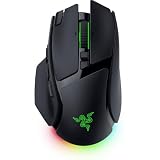
- IMMERSIVE CONTROL & SMART SCROLLING – Adapt every action to your workflow or gameplay with Razer HyperScroll Tilt Wheel Gen-2 featuring 24-step and 48-step tactile modes, free-spin scrolling, and Smart-Reel auto switching for gaming, productivity, and content creation
- PIXEL-PERFECT PRECISION FOR COMPETITIVE PLAY – Dominate FPS, battle royale, MOBA, and action games with the Focus Pro 50K Optical Sensor Gen-3 featuring 50,000 DPI, 930 IPS, 90G acceleration, and Frame Sync for ultra-low latency tracking
- LONG-LASTING WIRELESS PERFORMANCE – Play longer without interruptions with up to 200 hours of battery life at 1000Hz and ultra-responsive 8000Hz polling in both wired and HyperSpeed Wireless Gen-2 modes for esports-level responsiveness
- COMPLETE COMMAND AT YOUR FINGERTIPS – Execute advanced macros, push-to-talk commands, weapon swaps, profile cycling, and productivity shortcuts with 14 customizable controls including a multi-function trigger, M1 edge button, and 3 side buttons
- CUSTOMIZE YOUR DESKTOP EXPERIENCE – Personalize every session with 7-zone Razer Chroma RGB underglow, 16.8 million colors, dynamic lighting effects, and immersive game integrations across 300+ Chroma-enabled titles
Set a known DPI and in-game sensitivity first
Use a sensitivity that already feels familiar as your reference point. This gives every later change a meaningful comparison. If you alter DPI, alter the game’s sensitivity in the opposite direction so your overall feel remains comparable, or deliberately accept the new feel and train it; do not change several variables at once.
- Open Razer Synapse and select the Basilisk V4 device.
- Open the performance or sensitivity controls and record the current DPI stage that your FPS game uses.
- In the game, record horizontal and vertical sensitivity and any scoped multipliers.
- Play a short, repeatable practice routine: a few target switches, a 180-degree turn and a slow tracking exercise.
- Change only one value, repeat the same routine and keep the change only if it solves a specific problem.
There is no DPI value that Razer’s documentation establishes as “best” for FPS. A lower effective sensitivity can require more desk space and more lifting, while a higher one can make fast turns easier but expose small hand movements. The correct baseline is the value you can reproduce under pressure.
| Choice | What changes | When to consider it | Trade-off |
|---|---|---|---|
| Fixed DPI and fixed game sensitivity | The same input-to-aim relationship at all movement speeds | Players who rely on consistent muscle memory | Fast turns require the same sensitivity as fine corrections |
| Dynamic Sensitivity | Output changes with movement speed | Players who want slower precision and faster broad sweeps | Adaptive behavior can make familiar hand movements less predictable |
Choose a polling rate you can run consistently
The Basilisk V4 Pro is advertised with true 8,000 Hz polling in both wired and wireless modes. Polling rate describes how often the mouse reports its position; it does not directly set aim sensitivity. A higher rate can increase the frequency of reports, but the documentation does not show that every game, processor, display or player gains a measurable FPS advantage at 8,000 Hz.
What’s actually slowing this PC down?
Pick the symptom - the matching free tool is one click away.
Start with the rate that already feels stable. If you want to test 8,000 Hz, use the same DPI, in-game sensitivity and practice routine before and after the change. Watch for frame-time spikes, unusual CPU load, wireless battery impact or a game that feels less consistent. If any of those appear, use a lower rate available in your Synapse menu. The reviewed product material does not specify a universal lower rate or a guaranteed performance threshold.
| Polling choice | Use it when | Check before keeping it |
|---|---|---|
| Up to 8,000 Hz | Your PC and game remain smooth and you prefer the response feel | Frame-time consistency, CPU load, wireless run time and in-game stability |
| Lower available rate | The maximum setting causes stutter, extra load or no perceptible benefit | That your cursor and aim remain consistent during fast sweeps |
Do not treat the 8,000 Hz number as a requirement for competitive play. It is a selectable capability, not an independently demonstrated advantage.
Rank #2
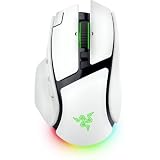
- IMMERSIVE CONTROL & SMART SCROLLING – Adapt every action to your workflow or gameplay with Razer HyperScroll Tilt Wheel Gen-2 featuring 24-step and 48-step tactile modes, free-spin scrolling, and Smart-Reel auto switching for gaming, productivity, and content creation
- PIXEL-PERFECT PRECISION FOR COMPETITIVE PLAY – Dominate FPS, battle royale, MOBA, and action games with the Focus Pro 50K Optical Sensor Gen-3 featuring 50,000 DPI, 930 IPS, 90G acceleration, and Frame Sync for ultra-low latency tracking
- LONG-LASTING WIRELESS PERFORMANCE – Play longer without interruptions with up to 200 hours of battery life at 1000Hz and ultra-responsive 8000Hz polling in both wired and HyperSpeed Wireless Gen-2 modes for esports-level responsiveness
- COMPLETE COMMAND AT YOUR FINGERTIPS – Execute advanced macros, push-to-talk commands, weapon swaps, profile cycling, and productivity shortcuts with 14 customizable controls including a multi-function trigger, M1 edge button, and 3 side buttons
- CUSTOMIZE YOUR DESKTOP EXPERIENCE – Personalize every session with 7-zone Razer Chroma RGB underglow, 16.8 million colors, dynamic lighting effects, and immersive game integrations across 300+ Chroma-enabled titles
Use profiles and bindings to keep each game predictable
The V4 Pro provides 14 customizable controls. Bind only actions you can reach without shifting your grip or accidentally moving the aim. Common candidates are push-to-talk, melee, ability, reload or a temporary sensitivity clutch, but the best layout depends on the game and your hand position. Avoid filling every button simply because it is available.
Create a game profile
- In Synapse, select the Basilisk V4 and open the customization or button-mapping page.
- Assign the controls you can reach naturally, then save the configuration as a named profile for the game.
- Open the profiles or Smart Profiles area and link that profile to the game’s executable or launch entry.
- Start the game and verify every binding in a safe practice area before entering a match.
Razer says Smart Profiles can load linked settings when a game starts. The V4 guide also describes up to five onboard memory profiles for carrying configurations between setups. Keep one neutral profile for troubleshooting and reserve the other slots for games or distinct control schemes. A profile that fails to switch should not leave you guessing: check which profile Synapse marks as active and confirm the game path still points to the installed executable.
Test Perfect 180 only if you play low sensitivity
Perfect 180 is an assignable instant-turn function intended for low-sensitivity FPS players. Razer’s promotional announcement says it can perform an instant 180-degree turn; the actual turn depends on the game’s sensitivity and Synapse’s total-count setting. It is not a universal replacement for ordinary mouse control.
Set up and validate the turn
- Open the Basilisk profile for the intended game and choose an unused, reachable control in the customization page.
- Assign Perfect 180 and set its total-count value in Synapse as instructed by the control’s panel.
- Enter the game’s practice range, stand beside a visible reference point and activate the bind.
- Check whether the view ends behind you rather than short or beyond 180 degrees.
- Repeat after changing either the game sensitivity or the Synapse total-count value; both affect the result.
Keep it only if the activation is deliberate and repeatable. A thumb button that is too easy to press can turn during a gunfight, and a turn that differs between profiles can undermine rather than improve consistency. Players who already make reliable manual turns may gain nothing from adding the bind.
Decide whether Dynamic Sensitivity fits your muscle memory
Razer describes Dynamic Sensitivity as changing DPI according to movement speed. In practice, the intended trade-off is slower output for careful movement and faster output during broad, rapid sweeps. That behavior may suit a player who struggles to combine precise micro-adjustments with quick turns, but the documentation does not establish that it improves aim.
Rank #3
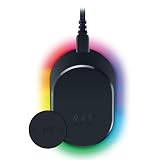
- MAGNETIC WIRELESS CHARGING – Recharge effortlessly between gaming sessions with a secure magnetic dock and wireless charging puck that keeps compatible Razer gaming mice powered and ready for continuous play
- TRUE 8000 HZ WIRELESS PERFORMANCE – Unlock ultra-low-latency Razer HyperSpeed Wireless Gen-2 connectivity with the integrated 8K Hz transceiver for maximum responsiveness in competitive FPS, MOBA, and esports gaming
- 8-ZONE CHROMA RGB UNDERGLOW – Customize eight lighting zones with 16.8 million colors and dynamic effects that sync with over 300 Chroma-integrated games for a more immersive gaming experience
- MULTI-DEVICE CONNECTIVITY – Keep your setup clean by pairing compatible Razer mice and keyboards through a single integrated transceiver, reducing cable clutter while maintaining reliable wireless performance
- CHARGE STATUS AT A GLANCE – Easily monitor battery levels through color-coded lighting indicators that show low, medium, and full charge status without opening software or interrupting gameplay
Run a controlled comparison
- Record your fixed-DPI baseline and leave the game sensitivity unchanged.
- Enable Dynamic Sensitivity in the profile and perform slow tracking, short corrections and a fast 180-degree sweep.
- Repeat the same exercises with Dynamic Sensitivity disabled.
- Keep the adaptive mode only if you can predict how much the reticle moves at both slow and fast hand speeds.
Disable it when your corrections feel inconsistent, when you cannot stop precisely at a target, or when switching between games leaves you with conflicting muscle memory. Do not combine a new adaptive curve with a new DPI and a new in-game sensitivity in one session; you will not know which change caused the result.
Do these 3 things before closing this tab:
1Fix the driver behind crashes, sound loss and screen glitches2Clear out junk files and repair common Windows errors3Scan for outdated or missing drivers - takes under a minuteUse Mouse Rotation only to match a naturally angled grip
Mouse Rotation is intended to align tracking with the angle at which you naturally hold the mouse. It is an adjustment for grip geometry, not an FPS performance preset. If your wrist and forearm consistently rotate the mouse relative to the desk and your crosshair appears to drift during straight tracking, it is worth testing.
- Hold the mouse as you normally do rather than forcing it square to the desk.
- Open Mouse Rotation in the Basilisk profile and apply a small adjustment.
- Track a vertical and horizontal target in the practice range.
- Return to neutral if the adjustment makes diagonal movement or familiar flicks harder to reproduce.
Use the same rotation value in each game profile that shares the grip. A value that compensates for an occasional wrist angle can make your usual movement worse.
Tune lift-off, landing and surface tracking around how you recenter
If you play at low sensitivity, you may lift the mouse repeatedly to recenter it. Razer documents Asymmetric Cut-Off for independently setting lift-off and landing distance, plus Smart Tracking for automatic lift-off calibration. The appropriate values depend on your surface and how high you naturally lift; the available material does not provide an independently tested best level.
Practical adjustment sequence
- Keep the mouse on your normal pad and open the sensor or calibration controls in Synapse.
- If your crosshair moves while the mouse is being lifted, reduce the lift-off distance or use Smart Tracking to calibrate the surface.
- Lift and place the mouse repeatedly, checking that it resumes tracking immediately when it lands.
- Adjust the landing distance if the sensor takes too long to reacquire or produces an inconsistent first movement.
- Test the final values during repeated recentering, not just with the mouse stationary.
Very aggressive cut-off settings can stop tracking before you expect; overly generous settings can allow unwanted movement during a lift. Consistency matters more than a particular number.
The Tool Desk
Outbyte PC Repair FREERepair Windows errors before they cause bigger problemsFix Now →Outbyte Driver Updater FREEScan for outdated or missing drivers - takes under a minuteDriver Scan →Rank #4
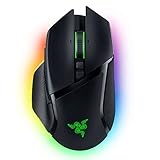
- ICONIC ERGONOMIC FORM WITH 10 1 PROGRAMMABLE BUTTONS: Favored by millions worldwide, the mouse’s signature shape perfectly supports cutting-edge ergonomics and endless customizability options
- 13-ZONE CHROMA LIGHTING WITH FULL UNDERGLOW: Customize each zone from over 16.8 million colors and countless lighting effects, and experience greater immersion as they react dynamically with over 150 Chroma-integrated games
- RAZER FOCUS PRO 30K OPTICAL SENSOR: Razer’s brand-new sensor provides flawless tracking performance on a wider variety of surfaces, including glass—supported by intelligent functions for enhanced aim and control
- RAZER OPTICAL MOUSE SWITCHES GEN-3: From an improved 90-million click lifecycle with zero double-clicking issues, to a blistering 0.2ms actuation with no debounce delay, enjoy reliability and speed that outshines all others
- RAZER HYPERSCROLL TILT WHEEL: Speed through content with a scroll wheel that spins freely or switch to the tactile mode for more precision and feedback
Configure scroll behavior and lighting for control, not appearance
The Basilisk V4 documentation describes multiple scroll modes and customizable scroll inputs. Choose tactile scrolling when distinct weapon or ability steps matter and you want clear detents. Use a freer mode only if rapid scrolling is genuinely useful in the game and you can avoid accidental inputs. Bind scroll clicks or directions only after confirming that the action does not interfere with your grip.
RGB lighting is a preference setting. It does not change sensor tracking, polling or aim. A simple color or disabled lighting can reduce distraction and preserve battery in wireless use, but there is no FPS accuracy benefit established for any lighting pattern.
Three sensible starting configurations
| Player situation | Starting configuration | Settings to test next |
|---|---|---|
| Established muscle memory | Known fixed DPI, existing in-game sensitivity, ordinary manual turns, neutral rotation | Game profile, reachable bindings and a stable polling rate |
| Low sensitivity with frequent recentering | Known sensitivity, consistent cut-off and landing behavior, tactile scroll | Perfect 180 and Smart Tracking, one at a time |
| Wants faster sweeps without raising baseline sensitivity | Fixed baseline first, then Dynamic Sensitivity in a separate profile | Compare adaptive and fixed behavior in the same practice routine |
| Angled or claw-style grip | Neutral Mouse Rotation first, then a small grip-alignment adjustment | Tracking tests in both axes and repeated flicks |
Troubleshoot changes that feel worse
Aim changed after launching the game
Check that Smart Profiles selected the intended profile, that the game is linked to the correct executable and that the game’s own sensitivity or scoped multiplier did not change. Confirm the active DPI stage on the mouse before changing any values.
The 180-degree bind stops short or overshoots
Verify the game’s sensitivity and Synapse total-count setting. Test in the same game and profile in which you configured it; Perfect 180 is not guaranteed to produce the same turn when either input changes.
Quick wins for a faster PC:
Repair Windows errors before they cause bigger problemsFix Now →Scan for outdated or missing drivers - takes under a minuteDriver Scan →High polling feels stuttery
Return to the previous stable rate, then test again after closing unnecessary background applications and confirming the game remains smooth. The maximum advertised rate is optional; consistent frame delivery is the priority.
Best Value

- ICONIC ERGONOMIC DESIGN WITH THUMB REST — PC gaming mouse favored by millions worldwide with a form factor that perfectly supports the hand while its buttons are optimally positioned for quick and easy access
- 11 PROGRAMMABLE BUTTONS — Assign macros and secondary functions across 11 programmable buttons to execute essential actions like push-to-talk, ping, and more
- HYPERSCROLL TILT WHEEL — Speed through content with a scroll wheel that free-spins until its stopped or switch to tactile mode for more precision and satisfying feedback that’s ideal for cycling through weapons or skills
- 11 RAZER CHROMA RGB LIGHTING ZONES — Customize each zone from over 16.8 million colors and countless lighting effects, all while it reacts dynamically with over 150 Chroma integrated games
- OPTICAL MOUSE SWITCHES GEN 2 — With zero unintended misclicks these switches provide crisp, responsive execution at a blistering 0.2ms actuation speed for up to 70 million clicks
Tracking moves when lifting
Recalibrate with Smart Tracking or lower the lift-off distance, then check landing behavior with repeated recentering. If the problem appears only on one pad, test the surface that you actually use for play.
Dynamic Sensitivity feels unpredictable
Disable it and restore your fixed baseline. If you revisit it, use a separate profile and change no other variable during the comparison.
What the specifications do—and do not—tell you
Razer’s October 8, 2026 announcement supplies the V4 Pro’s advertised 50,000 DPI, 930 IPS, 90 G acceleration and 8,000 Hz wired and wireless polling figures. The product guidance documents the sensor controls, 14 customizable controls, Smart Profiles, five onboard memory profiles and the behavior of Perfect 180, Dynamic Sensitivity, Mouse Rotation, Asymmetric Cut-Off and Smart Tracking.
Those materials do not provide controlled testing of one DPI, polling rate or feature combination, nor independent competitive results. Treat every recommendation in this guide as a method for finding a stable setup on your own computer, game, surface and grip—not as a claim that one setting wins for everyone.
Quick Recap
Product prices and availability are accurate as of the date/time indicated and are subject to change. Any price and availability information displayed on Amazon at the time of purchase will apply.

