Free tools Windows power users keep installed
One-click scans. No signup required.
There is no single best cinematography drone. For most solo filmmakers and travel creators, the DJI Air 3S is the practical starting point because it combines two focal lengths, 4K/60 HDR, 4K/120 and 10-bit D-Log M in a portable package. The DJI Mavic 4 Pro is the higher-end folding choice for productions that need a flagship multi-camera system. A crew that truly needs a dedicated cinema platform should look at the DJI Inspire 3, which DJI identifies as an S35 6K professional cinematography drone. Those are different production tiers, not three interchangeable rankings.
Quick picks by production need
| Production need | Best-fit tier | Why it fits | Important qualification |
|---|---|---|---|
| Travel, documentary, social and small-crew work | DJI Air 3S | Portable dual-camera design, a 1-inch main camera, a medium-tele camera, 4K/60 HDR, 4K/120 and 10-bit D-Log M. | These are manufacturer-published capabilities; they do not prove superior real-world image quality. |
| Higher-end folding production | DJI Mavic 4 Pro | DJIUSA positions it as a flagship with a triple-camera Hasselblad system and Infinity Gimbal. | The cited material does not establish independent image tests, complete recording specifications or current pricing. |
| Dedicated professional cinematography | DJI Inspire 3 | DJI Store labels it an S35 6K Professional Cinematography Drone, indicating a separate cinema-production class. | Detailed recording modes, pricing and direct comparisons with the Air 3S are not stated in the available official listing. |
Choose the row that matches the way your production is staffed, transported, shot and finished. A larger sensor or a higher resolution number can be useful, but neither one alone tells you whether a drone will produce the best shot for your project.
As an Amazon Associate I earn from qualifying purchases.
What makes a drone suitable for cinematic video?
Cinematic aerial work is a combination of image capture, movement, lens choice, exposure and post-production. The drone must give you enough control to preserve highlights and shadows, maintain a consistent look between shots and frame subjects at useful distances. It also has to be safe and legal to operate where you are filming.
Camera and lens flexibility
A single wide camera can cover landscapes, establishing shots and overhead views, but it may force you to fly close to a subject. A medium-tele camera can compress perspective and keep the aircraft farther away, which is useful around people, buildings or sensitive locations. Two cameras can also give a small crew alternate compositions without landing and changing equipment.
#1 Best Overall

- No Registration Needed - Under 249 g, this drone with camera for adults 4K does not require FAA registration or Remote ID for recreational use. Visit the FAA's official website for requirements related to drone registration and Remote ID. [1]
- 4K Ultra HD & 3-Axis Gimbal for Cinematic Quality Shooting - Capture stunning moments in any light—sunrises, sunsets, and night scenes with crystal-clear 4K resolution. Thanks to the 3-axis gimbal, you can achieve cinematic-quality footage with this advanced drone with camera.
- 38kph (Level 5) Wind Resistant - This drone for adults has a stable flight even in Level 5 winds. Brushless motors enhance power and allow takeoff at altitudes up to 4,000 meters.
- 10km Max HD Video Transmission-up to 10 km (32,800 feet) [2] of HD video transmission and has excellent anti-interference capabilities, giving you the ability to freely explore vast landscapes and see clearer.
- Due to platform compatibility issue, the DJI Fly app has been removed from Google Play. To ensure a better product usage experience, please log in to the DJI official website to download the latest version of DJI Fly.
Sensor dimensions affect how much light reaches the camera and how much latitude you may have when grading. They do not guarantee a particular level of dynamic range, noise performance, color response or lens sharpness. Those characteristics require controlled testing or footage from the exact camera and firmware version you intend to use.
Frame rates, HDR and log recording
Standard-speed footage is often captured at a frame rate such as 24, 25 or 30 frames per second, depending on the delivery standard and the look you want. Higher frame rates can be conformed to a lower timeline rate for slow motion, but they consume more storage and may impose different exposure or processing limits.
HDR modes are intended for a wider brightness range in capture and display. A log profile such as 10-bit D-Log M records a flatter image so that you can make larger tonal and color adjustments in post. Log footage is not finished footage: it needs a color-managed transform or a carefully built grade, and an incorrect transform can make it look washed out or oversaturated.
Bitrate and post-production headroom
Bitrate describes how much encoded data is allocated to the video stream. It can affect how well fine textures, foliage, water and fast motion survive compression, but it is only one part of image quality. Codec behavior, chroma sampling, bit depth, lens quality, exposure and the grade all matter.
Rank #2

- No Registration Needed - Under 249 g, this drone with camera for adults 4K does not require FAA registration or Remote ID for recreational use. Visit the FAA's official website for requirements related to drone registration and Remote ID. [1]
- 4K Ultra HD & 3-Axis Gimbal for Cinematic Quality Shooting - Capture stunning moments in any light—sunrises, sunsets, and night scenes with crystal-clear 4K resolution. Thanks to the 3-axis gimbal, you can achieve cinematic-quality footage with this advanced drone with camera.
- 38kph (Level 5) Wind Resistant - This drone for adults has a stable flight even in Level 5 winds. Brushless motors enhance power and allow takeoff at altitudes up to 4,000 meters.
- Due to platform compatibility issue, the DJI Fly app has been removed from Google Play. To ensure a better product usage experience, please log in to the DJI official website to download the latest version of DJI Fly.
- Uninterrupted Creation with Extended Battery Life - There are three sets available for you to choose from: 1-battery set (31-min), 2-battery set (62-min), or 3-battery set (93-min). [3] Say goodbye to battery anxiety and let nothing hold you back.
DJI’s Air 3S specification page says encoding bitrate can reach 130 Mbps when recording 4K/120fps in D-Log M. That is a manufacturer-published maximum for the stated mode, not a guaranteed bitrate for every clip or setting. Plan storage and transfer capacity around the actual mode you will use, rather than treating 130 Mbps as a universal figure.
DJI Air 3S: the portable all-rounder
The Air 3S is the most broadly applicable option for a creator who travels, works alone or carries a small kit. DJI describes it as a dual-camera drone for travel photography. Its main camera is listed at 50 megapixels with a 1-inch sensor. The second camera is listed at 48 megapixels with a 1/1.3-inch sensor and a medium-tele perspective.
What the two-camera system enables
- Use the primary camera for wide establishing views and scenes where the larger stated sensor is useful.
- Switch to the medium-tele camera when you want a tighter composition without moving the aircraft as close to the subject.
- Capture matching types of video from either camera while retaining alternate focal-length choices during a single flight.
DJI lists 4K/60fps HDR, 4K/120fps and 10-bit D-Log M for the Air 3S. The same video specifications and color modes are listed for both cameras in the product information. Confirm the exact camera, frame rate, color mode and firmware behavior in your intended workflow before a paid shoot.
Quick wins for a faster PC:
Fix the driver behind crashes, sound loss and screen glitchesFind Drivers →Repair Windows errors before they cause bigger problemsFix Now →Who should buy it
Choose the Air 3S when portability and versatility matter more than operating a dedicated cinema package. It suits travel films, real-estate exteriors, destination videos, documentaries, social campaigns and small narrative crews that can accept a compact consumer-class system. It is also a sensible learning platform because one aircraft can teach you wide and compressed composition, HDR delivery and log grading.
Rank #3

- Fly Without Your Phone: Equipped with a convenient 4.5-inch built-in screen controller, this drone eliminates the need to download an app or connect your smartphone. After powering on, the controller automatically connects to the drone, allowing you to view clear real-time FPV footage directly on the built-in display. The integrated screen combines live viewing and flight controls in one dedicated controller, allowing you to stay focused on flying.
- Capture Every Adventure in 4K: Featuring a 90-degree adjustable lens, this 4K drone provides clear aerial views from different angles. Whether recording everyday family moments, outdoor adventures, travel scenery, or checking hard-to-reach areas like rooftops and gutters, this drone helps you see and capture more from above. With FPV real-time image transmission, you can view live footage, easily frame your shots.
- GPS Flight with Smart Return: This GPS drone supports three Return-to-Home modes, including One-Key Return, Low Battery Return, and Signal Loss Return, helping reduce the risk of losing the drone. It also features Follow Me, Waypoint Flight, and Point of Interest, giving you more ways to explore and enjoy every flight. GPS positioning supports outdoor flight, while Optical Flow positioning helps maintain steady hovering indoors.
- Extended Flight with Brushless Power: Two 7.4V 1600mAh rechargeable batteries provide up to 30 minutes of flight time each, giving you up to 60 minutes of total flight time. When one battery runs out, simply replace it with the spare battery and continue flying without waiting for the battery to recharge. Equipped with brushless motors, this drone offers efficient operation, low-noise performance, and long service life for everyday flying.
- Easy to Fly, Ready for Travel: Featuring One-Key Takeoff and Landing, Headless Mode, Gesture Control, Auto Return, and 3 Speed Modes, beginners can get started easily, while experienced users can fully enjoy its range of versatile features. Weighing under 249g, it does not require FAA registration. Its compact foldable design makes it easy to take on camping, picnics, fishing, cycling, and other outdoor adventures with family and friends.
Where it may be limiting
A compact dual-camera drone is not automatically a substitute for a cinema platform. The available official material does not establish the Air 3S’s real-world dynamic range, rolling-shutter behavior, low-light performance or color matching against professional cameras. If your production requires a specific lens family, a larger crew workflow or a camera package integrated into a larger aerial system, evaluate those requirements separately.
DJI Mavic 4 Pro: the premium folding option
DJIUSA’s comparison material characterizes the Mavic 4 Pro as a flagship and the Air 3S as an all-rounder. The buyer guide likewise describes the Mavic 4 Pro as the flagship folding option. Its headline camera feature is a triple-camera Hasselblad system paired with an Infinity Gimbal.
Why a flagship folding drone can make sense
Three cameras can provide more composition choices than a wide-plus-medium-tele pair, while a folding design can still fit a mobile production kit. That combination is attractive when you need a premium aerial image but cannot justify transporting a dedicated cinema aircraft for every location. The gimbal designation also signals that stabilization and camera orientation are central to the product’s design.
Questions to answer before choosing it
- Which of the three cameras supplies the focal lengths and sensor characteristics your script requires?
- Does your post-production pipeline support the exact recording formats and color profiles available on your selected configuration?
- Will the aircraft, batteries, charging equipment and media fit your travel and insurance requirements?
- Is the flagship feature set solving a documented production problem, or are you paying for capability you will not use?
The cited manufacturer pages do not provide an independent head-to-head test against the Air 3S. They also do not establish every recording mode, current price or regional bundle. Treat the Mavic 4 Pro as a premium folding candidate, then verify the precise specification sheet and local availability before ordering.
Rank #4

- Cinematic 4K/60fps HDR Video & 48MP Photos: Captures smooth 4K/60fps HDR video and detailed 48 MP photos with a 1/1.32" CMOS sensor and f/1.7 aperture, The drone with camera for adults delivers clearer, more vibrant footage for travel, hiking, family activities, outdoor adventures, and everyday aerial photography
- 5.5" HD Touchscreen Remote — See Every Detail, Even in Direct Sunlight: 700-nit brightness and 60Hz display delivers crystal-clear live view outdoors. No phone needed — just tap, fly, and capture with confidence
- Under 249g & Travel Ready: Under 249g and easy to pack, the drone with camera for adults is built for grab-and-go flying without adding bulk to your bag. Take it on vacations, hikes, road trips, and weekend adventures to capture more of he moments you actually want to remember
- 360° Obstacle Avoidance for More Confident Flying : 360° obstacle sensing and Smart Return to Home support safer, more controlled flights when conditions get more challenging. That means less stress while exploring parks, scenic trails, open fields, or new places on your next trip
- Stable 9.32-Mi Long-Range Transmission with 1080p/60fps Live View: Enjoy responsive 1080p/60fps live view with SkyBridge transmission up to 9.32 miles, giving you a clear, stable feed while framing shots in wide-open landscapes or busy outdoor environments. Perfect for sightseeing, nature exploration, and capturing cinematic perspectives with greater control
DJI Inspire 3: when a dedicated cinema platform is justified
The DJI Store camera-drone listing identifies the Inspire 3 as an S35 6K Professional Cinematography Drone. That wording places it in a different category from portable travel drones. It is intended for productions whose camera, crew and operating requirements justify a dedicated platform.
Signs your production is ready for this tier
- You have a defined aerial-camera role rather than occasional drone shots.
- Your director, cinematographer, pilot and safety personnel need a coordinated set workflow.
- The script depends on cinema-oriented resolution, sensor format or integration that a compact folding drone cannot provide.
- You can transport, insure, maintain and safely deploy a professional aircraft and its supporting equipment.
An S35 designation and 6K label describe the platform’s stated format and resolution; they do not, by themselves, establish dynamic range, highlight roll-off, codec quality or a finished image. The available official listing does not state detailed Inspire 3 recording modes, pricing or a direct test against Air 3S. Request the current technical documentation and a qualified demonstration when those details determine your purchase.
Match the drone to your crew and deployment plan
Solo operator or two-person crew
A portable aircraft reduces setup time and simplifies travel. A solo operator must divide attention between flight safety, framing, exposure and communication, so a manageable system and conservative shot design are more valuable than features that require a larger crew. Build repeatable moves, keep a safe exit path and avoid flights that depend on last-second corrections.
Small commercial or documentary crew
A two-camera portable system can cover more focal lengths without adding a second aircraft. Before the shoot, decide whether the wide and medium-tele cameras need to match in color and exposure. Record a short reference clip from each camera under the expected lighting, then check the grade on the actual editing monitor.
Best Value
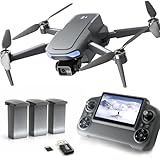
- 【Impressive 10000FT Long Range & 5G FPV Transmission】: Control this GPS drone from up to 10000 feet away with crystal-clear 5G real-time FPV feed on the 4.5" HD screen remote – great for exploring vast areas while seeing exactly what the drone with camera sees.
- 【Capture Cinematic 4K Footage with 3-Axis Gimbal Stability】: This drones with camera for adults 4K features a professional 3-axis gimbal that delivers smooth, shake-free 4K video and sharp photos, perfect for stunning aerial shots during travel, adventures, or family events.
- 【Extended 90-Min Flight Time with 3 Batteries Included】: Enjoy up to 90 minutes of total flight time thanks to the three powerful batteries – ideal for longer sessions without constant recharging, making this drone with camera a top choice for adults seeking reliable performance.(No charger included)
- 【Smart Features for Easy Flying: Auto Return, Follow Me & More】: Beginner-friendly drones with auto return home, intelligent Follow Me mode, and brushless motors for stable, quiet flights – perfect for adults new to drones or pros wanting hassle-free cinematic captures.
- 【Lightweight & FAA-Friendly – Under 249g, Foldable Design】: Weighing under 249g, this foldable RC quadcopter requires no FAA registration for most users – compact, portable drones with camera for adults 4K that fits easily in your backpack for on-the-go adventures.
Professional set with dedicated aerial department
A cinema platform becomes easier to justify when the production already has call sheets, risk assessments, location permissions, insurance and a qualified pilot. In this environment, the drone is part of a larger camera department rather than a personal travel accessory. Budget for transport, batteries, charging, media management, maintenance and contingency time in addition to the aircraft itself.
Independent reader supportYour contribution helps us test, update, and keep practical guides available for everyone.Plan the recording and grading workflow before the flight
- Define delivery. Write down the final resolution, frame rate, aspect ratio, HDR or SDR target and slow-motion requirements before selecting a camera mode.
- Choose the profile. Use HDR when the delivery chain supports it. Choose 10-bit D-Log M when you have a color-managed post workflow and enough time to grade.
- Set a consistent frame rate. Avoid switching frame rates mid-sequence unless the editorial plan calls for it. Confirm how your editor interprets high-frame-rate clips.
- Expose for the scene. Protect important highlights and monitor the image rather than relying on the nominal sensor size or resolution.
- Record references. Capture a short clip of a neutral surface, skin tone or gray card when you need to match the drone to other cameras.
- Back up immediately. Copy original files to two separate storage locations after the flight. Keep the camera, frame rate, color profile and take information with the media.
- Grade deliberately. Apply the correct technical transform for the recorded profile, then adjust contrast, saturation and shot matching. Do not judge log footage before the transform.
How to compare camera specifications without overrating them
| Specification | What it can tell you | What it cannot prove |
|---|---|---|
| Sensor size | Provides a useful indication of light-gathering area and potential depth-of-field behavior. | It does not prove dynamic range, noise, color science or lens performance. |
| Megapixel count | Describes still-image resolution and may indicate sampling detail. | It does not establish video sharpness or motion quality. |
| 4K/120fps | Provides a high-frame-rate capture option for slow motion or flexible conforming. | It does not guarantee the same exposure, bitrate or image quality as lower frame rates. |
| HDR | Signals a mode intended for wider brightness reproduction. | It does not guarantee a pleasing HDR grade or compatibility with every display pipeline. |
| 10-bit log | Offers more tonal and color values for a grading workflow than an 8-bit signal. | It does not make poorly exposed footage recoverable or remove the need for color management. |
| Bitrate | Indicates the maximum encoded data rate in a stated mode. | It does not replace tests of codec efficiency, motion detail or real-world image quality. |
Portability, system cost and availability
Do not compare aircraft prices alone. The total system includes batteries, chargers, high-speed media, a case, replacement parts, insurance, transport and any required crew or permits. A portable drone may cost less to deploy repeatedly because it fits in existing travel gear. A professional platform can be more efficient on a large set if it prevents reshoots or supplies the camera movement the production actually requires.
Current prices and regional availability are not established by the cited material. Check the manufacturer’s current store, authorized dealers and local import requirements immediately before purchase. Confirm whether a listed bundle contains the batteries, controller, charger and media you need; package contents can vary by region.
Outdated Drivers Are Slowing You Down
One free scan finds every outdated or missing driver and matches the right update for your exact hardware.Free scan · exact hardware matchWindows Errors? Fix Them Before They Spread
Repair common Windows errors and clear accumulated junk for a smoother, more stable PC - no reinstall needed.Free scan · no reinstallLegal and safety checks before every flight
Operating rules depend on the country, state or territory, aircraft category, location, altitude, proximity to people and the purpose of the flight. A commercial film may trigger requirements that do not apply to a recreational flight. DJI directs users to local regulations, but the manufacturer cannot replace the aviation authority or location owner.
- Identify the aviation authority and current rules for your launch site.
- Check registration, pilot competency, permissions and insurance requirements.
- Confirm airspace restrictions, temporary flight notices, wildlife limits and privacy rules.
- Obtain written location permission and coordinate with people affected by the operation.
- Set a weather cutoff, emergency landing plan and communication procedure.
- Keep visual awareness of the aircraft and never let a cinematic move override a safety decision.
A practical decision framework
- Start with the shoot. If most work is travel, documentary or small-crew capture, begin with the portable tier.
- Count the focal lengths. Choose a dual-camera system when wide and medium-tele views cover your scripts. Move to a triple-camera flagship only when its additional perspectives solve a real framing problem.
- Audit post-production. If you cannot manage log footage, HDR delivery or high-frame-rate media, select a workflow your editor can finish reliably.
- Measure deployment complexity. A dedicated cinema platform is appropriate when your crew, transport, insurance and location procedures support it.
- Verify before purchase. Recheck current firmware, recording modes, regional availability, total system contents and local flight rules.
For a single versatile recommendation, the Air 3S is the most defensible starting point from the stated specifications. Select the Mavic 4 Pro when a flagship folding system’s triple-camera design and gimbal are worth the added complexity. Select the Inspire 3 only when your production genuinely calls for a dedicated S35 6K cinema platform and can support its professional operating model.
Quick Recap
Product prices and availability are accurate as of the date/time indicated and are subject to change. Any price and availability information displayed on Amazon at the time of purchase will apply.

