The Ediacaran was the final period of the Proterozoic Eon, lasting from about 635 million years ago to about 539 million years ago on the timescale used by a recent geological study. Its rocks preserve some of the earliest widespread evidence of large, complex organisms and communities. Those fossils help scientists investigate animal origins, but many Ediacaran organisms cannot be confidently classified as animals, let alone identified as ancestors of living groups.
What was the Ediacaran period?
The Ediacaran was a span of geological time between the Cryogenian and the Cambrian. It is not the name of a single organism or animal group. The name is also related to the Ediacara biota, a collection of distinctive fossils and communities found in rocks from this period; the two terms are not interchangeable.
As an Amazon Associate I earn from qualifying purchases.
Dates differ slightly among published timescale summaries. Wood and colleagues give the period as 635 to 538.8 million years ago, while NASA’s 2018 public summary describes the interval before the Cambrian as running from 635 to approximately 541 million years ago. For a general overview, “about 635 to about 539 million years ago” reflects the newer date while making clear that the boundary is approximate. See Narbonne’s review of the Ediacara biota and NASA’s account of the Ediacaran–Cambrian transition.
Recommended Free Tools
What fossils lived in the Ediacaran?
Ediacaran rocks preserve large, architecturally complex forms and communities, including many soft-bodied organisms. Some are known from impressions left in sediment; other evidence comes from skeletal fossils or trace fossils, which record activity such as movement even when the organism that made the trace is unknown.
#1 Best Overall
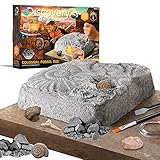
- Explore Real Fossils: Experience the thrill of paleontology as your child digs up authentic fossils from Gastropods, Brachiopods, or even a Shark Tooth. Each Discovery brick hides real fossils for kids ages 4+, making it a fun STEM toy for classroom or home use, with minimal mess indoors or outdoors
- Tools Of The Trade: Excavate like a pro with a chisel, brush, and magnifying glass to ensure you remove clean and beautiful fossils fully intact. Instead of passive learning, kids actively discover. This educational toy includes an instruction guide for easy setup and works great as a group STEM activity or dinosaur dig game for kids
- Every Set Is Different: Every dig brick features an assortment of fossils to heighten the excitement and mystery of what may be found. Children may uncover tiny dinosaur figures, fossilized coral, or dinosaur eggs, turning each STEM kit into an interactive learning and education toy experience
- Learn Something New: Kids will learn about new subjects such as Paleontology and Geology while also practicing patience and precision as they must work hard to unearth the fossils within. Great for boys and girls to encourage critical thinking and hands-on STEM activities in a fun way
- Mix Of Education And Fun: The fun and excitement of discovering new fossils is a great way to teach kids about science and is a delightful learning tool outside of school. Great for science kits, educational toys, Christmas gifts for kids and dinosaur enthusiasts. Not for children under 3 due to small parts
The fossil record is shaped by preservation as well as by what lived. Narbonne’s 2005 review describes several ways Ediacaran organisms could be preserved, including burial beneath sand or volcanic-ash event beds. As a result, the fossils available today are not a complete census: a site’s sediment, depositional setting and preservation conditions affect which organisms and features can be seen.
Were Ediacaran organisms animals?
Some may have been early animals or close evolutionary relatives of animals, but the answer is not settled for the biota as a whole. Narbonne’s review suggests it included a mixture of stem- and crown-group radial animals, stem-group bilaterians, extinct evolutionary experiments and perhaps organisms from other eukaryotic groups. This is a qualified interpretation, not a definitive classification of every fossil.
Rank #2
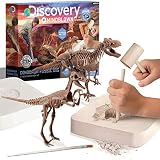
- ✔ EXCAVATE TWO DINOSAUR SKELETONS – Dig into prehistoric fun as you uncover a 15-piece T-Rex and 10-piece Velociraptor skeleton from clay dig bricks. Perfect science activity for budding paleontologists!
- ✔ ASSEMBLE & DISPLAY YOUR DISCOVERIES – Once excavated, fit the fossil pieces together like 3D puzzles to build full dinosaur skeletons. The dino models can be displayed on desktops and shelves in the bedroom or classroom.
- ✔ REAL DIG TOOLS INCLUDED – Comes with everything you need to start your jurassic excavation: 2 clay bricks, a wooden chisel, brush, mallet, and safety goggles for a realistic dig experience.
- ✔ LEARN THROUGH HANDS-ON PLAY – Encourages STEM learning with an engaging focus on paleontology, anatomy, and observation. The dinosaur figurines are great for classrooms, science fairs, or at-home discovery.
- ✔ FOR KIDS AGES 6+ – Easy to follow and fun to complete. A great gift for dinosaur lovers and science explorers. Adult supervision recommended during excavation.
A fossil’s age also does not by itself establish when its lineage first evolved. The fossil records an organism or trace from a particular time; the evolutionary history behind it may be older, and the fossil’s appearance alone does not identify it as a direct ancestor of a modern animal group.
Free tools Windows power users keep installed
One-click scans. No signup required.
How did Ediacaran fossil assemblages differ?
Researchers commonly use the names Avalon, White Sea and Nama for broad fossil assemblages, generally arranged from older to younger. These are useful ways to discuss changing fossils and communities, not perfectly separated chapters of a global timeline. Their ranges can overlap, and environmental setting, water depth, ecology and preservation can all influence which forms appear in a particular rock record.
Rank #3

- 🪠 Zero Mess & Built-In Digging Mat – The ultimate cleanup-free excavation experience is finally here. This fossil dig kit features 12 digging blocks, each sealed in its own smartly designed paper wrap that effortlessly unfolds into a dedicated digging mat. Your child can pry and dig the plaster right on this mat, containing every speck of dust. When the fossil is revealed, simply fold the paper up and toss it away. No messy plaster dust on your tables, floors, or carpets—just pure digging toys for kids joy without the parental headache.
- 🐚12 Genuine Fossils & Educational Cards – Uncover a genuine, diverse collection of prehistoric treasures with every single block. Unlike standard fossil kits, our premium fossil kit offers 12 distinct, real fossil rocks for kids, including a Sand Tiger Shark tooth, a Sea Urchin, Coral, Crinoid, and multiple types of gastropods. Each discovery is paired with a beautifully designed, educational collector card. These cards dive into the history and interesting facts behind the fossil, seamlessly turning an exciting play session into a fascinating science fossil kits for kids age 6-8 8-12 lesson.
- 🔎Perfect for Parties & Group Activities – Massive value designed for both individual learning and group fun. With 12 individually wrapped blocks, 12 sturdy chisels, and 12 matching cards, this fossils bulk set is ready to entertain a small group of friends, a birthday party crowd, or an entire classroom. It is the perfect hands-on fossil excavation kit kids activity to keep a group of young explorers engaged for hours, encouraging teamwork, patience, and shared excitement as they make their individual discoveries together.
- 🗺️ STEM Learning & Fine Motor Skills – Inspire a real passion for geology and paleontology through interactive play. The process of carefully chiseling, brushing, and revealing ancient specimens helps develop fine motor skills, concentration, and a scientific mindset. It transforms a simple game into a genuine junior archaeologist fossil dig experience. Whether for an individual child’s quiet afternoon or a classroom STEM project, this fossil dig kit for kids provides a rewarding challenge that sparks natural curiosity about Earth's ancient history.
- 🛡️ Safe, Non-Toxic & 100% Satisfaction Guarantee – Built with safety and quality at the forefront for worry-free playtime. Our fossils for kids kit is crafted from non-toxic, high-quality, and eco-conscious materials, ensuring a completely safe experience for children aged 6 and up. We stand firmly behind the quality and fun of our product. If your young explorer faces any issues or has questions during their adventure, our dedicated customer support team is ready to assist you promptly to ensure a 100% delightful experience.
| Assemblage | Broad position | What the framework conveys | Qualification |
|---|---|---|---|
| Avalon | Generally the older assemblage in the conventional sequence | One part of a framework for comparing Ediacaran fossil communities and body forms | These labels are broad assemblage categories, not clean global time boundaries. |
| White Sea | Generally follows Avalon in the conventional sequence | A later broad community grouping in the same framework | Assemblages may overlap; ecology, setting and fossil preservation affect what is found. |
| Nama | Generally the youngest in the conventional sequence | Associated in recent work with soft-bodied tubular forms, calcified fossils and complex trace fossils | A 2023-accepted study proposes a narrower evolutionary definition; it is not the only established use of the term. |
For example, Wood and colleagues report that the Nama Group in Namibia spans at least 550.5 million years ago to less than 538 million years ago. Their proposed evolutionary definition of the Nama assemblage emphasizes new tubular, calcified and complex-trace-fossil groups. In the authors’ age model, the tubular fossil Cloudina appears around 550 million years ago and persists to at least about 539 million years ago. Those dates describe the study’s evidence and age model, not the first appearance of every organism or feature across the planet.
When did animal-related fossils and innovations appear?
The following dates summarize claims from the geological study and reviews described above. They mark reported fossil evidence, not a claim that every site or fossil type appeared everywhere at once.
Rank #4

- 【3 Kinds of Different Digging Fun】: 1. Dinosaur head fossil: Child can excavate 5 real dinosaur fossils including 2 tyrannosaurus teeth, 1 tyrannosaurus claw & 2 lava stones! 2. The dinosaur bones inside Brick can assemble a 3D T-rex skeleton. 3. 6 pieces Dino Eggs Dig Kit & discover 6 unique dinosaur designs. Feel like a real paleontologist excavating up unique toy dinosaurs from 3 digging styles.
- 【Fun and Educational】: A science project usually can be engaging, but not so funny. But the science kit achieves both! Great set for individual play or as a group activity. It fascinates children as soon as they pull it out of the box and is a perfect STEM project. It fosters a love for science and paleontology in a fun and exciting way.
- 【Environmentally Safe Materials】: The fossil digging dig kit is composed primarily of gypsum. No Pollution, Odorless, Safe and Non-toxic.
- 【A Gift with An Activity Inside】: The dinosaur toys will be dinosaur party favors for dino dino-themed birthday party. It is a great birthday gift/ dinosaur easter eggs gift/Christmas gift/graduation gifts for boys, girls, kiddos, nephews, nieces, or grandchild or even to your imaginative pupils in the kindergarten as fun educational toys.
- [Plan Your Dig]: Designed for kids ages 5-7, 8-12. Use a covered work surface or tray to catch plaster debris, and follow the included instructions. A hands-on activity for family afternoons and rainy-day play
- 635 million years ago: the beginning of the Ediacaran in the cited timescale summaries.
- Before 580 million years ago: Wood and colleagues report the first fossils widely considered metazoan at less than 580 million years old. They also discuss putative metazoan trace fossils by at least 560 million years ago.
- Around 550 million years ago: the recent study notes the first skeletal taxa; Narbonne’s review also discusses calcification around this time. Timing varies by fossil and locality.
- About 539 million years ago: a rounded version of the 538.8-million-year Ediacaran end date used by Wood and colleagues. Older public summaries place the transition at approximately 541 or 542 million years ago.
Why does the Ediacaran matter for animal origins?
The Ediacaran moves the story of complex life earlier than the abundant fossil record of the Cambrian. Its fossils give researchers evidence about possible early animals and their relatives, while its communities reveal ecological changes that help explain how later animal-dominated ecosystems could develop.
Reviews of the period discuss innovations including mobility, calcification, interactions with the seafloor and competition for substrate. NASA’s synthesis notes that some ecological strategies evident in Ediacaran communities continued in later communities dominated by animals. The significance is therefore not limited to identifying early animal fossils: the period also helps scientists investigate when increasingly complex ecological interactions emerged.
Best Value

- ✔ 8 EXCAVATION KITS WITH 16 HIDDEN DISCOVERIES: Includes eight mini excavation kits across four exciting themes. Dig up genuine gemstones, genuine shark teeth, replica dinosaur fossils, and glow-in-the-dark dinosaur figures with two hidden treasures inside every kit.
- ✔ DIG, DISCOVER, EXAMINE & DISPLAY: Chip away each excavation block using the included digging tool to uncover hidden treasures, then examine and proudly display your discoveries just like a real paleontologist or geologist.
- ✔ HANDS-ON STEM SCIENCE LEARNING: Introduces kids to geology, paleontology, fossils, gemstones, and prehistoric creatures while building patience, fine motor skills, observation, and problem-solving through interactive excavation play.
- ✔ FOUR EXCITING DIG THEMES: Enjoy a variety of science activities with Gemstones Unearthed, Shark Tooth Unearthed, Dino Fossils Unearthed, and Dig & Discover dinosaur excavation kits, keeping every dig exciting and full of surprises.
- ✔ FUN STEM GIFT FOR CURIOUS KIDS: A perfect science kit, excavation kit, and educational toy for boys and girls ages 6+. Great for birthdays, holidays, classrooms, party favors, rainy days, and young dinosaur or shark fans.
How did the Ediacaran–Cambrian transition unfold?
Near the end of the Ediacaran, the record shows substantial biological turnover alongside the appearance of new skeletal and trace-fossil forms. Many characteristic Ediacaran forms disappear, but the evidence also supports ecological and evolutionary continuity across the conventional boundary. The change was not simply a sudden start to animal life with no earlier preparation.
There is no single uncontested explanation for all the turnover. The interpretation depends in part on unresolved questions about what different Ediacaran organisms were and how ecological and environmental changes affected them. The evidence supports a major transition; it does not establish one cause that accounts for every loss and appearance.
Quick Recap
What the fossils can—and cannot—tell us
- They can show: which body forms, traces and community patterns are preserved at particular places and times.
- They can suggest: early animal relationships and ecological developments, while leaving room for different interpretations of individual fossils.
- They cannot establish by appearance alone: that every Ediacaran organism was an animal, that a fossil was a direct ancestor of a living group, or that the fossil record captures every organism that lived.
Product prices and availability are accurate as of the date/time indicated and are subject to change. Any price and availability information displayed on Amazon at the time of purchase will apply.
Quick wins for a faster PC:
Repair Windows errors before they cause bigger problemsFix Now →Scan for outdated or missing drivers - takes under a minuteDriver Scan →Clear out junk files and repair common Windows errorsFree Scan →
