Choose PC speakers by checking three things against your setup: what their power rating actually measures, whether their inputs work with your computer and other devices, and whether the full system fits where you plan to put it. A higher wattage number alone does not tell you how loud or good a speaker will sound.
How to compare PC speaker specifications
Before comparing models, note five details: the power rating and its basis, input types, the dimensions of each component, how the speakers connect to power and to each other, and whether the system includes a separate subwoofer. Product specifications are useful for checking compatibility and fit; they do not by themselves establish which system sounds best.
As an Amazon Associate I earn from qualifying purchases.
What speaker power ratings mean
Check whether a wattage figure is RMS or peak, and whether it applies per channel or to the whole system. Those labels describe different things and should not be compared as if they were interchangeable.
Do these 3 things before closing this tab:
1Repair Windows errors before they cause bigger problems2Scan for outdated or missing drivers - takes under a minute3Clear out junk files and repair common Windows errorsFor example, Audioengine lists the A2+ Gen 3 at 20W RMS per channel at 4 ohms and 30W peak per channel. The figures are manufacturer specifications, not independent measurements. Audioengine cautions that higher power ratings do not necessarily mean a speaker is louder or sounds better, since efficiency and system design also matter (A2+ Gen 3 specifications; Audioengine power-rating FAQ). There is no universal wattage threshold that guarantees a particular listening level in a room.
#1 Best Overall

- External computer speaker in Black (set of 2) for amplifying PC or laptop audio
- USB-Powered from USB port of PC or Laptop
- In-line volume control for easy access
- Blue LED lights; metal finish and scratch-free padded base
- Bottom radiator for “springy” bass sound
Keep the basis attached to every number when comparing products. Edifier lists the M60 at 66W RMS total, while the CX7 is specified as 12W × 2 RMS for midrange and treble plus 45W RMS for bass. The QS30 is listed at 2.5W + 2.5W RMS. These figures have different channel and system descriptions, so they are not a simple loudness ranking (Edifier M60 specifications; Edifier CX7 specifications; Edifier QS30 specifications).
Check that the connections match your devices
Make a list of the ports and wireless connections you will actually use: for example, USB audio from a computer, a 3.5 mm output, RCA, or Bluetooth. Read the specification for the exact model and revision. A USB connector does not automatically mean that the cable carries both audio and power.
Rank #2

- Surge Stereo Sound - 4 large amplifier IC horns! Computer speakers achieved Distortion Free and Noiseless in stunning sound. Immersive cinema effect for movies, videos, games and music.
- Touch Angular Game Lights - Unique Dynamic Angular Game Atmosphere design! Desktop speaker with latest One Touch to turn on/off lights, avoid the traditional cumbersome button design.
- All In One Compact - Fits any desktop computer! Perfectly under the monitor without taking up any extra desktop space. Cables are glued together to avoid desktop clutter.
- Plug And Play - No need for any driver! Must Plug in the USB powered cable and 3.5mm audio cable to enjoy now! Top volume knob for easier volume adjustment.
- Type C Adapter Included & Compatibility - USB speakers match computers, desktops, PCs, laptops. Suitable for windows(Vista/7/8/10), Mac OS, Chrome OS, etc.
- Edifier QS30: USB-A and Bluetooth. Edifier says its attached USB cable carries both power and computer audio.
- Edifier M60: USB-C, 3.5 mm AUX, and Bluetooth.
- Audioengine A2+ Gen 3: 3.5 mm, RCA left/right, USB, and Bluetooth; it also lists an RCA line output.
- Edifier CX7: PC, AUX, USB, SD card, and Bluetooth.
USB power-and-audio behavior is model-specific: Edifier describes it for the QS30 and R20BT, but that should not be assumed for other USB speakers. Check the function of each port in the product documentation (Edifier R20BT specifications).
Free tools Windows power users keep installed
One-click scans. No signup required.
Measure the whole system, not just one speaker
Dimensions can describe a single speaker, a bar, or an entire system, so check what the manufacturer is measuring and in what order. These examples illustrate how different layouts affect desk space:
Rank #3

- Enhanced Clear Sound - Equipped with advanced sound drive unit with full range 2.0 channel enhanced stereo core, GS520 ANVIL offers you superior auditory feast.
- Touch Controlled RGB Lighting - Not only the sound quality is solid, but also the lighting bar is attractive. 6 modes are choosable for different vibes by touch-control, switch off the light is also available.
- More Than Fancy - Minimalism modern urban design with brushed material style, the seamless blend of dynamic stylish and upscale textural feel.
- Easy-access Volume Control - Individual volume up and volume down buttons make adjusting the volume easy and accurate.
- Plug & Play for Broad Compatibility - USB powered with 3.5mm audio and mic cables allows this rockstar to party on wide types of stages for PC, TV, and Laptop. Up to 31 in (80 cm) cable length between two speakers.
| Model and configuration | Manufacturer-listed dimensions | Connection and layout detail |
|---|---|---|
| Edifier QS30, speaker bar | 428.7 × 77.2 × 89 mm | One bar with attached USB cable |
| Edifier M60, stereo pair | 100 × 168 × 147 mm per speaker | Separate speakers; angled stands are included |
| Audioengine A2+ Gen 3, stereo pair | 15.6 × 10.6 × 13.8 cm per speaker | Separate speakers |
| Edifier CX7, 2.1 system | 425 × 450 × 335 mm for the system | Includes a separate 8-inch subwoofer |
Dimensions and configuration are manufacturer-listed, not independent measurements. Confirm the dimension convention on the model page, then measure your available surface and the route for power and signal cables. Leave room to reach controls and connectors; for a 2.1 system, identify a suitable location for the subwoofer as well.
Speaker-to-speaker cable length can affect placement. Edifier lists a 1.8 m inter-speaker cable and a 1.5 m USB cable for the R20BT (Edifier R20BT specifications). Check cable lengths and power arrangements for the specific speakers you are considering rather than assuming that components can be placed anywhere within the room.
Rank #4

- Versatile setup with speakers that connect easily to computers and other devices via Bluetooth wireless or 3.5mm cable
- Logitech Easy-Switch technology lets you seamlessly switch between audio devices Just by pausing the Audio on one device and pressing play on the other
- Each speaker has one active/powered driver that delivers full range Audio and ONE passive radiator that provides bass extension.
- On-speaker headphone jack Plus convenient controls for easy access to Bluetooth wireless pairing, power and Volume adjustments, Bluetooth version: 4.2
- Works with Bluetooth enabled devices and any device with a 3.5mm input including a computer, television, smartphone, tablet and music player
Choose a layout that works at your desk
A compact bar
A bar such as the QS30 uses one horizontal footprint, which may suit a narrow space better than two separate cabinets. Its listed dimensions are 428.7 × 77.2 × 89 mm, so check the width and clearance in front of your monitor, not just the speaker’s height.
Quick wins for a faster PC:
Fix the driver behind crashes, sound loss and screen glitchesFind Drivers →Repair Windows errors before they cause bigger problemsFix Now →A pair of separate speakers
Stereo pairs such as the A2+ Gen 3 and M60 require space on both sides of the display and a route for the connection between them. Measure each speaker’s footprint and account for included stands: Edifier says angled stands are included with the M60.
Best Value
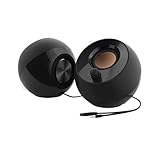
- Single USB cable for computers and laptops | enjoy a hassle-free Audio experience with a single USB cable without the need for a power adapter
- Far-field drivers and passive radiators | custom-tuned far-field driver solution with rear facing passive radiators for excellent audio and enhanced bass reproduction
- 45° elevated drivers | for enhanced audio projection and an immersive personal listening experience
- Modern and stylish aesthetics | perfect for any modern homes, offices and workspaces.
- Easy access volume control | Conveniently placed Front-facing controls for instant adjustments
A 2.1 system with a subwoofer
The CX7 illustrates a 2.1 layout with a separate 8-inch subwoofer. It requires a place for that extra component in addition to the main speakers, so consider floor or desk space and cable routing before choosing this configuration.
These product pages establish different configurations and specifications, not a universal sound-quality winner. No controlled listening comparison or neutral acoustic measurements are provided here, so use the listed facts to assess fit and compatibility rather than to rank sound.
Quick Recap
A practical pre-purchase checklist
- Write down the computer’s available outputs and any other device you want to connect.
- For each candidate, record whether its power figure is RMS or peak and whether it is per channel or total.
- Verify the exact input types and what each port does, especially USB audio and power.
- Measure the available space for every component, including any subwoofer, and allow clearance for controls and cables.
- Confirm cable lengths, power requirements, and where each speaker can sit before ordering.
Product prices and availability are accurate as of the date/time indicated and are subject to change. Any price and availability information displayed on Amazon at the time of purchase will apply.
What’s actually slowing this PC down?
Pick the symptom - the matching free tool is one click away.

