Quick wins for a faster PC:
Clear out junk files and repair common Windows errorsFree Scan →Scan for outdated or missing drivers - takes under a minuteDriver Scan →Repair Windows errors before they cause bigger problemsFix Now →The right digital signage system is a matched display-and-player setup, not simply the brightest screen or the cheapest media box. Start with the site: ambient light, viewing distance, daily schedule, portrait or landscape orientation, content type, network, mounting space and service access. Then verify that the display and player support the required resolution, inputs, CMS, audio and management method for the exact models you plan to deploy.
Use the display’s published operating rating as a hard filter, select brightness for the actual light around the screen, and decide whether built-in playback is sufficient before buying an external player. The sections below provide a practical way to make those decisions without treating one vendor’s specification as an industry-wide rule.
As an Amazon Associate I earn from qualifying purchases.
Begin with the installation, not the product catalog
Write down the conditions at every screen location before comparing specifications. A lobby display, a sunlit shop window, a menu board, a video wall and a self-service kiosk can need very different hardware even when they show similar content.
- Ambient light: note direct sunlight, bright retail lighting, reflections and any protective glass. Brightness must be judged against those conditions rather than a universal “good” number.
- Viewing distance: determine whether people will read small text close up or watch video from across a room. This affects useful resolution and screen size.
- Schedule: record the longest daily run, startup and shutdown times, and whether the screen may be left on continuously.
- Orientation: specify portrait, landscape or a design that may change later.
- Content: list video codecs, still images, web pages, live data, audio, captions and any interactive elements the CMS must deliver.
- Infrastructure: check wired Ethernet, Wi-Fi coverage, available power, ventilation, mounting points and service access.
- Scale: count screens now and at the planned expansion point. A single lobby screen has different management needs from a chain-wide rollout.
A June 3, 2026 buyer guide from ViewSonic identifies brightness, operating hours, orientation, resolution, operating system, connectivity and installation format as relevant selection factors. Use that list as a planning framework, then validate every requirement against the exact display and player documentation.
#1 Best Overall
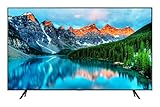
- This product is a Commercial grade television and only supports Youtube ; You would need an external media player for consumer apps such as Netflix or Amazon Prime Video.Controller type:vera
- TV dimensions ; With stand – 37.94" L x 7.89” D x 24.75” H ; Without stand – 37.94” L x 2.34” D x 22” H ; Ports ; HDMI – 2 ; USB – 2 ; RF – 1 (Terrestrial) and 1 (Cable) ; Wi-Fi 5 and Bluetooth Supported
- 43-Inch display features a super crisp and clear picture that is 4X more powerful than the resolution of full HD ; Crystal UHD takes your content to the next level by providing more accurate and smoother colors
- With the Samsung Pro TV app on your phone or tablet, create dynamic content on your time. With a super-easy guide to walk you through the setup, advertising your business has never been simpler or more convenient
- Your customers want to know exactly how it looks ; With Samsung’s Pro TV with high dynamic range, you can showcase every detail in a wide spectrum of colors ; With 16/7 operating time, you can depend on your TV to play what you want, when you want it
Display specifications that determine whether a screen will work
Brightness must match the light around the screen
Brightness is normally expressed in nits or candelas per square metre (cd/m²). A screen in a dim conference room does not face the same problem as one behind a shop window. Reflections, viewing angle and protective glass can reduce perceived contrast even when the panel’s headline brightness looks adequate.
The consulted material does not establish one brightness threshold that applies to every indoor or outdoor installation. Compare the exact model’s published value with the measured conditions at the mounting point. As product examples, Samsung Business lists 350 nits for the RH55E, while Sharp lists 400 cd/m² for the PN-ME502. Those figures describe those models only; they are not a universal recommendation.
Ask the supplier to clarify whether the stated brightness is typical or maximum, whether it changes by picture mode, and whether a protective enclosure or glass sits in front of the panel. If the display will face a window, evaluate it at the time of day when glare is worst rather than relying on a showroom impression.
Free tools Windows power users keep installed
One-click scans. No signup required.
Operating hours and duty cycle
Match the published operating schedule to the real schedule. A display rated for a limited number of hours should not be treated as a 24-hour appliance simply because it can be powered on continuously.
Daktronics specifies commercial-grade displays rated 24/7/365 for its supported LCD signage solution. That is a requirement of that solution, not a blanket rule for every signage screen. For your project, record the required daily runtime and select a model whose commercial rating covers it with appropriate service and warranty terms.
Native resolution and multi-screen output
Confirm the panel’s native resolution rather than assuming that a large screen is automatically high resolution. Daktronics’ cited minimum specifications for its solution call for either FHD (1920×1080) or UHD (3840×2160), together with portrait or landscape support and at least one HDMI input. Treat those figures as solution-specific requirements.
Rank #2

- Professional digital signage: The Amazon Signage Stick auto-launches your CMS in kiosk mode for seamless, unattended operation.
- Easy setup: Setup one or multiple Signage Sticks with the free Amazon Signage app. No tech skills needed.
- Works with over 80+ content management systems (CMS subscription may be required).
- Secure by design: Secure boot and encrypted storage keep your signage protected and running smoothly.
- Manage on the go: Create profiles, organize by location, and monitor real-time right from your phone.
Resolution also depends on the player. A player may output 4K to one screen but lower each output when driving several screens. Check the resolution per output, refresh-rate limits, content-processing capability and whether the CMS scales content or expects pre-rendered layouts.
Orientation, mounting and service access
Confirm that the panel is designed for the orientation you will install. Portrait operation can require a specific menu setting, ventilation clearance or manufacturer-approved mounting position. Check the mounting pattern, screen weight, wall strength, bracket depth, cable bend radius and access to service ports.
Plan for maintenance before the screen is on the wall. A mount that leaves no room to reach the player, power switch or network jack can turn a simple firmware update into a lift or removal job. In a screen array, Daktronics says its supported solution requires displays from the same manufacturer and model to maintain operational and performance consistency. Mixed models may be possible in other systems, but verify bezel, colour, timing and control behaviour before committing.
Inputs and control connections
List every source that must connect directly to the display. HDMI is common, but a deployment may also need DisplayPort, VGA, USB or a control interface. Daktronics’ cited specification calls for at least one HDMI input and notes that system control may require RS-232C. Do not buy an adapter until you confirm the direction of conversion and the supported resolution and refresh rate.
For remote power, input switching or diagnostics, establish whether control is handled by the CMS, a network protocol, RS-232C, a separate controller or only the display’s remote control. A player that can show content cannot necessarily turn the panel on, select an input or report a hardware fault.
Do these 3 things before closing this tab:
1Repair Windows errors before they cause bigger problems2Scan for outdated or missing drivers - takes under a minute3Clear out junk files and repair common Windows errorsAudio is a separate requirement
Commercial displays do not all include speakers. Daktronics notes that some models may need a connected soundbar. Decide whether your content needs audible speech, background music, accessibility narration or no audio at all. If audio matters, verify the display’s built-in speakers, audio output, amplifier connection, volume control and mute behaviour with the player and CMS.
Rank #3

- 50-inch 4K UHD 3840 x 2160 display with a non-glare panel delivering 300 nits of brightness
- Easily connect up to two sources via HDMI, or play content directly from USB with the built-in media player
- Crystal 4K Processory provides Intelligent UHD upscaling and ensures the highest picture quality for both standard and high definition content
- Slim and elegant with 3 side bezel-less design; VESA 200 x 200 wall mountable in portrait or landscape mode
- Built to operate reliably for up to 16 hours a day, 7 days a week and includes an IP5X dust-proof rating 3-Year commercial warranty to ensure peace of mind
Choose the playback architecture
Built-in system-on-chip playback
A display with embedded playback can reduce boxes, cables and mounting work. It is suitable when the built-in operating system supports your CMS, media formats, scheduling, remote management and security policy.
Samsung’s RH55E support page, for example, lists an embedded MagicInfo Express Player 2 and identifies supported content types. That example applies to the RH55E; it does not establish that every built-in signage player supports every CMS, codec, web page or data source. Request a current compatibility list for the exact display firmware and your intended CMS.
Embedded playback can also create a longer replacement cycle: when the panel remains healthy but its operating system or CMS support ends, replacing the whole display may be less convenient than swapping a player. Confirm the manufacturer’s software-update policy and support lifecycle.
External digital signage player
An external player is useful when you need a particular CMS, more processing power, multiple outputs, specialized peripherals, a standardized fleet or the ability to replace computing hardware independently of the panels.
Compare players by the number of screens they drive, resolution per screen, output connectors, wired and wireless networking, offline operation, management method, enclosure size, heat and power requirements, and the physical space behind the display. Make sure the player can be secured and serviced without blocking ventilation.
CAYIN’s published examples illustrate why model-level checking matters: the SMP-2200 is specified for one 4K screen or two 1080p screens and includes HDMI and VGA outputs; the SMP-2400 adds DisplayPort and 2.5GbE; the SMP-8100 provides four HDMI outputs for up to four 1080p screens. These are vendor claims for those models, not universal behaviour for external players. Confirm current specifications before ordering.
Rank #4

- SLIM AND SYMMETRICAL DESIGN: Slim, symmetrical design that will stand the test of time and ensure the QMR-A series blends seamlessly into any environment, with simple installation to get your display up and running as soon as possible.
- CISCO WEBEX CERTIFIED: The QMR-A series has achieved the most stringent of all testing by the Webex Device Business Unit and is fully certified. Cisco WebEx together with the QMR-A series provides the ultimate conferencing solution.
- CLEAN CABLE MANAGEMENT: With QMR-A's new cable guide feature, retailers are able to tuck away messy cables from view. This allows for a clean and visually-appealing shopping experience for customers, even when the back of the display is visible.
- POWERFUL, ALL-IN-ONE SOLUTION: SSSP is an all-in-one solution that simplifies installation and maintenance. The embedded MagicINFO player S6, backed by a powerful Tizen 4.0 operating system, allows for easy content management and playback without the need for a PC. Businesses can enjoy easy development, reinforced capability with multiple web formats and standards and secured protection.
- SAMSUNG WORKSPACE SECURED BY KNOX: With security provided by Knox, the displays feature Samsung Workspace which supports wireless cloud service access and control of a PC without needing a physical connection. Samsung Workspace simplifies meeting spaces while also improving security.
Existing compatible hardware
A compatible computer, thin client or Android device may run the CMS successfully and can reduce initial hardware purchases. Use it only after checking the CMS’s supported operating-system version, graphics output, automatic restart behaviour, storage, network security and physical installation requirements.
Recommended Free Tools
Document who patches the device, how it recovers after a power failure, whether it can run without a logged-in user and how support staff access it. “It plays a video” is not enough for unattended signage.
Player comparison checklist
| Decision axis | Questions to answer |
|---|---|
| Screen count | How many independent screens or zones must one player drive? |
| Resolution | What is the maximum resolution and refresh rate per output, especially when multiple outputs are active? |
| Outputs | Are HDMI, DisplayPort, VGA or adapters required, and are they supported in the intended combination? |
| Network | Is wired Ethernet required, is Wi-Fi reliable at the installation, and can the player continue offline? |
| Management | Can staff manage it locally, through a CMS server, or both? What permissions and audit controls exist? |
| Content | Does the player support the CMS, codecs, web pages, live data, captions and audio you actually use? |
| Physical fit | Will it fit behind the panel, remain ventilated and stay accessible for replacement? |
| Lifecycle | How are firmware updates, security fixes, backups and player replacement handled? |
CMS, network and offline operation
Ask whether a CMS server is mandatory. CAYIN describes players that can run independently, with a CMS server as an optional central-management layer. That arrangement is product- and configuration-specific. Other platforms may require a cloud account or server for scheduling, while some can accept locally stored playlists.
Define the failure behaviour before deployment. A useful test plan covers loss of internet, loss of the local network, a failed content download, a power interruption and a CMS outage. Confirm how long cached content remains available, whether schedules continue, how the player reports the fault and how staff recover it.
CAYIN also describes local management and operation on a local network without internet, plus a software player for supported Windows, Android and Chrome environments. Verify that the exact edition, license, firmware and CMS configuration you purchase provide those capabilities. Check subscription terms, account roles, encryption, update controls and end-of-support dates with the selected vendor.
Installation details that are easy to miss
- Power: provide a properly rated outlet and decide whether the display and player share a switched circuit.
- Ventilation: leave the manufacturer’s required clearance around both panel and player; enclosed cabinets can raise operating temperatures.
- Cable routing: plan HDMI or DisplayPort length, strain relief, bend radius and a replacement path.
- Mounting: match the bracket to the display’s mounting pattern, weight and approved orientation.
- Service: preserve access to power, network, control and USB ports without dismantling the installation.
- Audio: route soundbar or amplifier cables separately from signal cables where practical and test volume limits.
- Security: lock the player and display against casual removal and disable unused ports or accounts.
Input adapters are conditional accessories. Use an HDMI converter only after checking port direction, HDCP or other content-protection requirements, supported resolutions and the adapter’s power needs.
Best Value

- 【Ideal for Advertising and Promotion】MWE-QIXZOCV Floor Standing Digital Signage Display is designed with durability and sturdiness in mind. Its simple design and easy operation make it suitable for diverse indoor locations such as retail stores, restaurants, malls, airports, hospitals, and commercial centers. Stand out in the competition with this powerful and versatile LCD Advertising Display Kiosk
- 【Multifunctional Display Equipment】Advertising Display: Showcase advertisements for products, and promotional campaigns. Attracts attention, increase brand exposure, and drive consumer purchasing behavior; Brand Display: Showcasing brand logos, product information, brand stories, brand vision and more, effectively displays and enhances brand image
- 【MWE-QIXZOCV Intelligent solutions】Information Communication: Convey various types of information, such as announcements, public messages, transportation directions, event schedules, and more, to help people access the information they need; Wayfinding: Provide detailed maps and route instructions. In large venues like shopping centers, exhibition halls, hotels, LCD digital signage serves as a navigation system to guide people to their destinations
- 【Advantage Features】Slim Design: Ultra screen bezel. We're using the recent popular slim design, not heavy old design Kiosks; Stable Open Cell technology: Low-power consumption with lower heat generation. Make the screen life long time longer; Compatibility Design: Supported with other media player box installation and power connected insdie; Andriod Stable System: User friendly interface, Support app installation.
- 【High-Quality Visual Experience】Enjoy stunning image and video quality with the FHD IPS display screen, providing crisp and vibrant visuals. The wide 178° viewing angle of MWE-QIXZOCV Digital Signage ensures maximum visibility from various perspectives, while customizable display settings optimize viewing in different environments
A step-by-step buying process
- Describe each location. Record light, distance, orientation, runtime, content, network and mounting constraints.
- Set non-negotiable display filters. Eliminate models that lack the required duty rating, brightness, native resolution, orientation support, inputs or control interface.
- Decide on playback. Test the built-in player first; then compare an external player or existing device if CMS, output or lifecycle requirements are not met.
- Map the signal path. Draw the path from CMS or content source to player, adapter, display and audio equipment. Confirm every connector and resolution.
- Run a content proof. Play your real videos, images, web pages, fonts, captions and data feeds on the exact display-player combination.
- Test failure modes. Unplug internet, local network and power in controlled tests. Verify cached playback, automatic restart, schedule recovery and alerting.
- Review service terms. Confirm regional commercial warranty, software support, replacement procedure and who performs updates.
- Approve the installation plan. Check bracket, ventilation, cable lengths, outlet location, service clearance and physical security before purchase.
Common purchasing mistakes and fixes
Treating a vendor requirement as an industry minimum
A 24/7/365 rating, FHD or UHD requirement, or RS-232C connection may be essential to one supported solution while unnecessary for another. Label each requirement by the product or system that publishes it, then establish your own site requirement.
Choosing by brightness alone
A higher number does not solve reflections, poor viewing angle or unsuitable protective glass. Evaluate the complete installation and the content’s contrast at the worst viewing time.
Assuming every CMS works on every player
Confirm the exact CMS version, operating system, codec support, web-rendering behaviour, licensing and offline mode. Obtain compatibility in writing when the deployment is business-critical.
The Tool Desk
Outbyte PC Repair FREEClear out junk files and repair common Windows errorsFree Scan →Outbyte Driver Updater FREEScan for outdated or missing drivers - takes under a minuteDriver Scan →Ignoring multi-screen limits
Check output count and resolution per screen, not just the player’s headline maximum. A model that drives one 4K display may not drive several displays at the same quality.
Forgetting sound and control
Verify speakers or an audio output, then separately verify power control, input switching and remote diagnostics. A player’s video output does not guarantee those functions.
Buying without regional warranty confirmation
Warranty length, eligible sales dates and service coverage vary by region. Sharp lists a five-year commercial warranty for PN-ME502 sales from July 1, 2026, subject to regional terms. Confirm that the offer applies to your country, seller and intended use before relying on it.
How to read example specifications responsibly
| Example | Published detail | How to use it |
|---|---|---|
| Samsung RH55E | 350-nit brightness; embedded MagicInfo Express Player 2 and listed supported content types. | Use as evidence that a particular display has integrated playback; verify current CMS and format compatibility for the exact firmware. |
| Sharp PN-ME502 | 400 cd/m² brightness; five-year commercial warranty for sales from July 1, 2026, with regional terms to confirm. | Compare brightness and warranty structure, but do not treat either figure as representative of every commercial display. |
| Daktronics LCD solution | Commercial 24/7/365 rating, FHD 1920×1080 or UHD 3840×2160, portrait or landscape support and at least one HDMI input; RS-232C may be required for control. | Apply these as requirements of that solution, then identify the equivalent requirements for another system. |
| CAYIN SMP-2200 | One 4K screen or two 1080p screens; HDMI and VGA outputs. | Check whether the stated multi-screen mode matches your required resolution and current firmware. |
| CAYIN SMP-2400 | DisplayPort and 2.5GbE added to the model’s listed capabilities. | Useful only if your cabling and network actually need those interfaces. |
| CAYIN SMP-8100 | Four HDMI outputs for up to four 1080p screens. | Confirm independent-screen behaviour, timing and content layout before using it for a video wall. |
Final pre-purchase checklist
- The display’s duty rating covers the planned schedule.
- Published brightness suits measured ambient light and reflections.
- Native resolution, orientation and viewing distance fit the content.
- Mounting pattern, ventilation and service access are documented.
- Every required HDMI, DisplayPort, VGA, USB, network and control connection is present.
- Audio requirements are satisfied by speakers or an external sound system.
- The built-in player, external player or existing device is confirmed compatible with the CMS and media formats.
- Player output count and per-screen resolution match the deployment.
- Offline playback, restart and outage behaviour have been tested.
- Regional warranty, software lifecycle, security updates and support responsibilities are clear.
The safest purchase is the one whose display, player, CMS and installation plan have been tested as a single system. Treat every published number as belonging to a specific model or solution, verify current regional documentation, and reject any combination that cannot meet your site’s light, schedule, orientation, connectivity or service requirements.
Crashes, No Sound, or Screen Glitches?
Random freezes, missing sound and display glitches usually trace back to one bad driver. Find and replace yours safely.Free scan · under a minutePC Slower Than It Used to Be?
A free scan shows the junk files, broken settings and background clutter dragging Windows down - then fixes them in one click.Free scan · Windows 10 & 11Quick Recap
Product prices and availability are accurate as of the date/time indicated and are subject to change. Any price and availability information displayed on Amazon at the time of purchase will apply.

