PC Slower Than It Used to Be?
A free scan shows the junk files, broken settings and background clutter dragging Windows down - then fixes them in one click.Free scan · Windows 10 & 11Crashes, No Sound, or Screen Glitches?
Random freezes, missing sound and display glitches usually trace back to one bad driver. Find and replace yours safely.Free scan · under a minuteAI compatibility is a property of the complete deployment, not of a GPU or framework in isolation. Before buying hardware or reserving a cloud instance, match the intended workload and deployment mode with the exact GPU, qualified server, operating system, kernel, hypervisor, container and orchestration layers, driver, CUDA release, framework, network topology, and vendor support status. A configuration that is individually plausible can still be outside the vendor’s supported combination.
Start with the workload and deployment you actually intend to run
Write down the workload before comparing components. A local experiment, a single on-premises inference server, a virtual machine, a Kubernetes cluster, and a public-cloud training job have different compatibility boundaries. The same GPU may be suitable in one environment and unsupported in another because the host operating system, virtualization layer, image, network, or orchestration stack changes.
![Nvidia Corporation MCX75310AAC-NEAT Nvidia Connectx-7 Hhhl Adapter Card 400gbe / Ndr Ib [Default Mode] Sin Gle-por](https://m.media-amazon.com/images/I/31YOrTrkeoL._SL160_.jpg)
As an Amazon Associate I earn from qualifying purchases.
Record the model and workload requirements
- Model or application name and its exact release.
- Inference, fine-tuning, or distributed training as the primary job.
- Peak memory requirement, including framework overhead, batch size, sequence length, and room for concurrency.
- Expected number of GPUs and whether work must span nodes.
- Required latency, throughput, reliability, and availability targets.
- Whether you need a supported enterprise configuration or can accept an untested laboratory setup.
Memory capacity is only the first filter. Compute instructions, driver support, interconnects, host resources, and the framework’s own release requirements determine whether the workload is usable.
Quick wins for a faster PC:
Scan for outdated or missing drivers - takes under a minuteDriver Scan →Clear out junk files and repair common Windows errorsFree Scan →Choose the deployment mode explicitly
Label the design as local development, bare-metal on-premises, virtualized, Kubernetes-based, or public cloud. NVIDIA’s AI Enterprise compatibility material separates bare-metal, virtualized, and cloud configurations, so a check performed for one mode cannot automatically be carried to another. Capture the cloud provider, region, instance family, and image when the design is hosted.
#1 Best Overall

- Host Interface: PCI Express 5.0 x16 provides high-speed connectivity for maximum bandwidth and performance
- Total Number of Ports: 1 port configuration for streamlined network connectivity
- Expansion Slot Type: OSFP connector type for advanced optical networking capabilities
- Media Type Supported: Optical Fiber technology enables high-speed data transmission over long distances
- Maximum Data Transfer Rate: 200 Gbit/s throughput delivers exceptional network performance for demanding workloads
Verify the exact GPU and the system qualified to run it
Check the complete GPU model against the software release you plan to install, then check the server or platform qualification for that GPU. Board memory, form factor, power, firmware, PCIe layout, cooling, and the number of accelerator slots can make an otherwise supported GPU unsuitable for a particular chassis.
Use the release-specific support matrix
NVIDIA AI Enterprise prerequisites require a supported GPU and, for on-premises deployments, an NVIDIA-Certified System. Certain GB200 and GB300 platforms are handled as an exception requiring Qualified Systems status. This is a release and platform rule, not a universal statement that every NVIDIA GPU works in every server.
Save the matrix entry that matches your intended release. The AI Enterprise 4.8 matrix is pinned to that release, while the newer interactive matrix covers releases in the 7.x and 8.x families. A qualification can change when you move to a later release, change the host, or change from bare metal to a virtual machine.
Check architecture features without treating them as a guarantee
NVIDIA’s GPU reference describes compute capability as the definition of hardware features and supported instructions for an architecture. Use that value to identify architectural limits, but do not substitute it for the target framework and release check. A framework may require a particular instruction set, minimum driver branch, or supported GPU list even when the compute capability appears adequate.
Confirm the operating system and platform layers
Compatibility starts below the framework. Confirm the distribution and version, kernel, firmware expectations, hypervisor, container engine, and Kubernetes distribution before installing a driver.
Rank #2

- Host Interface: PCI Express 5.0 x16
- Total Number of Ports: 1
- Expansion Slot Type: OSFP
- Media Type Supported: Optical Fiber
- Maximum Data Transfer Rate: 400 Gbit/s
Operating system and kernel
Record the exact OS edition and point release, kernel version, architecture, and security-patching policy. NVIDIA AI Workbench states that “The primary dependency is on the target operating system.” Its validated configurations are distinct from configurations that are merely expected to work. A distribution that boots the application may still lack a supported kernel, driver package, or integration path.
Virtualization and containers
For a virtual machine, verify GPU pass-through or the vendor’s supported virtual GPU method, the hypervisor version, guest drivers, and host-driver relationship. For containers, identify the container runtime, GPU runtime integration, base image, and image CUDA version. A container does not remove host requirements: NVIDIA’s support guide states, “Container CUDA versions must be compatible with host GPU drivers.”
What’s actually slowing this PC down?
Pick the symptom - the matching free tool is one click away.
Kubernetes and orchestration
List the Kubernetes distribution and version, node operating system, GPU device plug-in or operator, container runtime, and scheduling policy. Check whether the vendor supports that combination rather than assuming that a generic Kubernetes installation is equivalent to a validated one. Include upgrade constraints: an operator update, node image refresh, or Kubernetes minor-version change can alter the supported set.
Align drivers, CUDA, runtimes, and frameworks
Build a version chain from the host driver to the application. The chain should identify the driver branch, CUDA Toolkit or runtime release, container image, framework version, and application release. Every link must support the GPU and the layer immediately above it.
Driver and CUDA checks
- Identify the minimum and recommended driver version for the chosen GPU and operating system.
- Check the CUDA Toolkit or runtime version required by the framework or application.
- Confirm that the installed host driver supports that CUDA level; a newer driver is not automatically accepted by every vendor support policy.
- If using a container, compare the image’s CUDA runtime with the host driver before deployment.
- Record the exact versions in the machine image or build manifest so a replacement node is reproducible.
Microsoft’s Azure documentation notes that validated distributions, kernels, and driver versions vary by CUDA Toolkit release and GPU. Therefore, use the toolkit-specific requirements for the release you will install rather than a generic compatibility chart.
Rank #3
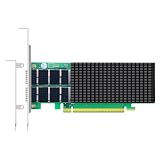
- AI-GENERATION FABRIC: NVIDIA ConnectX-7 (MCX713106AC-VEAT) drives two QSFP112 ports at 200Gb/s each on a PCIe 5.0 x16 host interface — 400Gb/s full-duplex aggregate for AI training, HPC and distributed storage.
- GPUDIRECT RDMA & STORAGE: GPU memory transfers bypass the CPU entirely (GPUDirect RDMA + GDS), feeding GPU clusters and NVMe-oF storage pools without host memory copies.
- INLINE SECURITY OFFLOAD: TLS 1.3, IPsec and MACsec encryption happen in silicon — data in transit stays secure across AI fabrics with zero CPU encryption overhead.
- CLOUD-SCALE OFFLOADS: ASAP² packet processing, OVS offload, SR-IOV up to 127 VFs per port (254 per card) and VXLAN/GENEVE tunnel termination for DPDK-based infrastructure.
- PRECISION & COMPATIBILITY: IEEE 1588v2 PTP hardware timestamping, standard server form factor, Linux/Windows/VMware support; brackets for 1U/2U and tower chassis.
Framework and application requirements
Check the framework’s supported Python or system runtime, GPU architecture list, and binary build options. Confirm whether the application expects a particular CUDA minor release, cuDNN or other accelerator libraries, NCCL for multi-GPU communication, or a vendor image. Also check whether prebuilt packages support your operating system and processor architecture; otherwise you may need a source build with its own compiler and dependency requirements.
Recommended Free Tools
Separate “installs” from “supported”
A package can install and execute a small example while remaining outside the vendor’s support boundary. Treat “supported,” “expected to work,” and “untested” as different states. NVIDIA AI Workbench documents those distinctions and notes that unsupported configurations may be untested or have known issues.
Check networking against the topology
Networking requirements depend on whether communication stays inside one server or crosses nodes. For a single host, confirm PCIe slot placement, GPU peer-to-peer behavior, and the bandwidth required between GPUs and storage. For multi-node training, evaluate the complete path: GPU or host adapters, link speed, topology, switch configuration, transport protocol, firmware, and the communication library used by the framework.
Use release-specific NIC requirements
NVIDIA AI Enterprise 4.8 states that a multi-node setup requires an Ethernet network interface controller supporting RoCE and lists supported Ethernet adapters, including ConnectX-7. This is an example for that product and release, not a universal requirement for every AI cluster. Verify the exact adapter model, firmware, server qualification, switch support, and software configuration before purchase.
Questions to answer for a distributed build
- Are all nodes using the same GPU model, driver branch, CUDA release, framework, and communication library?
- Does the NIC support the transport required by the chosen software, and is RoCE configured end to end when the matrix calls for it?
- Does the switch support the required speeds, buffering, priority flow control, and firmware?
- Are hostnames, addressing, MTU, routing, and security rules consistent across nodes?
- Can storage and management traffic be separated from accelerator traffic?
- Does the cloud instance or physical server expose the network device and topology expected by the framework?
Do not select a NIC solely by its advertised throughput. A mismatch in transport, firmware, switch features, or software support can leave a high-bandwidth adapter unusable for the intended job.
Rank #4

- Advanced Design, High Portability Brand New!
- Safe standard: FCC,CE, RoSH
- Replacement only, not original, but 100% compatible
- Tested Units. In Great Working Condition.
Validate cloud instance and vendor boundaries
Cloud compatibility is tied to a precise instance family, image, region, and orchestration environment. Confirm the GPU type and count, vCPU and memory ratio, local and attached storage, network bandwidth, virtualization mode, and whether the provider supplies or requires a particular driver image.
Use provider-supported images and drivers
When a cloud provider supplies an image or driver branch for a GPU family, prefer that supported path unless the vendor explicitly documents another one. Microsoft’s Azure overview emphasizes that validated combinations depend on the CUDA release and GPU. NVIDIA’s matrices list supported cloud instance types rather than declaring every instance interchangeable.
Account for cloud lifecycle changes
Record the region, image identifier, driver package, and instance SKU. Capacity, image revisions, and supported versions can change independently. Before scaling out or moving regions, repeat the matrix check and test that the same GPU, network, and orchestration features are exposed.
Compare candidate systems with one evidence-based table
For two or more builds, put the same evidence fields beside each other. Use “not stated” when a vendor has not published a value; do not fill gaps with assumptions.
| Comparison axis | Candidate A | Candidate B | What to verify |
|---|---|---|---|
| Workload and memory fit | Record model, batch, and peak memory | Record model, batch, and peak memory | Capacity plus headroom for runtime and concurrency |
| GPU and system qualification | Exact GPU and qualified server | Exact GPU and qualified server | Release matrix, certified or qualified system status |
| OS and kernel | Distribution, version, kernel | Distribution, version, kernel | Validated host configuration |
| Virtualization and orchestration | Hypervisor, container runtime, Kubernetes | Hypervisor, container runtime, Kubernetes | Support status for every platform layer |
| Driver and CUDA | Driver branch and CUDA release | Driver branch and CUDA release | Host-driver and container-CUDA relationship |
| Framework and application | Framework and application versions | Framework and application versions | GPU architecture and binary support |
| Network and topology | NIC, switch, transport, node count | NIC, switch, transport, node count | RoCE or other required protocol, firmware, and topology |
| Deployment and cloud SKU | Bare metal, VM, Kubernetes, or instance | Bare metal, VM, Kubernetes, or instance | Provider and release-specific listing |
| Cost, availability, support terms, upgrade path | Document current quotation and policy | Document current quotation and policy | These values are time- and vendor-dependent; not stated in the compatibility matrices |
Follow a repeatable compatibility workflow
- Freeze the target release. Write the AI application, framework, CUDA or runtime release, and deployment mode at the top of the design document.
- Collect hardware identifiers. Record the exact GPU SKU, memory, server model, BIOS or firmware level, NIC model, switch model, and intended node count.
- Check the vendor matrix. Use the matrix for the exact release, not a page for an older or newer branch. Confirm GPU, system, OS, hypervisor, cloud instance, and network entries.
- Build the software chain. Map host driver to CUDA, container image, framework, communication libraries, and application. Mark each dependency as supported, expected to work, or untested.
- Validate the deployment image. Reproduce the OS, kernel, driver, container runtime, and orchestration versions in a disposable node or staging environment.
- Test the real topology. For one node, run the intended model at representative memory and concurrency. For multiple nodes, test collective communication and failure recovery across the actual NIC and switch path.
- Record the decision. Save matrix version or date, URLs or document identifiers used by your team, package versions, firmware, configuration files, and test results.
- Recheck before purchase and upgrade. Repeat the review when a release, GPU, server, cloud SKU, kernel, driver, or network component changes.
Common compatibility failures and what they mean
The GPU is visible but the framework cannot use it
Check the driver branch, CUDA level, framework build, and architecture support as one chain. A successful device query proves detection, not application support. Install the vendor-supported driver and framework combination or select a release that lists the GPU.
The container starts, then CUDA errors appear
Compare the container’s CUDA runtime with the host driver. Rebuild the image from a supported base or update the host driver within the vendor’s supported range; do not assume that changing only the container fixes a host mismatch.
One server works but the cluster is slow or unstable
Inspect NIC and switch firmware, RoCE or other transport settings, MTU, routing, and collective-library configuration. Confirm that every node exposes the same GPU, driver, CUDA, and framework versions. A multi-node requirement documented for one release should not be generalized to another without a new check.
The installation works but support is unavailable
Locate the configuration’s status in the current matrix. If it is marked expected to work or untested, decide whether your organization can carry that risk, and document a rollback path. For production systems, prefer a supported or certified combination.
The Tool Desk
Outbyte PC Repair FREERepair Windows errors before they cause bigger problemsFix Now →Outbyte Driver Updater FREEFix the driver behind crashes, sound loss and screen glitchesFind Drivers →Keep compatibility evidence current
Version lists and product qualifications are volatile. Keep a dated configuration record with the release matrix, OS and kernel, driver and CUDA versions, container digest, orchestration versions, GPU and server identifiers, NIC and switch firmware, cloud SKU, and test outcomes. Revisit it before buying, expanding, or upgrading. This record turns a vague claim that “the GPU is compatible” into a reproducible statement about one complete deployment.
The practical decision rule
Choose the candidate that has a documented support path for your exact workload and deployment, not merely the highest theoretical compute specification. If any layer—GPU and qualified system, OS and kernel, virtualization or Kubernetes, driver and CUDA, framework, network topology, or cloud instance—has no verified status, treat the design as incomplete until that gap is resolved or explicitly accepted.
Quick Recap
Product prices and availability are accurate as of the date/time indicated and are subject to change. Any price and availability information displayed on Amazon at the time of purchase will apply.

