Outdated Drivers Are Slowing You Down
One free scan finds every outdated or missing driver and matches the right update for your exact hardware.Free scan · exact hardware matchWindows Errors? Fix Them Before They Spread
Repair common Windows errors and clear accumulated junk for a smoother, more stable PC - no reinstall needed.Free scan · no reinstallThe U.S. Geological Survey’s 2020 map highlights geologic units across the contiguous United States where pyrrhotite may occur. It is a broad screening tool—not a map of confirmed mineral deposits, a test of concrete aggregate, or a diagnosis of any home’s foundation.
Why pyrrhotite can damage concrete
Pyrrhotite is an iron sulfide mineral. When pyrrhotite-bearing crushed rock is embedded in concrete and exposed to water and oxygen, it can weather and produce sulfuric acid and secondary minerals, including gypsum. Those reaction products take up more volume, which can contribute to cracking and deterioration.
As an Amazon Associate I earn from qualifying purchases.
In Connecticut and Massachusetts, pyrrhotite-bearing aggregate used in some concrete foundations has been associated with cracking and crumbling. A 2020 Chemistry World report said thousands of homes had been damaged, attributing the estimate to the National Institute of Standards and Technology (NIST). The report did not identify the underlying NIST publication in the cited passage, so that figure should be understood as a reported estimate rather than a verified count from an identified NIST study.
What the 2020 USGS map shows
The USGS map, Pyrrhotite distribution in the conterminous United States, identifies mapped geologic units that may host pyrrhotite. “Conterminous” means the contiguous states, excluding Alaska and Hawaii. A marked area indicates possible host geology; it does not confirm that pyrrhotite is present at a particular site, that it occurs in harmful abundance, or that stone from that area was used in a particular foundation.
#1 Best Overall

- PREVENT MOISTURE PROBLEMS: A non-destructive analog moisture meter for instant measuring of moisture content in concrete flooring, slabs & screeds, as per ASTM F2659
- DUAL-DEPTH MEASUREMENT: Compare surface & core moisture, with a shallow depth penetration of up to 0.4" (9 mm) & deep depth up to 1.25" (30 mm); eliminate substrate influence when testing coverings
- ACCURATE MEASUREMENT: A pinless moisture meter to measure wood moisture content percentage from 5-30% & 0-100 comparative scale for other materials, with adjustment tables for wood type density
- PRE-CALIBRATED DETECTOR: Detects elevated moisture levels within most building materials & pre-calibrated to various material densities, such as wood, drywall, plaster, roofing, tile, masonry, walls, floor & ceiling
- MOISTURE MAPPING & REPORTS: The durable & ergonomic instrument can create visual test results & maps with our app; bluetooth device connectivity allows you to geotag & time-stamp reports & share photos
The agency compiled national geologic mapping data and mineral-occurrence records, then refined candidate units with input from state geologists. Its selection considered rock descriptions and geological characteristics, including sulfide attribution and moderate-to-high metamorphic grade, and compared candidate units with known occurrence locations in USGS and Mindat databases. The accompanying USGS data release documents the mapped information.
Why the map is necessarily broad
Geologic maps do not consistently describe rare minerals or report their abundance. In the relevant map database, pyrrhotite appeared by name 13 times — U.S. Geological Survey, 2020; “sulfide” or “sulfidic” appeared 106 times — U.S. Geological Survey, 2020; and the database contained more than 2,000 records — U.S. Geological Survey, 2020. These are counts of descriptions, not estimates of affected homes or the prevalence of pyrrhotite in rock.
Rank #2

- WATER LEAK DETECTOR detects relative moisture content from leaks and flooding
- PINLESS MOISTURE METER measures relative moisture content in building materials
- NONDESRUCTIVE DETECTION up to 3/4-Inch deep using Electromagnetic field (EMF) technology
- USE ON DRYWALL, MASONRY, HARDWOOD, AND SOFTWOOD; calibrated for these materials only
- REVERSE-CONTRAST DISPLAY for easy viewing of reading and nine LED bars to indicate moisture range
Incomplete mapping, limited rock descriptions, and variation in mineral abundance constrain what can be inferred. The map and fact sheet were published in 2020; their date alone does not establish whether a later map has since been released.
Do these 3 things before closing this tab:
1Repair Windows errors before they cause bigger problems2Scan for outdated or missing drivers - takes under a minute3Clear out junk files and repair common Windows errorsCan the map tell whether your home is affected?
No. A location on the map cannot establish whether a foundation contains pyrrhotite-bearing aggregate or whether the concrete is deteriorating because of it. A location outside a marked unit is not a property inspection or a guarantee about aggregate sources. The map offers geographic context, not a conclusion about an individual building.
Rank #3
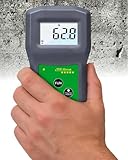
- CONCRETE MOISTURE TESTING FOR FLOORS & SLABS – Designed for contractors, inspectors and restoration professionals who need fast surface moisture detection before flooring, coating, tiling or renovation. Ideal for checking concrete slabs, floor screed, cement mortar and structural walls.
- NON-DESTRUCTIVE ELECTROMAGNETIC SENSOR – Scan concrete, plaster, gypsum and masonry without drilling or damaging the surface. Perfect for pre-installation inspections, moisture monitoring and renovation projects where surface integrity must remain intact.
- WIDE 0-70% MEASURING RANGE – Provides instant digital readings for testing concrete moisture content in slabs, subfloors and walls. Suitable for evaluating drying progress before epoxy, laminate, tile or wood floor installation.
- AUTO TEMPERATURE COMPENSATION – Automatically adjusts to ambient conditions to maintain stable readings across job sites. Helps reduce environmental influence during floor screed moisture testing and concrete moisture monitoring.
- ADJUSTABLE MATERIAL CODES – Multiple CD codes allow optimized measurement for concrete, mortar, gypsum and reference mode. Improves accuracy when checking moisture in different building materials.
The USGS cautions that the map is “no substitute for site-specific characterization and quality control programs” for aggregate used in concrete. The same distinction matters for a homeowner: a regional geology layer is not direct evidence from the foundation itself. A civil engineer quoted by Chemistry World made a related point about aggregate suitability: “this valuable information alone is not enough to judge the suitability of a particular aggregate, which requires appropriate testing and verification against clear limits for contaminant contents”.
What to do if you are concerned
- Use the map as context. Check whether your area overlaps a possible host unit, but do not treat that overlap as confirmation of a problem or its absence as proof of safety.
- Seek an assessment specific to the property. If you see cracking or crumbling and suspect pyrrhotite, consult a qualified building or materials professional who can assess the foundation and determine whether further investigation is warranted.
- Ask how any conclusion will be established. The USGS calls for site-specific characterization and quality control; its map does not supply a testing protocol or threshold for an individual home. Do not rely on a regional map or an unverified consumer test as a substitute for appropriate professional assessment.
Map versus site investigation
| Question | USGS map | Site-specific assessment |
|---|---|---|
| Geographic scope | Geologic units across the contiguous United States | A particular foundation or aggregate source |
| Evidence represented | Mapped geology and mineral-occurrence records | Characterization of the material or structure in question |
| What it can establish | Possible pyrrhotite-hosting geology | Findings about the investigated material, subject to the methods used |
Why the map was made
Rather than locating a resource for extraction, the project sought to show where a mineral that can cause problems may occur. Project leader and geologist Jeff Mauk told Chemistry World: “This project was a bit unusual for us, because typically we’re trying to help people find mineral deposits that they want, not minerals that they don’t want.” That purpose makes the map useful for screening and awareness, while its broad scale limits what it can say about any one home or quarry.
Quick Recap
Best Value

- PREVENT MOISTURE PROBLEMS: A non-destructive digital moisture meter for instant measuring of moisture content in wood or concrete flooring, slabs & screeds; an electronic instrument with hygrometer, Pin & RH probe functionalities
- ACCURATE MEASUREMENT: Instant quantitative measurement of moisture content using gravimetric testing as a baseline; it has Anhydrite & Gypsum scales & can test to a depth of 3/4 inch (20 mm) into the slab
- HUMIDITY TESTER: Features a built-in hygrometer with humidity sensor to measure the ambient relative humidity, temperature, dew point & humidity ratio of the environment
- CONCRETE & PIN METER PROBE: The optional external plug-in concrete moisture probe can measure in-situ moisture content up to 100 mm; the optional pin meter can measure the percentage moisture content of wood, drywall & building materials
- MOISTURE MAPPING & REPORTS: The durable & ergonomic instrument can create visual test results & maps with our app; bluetooth device connectivity allows you to geotag & time-stamp reports & share photos
Rank #4

- ✔️ QUICK, NON-DESTRUCTIVE READINGS: The C555 Concrete Moisture Meter provides fast, non-destructive preliminary moisture measurements on smooth, firm concrete to help pinpoint problem areas and determine where to place Rapid RH L6 Smart Sensors.
- ✔️ EASILY LOCATE HOTSPOTS: The C555 allows you to easily locate hotspots in your concrete slab. This information can help guide the best/vital placement of in-situ RH tests.
- ✔️ MONITORS AMBIENT CONDITIONS: Measures ambient temperature and humidity conditions so you can assess whether the environment is appropriate to install your floor.
- ✔️ MEASURES MULTIPLE MATERIALS: Measures concrete, brick and gypsum. *Please note this meter is ONLY for these materials. Measuring additional materials outside of these three will not provide accurate readings.
- ✔️ MEASURES DEW POINT: Measure dew point to easily help identify potential condensation risks.
Product prices and availability are accurate as of the date/time indicated and are subject to change. Any price and availability information displayed on Amazon at the time of purchase will apply.

