The phrase “most complete list ever of Martian organic compounds” refers to a 2023 analysis of the Tissint meteorite, not a finished inventory of every organic molecule on Mars. Researchers assigned more than 5,000 elementary compositions in methanol extracts and reported more than 100 separate organomagnesium compounds, alongside several other organic families. The result is best understood as a large, chemically diverse catalogue from one meteorite whose different mineralogical regions contained different organic signatures.
Those findings expand what is known about Martian geochemistry and carbon cycling. They do not demonstrate that Mars once hosted life: organic molecules can form through non-biological reactions, survive in minerals, or arrive through geological and extraterrestrial processes.
As an Amazon Associate I earn from qualifying purchases.
What the “most complete list” claim actually means
When the Tissint work appeared in 2023, Chemistry World described it as the most comprehensive catalogue then available of organic compounds found in Martian meteorites or detected in samples analyzed by Mars rovers. That wording describes the state of reporting at publication. It is not a verified claim that the catalogue remains the largest or most complete in 2026, and it does not mean scientists have enumerated every organic compound on Mars.
Outdated Drivers Are Slowing You Down
One free scan finds every outdated or missing driver and matches the right update for your exact hardware.Free scan · exact hardware matchPC Slower Than It Used to Be?
A free scan shows the junk files, broken settings and background clutter dragging Windows down - then fixes them in one click.Free scan · Windows 10 & 11Tissint is a single Martian meteorite. It contains several mineralogical lithologies—distinct rock types or regions formed under different conditions. The study examined those materials separately and found that organic molecules were not distributed uniformly. In the authors’ words, “We report a huge organic diversity in the Tissint Mars meteorite and the sampling of several mineralogical lithologies, which revealed that the organic molecules were nonuniformly distributed in functionality and abundance.”
#1 Best Overall

- GENUINE MARTIAN METEORITE: Each display features a real, authentic specimen of a Martian meteorite—rare material ejected from the surface of Mars by ancient impacts that eventually landed on Earth.
- ONE OF A KIND: Every Martian meteorite specimen is unique and will vary in size, shape, color, and texture, making each display a truly individual piece of space history.
- EDUCATIONAL DISPLAY: Includes an information card explaining how Martian meteorites are scientifically identified using chemical signatures matching samples taken from the Martian surface.
- HANDCRAFTED IN THE USA: The 6" x 8" display is carefully handcrafted, making it an impressive piece for home décor, classrooms, or a collector's showcase.
- PERFECT GIFT FOR SPACE ENTHUSIASTS: Ideal for collectors, students, educators, and anyone fascinated by space exploration and the mysteries of the Red Planet.
That scope matters. A catalogue from one meteorite can reveal chemical possibilities and mineral-organic relationships, but it cannot represent every Martian environment, depth, age or weathering history.
What was reported in Tissint
The study’s abstract describes a broad set of organic families. Rather than one dominant substance, the extracts contained compounds spanning different carbon skeletons, oxygenation states and aromatic structures.
| Reported organic group | What the study says | How to interpret it |
|---|---|---|
| Branched aliphatic carboxylic acids | Abundant C3–7 members were reported. | These are non-aromatic carbon chains bearing a carboxylic-acid group; the C3–7 notation indicates the reported carbon-number range. |
| Branched aliphatic aldehydes | Abundant C3–7 members were reported. | Aldehydes are oxygen-containing compounds with a terminal aldehyde group; branching describes the carbon framework. |
| Olefins | Included in the reported organic range. | Olefins contain carbon–carbon double bonds and can participate in oxidation and other geological reactions. |
| Polyaromatics with heteroatoms | Reported among the compounds detected. | These contain multiple aromatic rings plus atoms such as oxygen, nitrogen or sulfur in the relevant structures. |
| Polyaromatics without heteroatoms | Reported alongside the heteroatom-bearing forms. | These are multi-ring aromatic hydrocarbons whose frameworks are composed of carbon and hydrogen. |
| Organomagnesium compounds | More than 100 separate compounds were reported, especially in olivine macrocrystals and melt veins. | Their occurrence links organic material with magnesium-bearing silicates and thermal or impact-related geological conditions. |
The abstract describes the acids, aldehydes, olefins and polyaromatics as existing in a “homologous oxidation structural continuum.” In practical terms, related carbon frameworks appear at different oxidation levels, suggesting that chemical alteration pathways connected some of the detected families.
Free tools Windows power users keep installed
One-click scans. No signup required.
Why mineral location changed the result
A central finding is spatial and mineralogical unevenness. The researchers did not treat Tissint as chemically homogeneous. They sampled multiple lithologies and compared the organic signals associated with each one. Both abundance—the amount represented in an extract—and functionality—the chemical groups present—varied from material to material.
Olivine macrocrystals
Olivine is a magnesium- and iron-bearing silicate mineral common in mafic and ultramafic rocks. In Tissint, organomagnesium compounds were highlighted in olivine macrocrystals. Their concentration in these large crystals suggests that mineral composition and crystal-scale environments influenced which organic reactions occurred or which products were preserved.
Rank #2

- Rocksbury Place Space Collection 2020 - Eight meteorites from around the world, a moon rock specimen, and mar rock specimen. All specimens come with description of origin and individual specimen containers.
- Meteorites
- Moon Rock
- Mars Rock
- Descriptive cards
Melt veins
Melt veins are narrow regions that formed when intense heating briefly melted part of the rock, commonly during an impact event. Tissint’s melt veins also contained abundant organomagnesium compounds. The association with both olivine macrocrystals and melt veins led the authors to connect these compounds with interactions between organic matter, magnesium silicates and temperature stresses.
Other lithologies
The published study summary does not provide a molecule-by-molecule inventory for every Tissint lithology, but the study’s overall conclusion is clear: organic functionality and abundance were nonuniform. A compound detected in one sampled region should therefore not automatically be assumed to occur at the same concentration throughout the meteorite—or across Mars.
What the reported numbers count—and what they do not
Two headline figures are easy to overstate.
- More than 5,000 assigned elementary compositions: These are formula-level assignments made from Tissint methanol extracts. An elementary composition records the elements and their counts inferred for a detected signal. Different molecular structures can share the same elemental formula, so 5,000 assignments do not equal 5,000 individually isolated and structurally confirmed molecules.
- More than 100 separate organomagnesium compounds: This is a reported count of distinct organomagnesium signals or compounds in the study’s analysis. It is a narrower, particularly notable subset of the broader catalogue.
The distinction between a formula assignment and a confirmed structure is fundamental. Definitive molecular identification normally requires enough evidence to distinguish isomers—molecules with the same formula but different arrangements—as well as to establish bonding and stereochemistry where relevant. The available study summary supports the scale figures and compound classes, but not a verified, reproducible list of every individual structure.
How to read the compound classes
Branched C3–7 acids and aldehydes
The C3–7 range covers molecules containing three through seven carbon atoms in the reported families. “Branched” means that at least one carbon chain extends from another rather than forming a single straight chain. Carboxylic acids and aldehydes occupy different oxidation states, yet related frameworks can be converted into one another through oxidation, reduction and breakdown reactions. Their coexistence is therefore useful evidence for a network of chemical processes rather than a single formation event.
Olefins
Olefins, also called alkenes, contain carbon–carbon double bonds. Double bonds make them chemically reactive and can mark partially altered organic material. Their presence alongside acids, aldehydes and aromatic compounds fits the study’s description of an oxidation continuum, although the catalogue alone does not identify the exact reaction sequence that produced each molecule.
Rank #3

- Own a Genuine Piece of Mars: This authentic Martian meteorite was ejected from the surface of Mars by a cosmic impact and traveled millions of miles through space before landing on Earth.
- Certified Extraterrestrial Specimen: Each piece comes from a scientifically documented meteorite classified as Martian in origin.
- A Tangible Link to Interplanetary Exploration: As missions by NASA, SpaceX, and global space agencies gear up for Mars exploration, this specimen offers a rare physical connection to the Red Planet.
- Rare and Scientifically Priceless: Martian meteorites are among the rarest materials on Earth—ideal for collectors, educators, and those with an eye on the stars.
- Perfect Gift for Space Enthusiasts: Whether you're a seasoned meteorite collector or a future-focused dreamer, this piece of Mars is a timeless treasure from beyond Earth.
Polyaromatic compounds
Polyaromatics contain multiple fused or connected aromatic rings. Some reported examples include heteroatoms, while others do not. Aromatic compounds can be comparatively resistant to degradation and may become associated with mineral surfaces or trapped in rock pores. Finding both heteroatom-bearing and purely hydrocarbon polyaromatics broadens the chemical range detected in the meteorite.
Recommended Free Tools
Organomagnesium chemistry
The organomagnesium result was particularly unusual in the Martian context discussed by Chemistry World: the report said such compounds had not previously been observed in this setting. Their association with magnesium silicates and heated melt veins provides a geological clue, not a biological one. Organomagnesium bonds can be sensitive to water, oxygen and heat, so their survival and distribution may record specific mineral and thermal histories.
Why this matters for Martian geology
The Tissint catalogue links organic chemistry to mineralogy instead of treating “organics on Mars” as a single, uniform reservoir. Different minerals can adsorb, protect, catalyze or transform organic molecules. Impact heating can create short-lived reaction zones, while crystals and fractures can preserve products formed earlier. By comparing lithologies, the study offers evidence that Mars’s carbon-bearing material was shaped by local conditions at small geological scales.
The findings also bear on the Martian carbon cycle. Carbon can move among rock, fluids, atmospheric gases and incoming extraterrestrial material. A varied set of acids, aldehydes, unsaturated hydrocarbons and aromatic compounds records multiple oxidation states and reaction environments. The organomagnesium observations add a connection to magnesium-rich silicates and the thermal history of the rock, potentially informing models of Mars’s deep-interior geochemistry.
Andrew Steele, a co-author quoted by Chemistry World, said: “Understanding the processes and sequence of events that shaped this rich organic bounty will reveal new details about Mars’ habitability and potentially about the reactions that could lead to the formation of life.” The important qualifier is “potentially”: learning how prebiotic ingredients form is not the same as finding life.
What’s actually slowing this PC down?
Pick the symptom - the matching free tool is one click away.
Rank #4
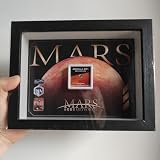
- ✅ Amgala 001 Martian meteorite (shergottite) specimen with themed shadow box display frame, found in Western Sahara 2022, genuine mars rock fragment.
Does Tissint contain evidence of life?
Organic compounds alone do not establish a biological origin. On Mars, the same broad categories of molecules can arise through abiotic chemistry involving minerals, heat, water, radiation, impacts or carbon-bearing material delivered from space. The Tissint study reports chemical diversity and mineral associations; it does not demonstrate fossils, cells, metabolism, biological isotopic patterns or another independent biosignature.
The safest conclusion is therefore two-part:
- What the study supports: Tissint contains a chemically diverse set of organic material, distributed unevenly among its mineralogical lithologies, with a notable concentration of organomagnesium compounds in olivine macrocrystals and melt veins.
- What it does not support: the claim that any listed molecule was made by life, that Tissint preserves a complete Martian inventory, or that the more-than-5,000 figure represents 5,000 confirmed molecular structures.
How this catalogue compares with other Mars-organics claims
Readers often combine meteorite results with measurements made by rovers, but those results answer different questions. A useful comparison needs more than a molecule count.
| Comparison axis | Tissint study | Why the distinction matters |
|---|---|---|
| Sample type | Meteorite recovered on Earth | The rock can be examined with laboratory methods, but its terrestrial recovery history must be considered. |
| Material context | Several mineralogical lithologies, including olivine macrocrystals and melt veins | Organic abundance and functionality can be tied to specific minerals and geological zones. |
| Reported scale | More than 5,000 assigned elementary compositions; more than 100 organomagnesium compounds | Assignments and compound subsets are not interchangeable with uniquely identified structures. |
| Compound description | Classes such as branched acids, aldehydes, olefins and polyaromatics | Class-level reporting shows chemical breadth while leaving some individual structures unresolved. |
| Publication context | 2023 catalogue framing | The “most comprehensive” wording reflects reporting at that time, not a permanent 2026 ranking. |
Because the available evidence does not provide a complete current survey of later meteorite and rover studies, it would be misleading to rank Tissint definitively against every subsequent Mars-organics result. The productive comparison is methodological: ask whether a result concerns a meteorite or in-place rover sample, a formula assignment or a structurally characterized molecule, and a bulk extract or a defined mineral location.
What remains unknown
The published summary establishes the major classes, counts and mineral associations, but it does not supply a fully verified molecule-by-molecule inventory that can be reproduced from the information here. Several questions therefore remain open:
Do these 3 things before closing this tab:
1Repair Windows errors before they cause bigger problems2Scan for outdated or missing drivers - takes under a minute3Clear out junk files and repair common Windows errors- Which exact structures correspond to every one of the more than 5,000 assigned formulas?
- How many assignments represent isomers, mixtures or repeated signals from related materials?
- Which compounds formed in Mars’s interior, during impact heating, through later fluid alteration, or after the meteorite reached Earth?
- How representative is Tissint of other Martian meteorites, ancient crustal environments or modern surface materials?
- How much of each compound class is present in absolute concentration rather than relative analytical abundance?
Answering those questions requires the full analytical dataset, structural validation and comparisons with independently collected Martian samples. The current catalogue is valuable precisely because it identifies a broad chemical landscape and the mineral settings that may control it, not because it closes the inventory.
What readers should take away
The 2023 Tissint study delivered one of the broadest reported views of Martian organic chemistry available at the time. It found thousands of assigned elemental compositions, more than 100 organomagnesium compounds and a mixture of branched C3–7 acids and aldehydes, olefins and polyaromatics. Those compounds were distributed unevenly across mineralogical lithologies, with organomagnesium species associated especially with olivine macrocrystals and melt veins.
The scientifically important result is the relationship between organic molecules and rock history. Tissint shows that Martian organics are not simply a uniform list of ingredients; their abundance, functional groups and preservation depend on minerals and thermal events. That advances the study of Mars’s carbon cycle and habitability while leaving the origin question open. Chemical richness is a reason to investigate Mars more closely, not proof that biology produced it.
Quick Recap
Product prices and availability are accurate as of the date/time indicated and are subject to change. Any price and availability information displayed on Amazon at the time of purchase will apply.
Quick wins for a faster PC:
Fix the driver behind crashes, sound loss and screen glitchesFind Drivers →Repair Windows errors before they cause bigger problemsFix Now →Scan for outdated or missing drivers - takes under a minuteDriver Scan →
