The Tool Desk
Outbyte Driver Updater FREEScan for outdated or missing drivers - takes under a minuteDriver Scan →Outbyte PC Repair FREEClear out junk files and repair common Windows errorsFree Scan →Keep a traceable record of every amount on your GST return. That means sales invoices and receipts, cash and electronic sales data, supplier invoices, expense and business-cost records, payment evidence, GST return calculations, and documents supporting adjustments. An auditor should be able to start with a figure on your return and follow it back to the underlying sale, purchase, payment, and tax treatment.
The exact retention period and format depend on your country. The examples below use current guidance from the Canada Revenue Agency (CRA) and the Australian Government; neither period should be applied to another jurisdiction without checking its tax authority.
As an Amazon Associate I earn from qualifying purchases.
The core records an auditor will expect
A GST inspection is fundamentally a verification exercise. The reviewer wants to establish what your business sold and bought, when each transaction occurred, how much tax applied, and how those transactions became the totals on your return. Keep source documents and the accounting records that connect them.
Sales and GST collected
- Sales invoices, receipts, credit notes, and other sales records.
- Point-of-sale reports and cash-register records.
- Electronic sales records from card terminals, online checkouts, payment processors, and bank deposits.
- Descriptions that identify the goods or services supplied and provide enough detail to determine the correct GST or HST treatment.
- Evidence of refunds, discounts, returns, deposits, bad-debt adjustments, and other changes to the original sale.
Keep both the transaction detail and the resulting payment evidence where practical. A daily sales summary can be useful, but it should be supported by underlying invoices, receipts, or system reports rather than replacing them without an audit trail.
#1 Best Overall

- All-In-One Monthly Organizer: Keep all your important documents in one place with Sooez Accordion File Organizer. 13 pockets design works great for Monthly organizing and protecting all your important paperwork, bills, taxes, receipts, invoices and more. Perfect for letter size.
- Expandable Capacity: The accordion file folder can be stretched up to 12 inches. 13 pockets allow you to store more than 2000 sheets. No matter how many documents you need to store, this folder can accommodate your needs as it can be easily expanded according to your requirements.
- Efficient Organization & Easy Lookup: To enhance your file organization, we provide blank labels along with this folder. You can personalize them to suit your requirements, such as labeling sections by month for effortless file retrieval.
- Stable & Portable: Stand on its own on the desk and not easy to tip over. Designed with portability in mind, allowing you to effortlessly move it between your desk, cabinet, and any other preferred locations.
- Maximum Protection and Durability: Well made, made from durable wipe-clean polypropylene. Waterproof & sturdy. Tear-resistant plastic provides durable structure. Acid-free, PVC-free, and archival quality for safe storage. Adjustable snap closure helps keep contents secure. Use 2 additional front pockets for business cards, project title cards or notes.
Purchases and input tax credits
- Supplier invoices and receipts for goods and services bought by the business.
- Tax invoices where the local rules require them to support a GST credit.
- Purchase orders, contracts, delivery records, and import documents when they explain the transaction or tax treatment.
- Proof of payment, such as bank, card, or electronic-transfer records.
- Calculations showing the business-use portion when an expense is partly personal or otherwise restricted.
In Canada, the CRA specifically identifies purchase invoices or receipts as evidence supporting input tax credit claims. Keep enough information to show the supplier, date, description, amount, and GST/HST charged, along with any allocation used in the claim.
Expenses, wages, and other business costs
Retain records for operating expenses, professional fees, rent, utilities, vehicle costs, inventory, equipment, and other costs that affect your GST calculation or explain the business activity. Australian small-business guidance also lists records of fees, wages, and other business costs used in GST calculations and credit claims. Payroll records may have separate employment-tax retention requirements, so preserve the payroll detail even when only part of it affects GST.
What each record needs to prove
Identity and timing
A record should identify the supplier or customer, the transaction date, and the reporting period in which you included it. Keep sequential invoice numbers or another reference that lets you detect missing transactions. For imported goods, retain customs or shipping documents that establish the relevant date and tax amount.
Quick wins for a faster PC:
Fix the driver behind crashes, sound loss and screen glitchesFind Drivers →Clear out junk files and repair common Windows errorsFree Scan →Scan for outdated or missing drivers - takes under a minuteDriver Scan →What was supplied or purchased
Descriptions such as “services” or “supplies” may be too vague. Use line-item descriptions, quantities, service periods, product categories, or contract references that allow a reviewer to determine what was supplied and whether the applicable GST/HST treatment was taxable, zero-rated, exempt, or otherwise different. The CRA says descriptions must be detailed enough to determine the GST/HST treatment.
Rank #2

- Check-Size Design: This check-size expanding file is specially designed for coupons organizer. The size of 10" x 5.5" x 1" fits for coupons, receipts or cash size
- Thirteen Pockets: Accordion folder is featuring thirteen pockets with a 6" expansion, that could stands up and expands fully on a desk or counter, contents are easy to access
- Five Colors: Offer five colors for choose, the durable shell and multiple colored pockets make coupons and receipts organized well
- Polypropylene Material: Made of polypropylene material, lightweight and strong, elastic and button closure keeps contents secure, even on the move, perfect for slipping into your purse
- Labels for Organization: Offer adhesive A-Z, Monthly and Blank tab labels to help you locate each pocket for adaptable filing to suit your needs
Amounts and tax treatment
Preserve the pre-tax amount, GST or HST amount, total, currency where relevant, and the method used for exchange-rate or apportionment calculations. If a transaction has mixed tax treatment, show the calculation by category rather than only recording one combined total.
Business purpose and payment
Attach a short business-purpose note when the invoice alone does not make the connection clear. Match invoices to bank, card, cash, or payment-platform records where possible. Payment evidence does not replace an invoice, and an invoice does not by itself prove that a payment was made; together they provide a stronger audit trail.
Return workings, ledgers, and adjustments
Keep the working papers behind every filed return
Save the sales and purchase ledgers, trial-balance extracts, GST control-account reconciliation, tax-code reports, spreadsheets, and other working papers used to prepare each return. The CRA advises electronic filers to retain working copies even though supporting documents are not sent with the electronic filing.
Document adjustments and unusual calculations
For every manual adjustment, record what changed, why it changed, the period affected, the calculation, and the person who approved it. Examples include credit notes, bad debts, private-use allocations, inventory adjustments, change-of-use calculations, prior-period corrections, and foreign-currency conversions. Keep the original source record alongside the adjustment rather than overwriting it.
Rank #3

- Superior Durability: Featuring strong 100C thickened cover and reinforced edges, surpassing competitors in durability. Made from PVC-free, acid-free materials, ensuring secure organization of bills and documents while delivering unparalleled durability and reliability
- Deeper Pockets & Unobstructed Tabs: In response to a common issue in accordion folders where papers cover index labels, we've increased pocket height by 0.8 inches (2 cm). This unique enhancement ensures your labels remain visible—a feature unmatched by competitors
- Ample Capacity Monthly Bills Organizer: Our expandable monthly bill organizer can extend up to 14 inches, accommodating over 1500 sheets files while standing stable. With 12 pockets, it's perfect for storing tax records, bills, receipts, invoices and important family files for over a year
- Sticky Labels & 3 Loops Bungee Closure: Colorful monthly tabs and labels help you locate the target object at a glance and manage monthly tasks with ease. The elastic band closure with three loops expands generously to accommodate all your storage needs
- Unlock Versatile Organization: Whether at home, in the office, or on the go, it offers flexible organization for invoices, medical finance records, and identification documents, ensuring efficiency wherever you need it
Reconcile reported totals
Reconcile the GST collected in your sales records to the amount reported on the return, and reconcile claimed credits to eligible purchase records. Investigate differences caused by timing, refunds, deposits, rounding, or transactions recorded outside the main accounting system. A dated reconciliation file gives an auditor a clear explanation instead of forcing a reconstruction years later.
Retention periods: Canada and Australia examples
Retention rules are jurisdiction-specific. The following periods come from current public guidance and are examples, not a universal GST rule.
| Jurisdiction | General GST record period | How the period is counted | Important qualification |
|---|---|---|---|
| Canada | Usually six years | From the end of the year to which the records relate | CRA rules can require records to be kept longer in particular circumstances, such as unresolved objections, appeals, or directions to retain them. |
| Australia | Generally five years | From the later of when the record was prepared or obtained, or when the related transaction was completed | Australian guidance notes that some situations require longer retention. Companies also have a distinct ASIC record rule requiring seven years; that is not the general GST period. |
Before destroying anything, check the rule for your entity type, tax period, audit status, objection or appeal, and any other law that applies. If a tax authority has asked you to preserve records, do not dispose of them when an ordinary period appears to have ended.
Paper and electronic records
Paper files
Paper invoices and receipts are acceptable where local rules permit them, but they must remain legible and retrievable. File them by tax period, supplier or customer, and transaction type in a way that matches your ledger. A receipt organizer can make paper filing easier; it does not supply missing details, prove a GST treatment, or replace required backups.
Rank #4
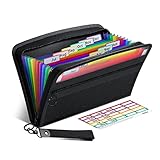
- Receipt Coupon Organizer - ThinkTex Small Folder with 12 Pockets. Exclusive size 11*6'' for receipts, coupons. Perfect monthly organizer
- 12 REAL POCKETS - Sealed bottom makes papers stay in the proper slot, No need worry the papers slide into the other compartments from the bottom
- QUICK ACCESS - Bright colorful tabs with monthly labels, just take a glance and locate. The tabs is clear and easy to read
- RELIABLE ZIPPER - Zip it up and nothing will fall out, extra wristband makes carrying easier
- LITTLE THINGS MAKE LIFE EASIER - No more big and heavy accordion folders, easy to put in glove box, purse. Have a smallish, portable filer to hold all receipts instead of many envelopes. One of the most valuable items you didn't know before one purchase
Electronic storage
Scan paper records at a readable resolution and preserve the original file name, date, and source reference. Keep searchable PDFs or images with the related transaction record, and maintain backups that are separate from the computer used for daily bookkeeping. Test that you can open and export the files, not merely that a backup job reports success.
The CRA’s September 2026 memorandum discusses source records in paper or electronic form and electronically readable records that can be related back to source documents. Australian guidance permits records in writing, electronic or paper, and in English or a form that can be easily translated. Follow the stricter local requirement if another law governs a particular record.
Access and security
Limit editing rights after a return is filed, retain an audit log where your system provides one, and protect records containing personal or payment information. Keep a documented process for restoring files after device loss, ransomware, or account closure. An auditor needs timely access to an intelligible record set, not merely possession of an unreadable archive.
A practical recordkeeping workflow
- Capture at the transaction. Issue an invoice or receipt, save the supplier document, and record the tax code, date, amount, and payment method.
- Link the evidence. Attach the source document to the ledger entry or give both the same reference number. Add a business-purpose note for ambiguous expenses.
- Separate tax categories. Use distinct codes or folders for taxable, zero-rated, exempt, imported, private-use, and adjustment transactions where those categories apply.
- Reconcile regularly. Compare cash and electronic sales to deposits and payment-platform reports. Australian small-business guidance specifically recommends regular reconciliation.
- Prepare the return from the ledger. Save the reports, spreadsheets, formulas, and review notes used to move from transaction totals to the filed figures.
- Lock the period. Preserve the filed return and its working papers together. If a later correction is necessary, create a dated correcting entry rather than silently changing the old file.
- Back up and test retrieval. Keep at least one separate backup and periodically retrieve a sample invoice, receipt, sales report, and return calculation to confirm the system works.
Common gaps that create audit problems
Only keeping bank statements
Bank statements show money movement but usually do not identify what was supplied, the GST charged, or whether a purchase was for the business. Pair them with invoices, receipts, and tax calculations.
Best Value

- Zipper Closure for True Security: Unlike folders using elastic bands that can let contents slip out, our expanding file folder features a dependable zipper closure, ensures everything stay safely secured inside, safe and sound. No more worries about losing small items.
- Sleek Design with Fresh Colors: 4 assorted pastels colored add a soft, delicate touch (purple, pink, sky blue, green). The black and gray hues present you a professional image. The tactile pattern exterior enhances and enriches the bright on trend colour-way.
- Unrivaled Durability: Say hello to an excellent all-rounder for secure and long-lasting storage. Made of PP tough shell (42% thickness upgraded) that endures daily handling and wear, and never tears. Acid-free, PVC-free. The metal zipper pull and reinforced edge construction offer reliable usage over time.
- Truly Large Capacity: 14 x 11.2 inches. Fit A4/letter size. This portable file organizer with expandable spine design is more stretchy to fit over 400 sheets without bulking up too much. Convenient size to carry around. Easily take your paperwork to a meeting or school.
- Monthly labels for Quick Retrieval: Customizable pastels stickers and 13 tabbed pockets allow you to sort by subject or task, bonus monthly labels increase its ease of locate and access.
Keeping totals without source detail
A monthly spreadsheet total cannot normally establish which transactions make up the number. Retain the underlying sales and purchase records and preserve the method used to summarize them.
Missing electronic sales
Businesses sometimes reconcile cash but overlook card, marketplace, subscription, or payment-processor sales. Export those reports and match them to deposits, fees, refunds, and chargebacks.
Overwriting corrections
Changing an invoice or ledger figure without preserving the original removes the history an auditor needs. Keep the original, the correction, the date, and the reason.
Crashes, No Sound, or Screen Glitches?
Random freezes, missing sound and display glitches usually trace back to one bad driver. Find and replace yours safely.Free scan · under a minutePC Slower Than It Used to Be?
A free scan shows the junk files, broken settings and background clutter dragging Windows down - then fixes them in one click.Free scan · Windows 10 & 11Assuming an agent owns the responsibility
The Australian Government states: “Even if you use a registered tax agent or digital service provider, record-keeping is your responsibility.” Your accountant may store copies, but agree in writing on who retains the source files and how you can retrieve them.
What to do when an inspection is announced
- Identify the exact tax periods, accounts, and transaction categories requested.
- Freeze routine deletion and preserve relevant email, accounting, point-of-sale, and payment-platform records.
- Build an index linking each return line to the ledger report and representative source documents.
- Check that scans open, passwords and encryption keys are available, and any non-English record can be translated or explained.
- Prepare a written explanation for unusual adjustments, late entries, refunds, private-use allocations, and reconciliations.
- Provide records in the format requested and keep a copy of everything supplied.
For electronically filed Canadian returns, the CRA says: “You do not have to send receipts or supporting documents when you file your GST/HST information electronically. However, you must keep your records in case we ask to see them.” The practical implication is simple: filing the return is not the end of the recordkeeping obligation.
Country and business differences to check before relying on this checklist
- Confirm whether your registration covers GST, HST, or another sales-tax regime and whether special schemes change invoice or credit requirements.
- Check rules for cash-basis versus accrual reporting, imports, exports, real property, vehicles, mixed-use expenses, and capital assets.
- Ask whether payroll, company, customs, privacy, or corporate-record laws impose a longer period than the GST rule.
- Verify whether records must be stored in a particular language, readable format, location, or approved electronic system.
- Keep records for closed periods that remain under audit, objection, appeal, litigation, or an official preservation request.
If your business operates in more than one country, map each transaction to the jurisdiction whose tax return includes it and apply that jurisdiction’s documentation and retention rules. A single shared folder is fine only when its indexing clearly separates the obligations.
Quick Recap
Product prices and availability are accurate as of the date/time indicated and are subject to change. Any price and availability information displayed on Amazon at the time of purchase will apply.
Recommended Free Tools

