Outdated Drivers Are Slowing You Down
One free scan finds every outdated or missing driver and matches the right update for your exact hardware.Free scan · exact hardware matchWindows Errors? Fix Them Before They Spread
Repair common Windows errors and clear accumulated junk for a smoother, more stable PC - no reinstall needed.Free scan · no reinstallFor most RTX 5090 owners, buy a 4K 240Hz OLED gaming monitor. It matches the card’s flagship use case: NVIDIA says DLSS 4 with Multi Frame Generation can let RTX 5090 systems target 4K at 240Hz/FPS with full ray tracing and maximum settings. Choose an ultrawide instead when immersion and side-by-side desktop space matter more than standard 16:9 compatibility. Choose 1440p at an exceptionally high refresh rate when competitive games and the lowest possible render load are your priorities.
The short answer: match the monitor to how you use the 5090
The RTX 5090 is unusually capable at both high resolution and high frame rates. Its 32GB of GDDR7 memory, DisplayPort 2.1b with UHBR20, and HDMI 2.1b outputs remove the interface bottlenecks that limited earlier cards. NVIDIA lists support for up to 4K at 480Hz or 8K at 165Hz with Display Stream Compression (DSC) over DisplayPort 2.1b UHBR20, plus four independent 4K 165Hz displays.
As an Amazon Associate I earn from qualifying purchases.
Those are maximum display capabilities, not a promise that every game will render at those rates natively. Your choice should follow the experience you want:
The Tool Desk
Outbyte PC Repair FREEClear out junk files and repair common Windows errorsFree Scan →Outbyte Driver Updater FREEFix the driver behind crashes, sound loss and screen glitchesFind Drivers →- 4K 240Hz OLED: the best all-round flagship option for image sharpness, HDR contrast and fast games.
- Ultrawide: the better choice for cockpit, simulation and cinematic games, a wider field of view, and desktop multitasking.
- 1440p high refresh: the practical choice for esports players who value very high frame rates and low latency over 4K detail.
A 240Hz panel is most meaningful when your games and settings can approach that refresh rate. Variable refresh rate (VRR) remains important because demanding ray-traced titles will often run below the panel’s maximum.
#1 Best Overall

- High-Performance Display Specifications: 26.5-inch 4K (3840 x 2160) QD-OLED gaming monitor with 240Hz refresh rate and 0.03ms response time
- Advanced QD-OLED Technology: Latest 4th-gen QD-OLED technology delivers sharper imagery and crystal-clear text, a longer lifespan over previous-gen OLEDs
- Enhanced Viewing Comfort: OLED Anti-Flicker 2.0 technology includes a new luminance compensation algorithm that reduces flicker by 20% compared to previous-gen panels, ensuring comfortable viewing
- Intelligent Burn-In Protection: New ASUS OLED Care Pro functions with Neo Proximity Sensor that precisely detects when the user is away, switching to a black screen to reduce the risk of burn-in
- Comprehensive Connectivity Options: Extensive connectivity options include DisplayPort 2.1a UHBR20 with full 80Gbps bandwidth, USB-C (90W PD), HDMI 2.1, and a tripod socket
Why 4K 240Hz is the default recommendation
It uses the 5090’s performance headroom
NVIDIA positioned the RTX 5090 and DLSS 4 together for 4K 240Hz/FPS gaming with full ray tracing and maximum settings. DLSS 4’s Multi Frame Generation creates additional displayed frames between rendered frames in supported games, so the advertised 240Hz target is not equivalent to 240 traditionally rendered frames. The result can still look exceptionally fluid, but response feel depends on the game’s base render rate, input latency and implementation.
OLED supplies the image quality a flagship GPU deserves
OLED pixels can switch rapidly and turn off completely for very dark scenes, giving high perceived contrast and clean motion. At 4K, the 16:9 image also has the broadest game compatibility and the greatest pixel density among the three formats considered here. Text and fine geometry look sharper than on a same-size 1440p display, provided your operating system is scaled appropriately.
240Hz is a useful ceiling, not a requirement
If your budget, desk space or preferred games do not justify 240Hz, a lower-refresh 4K monitor still makes sense with a 5090. The card can drive demanding games at high settings while VRR smooths fluctuations. The trade-off is paying for a panel whose maximum refresh you may not use; the 5090 does not require a 240Hz monitor to be worthwhile.
Free tools Windows power users keep installed
One-click scans. No signup required.
Rank #2

- Dual Mode Display Technology: 32-inch 4K (3840 x 2160) WOLED gaming monitor with versatile dual mode (4K @ 240 Hz or FHD @ 480 Hz)
- ROG-Exclusive OLED Anti-Flicker Technology: Helps reduce the flicker during refresh-rate fluctuations for more comfortable viewing during extended gaming sessions
- Advanced AI Assistant Features: Provides dynamic AI Crosshair, AI Sniper, and AI Visual functions for improved gaming experiences
- Uniform Brightness Setting: Optional uniform brightness setting ensures consistent luminance levels across the entire display
- DisplayWidget Center Software: Allows users to easily access OLED Care functions and adjust monitor settings using a mouse
4K, ultrawide and 1440p compared
| Format | What it optimizes | Advantages with an RTX 5090 | Trade-offs | Best for |
|---|---|---|---|---|
| 4K 16:9, ideally 240Hz OLED | Sharpness, HDR and broad compatibility | Highest standard 16:9 detail; aligns with NVIDIA’s 4K 240Hz DLSS 4 positioning; excellent for modern ray-traced games | Higher render demand; premium OLED models can have different brightness and burn-in warranty terms | Mixed libraries, single-player AAA games, and one-monitor setups |
| Ultrawide OLED or LCD | Horizontal immersion and workspace | Wider field of view in supported games; useful side-by-side windows; more cinematic racing and simulation experience | Not every game supports the aspect ratio correctly; horizontal resolution increases render demand; fewer standard 16:9 modes | Simulation, racing, strategy, productivity and users who prefer an enveloping desk display |
| 1440p high refresh | Frame rate and competitive responsiveness | Lower pixel workload leaves more headroom for very high frame rates; excellent for esports titles and high-speed play | Less detail than 4K; the 5090 is substantially more powerful than necessary for many 1440p games | Competitive shooters, esports and players who prioritize refresh over visual fidelity |
“Ultrawide” covers several resolutions and aspect ratios, so compare the actual pixel dimensions rather than the label. A wider 1440-class panel still has fewer vertical pixels than 4K, while a very wide high-resolution panel can approach or exceed 4K’s total pixel workload. Check each game’s aspect-ratio support before buying.
When an ultrawide is the better purchase
Choose it for immersion
Racing, flight, space and role-playing games can benefit more from extra horizontal view than from maximum vertical pixel density. A curved ultrawide can fill more of your peripheral vision at a normal desk distance. The benefit is strongest in titles that expose a genuine wider field of view rather than simply stretching a 16:9 image.
Choose it for one-screen productivity
An ultrawide can replace two conventional monitors for timelines, code, documents and browser windows. The RTX 5090’s multi-display capability is still available if you later add a second screen, but one wide panel avoids a bezel in the center of your workspace.
Rank #3

- 31.5" UHD (3840 x 2160) QD-OLED panel
- High 240Hz refresh rate, ultra-low 0.03ms GtG response time
- 1.07 billion colours (10-bit) with incredible gamut (DCI-P3 99%) & accuracy (ΔE ≤2)
- VESA DisplayHDR True Black 400 certified
- OLED Care 2.0 & MSI Gaming Intelligence AI
Check game and application behavior first
Some games render ultrawide correctly; others place menus at the edges, add side bars, or restrict the field of view for competitive balance. Verify support for your frequently played titles. Streaming and video content are also commonly mastered for 16:9, so an ultrawide may show unused space during non-gaming viewing.
Quick wins for a faster PC:
Repair Windows errors before they cause bigger problemsFix Now →Scan for outdated or missing drivers - takes under a minuteDriver Scan →Clear out junk files and repair common Windows errorsFree Scan →When 1440p high refresh is the right answer
Esports benefits from lower rendering demand
At 1440p, the GPU has fewer pixels to process than at 4K. That makes it easier to sustain very high frame rates in competitive games, where a stable frame time and low latency can matter more than maximum texture detail. A 360Hz-class or faster display can therefore be rational for a specialist esports setup even though the RTX 5090 can drive 4K.
Do not buy resolution you will not use
If you play mostly competitive titles at reduced settings and sit close to the screen, a fast 1440p panel may feel better than a 4K display running at a lower effective frame rate. You can also keep a 1440p high-refresh monitor for competition and add a separate 4K display for single-player games, using the 5090’s ability to operate multiple displays.
Rank #4
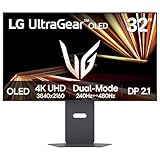
- Dual Mode: 4K UHD 240Hz or Full HD 480Hz - LG UltraGear OLED is a VESA Certified Dual Mode gaming monitor. This innovation allows gamers to experience graphically rich, story-driven games in 4K/UHD at up to 240Hz or switch to Full HD at up to 480Hz for fast-paced FPS, MOBA or racing games via hotkey.
- Leave Lag Behind with 0.03ms Response Time - Enjoy smoother scenes with less lag or ghosting thanks to LG UltraGear OLED's nearly instantaneous 0.03ms (GtG) response time.
- NVIDIA G-SYNC Compatible and AMD FreeSync Premium Pro - Officially validated by NVIDIA as G-SYNC Compatible and equipped with AMD FreeSync Premium Pro means this UltraGear provides smooth, fast action that reduces screen tearing and stutter. Never miss a frame of the action as you clinch your victories.
- Bright OLED Gaming - This UltraGear features Micro Lens Array+ technology. So with a typical brightness of 275 nits and a peak brightness of up to 1300 nits, this monitor is UltraGear's brightest OLED gaming display.
- VESA DisplayHDR True Black 400 & 1.5M:1 Contrast Ratio - VESA DisplayHDR True Black 400 certified means this monitor meets industry standards for brightness as well as deep, rich black color expression. With a 1.5M:1 contrast ration, the benefit for gaming impeccable color and image detail in dark scenes for a stunning visual experience.
Understand the opportunity cost
The downside is visible: fine details, desktop text and distant objects are less dense than on 4K. The 5090’s extra performance will often be underused outside high-refresh games, so this is a deliberate specialization rather than the general-purpose choice.
Display interfaces: do you need DisplayPort 2.1?
You do not need DisplayPort 2.1 for every RTX 5090 monitor. You do need an interface that supports the resolution and refresh combination you intend to run. For the highest modes, look for DisplayPort 2.1b with UHBR20 or HDMI 2.1b on both the graphics card and the monitor. Display Stream Compression may be required for some high-resolution, high-refresh combinations; DSC is designed to preserve a visually lossless image while fitting the signal within available bandwidth.
What’s actually slowing this PC down?
Pick the symptom - the matching free tool is one click away.
Match the cable to the mode
- Read the monitor’s manual or specifications for the exact input required for its top resolution and refresh rate.
- Use a certified DisplayPort 2.1 UHBR20 cable when the monitor specifies UHBR20 for its maximum mode.
- Connect the monitor directly to the RTX 5090 rather than through an older dock, receiver or adapter that could limit bandwidth.
- In the operating system and GPU control panel, select the monitor’s native resolution and highest available refresh rate, then enable VRR.
- If the maximum mode is missing, test another port, reinstall or update the display driver, check whether DSC is enabled, and confirm that the cable is rated for the required bandwidth.
Cards can vary by board design. For example, one current RTX 5090 specification lists three DisplayPort 2.1b outputs and one HDMI 2.1b output. Check the exact add-in-card model rather than assuming every board has an identical connector layout.
Best Value

- Immersive 4K QD-OLED Display: 32-inch 4K (3840 x 2160) QD-OLED gaming monitor with 240 Hz refresh rate and 0.03 ms (GTG) response time for immersive gaming
- Advanced Heat Management System: Highly efficient custom heatsink, advanced airflow design, and graphene film for better heat management to reduce the risk of burn-in
- Exceptional HDR Performance: VESA DisplayHDR 400 True Black compliance, 99% DCI-P3 gamut, true 10-bit, and Delta E < 2 color difference for astonishing HDR performance
- Uniform Brightness Setting: Optional uniform brightness setting ensures consistent luminance levels across the entire display
- Convenient Monitor Control: DisplayWidget Center allows users to access OLED Care functions, as well as adjust monitor settings with a mouse
Panel, HDR and OLED warranty checks
Compare brightness, not just the word “HDR”
HDR quality depends on measured brightness, black level, local or per-pixel dimming and the monitor’s tone mapping. OLED offers per-pixel control, but OLED models can differ substantially in full-screen brightness and in how long they sustain highlights. Compare the current model specifications and independent measurements for the displays you are considering.
Read the burn-in policy before choosing OLED
OLED is the premium image-quality choice, but long periods of static desktop content create a different ownership concern than gaming. Warranty terms differ on whether image retention or burn-in is covered, for how long, and under what conditions. Check the policy in your region, the required registration steps and any pixel-refresh or panel-care guidance. If your monitor will show fixed application windows for many hours each day, an LCD may be a more comfortable risk trade-off even with a 5090.
Consider text and room lighting
Look at the panel’s subpixel layout and text-rendering behavior if you spend substantial time reading code or documents. In a bright room, sustained full-screen brightness can matter more than peak HDR highlights. A glossy OLED can produce richer contrast but also stronger reflections; a matte surface may be easier to use near windows.
Power, system and desk requirements
NVIDIA lists the RTX 5090 at 575W total graphics power and recommends a 1,000W system power supply for its reference configuration. Those figures describe NVIDIA’s specified test configuration; an add-in board can have different power and cooling requirements. Confirm the exact card manufacturer’s recommendation, use the required power connector and leave appropriate thermal clearance in the case.
A 4K 240Hz or large ultrawide monitor also needs a desk, stand or arm rated for its size and weight. Measure viewing distance, stand depth and cable routing before ordering. High refresh is wasted if the monitor is forced into an awkward position or cannot receive a full-bandwidth connection.
A practical buying decision
- Start with your games. If your library is mixed or dominated by visually demanding single-player titles, begin with 4K. If it is mostly racing or simulation, evaluate ultrawide support. If it is competitive esports, prioritize 1440p refresh.
- Set your target refresh. Choose 240Hz for the flagship 4K experience, a lower 4K rate when value or brightness matters more, or a much higher 1440p rate for competition.
- Confirm total pixel workload. Do not assume every ultrawide is easier to drive than 4K; compare its actual resolution and your intended settings.
- Verify ports and cable requirements. Ensure the monitor accepts DP 2.1b/UHBR20 or HDMI 2.1b for the mode you want, and budget for a certified cable if needed.
- Evaluate the panel policy. Compare OLED burn-in coverage, brightness behavior, VRR range, pixel-care features and warranty length in your region.
- Check the card and power supply. Use the exact add-in-board specifications and the manufacturer’s power recommendation, not only NVIDIA’s reference figures.
Common mistakes to avoid
- Buying on refresh number alone: a 480Hz display does not make every game render at 480 frames per second, and a 240Hz 4K OLED may deliver a better overall experience for a broad library.
- Assuming DLSS 4 works everywhere: Multi Frame Generation depends on game support and settings. Treat NVIDIA’s 4K 240Hz statement as a supported-use-case target, not a universal native frame-rate guarantee.
- Ignoring aspect-ratio support: an ultrawide can show side bars or imperfect menus in games that were designed for 16:9.
- Using an inadequate cable or intermediary: an older cable, dock or receiver can hide the monitor’s top refresh modes even when the 5090 and monitor are capable of them.
- Skipping warranty details: OLED policies differ, especially for burn-in, and the terms that apply to one region may not apply to another.
- Confusing GPU capability with system readiness: the card’s 575W reference power figure and 1,000W recommended system supply are not a substitute for checking your specific board, CPU, cooling and case.
Bottom line
Buy a 4K 240Hz OLED when you want one monitor that showcases the RTX 5090 across modern AAA games, HDR media and everyday use. Buy an ultrawide when a wider view and one-screen workspace are central to your routine, after confirming game support. Buy 1440p high refresh only when esports responsiveness is the priority; it is the specialist option, not the default match for a 5090.
Quick Recap
Product prices and availability are accurate as of the date/time indicated and are subject to change. Any price and availability information displayed on Amazon at the time of purchase will apply.

