Biomass torrefaction is a controlled heat treatment that warms plant material—often to 200–300°C—with oxygen excluded or restricted. It removes moisture and some volatile compounds, leaving a drier, more brittle solid that is easier to grind and can be pressed into pellets. Crop residues such as corn stover and straw can be considered as feedstocks, but their suitability and the resulting fuel quality depend on the material and process.
How torrefaction turns crop residues into fuel
Torrefaction is a pretreatment, not the burning of crop waste. In a torrefaction reactor, biomass is heated with little or no oxygen. The process changes the material without turning it fully into charcoal. The solid product can be used as a fuel directly or densified into pellets or briquettes.


As an Amazon Associate I earn from qualifying purchases.
- Collect and prepare the feedstock. Crop residues are the stalks, leaves and other plant material left after the main food or fiber product is harvested. The U.S. Department of Energy lists corn stover—including stalks, leaves, husks and cobs—as well as wheat, oat and barley straw, sorghum stubble and rice straw as examples of agricultural residues (U.S. Department of Energy, Biomass Resources).
- Dry and size it as needed. Moisture affects how much energy is available from process gases and how the plant can recover and reuse heat. In one process configuration discussed by IEA Bioenergy, incoming moisture is generally recommended not to exceed about 15%; that is not a universal specification for every feedstock or reactor.
- Heat it with oxygen excluded or limited. IRENA gives 200–300°C as a common torrefaction range. This is milder than the 400–600°C range it describes for pyrolysis, which produces a different mix of products, including oil, solid char and gas (IRENA, Biomass for Heat and Power: Technology Brief).
- Recover process heat where practical. Vapors and gases from torrefaction may be used to help heat the reactor or dry incoming material. Whether that works well depends on feedstock moisture, the extent of treatment, reactor technology and heat integration.
- Cool and optionally grind or densify the product. Heating damages much of the original fibrous structure. The solid becomes more brittle and easier to grind; it can then be pressed into pellets or briquettes for handling and transport.
Which crop wastes can be used?
Crop residues are potential feedstocks, not interchangeable ingredients. Corn stover, cereal straws, sorghum stubble and rice straw differ in moisture, ash, composition and availability. Those differences affect the settings needed and the properties of the finished fuel.
Do these 3 things before closing this tab:
1Scan for outdated or missing drivers - takes under a minute2Repair Windows errors before they cause bigger problems3Fix the driver behind crashes, sound loss and screen glitchesIEA Bioenergy’s 2015 review says many lignocellulosic materials are theoretically suitable and describes work involving straw, hay, roadside grass and other agricultural residues. It also records that commercial operating experience with alternative and mixed feedstocks was limited at the time. That review is useful for understanding the technology’s development, but it is not a current market census (IEA Bioenergy, Status overview of torrefaction technologies).
#1 Best Overall

- Low-Cost Biomass Raw Material Utilization: Convert sawdust, rice husks, peanut shells, and straw into high-value charcoal briquettes without adding binders. Directly utilize agricultural and forestry waste to cut raw material costs while producing clean-burning material for BBQ, heating, and industrial applications. No binder required—just pressure and heat
- Industrial-Grade Production at 440LB/H: Powered by a 22KW motor with 5.4KW heating rings, this biomass briquette press delivers 440.9 lbs (220 kg) per hour production capacity. Spiral extrusion technology combined with electric heating ensures dense, uniform briquettes every run. Power consumption under 100kWh per ton keeps operating costs low
- Precision Digital Temperature Control: Built-in digital temperature regulation system maintains stable set temperatures for consistent briquetting quality. Accurate heat control reduces temperature errors, improves briquette density, and ensures reliable output batch after batch. Set it and let the machine handle the rest
- Heavy-Duty Durability for Continuous Operation: Constructed from high-strength materials for long-term industrial use. Sturdy structure handles 3-phase 220V 60Hz power input with minimal maintenance. Built for commercial charcoal production lines, BBQ burning material manufacturing, and biomass recycling operations that run daily
- High-Calorific Briquettes — 20% More BTUs: Produces solid rods (Φ50mm outer, Φ20mm inner, >50mm length) with 4400-5000 kcal/kg calorific value—20% higher than ordinary wood. Specific weight of 1200-1300 kg/m³ means compact, easy-to-store briquettes that ignite easily and burn efficiently for BBQ catering and industrial heating
What changes in the fuel?
- Less moisture and greater resistance to water uptake: Torrefaction removes moisture and makes the material more hydrophobic, which can ease storage and handling. It does not mean the product is impervious to water.
- Improved grindability: The treated material is more brittle, so it is easier to grind than fibrous untreated biomass. This can help with industrial fuel handling.
- Higher energy per unit of mass than conventional wood pellets in one comparison: IEA Bioenergy’s 2015 table lists lower heating values of 20–24 MJ/kg for torrefaction pellets and 15–18 MJ/kg for conventional wood pellets.
- More energy per unit of volume when densified: Pelletizing packs material more tightly. This affects bulk energy density, which is useful when estimating storage and transport needs; it is distinct from heating value per kilogram.
The same IEA Bioenergy comparison table gives the following illustrative values. They are not guaranteed specifications: actual results vary with feedstock and processing.
| Fuel in the 2015 comparison | Lower heating value | Bulk energy density | Moisture by weight |
|---|---|---|---|
| Torrefaction pellets | 20–24 MJ/kg | 15.0–18.7 GJ/m³ | 1–5% |
| Conventional wood pellets | 15–18 MJ/kg | 7.5–10.4 GJ/m³ | 7–10% |
| Coal | 23–28 MJ/kg | 18.4–23.8 GJ/m³ | 10–15% |
| Charcoal | 30–32 MJ/kg | 6–6.4 GJ/m³ | Not stated in the comparison table |
Torrefaction aims to retain more volatile matter and energy than charcoal production, which removes much more volatile matter. The review also notes that ash content can rise slightly because some dry material is lost during treatment. A higher heating value per kilogram does not by itself establish how much fuel a truck, silo or plant can handle: the volume-based figure matters for those decisions.
Rank #2
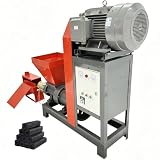
- COMMERCIAL CHARCOAL BRIQUETTE MAKER: Transform waste biomass like sawdust, rice husks, and peanut shells into high-value charcoal briquettes, directly reducing raw material expenses while recycling agricultural byproducts efficiently.
- 440.9LB/H LARGE CAPACITY: Equipped with spiral extrusion and electric heating technology, produces dense and uniform briquettes at a rate of 440.9 pounds per hour, saving significant time and labor for high-volume operations.
- PRECISE DIGITAL TEMPERATURE CONTROL: Features a digital temperature regulation system that maintains accurate and consistent heat levels, improving briquette quality and forming results while minimizing temperature fluctuations.
- HEAVY-DUTY STRUCTURE: Built from high-strength materials for enhanced durability, long-term reliability and stable performance under continuous heavy use.
- VERSATIL BRIQUETTE PRODUCTION: Creates clean-burning charcoal briquettes suitable for BBQ, catering, heating, and industrial fuel applications, meeting growing market demand for sustainable alternatives.
Why pelletize torrefied biomass?
Torrefied chips are less bulky in energy terms than a compact pellet. IEA Bioenergy’s 2015 review reports that pelletizing torrefied chips can increase volumetric energy density by a factor of 4–8 compared with the chips. The review also cites approximately 150 kWh of pelletizing energy per tonne for torrefied biomass, versus 50–60 kWh per tonne for wood pellets in the comparison it discusses. These are report-specific figures, not guarantees for every mill.
Densification adds energy use and operational hazards. Friction in pellet-press channels can generate heat, creating fire and dust-explosion risks that require appropriate controls.
Rank #3
How does torrefaction compare with pyrolysis and combustion?
- Torrefaction: A moderate-temperature pretreatment, commonly 200–300°C, with oxygen excluded or limited. It produces a solid fuel with less moisture and greater brittleness.
- Pyrolysis: A higher-temperature thermal process; IRENA describes a range of 400–600°C and outputs that can include oil, char and gas.
- Combustion: Burning the resulting fuel in oxygen to release heat. Combustion is a possible later use of torrefied biomass, not what torrefaction itself means.
Where can torrefied crop fuel be used?
Its improved grindability and densification can support industrial handling and co-firing applications. But compatibility depends on the receiving plant, fuel specifications and supply-chain economics. Torrefied biomass is not automatically a drop-in coal replacement: in IRENA’s comparison, biomass energy density remains below coal’s, and transport distance and local feedstock availability matter.
Quick Recap
What determines whether the process makes sense?
- Feedstock quality and supply: Moisture, ash, composition and seasonal availability vary by residue and location.
- Heat integration: Process gases may help supply heat, but the energy balance depends on drying needs, reactor design and treatment severity. A single net-efficiency figure would not apply across all setups.
- Pelletizing requirements: Densification can reduce storage and shipping burdens but consumes energy and introduces mill hazards.
- Delivered cost and plant fit: A fuel’s laboratory or table values do not establish that it is economical to move or suitable for a particular boiler or industrial system.
- Lifecycle sustainability: The UK Biomass Strategy says biomass can be low-carbon when produced sustainably, and emphasizes genuine greenhouse-gas reductions alongside cost effectiveness, food security and biodiversity. Calling a feedstock a crop waste does not by itself prove that its use is carbon neutral or environmentally harmless (UK Department for Energy Security and Net Zero, Biomass Strategy 2023).
Product prices and availability are accurate as of the date/time indicated and are subject to change. Any price and availability information displayed on Amazon at the time of purchase will apply.

