Quick wins for a faster PC:
Repair Windows errors before they cause bigger problemsFix Now →Fix the driver behind crashes, sound loss and screen glitchesFind Drivers →Clear out junk files and repair common Windows errorsFree Scan →A “data center load center” is not a universally defined equipment category. In United States usage, load center commonly means a compact panel assembly that divides an incoming feeder into protected branch circuits. A data center may use that type of panel, but its electrical specification is more likely to name a panelboard, switchboard, switchgear, busway or power distribution unit (PDU)—each with different construction, ratings and responsibilities. The practical answer is to identify the exact assembly on the one-line diagram and verify its voltage, current, fault-duty, listing, environment and coordination requirements rather than relying on the label “load center.”
What is a data center load center?
The phrase describes a function more reliably than a product. A load center receives electrical power and splits it into multiple protected outgoing circuits. In a small commercial room, that may be a wall-mounted panel. In a large facility, distribution is usually divided among several assemblies, and the drawings may never use the term load center at all.
As an Amazon Associate I earn from qualifying purchases.
Schneider Electric’s US technical reference treats panelboards, switchboards and switchgear as related but distinct equipment categories. ABB likewise describes data-center distribution as a portfolio that can include source equipment, low-voltage switchboards and switchgear, busway and PDUs. Those references do not establish a separate universal class called a “data center load center.”
Therefore, use “load center” as a conversational description only until the specification identifies the actual equipment. The equipment name determines which construction rules, protective-device options, access requirements, testing and ratings apply.
#1 Best Overall

- RACK MOUNTABLE: This 1U Rackmount PDU power strip fits 19" standard server racks and cabinets, featuring a 1U horizontal rack mount form factor that ensures compatibility with all 19" server racks.
- 15A Overload Protection Switch: Provides overload protection by interrupting the circuit when the load exceeds the rated current.
- HEAVY-DUTY: The power distribution unit features a heavy-duty construction, meticulously designed with robust components and housed in a durable aluminum alloy casing, ensuring a sturdy and long-lasting performance for reliable power management.
- POWER CORD: The power distribution unit comes equipped with a 6-foot (1.8 meter) 14AWG power cord, providing flexible placement options and extended reach for versatile installation in various settings.
- Commitment: ElecVoztile is dedicated to delivering superior products and outstanding customer service. Should you encounter any issues, please do not hesitate to reach out to us for immediate assistance.
What the equipment does
At its simplest, the assembly contains a bus or other conductor system, overcurrent protective devices and an enclosure. Power enters from a feeder; breakers or fuses protect and disconnect outgoing circuits. Some assemblies are branch-circuit panels close to loads. Others are larger intermediate distribution points between a main switchboard and downstream panels, busway or PDUs.
Why the distinction matters in a data center
Information-technology loads are sensitive to interruptions and power quality, while cooling, pumps, fire systems and building services have their own electrical requirements. A facility can have A and B power paths, multiple voltage levels, transformers, maintenance bypasses and generator or UPS sources. Calling every assembly a load center hides where isolation, protection, metering and redundancy actually occur.
How does power get from the utility to a data center rack?
The following sequence is a teaching model, not a universal one-line diagram. Actual projects may omit stages, repeat them on redundant paths, or place transformers and UPS systems at different points.
- Utility or on-site source: Service conductors, generators, energy-storage systems or another source feed the facility’s service and primary distribution equipment.
- Service and switching equipment: Main disconnects, service switchgear or switchboards provide isolation, protection and source transfer as required by the design and jurisdiction.
- Voltage transformation and power conditioning: Transformers, UPS systems and automatic transfer equipment may change voltage, ride through outages or condition power before it reaches IT distribution.
- Low-voltage switchboard or switchgear: This equipment divides large feeders, houses protective devices and sends power toward rooms, mechanical systems and data halls.
- Panelboards and/or busway: Panelboards feed branch circuits or smaller distribution panels. Busway provides a modular, enclosed conductor route with plug-in tap-off points where the design calls for flexible rack placement.
- Downstream PDU: A PDU may transform voltage, provide branch protection and meter output. ABB lists transformer-equipped TruFit PDUs with monitoring as one example of this downstream role.
- Rack-level distribution: Final circuits feed rack power distribution units, remote power panels or directly connected equipment. Dual-cord servers can use separate A and B paths, but only if both paths are independently designed, protected and maintained.
Designers may use different arrangements for colocation halls, enterprise rooms and high-density computing. The one-line diagram, equipment schedules and coordination study—not the word load center—show the real path.
Rank #2

- CONVENIENT LAYOUT: This rack-mount 16-outlet (120V) NEMA 5-15 power strip features a steel chassis, 6 ports on the front, and 10 ports on the back, so you can easily plug devices in and manage cables
- SCALABLE: This 1U rack mount PDU is ideal for small rack setups with only a few devices, allowing for plenty of future expansion, and features a 6 ft long cord so you can move your rack around
- EASY INSTALLATION: This rackmount PDU supports 19 inch rack 1U horizontal installation; Features LED indicators for ground and surge detection, a built-in circuit breaker, surge protection, and meets ANSI/EIA RS-310-D standards
- BROAD COMPATIBILITY: 1U horizontal rack-mounted power distribution unit fits many network / data 2-post and 4-post racks; Compatible with 19" server racks with minium 4" (10.2cm) depth
- THE IT PRO'S CHOICE: Designed and built for IT Professionals, this rack PDU is backed for 2-Years, including free lifetime 24/5 multi-lingual technical assistance
Is a load center the same as a panelboard?
Not exactly. In everyday US electrical language, the terms are sometimes used interchangeably for compact panels, but a project specification should use the listed equipment category.
A panelboard is a low-voltage assembly with a bus and overcurrent protective devices that distributes power to outgoing circuits. ABB describes power panelboards as suitable for larger loads and notes that they can sit between a main switchboard and lighting panelboards. Schneider’s US reference says panelboards are built and tested to UL 67 in that context.
A load center usually suggests the smaller, more standardized end of the panelboard family, commonly found in residential and light-commercial work. That shorthand does not tell you the available fault current, enclosure, mounting, breaker family, metering or data-center suitability.
The Tool Desk
Outbyte Driver Updater FREEScan for outdated or missing drivers - takes under a minuteDriver Scan →Outbyte PC Repair FREEClear out junk files and repair common Windows errorsFree Scan →When a schedule says “panelboard,” ask for the bus rating, main-device arrangement, branch-device type, voltage and phase, short-circuit rating, enclosure, dimensions, cable space and listing. When it says “load center,” request the same information and confirm what formal product category the manufacturer is offering.
Rank #3

- 1U 8-OUTLET RACK MOUNT PDU: Built-in 8ft. (2.4m) NEMA 5-15P Power Cord; 8x NEMA 5-15R Outlets; 125V Max. Input/Output; 15A Circuit Breaker; Ideal power supply for server rooms, server closets, small data centers and recording studios
- ON/OFF OUTLET SWITCHES: Each outlet features an individual illuminated rocker switch for controlled power management; Enumerated switch labels clearly identify the corresponding outlet; Safety covers prevent accidental power cycling
- 15 AMP CIRCUIT BREAKER: This 8-port rackmount power distribution unit features a self-tripping and resettable circuit breaker with 15A trip-point to protect connected equipment
- 1U RACK DESIGN: This horizontal power distribution unit installs in 1U of rack space on network racks and is compatible with all 19-inch server racks 4" or deeper; Compatible with ANSI/EIA RS-310-D standards
- OPTIMIZED DESIGN: Heavy-duty steel housing with rear facing outlets; Attached 8 ft. (2.4m) long power cord
Panelboard, switchboard and switchgear: what is the difference?
These assemblies overlap in purpose—distributing and protecting electrical power—but differ in construction, protective-device choices, accessibility and standards context. Size alone is not a reliable dividing line.
| Equipment | Typical role | Construction and protection considerations | Questions to verify |
|---|---|---|---|
| Panelboard | Branch or intermediate distribution from a feeder to protected circuits | Bus with circuit breakers or fuses in an enclosure; Schneider’s US reference discusses UL 67 for panelboards | Is the main device integral or separate? What branch breakers, bus rating, SCCR and enclosure are listed? |
| Switchboard | Low-voltage distribution for larger feeders and multiple outgoing sections | Broader construction and protective-device configurations; Schneider discusses dead-front switchboards listed to UL 891 in its US context | What sections, barriers, access, service rating, metering and maintenance clearances are required? |
| Switchgear | Higher-duty distribution and switching, including low-, medium- or high-voltage applications | Distinct equipment category with its own design and standards context; breaker technology, compartmentalization and accessibility are central | What voltage class, breaker type, withstand rating, arc-flash mitigation and utility or authority requirements apply? |
| Busway (busduct) | Modular power route through a data hall or building | Enclosed conductors with tap-off units; supports layout changes when the listed system and tap-offs are compatible | What bus rating, fault rating, temperature limits, tap-off options and clearance rules apply? |
| PDU | Downstream distribution, often near the data hall or racks | May include a transformer, breakers, monitoring and branch outputs | Does it transform voltage? How are branch circuits metered, bypassed, maintained and connected to the monitoring system? |
Schneider’s descriptions are manufacturer guidance, not a replacement for the current standards text or the authority having jurisdiction. A qualified engineer should match the named equipment to the project’s applicable listing and code requirements.
Which ratings matter when choosing data-center power distribution equipment?
There is no safe generic rating for a data center. Ratings come from load calculations, source characteristics, fault studies, coordination, environmental conditions and the installation’s code requirements.
Recommended Free Tools
Voltage, phase and frequency
Confirm nominal and maximum system voltage, number of phases, wire configuration and frequency. A device rated for one voltage class cannot be assumed suitable for another, even when its ampere rating appears adequate. ABB’s panelboard explainer gives examples of 240 V, 480 V and 600 V three-phase systems; these are examples, not a universal data-center standard.
Rank #4

- Rack mount 9-outlet power distribution unit (PDU) designed for standard 19-inch server racks, ideal for data centers, server rooms, and network closets
- Wide spacing for 2 outlets to accommodate larger plugs and adapters, improving cable management and reducing outlet overcrowding
- Individual on/off switches for each outlet, allowing convenient and independent control of connected devices
- 1u PDU includes 2 high-speed USB fast charging ports and 2 type C ports for simultaneous power supply and device charging
- Built-in overloading protection safeguards connected equipment from power surges and overloads, ensuring safe, reliable operation
Continuous current and load calculation
The bus and main device must carry the calculated continuous and noncontinuous loads under the stated ambient and installation conditions. Include present IT demand, cooling and facility loads, diversity assumptions, future capacity and any derating caused by conductor arrangement or temperature. Do not size from the number of rack positions alone.
Available fault current and interrupting rating
The equipment’s interrupting rating must meet or exceed the fault current available at its line terminals, with the correct series-rating rules where permitted. “AIC” is commonly used for an overcurrent device’s ampere interrupting capacity; short-circuit withstand and assembly ratings also matter. A breaker with a high standalone rating does not make an under-rated assembly acceptable.
Selective coordination
Protection should be coordinated so the device nearest a fault opens first when the design requires selective coordination. The engineer needs manufacturer time-current data, upstream and downstream settings, transformer impedance and source operating cases, including generator and UPS modes. Coordination can affect breaker frame sizes, trip units and available settings.
Short-circuit withstand, listing and enclosure
Verify the marked short-circuit current rating or equivalent assembly rating for the complete listed configuration, not just an individual breaker. Select an enclosure for the location—such as indoor, outdoor, damp or corrosive conditions—and provide the working space, cable bending room, ventilation and maintenance access required by the design and jurisdiction.
Best Value
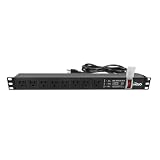
- Efficient Power Distribution: Delivers 12A (US Listed 12A) power through 8 NEMA 5-15R ports, ideal for server racks, network setups, and office environments
- Comprehensive Indicators: Monitors status with Power (yellow), Earth (green), and Lightning Protection (red) indicators, ensuring secure power for server rooms and warehouses
- Compact Design: Sleek 1U horizontal profile (19" x 1.7" x 1.7") maximizes rack space efficiency in IT cabinets
- Versatile Compatibility: 1 NEMA 5-15P input for seamless integration in diverse setups, providing flexibility for network installations
- Safety Assurance: UL listed for compliance, guaranteeing safety and quality in data centers and office spaces
Metering, communications and power quality
Determine whether the facility needs revenue metering, branch-circuit monitoring, power-quality measurements, alarms or integration with a building-management or data-center-infrastructure-management platform. Confirm sensor accuracy, network protocol, cybersecurity controls and whether monitoring remains available during bypass or maintenance states.
Capacity, redundancy and maintainability
Compare initial capacity with expansion strategy. A larger lineup may reduce future shutdowns but consume floor space and increase fault energy. Redundant A/B paths, spare breakers, draw-out devices, bypasses and maintainable busway tap-offs can improve resilience, yet each adds cost, coordination work and inspection points.
Independent reader supportYour contribution helps us test, update, and keep practical guides available for everyone.Published rating examples (not a generic specification)
Manufacturer product pages illustrate how widely ratings vary. These figures are product-specific examples published by Eaton, undated pages accessed in 2026; they do not approve a particular installation.
Do these 3 things before closing this tab:
1Repair Windows errors before they cause bigger problems2Fix the driver behind crashes, sound loss and screen glitches3Clear out junk files and repair common Windows errors| Product example | Maximum voltage class | Continuous-current range | Interrupting rating |
|---|---|---|---|
| Eaton Pow-R-Line 3e | 480 Vac and 250 Vdc | 100–600 A | Fully rated to 100 kAIC; series-rated to 200 kAIC |
| Eaton Pow-R-Line 4B | 600 Vac and 600 Vdc | 250–1,200 A | Fully rated and series-rated to 200 kAIC |
The ranges show why “load center” is insufficient information. A facility still must establish the system voltage, calculated current, available fault current, device compatibility, enclosure and listing for the exact lineup and location.
How to identify the right equipment from a specification
- Start with the one-line location. Mark whether the equipment is at service entrance, main distribution, electrical room, data hall or rack level.
- Write the functional name. Record panelboard, switchboard, switchgear, busway, PDU or another formal designation instead of copying “load center” alone.
- Capture source conditions. Note utility, generator, UPS and transformer sources; nominal voltage; phase; frequency; grounding arrangement; and operating modes.
- Obtain fault-study values. Record available fault current at the equipment terminals for each relevant source and configuration.
- Match protective devices. Check breaker or fuse type, frame and trip ratings, interrupting capacity, zone or maintenance settings and coordination requirements.
- Check physical constraints. Verify enclosure, dimensions, heat dissipation, cable entry, working clearances, seismic or environmental requirements and service access.
- Define monitoring and growth. Specify branch metering, communications, spare capacity, future sections and how equipment will be maintained without removing a critical path.
- Obtain approval. Have the engineer of record and the authority having jurisdiction review the current code basis, listing, drawings and installation details before purchase or energization.
Common mistakes and how to avoid them
- Treating the label as a rating: Replace “load center” with the formal equipment type and complete schedule.
- Using the breaker’s AIC as the assembly rating: Verify the marked rating of the listed combination at the installation point.
- Ignoring alternate sources: Recalculate fault current and coordination for utility, generator, UPS-bypass and tie-breaker states.
- Planning only for IT receptacles: Include cooling, pumps, controls, lighting, fire protection and other facility loads in the distribution model.
- Underestimating heat and access: Reserve working clearance, cable space and maintenance routes; a lineup that fits on paper may be unserviceable in the room.
- Assuming monitoring equals protection: Meters report conditions but do not replace correctly selected overcurrent devices, coordination or commissioning.
- Mixing incompatible components: Use only breakers, tap-offs, transformers and accessories listed for the specific panelboard, switchboard, switchgear, busway or PDU system.
- Skipping change control: A new high-density rack, transformer or generator can alter load flow and fault levels; update studies and labels after material changes.
What “load center” should mean on a data-center project
Use the phrase as an initial question, not as a final design decision. Ask: Which assembly is intended, where is it in the one-line, what source feeds it, and what protected circuits leave it? Then verify the complete ratings and listing for that location. Panelboards may be appropriate for branch or intermediate distribution; switchboards and switchgear handle different construction and duty requirements; busway and PDUs solve downstream routing and transformation needs. The correct choice is the one supported by the facility load calculation, fault and coordination studies, environmental review, current jurisdictional requirements and engineer approval.
Quick Recap
Product prices and availability are accurate as of the date/time indicated and are subject to change. Any price and availability information displayed on Amazon at the time of purchase will apply.

