The Tool Desk
Outbyte Driver Updater FREEScan for outdated or missing drivers - takes under a minuteDriver Scan →Outbyte PC Repair FREEClear out junk files and repair common Windows errorsFree Scan →A crystal structure is a three-dimensional model of how atoms, ions, or molecules are arranged and connected in a crystalline solid. It tells you which particles are neighbors, how they pack, and how the same arrangement extends through the material. Crystallographers usually infer that model from diffraction: measured reflection directions and intensities are converted into an electron-density map, then into an atomic model that is repeatedly tested against the observations.
The key ideas are the unit cell, symmetry, space group, reciprocal space, and the phase problem. Together they explain both the visual picture of a crystal and how scientists can determine positions they cannot observe directly.
As an Amazon Associate I earn from qualifying purchases.
What a crystal structure represents
In direct space, a crystal structure is an arrangement of particles in three dimensions. The particles may be atoms, ions, molecules, or groups of them. A useful description includes both positions and connectivity: which atoms are bonded or coordinated, how molecules are oriented, and how neighboring units fit together.
For many crystals, a small motif repeats by translation. The motif might be one molecule, several ions, or a chemically meaningful fragment. Repeating it in three dimensions produces the extended solid. This is why a crystal structure is more than a drawing of one molecule: the model also describes contacts and symmetry-related neighbors throughout the lattice.
#1 Best Overall

- FAST-GROWING CRYSTALS IN 6 COLORS - Grow blue, red, purple, green, yellow, and glow in the dark crystals! Crystal chemistry has never been so fast (grows in 3 - 4 days), fun, and colorful, making this the perfect educational activity or gift!
- GROWING IS EASY – Easy-to-follow instructions and the 2 included silicone growing chambers make growing your crystals easier than ever!
- NIGHT LIGHT DISPLAY – Show off 5 of your favorite home-grown crystals in the USB-powered (cable included) light-up display! This fun kids STEM activity can help inspire a lifelong love of science and learning.
- INCLUDES REAL CRYSTAL SPECIMENS – Start or expand your rock collection with 4 real gemstone specimens: rose quartz, fluorite, blue calcite, and quartz geode. Learn about the gemstones in the kit with the included full-color Learning Guide.
- AMAZON EXCLUSIVE - Blue Marble has developed this product exclusively for Amazon.
Periodicity is common, but it is not an absolute requirement for crystalline order. The International Union of Crystallography (IUCr) recognizes aperiodic crystals, whose arrangement can have long-range order without repeating periodically in all three dimensions. In direct-space language, the order extends over long distances; in diffraction-space language, it produces essentially sharp diffraction peaks. That distinction matters when a simple repeating-cell picture would be misleading.
Unit cells: the repeatable geometric description
A unit cell is a convenient geometric repeat for representing an ordered crystal arrangement. It is defined by three edge lengths and three angles:
- a, b, c: the lengths of the cell edges.
- α, β, γ: the angles between the edges, using the conventional crystallographic pairing.
Choosing a unit cell does not mean that the crystal physically ends at its boundaries. The boundaries are bookkeeping surfaces. Translating the cell along its edges reproduces the full array, while the particles on a boundary are shared with neighboring cells. A reported cell therefore needs to be interpreted together with the symmetry and the atom coordinates inside it.
Cell dimensions also provide a first check on a proposed structure. If a model’s angles, edge lengths, chemical formula, and atom positions do not fit one another, the problem may be an incorrect symmetry assignment, an incomplete model, or an error in the experimental interpretation.
How symmetry turns one cell into an infinite crystal
Symmetry operations relate equivalent positions. Translation moves a motif to a neighboring cell; other operations can rotate, reflect, invert, or combine these actions in ways allowed by the crystal. Instead of listing every atom in the infinite solid, a crystallographer can list a set of unique positions and specify the operations that generate their equivalents.
A space group summarizes the symmetry of the infinite periodic array. The IUCr symmetry educational resource describes 230 space groups. This is a classification count, not a count of materials or a prediction that every crystal uses a different group. The reported group determines which atom positions are symmetry-equivalent and constrains the geometry that a valid model can have.
Space-group choice is therefore not a decorative label. It affects how many independent atom sites must be refined, how intensities are expected to relate, and whether the proposed arrangement is compatible with the diffraction pattern. A lower-symmetry alternative may appear to fit some data, but it can introduce unnecessary parameters or conflict with systematic intensity relationships.
Recommended Free Tools
Rank #2

- 5 CRYSTAL-GROWING ACTIVITIES – This ultimate crystal kit lets kids safely grow five unique types of crystals: a mini crystal, a dinosaur-shaped crystal, a glow-in-the-dark crystal, 2 crystal trees, and awesome underwater crystals!
- GLOW-IN-THE-DARK CRYSTAL – Grow a luminous crystal that shines in the dark, making science fun even after the lights go out.
- UNDERWATER CRYSTALS – Kids will love watching 4 vibrant crystals grow right before their eyes in a safe, immersive underwater environment!
- CRYSTAL TREES & DINOSAUR – Grow a sparkling crystal-covered dinosaur figure and 2 colorful crystal trees for an eye-catching display.
- ALL-INCLUSIVE EDUCATIONAL SCIENCE KIT – Includes crystal solutions, crystal-growing stones, display container, dinosaur mold, tree forms, safety gear, kid-friendly instructions & an educational Learning Guide filled with cool facts about crystals!
Direct space and reciprocal space
The direct-space picture is the one most people imagine: particles occupy locations in a repeating or long-range ordered arrangement. Diffraction is easier to understand in reciprocal space, where each measurable spot or reflection represents a set of lattice planes and a particular scattering condition.
In an X-ray experiment, an incident beam interacts with the electrons in the sample. Waves scattered by the enormous number of repeating units interfere. At specific directions, the interference is strong enough to produce a reflection. The instrument records the reflection’s position and intensity rather than a photograph of individual atoms.
Sharp, well-defined peaks indicate long-range order. Aperiodic crystals can still produce essentially sharp peaks even though their order is not a simple three-dimensional periodic repeat. An amorphous solid, by contrast, lacks the same long-range crystalline order and produces a different, more diffuse scattering signature.
How X-ray diffraction becomes an atomic model
1. Prepare an appropriate sample
A conventional single-crystal X-ray structure determination requires one suitable single crystal. The crystal must be large and ordered enough to produce measurable reflections and stable enough to survive mounting and exposure. If solvent molecules are part of the crystalline material, the IUCr beginner guide advises keeping the crystal in solvent; evaporation can crack the sample and change or destroy the structure being measured.
Outdated Drivers Are Slowing You Down
One free scan finds every outdated or missing driver and matches the right update for your exact hardware.Free scan · exact hardware matchPC Slower Than It Used to Be?
A free scan shows the junk files, broken settings and background clutter dragging Windows down - then fixes them in one click.Free scan · Windows 10 & 112. Measure reflection positions and intensities
The diffractometer rotates the crystal and records the directions and strengths of the reflected beams. Reflection indices such as hkl label the reciprocal-space conditions. The collection of measured intensities supplies the experimental constraints for the structure calculation.
3. Relate each reflection to a structure factor
A structure factor is a complex quantity associated with a reflection. As S. C. Wallwork states in the IUCr pamphlet Introduction to the Calculation of Structure Factors: “In X-ray crystallography the structure factor F(hkl) of any X-ray reflection (diffracted beam) hkl is the quantity that expresses both the amplitude and the phase of that reflection.”
The amplitude describes the strength of the wave contribution. The phase describes where that wave is in its cycle relative to a reference. Both are needed to reconstruct electron density accurately.
Rank #3

- GROW VIBRANT COLORED CRYSTALS - Grow crystals in 3 amazing colors: blue, purple, and green. With this engaging and educational science experiment for kids, chemistry has never been so fun and colorful!
- NIGHT LIGHT DISPLAY - Show off your crystals on the patent-pending light-up display. With 7 single color modes, rainbow color mode, and 3 brightness levels to choose from, your crystal treasures will shine!
- COMPLETE SCIENCE KIT – Contains all you need! Growing powder, clear seed rocks, growing chamber, light-up display, and easy-to-follow instructions. Our uniquely flexible growing chamber allows you to easily remove your crystals for display without damage!
- START A ROCK COLLECTION – This kit comes with 3 real gemstone specimens, including a geode, green fluorite, and blue calcite, along with a detailed learning guide explaining how crystals grow and more! Makes an excellent STEM gift for boys and girls.
- AWARD-WINNING PRODUCTS - Blue Marble, winner of the Toy Association's prestigious Toy of the Year Award, proudly develops products that foster education, imagination, and creativity, with a U.S. support team to ensure a stellar experience!
4. Address the phase problem
The detector measures intensities, from which amplitudes can be obtained, but it does not directly measure the phases. This missing information is the phase problem. Structure solution uses mathematical and chemical constraints to estimate phases or generate an initial model. Depending on the case, the starting information can come from relationships among reflections, a related known structure, or other experimental strategies.
5. Calculate electron density and build atoms into it
With estimated amplitudes and phases, crystallographers calculate an electron-density distribution. Peaks in that distribution suggest where atoms may be located. The scientist then builds an atomic model, assigns chemical identities, and checks whether the geometry and connectivity make chemical sense.
6. Refine the model against the observations
Refinement adjusts coordinates, displacement parameters, occupancies, and other model variables to improve agreement between calculated and observed diffraction data. The process is iterative: a revised model produces calculated reflections, discrepancies are examined, and the model is updated.
A refinement index is not expected to reach zero. Measurements contain experimental errors, crystals can have disorder or defects, and the model is an approximation. A small residual is useful only alongside other evidence, such as sensible geometry, appropriate displacement parameters, complete atom assignments, and agreement with the expected symmetry.
What the diffraction data can and cannot tell you directly
Diffraction reflections are measurements in reciprocal space, not direct images of atoms. Their positions constrain the unit-cell geometry and symmetry; their intensities constrain how electrons are distributed within that geometry. Converting those measurements into atom coordinates requires the structure-factor calculation, phase estimation, chemical interpretation, and refinement described above.
Free tools Windows power users keep installed
One-click scans. No signup required.
This distinction explains why two models can initially look plausible and why validation is essential. A visually attractive molecular drawing is not enough if it fails to reproduce the observed intensities or violates the crystal’s symmetry. Conversely, a model can have a nonzero residual while still being scientifically sound if the remaining differences are consistent with measurement uncertainty and known limitations.
Choosing between single-crystal, powder, and non-crystalline samples
| Sample form | Typical diffraction approach | What it can provide | Important limitation |
|---|---|---|---|
| Suitable single crystal | Single-crystal X-ray diffraction | Three-dimensional reflection data that can support a detailed atomic model, including independent atom sites, symmetry, and connectivity | A suitable single crystal is required; the method cannot be performed on an amorphous, non-crystalline sample |
| Polycrystalline material or very fine powder | Powder X-ray diffraction | Structural information from the combined diffraction pattern, useful for phase identification, cell information, and analysis of crystalline powders | Many reflections overlap in a powder pattern, so the information is not identical to, and generally does not provide the same detail as, a single-crystal measurement |
| Amorphous solid | Not a conventional crystalline structure determination | Scattering can reveal short-range or average order with methods suited to non-crystalline materials | It does not have the same long-range crystalline order assumed by ordinary unit-cell and space-group descriptions |
Powder diffraction is therefore not simply a drop-in replacement for single-crystal analysis. It answers related but different questions and often requires different modelling assumptions. If a material is available only as a powder, the experiment should be designed around the information that powder data can support rather than treated as if individual-crystal reflections had been measured.
Rank #4
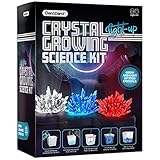
- GROW RED, BLUE AND CLEAR CRYSTALS AND MAKE THEM GLOW: Let your child feel like a real chemist mixing the special ingredients and watching the crystal grow, day by day. And when you're done, display it on the light-up display for all to admire! Follow along with the beautifully illustrated 12-page booklet describing how crystals are formed.
- LET IT GLOW: Growing the crystals is only half the fun. Turn your newly formed crystals into a piece of art by placing them on the included LED Light-up Display and watch the lights burst through the complex crystal formations. It's a truly magical sight at night. (Powered by an included Micro-USB cable).
- KIT INCLUDES: USB Powered LED Light-up Display, Micro-USB Cable, 3 Growing Cups, 3 Crystal Powder Bags (Red, Blue, Clear), 3 Crystal Starters, Mixing Stick, Tweezers, and a gorgeous 12-page instruction and learning guide. Includes everything needed for the young scientist to grow the crystals with ease, and gain a deeper understanding of them.
- FOOL-PROOF SATISFACTION GUARANTEED: This kit has been designed from the ground up to help kids grow beautiful crystals with confidence. With premium ingredients, innovative tools, and a comprehensive step-by-step instruction booklet that adults and children can easily understand and follow, it’s a fun, hands-on activity the whole family can enjoy.
- A FUN AND EDUCATIONAL GIFT FOR ALL AGES: It's not often that a science project can be fun and engaging, but this kit achieves both! It fascinates children as soon as they pull it out of the box and is a perfect STEM project. It fosters a love for science and crystallography in a fun and exciting way.
How to read a reported crystal structure
Check the unit-cell dimensions and angles
Look for the reported values of a, b, c, α, β, and γ, together with the temperature and measurement conditions when supplied. These values define the cell used for the atomic coordinates and should be compatible with the stated crystal system and space group.
Check the space group against the diffraction evidence
IUCr data requirements state that the reported space group should encompass the symmetry permitted by the diffraction intensities and agree with the unit-cell dimensions and angles. This is a consistency requirement, not a guarantee that every model using a formally allowed group is correct.
Check the chemical formula and formula units per cell
The number of formula units assigned to one unit cell should agree with the chemical formula, the space group, and the atom-site information. A mismatch can indicate an incorrect molecular formula, missing solvent, unrecognized disorder, an incorrect symmetry assignment, or an error in the reported coordinates.
Check atom sites, occupancies, and connectivity
Independent atom sites should generate the stated structure under the space-group operations. Partial occupancies need a chemical or physical explanation, such as disorder or mixed composition. Bond lengths, angles, coordination environments, and intermolecular contacts should be chemically plausible for the elements and oxidation states involved.
Read refinement statistics in context
Residual indices summarize agreement with the measured data, but they are not a pass-or-fail certificate by themselves. Inspect whether the model accounts for the significant reflections, whether displacement parameters are reasonable, and whether unresolved density or twinning is discussed. The best-supported interpretation is the one that satisfies the diffraction data, symmetry, chemistry, and uncertainty together.
Common misconceptions
- “The unit cell is one molecule.” Sometimes it contains one formula unit, but it can contain several, partial molecules, ions, solvent molecules, or symmetry-generated portions of molecules.
- “A diffraction pattern is a direct photograph of atoms.” It is a set of reciprocal-space measurements. Atomic positions are inferred through structure factors, phase estimation, and model refinement.
- “The lowest refinement residual must be the correct answer.” A model can overfit or violate chemical and symmetry constraints. Residuals must be evaluated with the rest of the validation evidence.
- “Every crystal repeats in a simple three-dimensional grid.” Aperiodic crystals have long-range order without ordinary three-dimensional periodicity, while still producing essentially sharp diffraction peaks.
- “Any solid can be analyzed by single-crystal X-ray diffraction.” The method requires a suitable single crystal. Amorphous materials do not provide the same crystalline long-range order, and powders require powder-diffraction methods.
Further reading for a deeper course
Readers who want a technical treatment can consult Christopher Hammond’s The Basics of Crystallography and Diffraction, fourth edition (2015). An IUCr review describes coverage of crystal symmetry, point groups, space groups, and X-ray diffraction. The IUCr’s International Tables for Crystallography provide an authoritative reference series, in print and online, covering symmetry, diffraction, structure determination, and crystal properties.
Why the model matters
A crystal structure connects an experimental pattern to a physical explanation: which particles are present, where they sit, how they interact, and how those relationships repeat or remain ordered through the solid. Unit-cell geometry provides the coordinate framework; symmetry reduces and organizes the description; diffraction supplies measured constraints; and refinement tests whether the proposed atomic arrangement is consistent with those constraints. Treating the result as a tested scientific model—not merely a picture—makes its strengths, limits, and uncertainty clear.
Quick Recap
Product prices and availability are accurate as of the date/time indicated and are subject to change. Any price and availability information displayed on Amazon at the time of purchase will apply.

