Excavation is the beginning of an artifact’s professional life, not the end. After an object is removed from the ground, archaeologists record its exact context, stabilize it against new deterioration, analyze it with related finds and samples, and place it in a managed repository. Some objects later appear in exhibitions, reports, books, lectures, or educational programs; many remain in storage so they can be studied again. Ownership, retention, and repatriation depend on the country, land status, permit, material, and cultural affiliation involved.
1. The find is recorded before it is treated as an isolated object
An artifact’s scientific value comes partly from its provenience: the precise place, layer, feature, and relationships in which it was found. Excavators assign an identifier, photograph the object, map its location, describe its condition, and connect it to field notes and the other materials recovered nearby. A ceramic fragment separated from its excavation records may be much less informative than the same fragment tied to a dated floor, a burial, or a group of production debris.
As an Amazon Associate I earn from qualifying purchases.
Labels, photographs, and field records
Labels and catalogue numbers travel with the object through washing, conservation, analysis, storage, and exhibition. Databases can record a catalogue description, current location, treatment history, associated samples, and movements between rooms or institutions. The physical object is therefore only one part of the archaeological collection; drawings, photographs, maps, reports, and laboratory results preserve the context that makes interpretation possible.
Transport from the excavation
Removal changes an object’s environment. An item that was stable while buried can begin deteriorating when exposed to oxygen, drying air, light, salts, or a different temperature. Fragile material may be supported in a soil block or “blocklifted” rather than picked up piece by piece. Conservators may require a find to go directly to a laboratory, while more stable objects can be packed for later processing. There is no safe universal instruction to wash or dry every discovery.
#1 Best Overall

- Portable and Easy to Store: The compact size of each tool makes this dig tool set portable.Each lightweight tool in this kids digging tools set is designed for small hands, making it easy for children to explore and dig wherever they go./Size(wood hammer):14.00X4.00X2.00cm/5.50X1.57X0.79in
- Complete Set for Exploration: This set offers a comprehensive collection of essential archaeological tools, including hammers, chisel, brushes, and magnifying glasses.providing all the essential digging tools for a fun excavation experience
- Stimulates Imagination: By using these tools, little ones can immerse themselves in the role of archaeologists, uncovering hidden treasures in their imaginative world.These digging toys for kids are designed to enhance fine motor skills and observational abilities, making archaeology engaging and educational
- Educational Value: Ideal for educational experiments, these dig tools help learn about archaeology in a hands - on way.helping children explore the fascinating world of archaeology while having fun
- Improve Fine Skills: You can practice skills like careful excavation, precise brushing, and detailed observation, which are for scientific thinking and problem - solving.Exciting Gift Option, This excavation kit for kids makes a fantastic gift for young archaeology enthusiasts, encouraging creativity and a passion for science
2. Condition assessment determines the next treatment
A conservator first identifies the material, construction, deposits, and immediate risks. The same category of object can require different handling: a fired ceramic in good condition is not treated like a salt-filled ceramic, and a dry metal object is not treated like metal recovered from saturated soil. The Canadian Conservation Institute warns that deterioration can accelerate after excavation, so decisions made in the field affect an object’s survival for decades or centuries.
Why drying can be dangerous
Waterlogged wood, leather, and textile fibers can collapse or shrink when allowed to dry uncontrolled. Wet, salt-contaminated metals can crack, powder, or corrode rapidly as moisture and oxygen interact. Some unstable glass can develop surface damage when its internal salts migrate during drying. These cases may require temporary humidity control, specialized supports, desalination, or other conservation procedures chosen for the specific material and condition.
Cleaning is selective, not automatic
Removing soil can reveal decoration and make analysis possible, but cleaning can also erase residues, pigments, use-wear, or information about manufacture. Alexandria’s archaeological program describes washing some ceramics, glass, and bone in plain water, dry-brushing some metals, and keeping waterlogged wood, leather, or cloth under different conditions. Those examples illustrate a professional assessment process, not a do-it-yourself recipe.
Free tools Windows power users keep installed
One-click scans. No signup required.
3. Typical treatment by material and condition
| Find type | Immediate concern | Possible professional response | Why the response varies |
|---|---|---|---|
| Stable ceramic | Attached soil, fragile edges, or surface decoration | Careful cleaning, joining, labelling, and protective storage | Water, brushing, and adhesives must not remove residues or damage a weak surface |
| Glass | Crizzling, salts, or unstable surfaces | Controlled handling and environmental management; treatment selected after examination | Drying or aggressive cleaning can worsen deterioration in unstable glass |
| Metal | Active corrosion, especially with salts | Dry brushing in some cases, corrosion assessment, desalination or stabilization when required | Wet archaeological metals can be harmed by uncontrolled drying |
| Waterlogged wood, leather, or textile | Collapse, shrinkage, and biological deterioration after exposure | Keep under controlled conditions and send promptly for specialist conservation | Fibers and cellular structures can deform irreversibly as they dry |
| Bone or human remains | Fragility, contamination, and legal or cultural sensitivity | Document, stabilize, analyze only when permitted, and follow applicable human-remains procedures | Scientific handling is constrained by jurisdiction, affiliation, and repatriation rules |
4. Laboratory analysis links the object to larger questions
Once an object is stable enough to handle, specialists may identify its material, date it, compare its manufacturing technique, or examine residues and microscopic wear. Associated samples can provide evidence about species, diet, health, nutrition, industrial processes, or DNA. The goal is usually to understand an assemblage and the people or activities it represents, rather than to produce a decorative object for display.
Rank #2
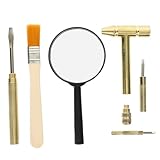
- Size: The size is 12.50X6.20X1.50cm/4.91X2.44X0.59in(magnifying glass), 13.50X1.50X0.50cm/5.31X0.59X0.20in( brush) ,16.00X5.30X1.30cm/6.29X2.08X0.51in( hammer)
- ABS, metal, wood Material:magnifying glass is made of ABS, hammer chisel is made of metal and brush is wood material and good workmanship for use, with smooth surface, will not hurt the hand of you
- Excavation Tool: This is a set of complete excavation tool kit, which includes hammer, brush and chisel and magnifier .
- Digging tool: Practical gem digging tool set can better develop the cognitive ability and hands-on ability, keep them from the electronic screen.
- Presents: The dinosaur dig tools kit is a presents birthday, shower , christmas, new year for your lovely. It will catch your boys and girls more attention.If you have any questions, please don't hesitate to contact us
Protecting samples from contamination
Sampling is planned around future as well as immediate questions. Modern DNA, conservation chemicals, handling residues, or soil from another context can compromise results. The Canadian Conservation Institute emphasizes contamination control because a sample consumed in one test may not be available for later work. Records should state what was sampled, how it was removed, where it is stored, and which methods were used.
Analysis can continue for years
New dating techniques, comparative collections, or questions about climate and migration can make an old assemblage newly valuable. An excavation report may be completed while specialists continue examining selected materials. Alexandria notes that archaeological study can continue for years after fieldwork, and that the work includes cataloguing, interpretation, and reporting rather than excavation alone.
5. Most artifacts enter long-term repository storage
After processing, objects and their documentation are usually transferred to a museum, university, government facility, or other approved repository. Storage is not a neglected “back room”; it is the normal way collections remain available for future research. Facilities use stable environmental conditions, suitable containers, pest management, secure access, location tracking, and disaster planning. Digital records must also be backed up and maintained as software and hardware change.
The Tool Desk
Outbyte Driver Updater FREEFix the driver behind crashes, sound loss and screen glitchesFind Drivers →Outbyte PC Repair FREERepair Windows errors before they cause bigger problemsFix Now →The scale is larger than a display case suggests
The Canadian Conservation Institute notes that relatively small sites can produce thousands of objects, while large, multi-year excavations can generate hundreds of thousands or millions. Space, shelving, packaging, staff time, and database work therefore need to be planned before excavation begins. The City of Alexandria estimates that completing laboratory and other work in its urban archaeology program can require at least twenty hours for every hour spent excavating. That figure is an Alexandria program estimate, not a universal archaeological ratio.
Rank #3

- ✔️【GEOLOGY ROCK PICK COMES WITH STURDY DURABILITY CANVAS BAG】Tough and durabilitycanvas bag with multiple pockets to keep your tools organized and protected.Carry all your tools as well as the rocks, minerals, gems, gold & fossils that you find.
- ✔️【QUALITY MADE TOOLS INCLUDING】Kit comes with Large Canvas Bag, Rock Hammer, 3 Chisels, Anti-Fog Safety Goggles, 10x Jeweler's Loupe, Compass, Whistle, Multi-function Shovel, 2 Pairs Gloves, 2 Musette Bag, 1 Spray Bottle, 2 Brushes.
- ✔️【DIFFERENT SIZE OF ROCK CHISELS】9.8 inch cuspidal chisels , 9.8 inch & 11.8 inch flathead chisels .Used for chipping brickwork, concrete, metal, and stone, made of chrome vanadium steel, hardness: 54~58HRC. 32 oz steel rock pick hammer:Drop forged one-piece all steel head-handle construction with fully polished finish and additional rust-preventative clear coating for maximum strength and durability.
- ✔️【GEOLOGY HAMMER AND TOOLS KIDS WILL LOVE】Inspire that budding rock hound or geology student by giving them the right tools to explore their passion.This kit is convenient and brings together all the tools to get started with geology and paleontology or archeology or even just a beginner
- ✔️【ROCK PICK HAMMER KIT MAKES GREAT 】For holidays this rock hounding equipment is the good idea.If you are not satisfied with the geological rock pickaxe hammer kit tool, we’re very happy to either provide Refund or Replacement. Order today risk free!Thank you for coming again!
Why collections stay together
Repositories try to retain objects with their field records, catalogue information, photographs, and samples. A sherd, animal bone, soil sample, and map from the same feature can answer questions together that none could answer alone. Researchers may request access years later, and curators must be able to locate the item and verify its history.
6. Only some finds are exhibited
Exhibitions select objects that can communicate a clear story, survive public handling, and fit the institution’s interpretation and conservation capacity. A museum may display a representative vessel while storing hundreds of comparable fragments. Other ways to share results include excavation reports, books, academic articles, lectures, public events, digital catalogues, and school programs. Public visibility is therefore one possible outcome, not the definition of success.
Storage can be the more responsible choice
An object may remain in storage because it is too fragile, chemically unstable, culturally restricted, repetitive, or needed for continuing analysis. Keeping it protected with its records preserves options for future researchers and communities. A lack of display does not mean the artifact was discarded or forgotten.
What’s actually slowing this PC down?
Pick the symptom - the matching free tool is one click away.
7. Archaeologists generally do not personally keep or sell excavated finds
Professional excavators work under permits and institutional responsibilities. The Archaeological Institute of America explains that remains generally belong to the country where they are found, but that broad statement does not settle every case. The controlling rules can depend on land ownership, the excavation permit, national and local law, the object category, and cultural affiliation. A researcher cannot treat a permitted excavation as a private treasure hunt.
Rank #4

- The tool kit includes a large canvas backpack, 32-ounce hammer, pointed chisel, flat chisel, multi-functional shovel, safety goggles, goggles case, jeweler's loupe, three-in-one whistle, two pairs of gloves, an 8-grid small box, waterproof bag, brush, and tweezers. It has all the equipment you need!
- Safe and Convenient Backpack: The YTYLSJ geological tool kit comes with a backpack that has thick padding to protect the wearer from sharp tools. Elastic straps inside the bag keep the tools in place, while the roomy design allows you to carry a packed lunch, gold panning equipment, and all the rocks, minerals, gems, gold and fossils you find.
- Complete Starter Set: This tool kit set is perfect for budding rock lovers, geology students, and beginners in paleontology or archaeology. It brings together all the tools you need to start exploring the world of rocks and fossils.
- Durable and High-Quality Tools: The YTYLSJ geological tool kit includes a pointed chisel, flat chisel, and a steel cordless drill made of chrome vanadium steel.The steel cordless drill has a one-piece all-steel shank construction with a fully polished finish and an additional rust-resistant clear coat for maximum strength and durability.The rock drilling hammer adopts a one-piece forged all-steel head handle structure, and the non-slip rubber handle is ergonomically designed for comfortable use.
- Lightweight Goggles: The goggle frame in the geological tools set is made of PVC, which is light and not easy to slip off. The adjustable elastic band design is convenient for fixing the head circumference, making these goggles ideal for extended use.
Federal and tribal land in the United States
U.S. federal law establishes specific duties for collections recovered from federal land. The National Park Service’s 36 CFR 79 curation standard addresses the care of federally owned and administered archaeological collections, including associated records. Repository arrangements, access, security, and preservation requirements are part of that framework.
Human remains and cultural items
Human remains are not ordinary artifacts. In the United States, the Native American Graves Protection and Repatriation Act (NAGPRA) provides procedures for covered human remains, funerary objects, sacred objects, and objects of cultural patrimony, including consultation, inventory, notice, and repatriation where the legal criteria are met. Tribal or Native Hawaiian affiliation, land status, and the facts established during consultation matter to the outcome.
Other countries use different systems. UK guidance for museums addresses the care and management of human remains in England, Northern Ireland, and Wales. It does not create a worldwide rule, and it should not be substituted for the law governing a find elsewhere.
Do these 3 things before closing this tab:
1Fix the driver behind crashes, sound loss and screen glitches2Repair Windows errors before they cause bigger problems3Scan for outdated or missing drivers - takes under a minuteInternational principles are not a replacement for local law
UNESCO’s 1956 recommendation sets international principles for archaeological excavations, but it is not a current permit or ownership decision for a particular site. For a real collection, the applicable national law, land manager, permit terms, repository agreement, and community consultation control.
Best Value

- 【Rock Pick Hammer Kit】Kit comes with Large Canvas Bag, Rock Hammer, 3 Chisels, Anti-Fog Safety Goggles, Jewelry Magnifier, 3 Brushes.
- 【Portable Design】Tough and durable canvas bag to keep your tools organized and protected.Carry all your tools as well as the rocks, minerals, gems, gold & fossils that you find.
- 【SIZE OF Hammer Kit】 4.9 & 9.8 & 11.5 inch flathead chisels .Used for chipping brickwork, metal, and stone, made of chrome vanadium steel, 32 oz steel rock pick hammer:Drop forged one-piece all steel head-handle construction with fully polished finish and additional rust-preventative clear coating for maximum strength and durability.
- 【Beginners And Children】The right set of tools can inspire beginners and rock hound or geology students alike, and this can provide everything you need.
- 【ROCK PICK HAMMER KIT MAKES GREAT GIFTS 】Rock hounding equipment is the perfect gift idea.If you are not satisfied with it we’re very happy to either provide Refund or Replacement.
8. Possible long-term outcomes
| Outcome | What it means | Typical reason |
|---|---|---|
| Repository storage | The object remains catalogued and accessible under controlled conditions | Most finds are retained for research, teaching, and accountability |
| Publication or database release | Measurements, images, context, and interpretations become available to specialists or the public | Sharing evidence without exposing every object to handling |
| Exhibition | A selected object is displayed with an explanatory interpretation | It is stable, meaningful for the story, and suitable for public access |
| Return or repatriation | Custody or physical control changes under an applicable legal or community process | Human remains, cultural items, or objects governed by land and cultural-affiliation rules |
| Further conservation or study | The object remains unavailable for ordinary display while specialists work on it | Active corrosion, fragile structure, unresolved identification, or new analytical questions |
9. The records may be as important as the object
Archaeological interpretation depends on associations: which layer an item came from, what was beside it, how it was recovered, what treatment it received, and which samples were taken. If an artifact is separated from that information, its evidentiary value can fall even when the object itself remains physically intact. For that reason, professional curation preserves field documentation and digital data alongside the find.
The Canadian Conservation Institute summarizes the time scale of this obligation: “The care of archaeological objects begins with decisions made in the field and extends for decades or centuries after the objects enter a collection in a museum or repository.” That principle explains why excavation budgets include conservation, cataloguing, storage, and reporting rather than ending when the soil is removed.
10. A practical way to understand any specific artifact’s fate
- Identify the material and condition. Ask whether it is stable ceramic, wet organic material, corroding metal, fragile glass, bone, or human remains.
- Identify the legal setting. Determine the country, state or province, landowner, permit, and whether the find came from federal, tribal, Indigenous, or protected land.
- Check the collection records. The catalogue number, context description, treatment history, and repository location show what has happened since excavation.
- Determine access rules. Some objects can be requested for research or teaching; others are restricted for conservation, privacy, safety, or cultural reasons.
- Look for the published interpretation. Reports, catalogues, lectures, and exhibitions may explain the find even when the physical object remains in storage.
There is no single universal destination. A stable sherd may be washed, catalogued, stored, and later displayed; a waterlogged wooden object may spend years under controlled treatment; a human remain or culturally affiliated item may follow a consultation and repatriation process. In every case, the professional sequence begins with preserving context and continues with care, analysis, documentation, and lawful stewardship.
Quick Recap
Product prices and availability are accurate as of the date/time indicated and are subject to change. Any price and availability information displayed on Amazon at the time of purchase will apply.

