Free tools Windows power users keep installed
One-click scans. No signup required.
Crystal engineering networks are designed by choosing molecular or metal-containing building blocks, matching their interaction sites and geometry, and then controlling crystallization so those units assemble into a repeatable extended structure. The result may be a hydrogen-bonded molecular crystal, a coordination network, or a hybrid architecture. Some networks are porous and some are not; useful properties such as gas separation, catalysis, sensing, or storage must be demonstrated for the specific material and operating conditions.
What a crystal engineering network is
Crystal engineering treats a crystal as an organized solid whose architecture can be influenced through molecular shape, charge, symmetry, and intermolecular forces. G. R. Desiraju defined the field in his 2007 review, Crystal Engineering: A Holistic View, as “the design of molecular solids” and “the synthesis of functional solid-state structures from neutral or ionic building blocks, using intermolecular interactions in the design strategy.” That definition is deliberately broad: it includes molecular crystals held together by hydrogen bonds as well as solids in which metal centers and ligands form coordination networks.
As an Amazon Associate I earn from qualifying purchases.
A network is an extended connectivity pattern, not a guarantee of pores or a particular application. A two-dimensional sheet can be dense, while a three-dimensional framework can contain accessible cavities. A crystal may also include solvent molecules, interpenetrating nets, or several polymorphs with different properties. The words network, framework, and hybrid therefore need to be tied to the actual bonding mode, composition, and measured behavior of the material.
Windows Errors? Fix Them Before They Spread
Repair common Windows errors and clear accumulated junk for a smoother, more stable PC - no reinstall needed.Free scan · no reinstallOutdated Drivers Are Slowing You Down
One free scan finds every outdated or missing driver and matches the right update for your exact hardware.Free scan · exact hardware matchThe two main strands
Coordination networks
In a coordination network, metal ions, metal clusters, or other robust metal-containing units act as nodes. Organic or inorganic ligands connect those nodes through coordinate bonds. The node’s preferred coordination number, geometry, oxidation state, charge, and symmetry constrain which linkers can attach and how many directions of connection are available. Ligand length, rigidity, angular shape, and placement of donor atoms then influence dimensionality and topology.
#1 Best Overall

- FAST-GROWING CRYSTALS IN 6 COLORS - Grow blue, red, purple, green, yellow, and glow in the dark crystals! Crystal chemistry has never been so fast (grows in 3 - 4 days), fun, and colorful, making this the perfect educational activity or gift!
- GROWING IS EASY – Easy-to-follow instructions and the 2 included silicone growing chambers make growing your crystals easier than ever!
- NIGHT LIGHT DISPLAY – Show off 5 of your favorite home-grown crystals in the USB-powered (cable included) light-up display! This fun kids STEM activity can help inspire a lifelong love of science and learning.
- INCLUDES REAL CRYSTAL SPECIMENS – Start or expand your rock collection with 4 real gemstone specimens: rose quartz, fluorite, blue calcite, and quartz geode. Learn about the gemstones in the kit with the included full-color Learning Guide.
- AMAZON EXCLUSIVE - Blue Marble has developed this product exclusively for Amazon.
Daniel O’Nolan and Michael J. Zaworotko describe this class as structurally and compositionally diverse network solids engineered by exploiting the interactions and symmetry of metal-center nodes and connecting ligands. Their 2021 chapter, Crystal engineering of coordination networks: Then and now, states that its primary focus is “the delineation of those design principles that are now well established, in particular the node-and-linker approach to network design.” This approach is a design framework, not a promise that one selected metal and ligand will crystallize into one unique structure.
Molecular and hydrogen-bonded networks
Molecular crystals can form extended chains, sheets, or three-dimensional networks without metal coordination. Directional hydrogen bonds are common structure-directing interactions, but halogen bonds, ionic contacts, π-related contacts, and other noncovalent forces can contribute as well. In this strand, researchers often describe recurring interaction motifs as supramolecular synthons. A synthon is a recognizable pattern between functional groups, such as a repeated donor–acceptor arrangement.
The molecular units designed to express those interactions are called tectons. A tecton has deliberately positioned peripheral interaction sites; the number and geometry of those sites can favor a chain, layer, or three-dimensional net. Tecton and synthon language helps researchers discuss intended connectivity even when the final crystal contains competing contacts or a different packing arrangement.
Do these 3 things before closing this tab:
1Repair Windows errors before they cause bigger problems2Fix the driver behind crashes, sound loss and screen glitches3Clear out junk files and repair common Windows errorsHybrid networks
Hybrid coordination networks combine organic and inorganic components, often using metal nodes and organic linkers while relying on several interaction types at once. They are studied for functions including gas separation and other transport-related behavior. “Hybrid” describes composition and bonding; it does not establish that a material is porous, stable in a working environment, or ready for industrial use.
Rank #2

- 5 CRYSTAL-GROWING ACTIVITIES – This ultimate crystal kit lets kids safely grow five unique types of crystals: a mini crystal, a dinosaur-shaped crystal, a glow-in-the-dark crystal, 2 crystal trees, and awesome underwater crystals!
- GLOW-IN-THE-DARK CRYSTAL – Grow a luminous crystal that shines in the dark, making science fun even after the lights go out.
- UNDERWATER CRYSTALS – Kids will love watching 4 vibrant crystals grow right before their eyes in a safe, immersive underwater environment!
- CRYSTAL TREES & DINOSAUR – Grow a sparkling crystal-covered dinosaur figure and 2 colorful crystal trees for an eye-catching display.
- ALL-INCLUSIVE EDUCATIONAL SCIENCE KIT – Includes crystal solutions, crystal-growing stones, display container, dinosaur mold, tree forms, safety gear, kid-friendly instructions & an educational Learning Guide filled with cool facts about crystals!
How researchers design a network
- Define the target structure or function. Decide whether the priority is a one-dimensional chain, a layered solid, a three-dimensional net, a flexible host, a selective sorbent, a catalyst, or a sensing response. A structural objective and a functional objective are related but not identical: a beautiful topology may have inaccessible pores, and a porous solid may be unstable under the intended conditions.
- Choose nodes or molecular tectons. For coordination systems, evaluate metal coordination preferences, charge balance, symmetry, and the availability of robust molecular or supramolecular building blocks. For molecular crystals, choose molecules with donor and acceptor groups positioned to express a desired synthon. Rigidity can preserve a designed angle; flexibility can enable adaptation but also increases the number of possible packing outcomes.
- Match linkers and interaction sites. Linkers connect coordination nodes through donor atoms, while tectons connect through hydrogen-bond or other noncovalent sites. Connectivity depends on the number and orientation of available sites, not merely on molecular size. A linear linker and a bent linker can produce entirely different nets with the same metal center.
- Use topology as a planning language. Topological analysis abstracts a crystal to nodes, edges, and connectivity. It allows researchers to compare related nets, identify recurring structural families, and describe a proposed blueprint without treating every atom as a separate design decision. Topology narrows the possibilities; it does not remove polymorphism or guarantee the targeted net.
- Plan the crystallization experiment. Solvent, concentration, temperature, reaction time, reagent order, pH or other chemical conditions, and the balance between kinetic and thermodynamic control can determine which solid appears. Trace impurities and solvent inclusion can redirect assembly. Reproducibility therefore requires recording the full crystallization protocol, not just the identities of the building blocks.
- Characterize the product before assigning performance. Diffraction and complementary analyses establish composition, connectivity, dimensionality, guest content, and polymorph. For a claimed application, measure the relevant property under stated conditions and identify whether the result is a structural prediction, a laboratory demonstration, or evidence of durability in a realistic process.
Interactions: why a plausible design can still change in the crystal
Crystal packing is governed by a balance of interactions rather than by one isolated bond. Strong, directional hydrogen or halogen bonds may dominate when they are available, while weaker contacts can fill remaining space or stabilize an arrangement. The practical guide A Practical Guide to the Design of Molecular Crystals discusses C–H···X contacts as potentially stabilizing but generally secondary for directing assembly when stronger hydrogen or halogen bonds compete.
Competing donors and acceptors can produce crossover interactions. A molecule designed to form one pair may instead satisfy a different donor with a neighboring acceptor, creating another chain or sheet. Solvent molecules can occupy sites intended for intermolecular contacts, alter hydrogen-bond patterns, or remain in pores after crystallization. Water is especially important because it can bridge components, change composition, and affect stability.
Polymorphism is another central limitation. The same chemical components can crystallize in more than one arrangement, with differences in density, melting behavior, flexibility, guest uptake, or reactivity. A successful crystal-engineering strategy therefore identifies conditions that favor a reproducible form and tests whether that form persists when solvent, temperature, humidity, or pressure changes.
Topology, dimensionality, and interpenetration
Dimensionality describes how far connectivity extends: one-dimensional chains, two-dimensional sheets, and three-dimensional frameworks. Connectivity and topology provide a more detailed description of how nodes are linked. Two structures can both be three-dimensional yet differ in node degree, ring sizes, channels, and mechanical response.
Rank #3

- GROW VIBRANT COLORED CRYSTALS - Grow crystals in 3 amazing colors: blue, purple, and green. With this engaging and educational science experiment for kids, chemistry has never been so fun and colorful!
- NIGHT LIGHT DISPLAY - Show off your crystals on the patent-pending light-up display. With 7 single color modes, rainbow color mode, and 3 brightness levels to choose from, your crystal treasures will shine!
- COMPLETE SCIENCE KIT – Contains all you need! Growing powder, clear seed rocks, growing chamber, light-up display, and easy-to-follow instructions. Our uniquely flexible growing chamber allows you to easily remove your crystals for display without damage!
- START A ROCK COLLECTION – This kit comes with 3 real gemstone specimens, including a geode, green fluorite, and blue calcite, along with a detailed learning guide explaining how crystals grow and more! Makes an excellent STEM gift for boys and girls.
- AWARD-WINNING PRODUCTS - Blue Marble, winner of the Toy Association's prestigious Toy of the Year Award, proudly develops products that foster education, imagination, and creativity, with a U.S. support team to ensure a stellar experience!
Interpenetration occurs when two or more independent networks weave through the same crystal, like intertwined nets. Reviews of entangled two-dimensional coordination networks show why it cannot be labeled simply good or bad. Interpenetration may reduce accessible pore volume or narrow channels, but it can also increase mechanical stability, change adsorption selectivity, or alter framework flexibility. In some materials, motion between entangled motifs contributes to softness.
| Comparison axis | Questions to ask | Why it matters |
|---|---|---|
| Bonding mode | Are connections coordinate bonds, hydrogen bonds, halogen bonds, ionic contacts, or a combination? | Bond directionality, reversibility, and response to heat or solvent differ. |
| Building blocks | What are the node, linker, tecton, or cluster, and what are their geometries and charges? | These features constrain connectivity and possible dimensionality. |
| Topology and dimensionality | Is the structure a chain, sheet, or three-dimensional net, and what is its connectivity pattern? | Topology helps compare structures and anticipate channels or mechanical pathways. |
| Interpenetration | How many nets occupy the same crystal, and what pore space remains accessible? | Entanglement can trade pore volume for stability or selectivity. |
| Stability and flexibility | Does the structure retain its form under the stated temperature, pressure, humidity, solvent, or guest loading? | A design that collapses or transforms cannot support the same application claim. |
| Evidence for function | Was adsorption, separation, sensing, or catalysis measured for this material and these conditions? | Application performance is material-specific and cannot be inferred from topology alone. |
What properties can these networks provide?
Porosity and gas handling
Open coordination or hybrid networks may contain channels or cavities that take up gases. Researchers investigate them for storage, purification, and separations, including selective transport through pores of different size or chemical environment. Accessible pore geometry, guest diffusion, framework stability, and activation history all matter. A nominal cavity in a crystal structure is not the same as a pore that remains open and usable during a measurement.
Catalysis
Metal sites, functional linkers, or confined spaces can create catalytic environments. A network may immobilize an active center, influence substrate access, or provide a reusable solid. Catalytic claims require reaction-specific measurements: conversion, selectivity, turnover behavior, solvent and temperature, and whether the framework remains intact. The presence of a metal node alone does not establish catalytic activity.
What’s actually slowing this PC down?
Pick the symptom - the matching free tool is one click away.
Sensing
Networks can respond to guest molecules through changes in fluorescence, conductivity, color, mass, or structural dimensions. Selectivity depends on the interaction sites and on interference from other species, humidity, and competing guests. A laboratory response to one analyte should not be presented as a general sensor capability without testing the relevant mixture and operating range.
Rank #4
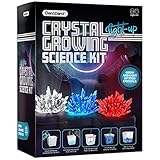
- GROW RED, BLUE AND CLEAR CRYSTALS AND MAKE THEM GLOW: Let your child feel like a real chemist mixing the special ingredients and watching the crystal grow, day by day. And when you're done, display it on the light-up display for all to admire! Follow along with the beautifully illustrated 12-page booklet describing how crystals are formed.
- LET IT GLOW: Growing the crystals is only half the fun. Turn your newly formed crystals into a piece of art by placing them on the included LED Light-up Display and watch the lights burst through the complex crystal formations. It's a truly magical sight at night. (Powered by an included Micro-USB cable).
- KIT INCLUDES: USB Powered LED Light-up Display, Micro-USB Cable, 3 Growing Cups, 3 Crystal Powder Bags (Red, Blue, Clear), 3 Crystal Starters, Mixing Stick, Tweezers, and a gorgeous 12-page instruction and learning guide. Includes everything needed for the young scientist to grow the crystals with ease, and gain a deeper understanding of them.
- FOOL-PROOF SATISFACTION GUARANTEED: This kit has been designed from the ground up to help kids grow beautiful crystals with confidence. With premium ingredients, innovative tools, and a comprehensive step-by-step instruction booklet that adults and children can easily understand and follow, it’s a fun, hands-on activity the whole family can enjoy.
- A FUN AND EDUCATIONAL GIFT FOR ALL AGES: It's not often that a science project can be fun and engaging, but this kit achieves both! It fascinates children as soon as they pull it out of the box and is a perfect STEM project. It fosters a love for science and crystallography in a fun and exciting way.
Mechanical and adaptive behavior
Flexible linkers, weak contacts, and interpenetrated motifs can permit breathing, sliding, or other structural changes. Such motion may help a material discriminate between guests or absorb energy, but it can also cause hysteresis, fatigue, or loss of crystallinity. Flexibility is therefore a measurable property, not an automatic advantage.
Common misconceptions and the correct interpretation
- “Every coordination network is a MOF.” Metal–ligand networks include many classes of solids, and not all are porous or conventionally classified as metal–organic frameworks.
- “A synthon determines the final crystal.” Synthons are useful recurring motifs, but competing functional groups, polymorphism, solvent inclusion, impurities, and crystallization pathways can produce another structure.
- “Interpenetration is always harmful.” It can reduce pore space, yet sometimes improves stability or changes selectivity. The outcome must be measured for the specific net.
- “Weak contacts are equivalent to hydrogen bonds.” Secondary contacts may stabilize packing, but their structure-directing role is usually different from that of stronger, more directional interactions.
- “A predicted framework is application-ready.” A proposed topology is a design hypothesis. Practical readiness requires synthesis, structural verification, durability testing, and performance data under relevant conditions.
- “A crystal structure is fully predictable from the ingredients.” Building-block geometry narrows the options but does not eliminate kinetic and thermodynamic competition during crystallization.
How to evaluate a reported network
- Identify the exact chemical composition, including counterions, coordinated solvent, and guest molecules.
- Classify the primary connection: coordination, hydrogen bonding, another supramolecular interaction, or a hybrid combination.
- Map the nodes and linkers or tectons, then note dimensionality, connectivity, and topology.
- Check for interpenetration, disorder, defects, and solvent-filled voids before interpreting pore dimensions.
- Read the stability evidence at the temperature, pressure, humidity, and chemical environment relevant to the intended use.
- Separate a proposed mechanism from a measured result. Look for material-specific adsorption, separation, sensing, or catalytic data rather than relying on an analogy to another framework.
- Ask whether the synthesis and activation procedure is sufficiently described to reproduce the reported polymorph and guest state.
Where the field stands
Crystal engineering has moved from recognizing recurring packing motifs toward combining building-block design, topology, and function. The node-and-linker model gives coordination-network research a common vocabulary, while synthons and tectons help molecular-crystal researchers reason about directional noncovalent assembly. Neither vocabulary replaces experiment: the final solid emerges from interactions, component flexibility, solvent, impurities, and crystallization history acting together.
For readers who want a formal treatment of coordination networks, the 2021 O’Nolan and Zaworotko chapter appears in the academic volume Hot Topics in Crystal Engineering (Elsevier). It is a scholarly reference rather than a laboratory kit or a product recommendation. Desiraju’s 2007 holistic review and the 2019 practical guide to molecular-crystal design provide complementary perspectives on definitions, interaction patterns, and the limits of prediction.
The most reliable way to understand a claimed crystal-engineering network is to connect four layers of evidence: the building blocks, the interaction pattern, the verified topology, and the measured behavior under named conditions. When those layers agree, a network can be a powerful route to a functional solid. When one layer is missing, the result should be described as a structural possibility or research lead, not as a guaranteed material solution.
Quick Recap
Product prices and availability are accurate as of the date/time indicated and are subject to change. Any price and availability information displayed on Amazon at the time of purchase will apply.

