Free tools Windows power users keep installed
One-click scans. No signup required.
In brief: “AI” in a washing machine usually means a model-specific combination of sensors and software. The washer estimates factors such as load weight, fabric type and soil in the wash water, then changes settings such as water, detergent, drum motion, temperature, rinsing, spinning or cycle length. It can automate cycle choices and resource use, but the label alone does not prove cleaner clothes. In one independent test, an LG WM6700HBA’s AI Wash performed similarly to its Normal cycle while taking about twice as long.
AI is a product label, not a single washing-machine standard
There is no universal specification for an “AI washer.” Each manufacturer decides which sensors to install, what the software estimates and which controls it is allowed to change. One model may sense weight and water turbidity; another may concentrate on fabric-aware drum motions. The same brand can offer different capabilities under similar names on different generations or in different countries.
As an Amazon Associate I earn from qualifying purchases.
In this context, AI generally means pattern-based decision software working with sensors. It does not, by itself, establish that the machine is self-learning, connected to a cloud model or able to recognize every textile and stain. Unless a product page documents those capabilities, treat them as assumptions rather than specifications.
What an AI wash cycle measures and changes
A documented adaptive cycle follows a simple chain: gather measurements, estimate the load’s needs and alter the program. The exact sequence varies by model, but the controls fall into familiar categories.
#1 Best Overall
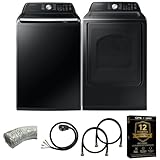
- Exclusive Installation Bundle: Includes 3-Prong and 4-Prong Dryer Power Cords, Washer Hose Set, 8-ft Vent Duct, and 1-Year CPS Protection Plan
- Smart Wi-Fi Enabled: Control washer and dryer remotely via SmartThings app
- 4.7 cu ft capacity Washer with Active WaterJet & vibration reduction tech
- Built-in WaterJet faucet lets you pretreat stains inside the tub
- Self Clean keeps the tub fresh without harsh chemicals
1. Load weight
Weight gives the washer an estimate of how much water, detergent and mechanical action the load needs. It can also help determine whether the drum is lightly or heavily filled, which affects how long the cycle runs and how much water is used.
2. Fabric characteristics
Some systems infer fabric categories and select gentler or more vigorous motions. Samsung’s UK description of AI Wash on the WF90F09C4SU1 says the washer senses fabric and adjusts the soaking, rinsing and spinning times as well as water and detergent. LG’s UK description of AI Wash says it applies washing motions based on fabric for what it calls optimal care. Neither description establishes a general stain-removal advantage.
3. Soil in the water
A turbidity sensor measures how cloudy the wash water is. Cloudiness is an indirect signal of soil leaving the garments, not a photographic identification of a particular stain. Samsung says its cited AI Wash system uses turbidity sensing at all load weights and can alter detergent use and timing in response.
4. Program settings
Depending on the model, the estimate can influence water level, detergent dose, wash motion, temperature, soaking, rinsing, spinning and total duration. These are adjustments to an existing wash program, not proof that the machine has discovered a new cleaning method.
What Samsung’s documented systems actually claim
Samsung provides unusually specific examples of how its naming works, and they show why model and region matter.
AI Wash on the WF90F09C4SU1
On its UK product page for the WF90F09C4SU1, Samsung says AI Wash senses laundry weight, fabric and soil level, then adjusts water and detergent together with soaking, rinsing and spinning times. The page says fabric sensing covers three categories—Cotton, Delicates and Towels—for loads up to 2 kg. Its turbidity sensor operates at all weights.
That qualification is important. A statement that the washer “detects fabric” does not mean it identifies every garment in a mixed load. Samsung warns that mixed fabrics can reduce detection accuracy and that results vary with use. A small, clearly categorized load is closer to the conditions the fabric-sensing specification describes than a full drum containing many materials.
Samsung’s detergent-use figure
Samsung reports that detergent use can be “up to 15%” lower. The company says this comes from its own comparison of the WW9000B Cotton cycle, loaded with 2 kg of delicate fabric, against a conventional WW5000T. Samsung also says results may vary by laundry and environment.
This is a detergent-use result under stated internal test conditions. It is not an independent finding that stains were removed 15% better, nor does it mean every load will use 15% less detergent. The figure should be read as a conditional resource claim, not a cleaning-performance score.
Rank #2

- Large 4.8 Cu. Ft. Capacity : Wash more in fewer loads—perfect for families and busy households with heavy laundry demands.
- UltraFresh Vent System with OdorBlock: Helps eliminate excess moisture after each wash cycle, keeping your washer interior fresh between uses.
- Built-In WiFi with SmartHQ App Integration: Remotely control your washer from your phone—start, stop, monitor, and receive alerts anytime, anywhere.
- Quick Wash Cycle (20 Minutes): Perfect for lightly soiled clothes, this cycle delivers a fast and efficient clean when time is limited.
- Time Saver Mode (35 Minutes): Enjoy a full, deep clean in just 35 minutes—ideal for mixed loads on busy days.
AI Wash+
Samsung’s newer AI Wash+ description says the system uses multiple sensors to detect weight and five fabric types, including outdoor clothing and denim. It also monitors soil during the cycle and can adjust detergent use and wash time when needed. That is a feature description for a particular newer lineup; it should not be applied automatically to every washer marketed as AI Wash.
| Documented system | Inputs described by the manufacturer | Adjustments described | Important qualification |
|---|---|---|---|
| Samsung AI Wash, WF90F09C4SU1 (UK) | Weight, three fabric categories and soil; turbidity sensing at all weights | Water, detergent, soaking, rinsing and spinning times | Fabric sensing is specified for Cotton, Delicates and Towels up to 2 kg; mixed fabrics can reduce accuracy |
| Samsung AI Wash+ | Weight, five fabric types and soil monitored during the cycle | Detergent use and wash time | Applies to the described newer lineup, not every AI-labeled washer |
| LG AI Wash (UK product description) | Fabric characteristics | Washing motions | The description does not establish greater stain removal than other cycles |
Does AI improve cleaning?
The strongest defensible answer is: sometimes it may choose a suitable treatment for a particular load, but the AI label does not demonstrate better cleaning. Adaptive sensing can prevent an obviously light load from receiving the same settings as a heavy, dirty one, and it may reduce unnecessary detergent or time. Those are useful outcomes, but they are different from measured stain removal.
Quick wins for a faster PC:
Scan for outdated or missing drivers - takes under a minuteDriver Scan →Clear out junk files and repair common Windows errorsFree Scan →The independent result available for a named model
Reviewed tested the LG WM6700HBA and found that its AI Wash performance was similar to the Normal cycle. Reviewed also reported that AI Wash took about twice as long. This is evidence about that washer and those tested cycles; it is not a verdict on Samsung, LG’s other models or AI washers generally.
The result illustrates a practical trade-off: an adaptive cycle can spend more time sensing or applying a tailored sequence without producing a visibly better result than a conventional program. If time matters, compare the tested duration as well as the cleaning score.
Why a manufacturer’s optimization language is not proof
Terms such as “optimal care,” “intelligent” or “optimized cleaning” describe the intended behavior of a product. They do not substitute for a controlled comparison against another cycle using the same load, detergent and stain set. Samsung’s 15% figure concerns detergent use under a specified internal comparison, not a general improvement in removing stains.
How independent washer tests measure cleaning
Consumer Reports describes a more useful approach than judging a feature name. Testers wash fabric swatches marked with stains such as red wine, cocoa and carbon. They measure stain intensity before and after washing with a spectrocolorimeter, allowing the change to be compared numerically. Cycle time and resource use can then be considered alongside stain removal.
When a published comparison is available, check whether it tested the AI-labeled cycle or a conventional cycle. An overall washer score may combine results from a standard program and therefore cannot answer whether the AI feature itself helped. Look for the exact cycle, load, stain set, detergent and measured duration.
How to compare an AI washer with a conventional one
Use the feature as one data point, not as a shortcut around performance evidence. A sensible comparison proceeds in this order:
- Start with measured stain removal. Prefer tests that identify the cycle and use instrumented stain measurements.
- Check cycle duration. An adaptive program that takes substantially longer may not fit your routine, especially if its cleaning result is similar to Normal.
- Examine water and energy use. A lower detergent dose is only one resource outcome; compare the full cycle where figures are available.
- Check fabric-care behavior. See which fabric categories the sensors actually support and whether mixed loads reduce accuracy.
- Match capacity to your normal loads. A sensor specification limited to small loads may not describe performance with a full drum.
- Consider reliability, repairability and price. These ownership factors remain relevant whether or not the control software is marketed as AI.
| Evidence or claim | What it can tell you | What it cannot establish |
|---|---|---|
| Samsung’s “up to 15%” detergent figure | A potential detergent-use reduction in Samsung’s stated internal comparison | A 15% cleaning improvement or a result for every load |
| Reviewed test of LG WM6700HBA AI Wash | That model’s AI Wash was similar to Normal and took about twice as long in the review | How all AI washers perform |
| Consumer Reports’ swatch and spectrocolorimeter method | A way to quantify stain removal and compare cycles | An AI-versus-standard result for a model unless that comparison is published |
How to use an AI cycle without overestimating it
You do not need a special technique, but the sensor’s limits make loading and cycle selection important.
Rank #3

- High-Efficiency Front-Load Washer – ENERGY STAR certified design delivers powerful cleaning performance while helping reduce annual energy consumption to approximately 105 kWh/year.
- Large 5.0 Cu. Ft. Capacity – Easily handles bulky items like comforters and large laundry loads, reducing the number of cycles needed.
- Depth With Door Open (Maximum 55 inches) – Requires up to 55 in. of clearance with the door fully open (90°) for convenient loading and unloading.
- Smart ThinQ Technology – Wi-Fi enabled washer allows remote monitoring, cycle control, and notifications through the LG ThinQ app.
- Quiet & Durable Inverter Direct Drive Motor – Designed for reduced vibration, quieter operation, and long-term reliability.
- Read the model’s AI description. Confirm which fabrics and load sizes the manufacturer says it can sense. Do not assume a similarly named feature has the same sensors.
- Separate unusual loads when practical. If fabric detection is documented only for specific categories or small loads, a homogeneous load gives the system a better chance of matching its stated conditions.
- Use the correct detergent amount. An adaptive dose is not permission to add extra detergent. Excess detergent can leave residue and may change the conditions under which the cycle is designed to operate.
- Check the estimated time before starting. AI Wash may run longer than a conventional cycle. Choose Normal or a fabric-specific program when the longer treatment offers no practical benefit for your load.
- Treat persistent stains separately. A turbidity sensor responds to soil in the water; it does not guarantee recognition or removal of every set-in stain. Follow the garment-care label and use an appropriate pre-treatment when needed.
- Review the result, not the animation or label. If everyday loads are no cleaner after repeated use, compare the machine’s conventional cycles and published test data rather than assuming the AI mode must be superior.
Common misunderstandings and failure modes
“AI” means the washer learns over time
Not necessarily. The cited product descriptions explain sensing and programmed adjustments; they do not establish self-learning behavior. Unless a specific model documents learning, regard the system as a fixed product design that reacts to current measurements.
What’s actually slowing this PC down?
Pick the symptom - the matching free tool is one click away.
The washer can identify every fabric
Samsung’s own qualification shows why that is too broad: the WF90F09C4SU1’s fabric sensing is described for three categories and loads up to 2 kg, while mixed fabrics may reduce accuracy. A mixed load can therefore produce a less certain estimate than the marketing shorthand suggests.
A turbidity sensor recognizes stains
Turbidity measures cloudiness in the water. It can indicate that soil is being released, but it does not identify “red wine,” “cocoa” or another named stain. It is an indirect control signal.
A longer cycle must clean better
Reviewed’s LG result demonstrates why duration and cleaning should be checked independently: AI Wash took about twice as long while performing similarly to Normal in that test. Time is a cost, not proof of efficacy.
A resource-saving claim proves superior washing
Detergent use, water use, fabric care and stain removal are separate outcomes. A washer can reduce detergent in a specified test and still produce no measured gain in stain removal.
The Tool Desk
Outbyte Driver Updater FREEScan for outdated or missing drivers - takes under a minuteDriver Scan →Outbyte PC Repair FREEClear out junk files and repair common Windows errorsFree Scan →What to look for in a buying specification
Before paying extra for an AI-branded model, ask for concrete answers:
- Which sensors are installed: weight, turbidity, fabric or others?
- Which fabric categories and load weights are covered?
- Which settings can change automatically?
- Is the published result from the manufacturer or an independent tester?
- Was cleaning measured on the AI cycle itself?
- What is the cycle time compared with Normal?
- Are water, energy or detergent figures tied to a named load and test condition?
If the seller cannot answer these questions, the AI badge tells you little about cleaning performance. A well-tested conventional cycle may be a better choice than an adaptive cycle whose advantages are described only in general marketing language.
Bottom line for everyday laundry
AI in a washing machine is best understood as automated sensing and control. It can estimate load weight, fabric and soil, then adjust water, detergent, motion and timing. That may improve convenience, fabric handling or resource allocation for some loads. Current evidence does not support treating the label as a guarantee of cleaner clothes. Judge a model by independent, cycle-specific stain results, duration and resource use—and remember that the available LG test found AI Wash comparable to Normal while taking about twice as long.
Quick Recap
Product prices and availability are accurate as of the date/time indicated and are subject to change. Any price and availability information displayed on Amazon at the time of purchase will apply.

