Quick wins for a faster PC:
Fix the driver behind crashes, sound loss and screen glitchesFind Drivers →Repair Windows errors before they cause bigger problemsFix Now →Loquent’s account of using vox-bench offers a useful lesson in voice AI latency: an average can hide the slow responses callers notice. But the post does not substantiate the title’s “14,000 benchmark runs” figure. Autor Technologies says it tracked latency across more than 10,000 calls over six months, and describes the first four months of monitoring as flawed. Its numbers are company-reported observations from a particular setup, not a universal benchmark or vendor guarantee.
What Loquent’s production experience actually showed
In a June 3, 2026 post, Autor Technologies Inc. described a Loquent voice-agent pipeline that ingested calls through Twilio media streams, used Deepgram for speech recognition, sent text to Anthropic Claude with OpenAI as a fallback, generated speech with ElevenLabs, and streamed audio back through Twilio. The company said it tracked more than 10,000 calls over six months. Its post does not report 14,000 benchmark runs.
As an Amazon Associate I earn from qualifying purchases.
The first monitoring approach logged only inbound and outbound timestamps. That produced an average round trip near 650 ms, but did not reveal which stage was slow or how bad the slowest responses could get. During an ElevenLabs latency incident, the company reported that TTS p50 rose from 120 ms to p95 340 ms. The overall average moved from 650 ms to 710 ms, while 12% of calls reached 1.4 seconds or more. Autor Technologies said callers began talking over the agent and repeating themselves.
Those figures describe the company’s account of one production configuration. They should not be read as typical performance for Twilio, Deepgram, Claude, ElevenLabs, or voice agents generally. Read Autor Technologies’ account and description of vox-bench.
#1 Best Overall
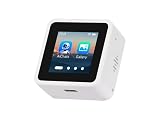
- High-Performance ESP32-S3 Processor-- Equipped with a dual-core Xtensa LX7 CPU with a clock speed of up to 240MHz, built-in 512KB SRAM, 384KB ROM, stacked 8MB PSRAM and external 16MB Flash, supports 2.4GHz Wi-Fi and Bluetooth 5 (LE), easily handling complex applications and AI calculations.
- 1.54inch IPS LCD Display-- Onboard 1.54inch LCD display for clear color picture display, 240 × 240 resolution, 262K color. It perfectly presents rich visual content such as AI dialogue, electronic photo album, video playback, and game animation.
- Intelligent AI Voice Interaction-- Supports mainstream online large model platforms such as Xiaozhi AI and DeepSeek. It features an onboard dual microphone array and ES7210/ES8311 audio codec chip, providing voice wake-up, conversation interruption, noise reduction, and echo cancellation functions for a smooth and intelligent dialogue experience.
- Multifunctional Sensors and Expansion-- Integrated six-axis inertial measurement unit (3-axis accelerometer + 3-axis gyroscope) to support motion detection; onboard Micro SD card slot for storage expansion; Type-C interface for convenient power supply and data transmission; additional I2C and UART pads for peripheral connections.
- Secondary Development-- The factory firmware includes built-in AI dialogue, audio and video playback, electronic photo album, text reading, and fun games. It can be used directly as a smart chat toy, or developers can perform personalized programming and in-depth customization.
Why an average is not enough
Latency is a distribution, not one number. The median, or p50, describes the point at which half of measured responses were faster and half slower. A p95 value is the point at which 95% were faster; p99 exposes still rarer delays. These percentiles answer different questions: p50 describes a typical turn, while higher percentiles help reveal the tail that can disrupt a conversation.
In its reported configuration, Loquent’s total pipeline had p50 latency of 620 ms and p99 of 1,150 ms. The gap matters: a system can feel responsive in most turns while still producing a meaningful share of noticeably slower ones. An average can blur that distinction, especially when a few long delays are mixed with many quick responses.
Rank #2

- 【POWERFUL ESP32‑S3 CONTROLLER】Built‑in Xtensa 32‑bit LX7 dual‑core processor, 512KB SRAM, 8MB PSRAM, 16MB Flash for stable AI voice computing and multitask processing.
- 【Preloaded Dual AI Platforms】Comespre-installed with complete Deepseek and OpenAI voice dialogue projects.Experience intelligent voice interaction instantly. (Note: OpenAI functionality requires your own API key.)
- 【STABLE WIRELESS & CLEAR AUDIO】Integrated 2.4GHz Wi‑Fi + Bluetooth 5 (LE); dedicated audio decoding module for natural, responsive voice interaction.
- 【USER‑FRIENDLY VISUAL & PLUG‑AND‑PLAY】2” TFT‑SPI color screen shows real‑time chat; modular design, no extra wiring, ready to use after setup.
- 【FULL LEARNING SUPPORT】45 programmable GPIOs, rich interfaces, online web tutorials, free technical support for beginners & developers.
Autor Technologies described under 800 ms as its own “feels natural” threshold, and said callers began repeating themselves above 1.2 seconds and hung up above 1.8 seconds. These are the company’s operational thresholds, not an industry standard. The practical test is whether your own callers can comfortably take turns under the conditions you serve.
Do these 3 things before closing this tab:
1Clear out junk files and repair common Windows errors2Fix the driver behind crashes, sound loss and screen glitches3Repair Windows errors before they cause bigger problemsWhat the reported stage measurements say
The company published component timings as well as its total pipeline results. Each value below is Autor Technologies’ report for the configuration described in its June 3, 2026 post; component measurements and end-to-end timings are not interchangeable.
Rank #3

- Unleash Creativity with VC-02 Kit: Elevate your smart home and gadgets to the next level with the VC-02-Kit AI Intelligent Offline Voice Module. Integrated with a CH340C serial to USB chip, it offers fundamental debugging interfaces and USB upgrade options, making it an indispensable tool for hobbyists and innovators alike
- Intuitive Design, Enhanced Interaction: Experience seamless control with the VC-02's built-in wake-up and mood lights, providing clear status and control indications. This Voice Recognition Module is designed to add a touch of sophistication
- Engineered for Excellence: The VC-02 Development Board is powered by a 32bit RISC architecture core, supplemented with a DSP instruction set tailored for signal processing and voice recognition. It boasts an FPU for floating-point operations and an FFT accelerator, ensuring robust performance for complex projects
- Sophisticated Voice Control: With the ability to recognize 150 local commands offline, the VC-02 Voice Control Module brings smart technology to your fingertips. Without the need for an internet connection
- Versatile Application: Whether you're developing for smart homes, enhancing small intelligent appliances, or creating interactive toys and lighting, the VC-02 Kit offers a versatile solution. Supporting a lightweight RTOS system, it's specifically designed to meet the demands of creative developers aiming to push the boundaries of voice-controlled innovation
| Stage or measure | Reported latency |
|---|---|
| Deepgram Nova-3 speech recognition | p50 180 ms; p95 245 ms; p99 310 ms |
| Claude Haiku, time to first byte (TTFB) | p50 210 ms; p95 340 ms; p99 480 ms |
| Claude Sonnet, TTFB | p50 380 ms; p95 620 ms |
| ElevenLabs text-to-speech | p50 130 ms; p95 220 ms; p99 350 ms; p99 reportedly reached 600 ms at times |
| Total pipeline | p50 620 ms; p95 890 ms; p99 1,150 ms |
The same company said its streaming approach reduced total p50 from more than 1,100 ms to 620 ms. It also reported that healthcare-domain utterances benchmarked 15–20% slower on STT than general conversation in its tests, using a corpus of 200 healthcare utterances. These are configuration- and test-specific results, not a guarantee that streaming or a particular provider will produce the same improvement elsewhere.
How to benchmark a voice agent usefully
Measure each stage to diagnose bottlenecks, but also measure the response a caller experiences. A component timer can tell you about STT, model, or TTS behavior; it cannot by itself establish when the caller hears a usable answer.
Rank #4

- Please note!!! This product requires a 3.7V MX1.25 lithium battery for operation, which is not included. Please purchase it separately.
- High-Performance MCU: The board is equipped with the ESP32-S3R8 module, featuring a powerful Xtensa 32-bit LX7 dual-core processor that operates at up to 240MHz, ensuring efficient processing for various smart applications.
- Wireless Connectivity: With built-in support for 2.4GHz Wi-Fi (802.11 b/g/n) and Bluetooth 5 (LE), the ESP32-S3-AUDIO-Board offers robust wireless capabilities, facilitated by the onboard antenna for seamless communication and connectivity.
- Advanced Voice Interaction: The dual microphone array is designed with noise reduction and echo cancellation features, enabling accurate speech recognition and responsive near/far-field wake-up functionality, perfect for voice-activated applications.
- Dynamic Lighting Effects: Equipped with 7x programmable surround RGB LEDs, the board allows the creation of vibrant and colorful lighting effects, enhancing user interaction and visual appeal for projects.
- Define the end-to-end boundary. State exactly when the clock starts and stops. OpenBenchmarks defines time to first agent byte from the end of caller speech to the start of the agent reply. Voxworks advises distinguishing acoustic turn end from the system’s accepted turn end, and proposes measuring the first stable, playable phrase rather than counting any initial audio byte. These boundaries yield different results, so name the one you use.
- Instrument the pipeline by stage. Record separate timestamps for speech recognition, model response, speech generation, and audio delivery. Keep first-byte measures distinct from complete-response measures; a quick first byte does not mean a caller has received a complete or playable answer.
- Report percentiles and the sample size. Include at least p50 and p95, and consider p90, p99, and maximum when diagnosing tail behavior. Give the number of calls and turns so readers can understand the scale behind the distribution.
- Use representative conversation patterns. Include realistic utterances, longer turns, pauses, interruptions, and recovery after interruption. Loquent’s account says its tool could simulate interruptions, pauses, and silence; a clean, short prompt alone will not describe a live conversation.
- Make the test reproducible. Record model and configuration versions, region, connection state, codec, network route, and recording point. Separate conversational turns from tool or API turns, clean turns from interruption and recovery turns, and warm connections from cold ones.
- Disclose exclusions. State how many turns were excluded and why. Quality-gated benchmark sets can be useful, but their results cannot be compared fairly without knowing what was removed.
OpenBenchmarks publishes turn-level artifacts and exclusion reasons, and its repository leaderboard is a separate dataset: it lists 2,078 usable turns across 550 calls from 2,158 measured, with the leaderboard marked generated on August 1, 2026. Do not merge those figures with Loquent’s production account. See the OpenBenchmarks leaderboard and methodology.
What vox-bench was designed to do
Autor Technologies described vox-bench as a TypeScript command-line tool for measuring STT, LLM, and TTS stages independently and in chained pipeline simulations. The post says it reports p50, p95, p99, and maximum latency; compares providers; can detect scheduled p95 regressions; and simulates conversation profiles with interruptions, pauses, and silence.
Best Value

- Powerful MCU Board: Incorporate the ESP32 S3 32-bit, dual-core, Xtensa processor chip operating up to 240 MHz, mounted multiple development ports, Arduino / MicroPython supported
- Advanced Functionality: Detachable OV2640 camera sensor for 1600*1200 resolution, compatible with OV3660 camera sensor, integrating additional digital microphone
- Great Memory for more Possibilities: Offer 8MB PSRAM and 8MB FLASH, supporting SD card slot for external 32GB FAT memory
- Outstanding RF performance: Support 2.4GHz Wi-Fi and BLE dual wireless communication, support 100m+ remote communication when connected with U.FL antenna
- Thumb-sized Compact Design: 21 x 17.5mm, adopting the classic form factor of XIAO, suitable for space-limited projects like wearable devices
The post describes a Node.js 20+ implementation with a provider-adapter layer, pipeline orchestrator, t-digest statistics engine, and JSON, Markdown, or webhook reporting. It says the project was released under the MIT license. The post’s description establishes what the authors said they built; it does not by itself verify the repository’s present status or feature availability.
How to interpret other voice-latency figures
Different datasets can provide context, but only when their measurement boundaries and populations are clear. Voxworks reports analyzing 102,201 selected latency rows in an evolving staging corpus, with an approximate median total response latency of 1.645 seconds, p90 of 3.115 seconds, median LLM TTFT of 293 ms, and median TTS first-byte time of 237 ms. Voxworks cautions that the corpus combines changing models, architectures, scripts, and instrumentation, so it is not an immutable product benchmark. Those figures should not be ranked directly against Loquent’s production measurements.
Voxworks also proposes “Time to First Playable Phrase” (TTFPP), with a quality gate, as a caller-focused metric. It is a proposal from Voxworks, not an established standard. The underlying point is practical: a system should not get credit for a fast audio byte if that byte is not yet a stable, understandable phrase.
For vendor or architecture comparisons, hold the test conditions steady and publish the route, configuration, boundary, and exclusions. Latency is only one dimension; streaming behavior, speech quality, content-domain variation, and the caller’s ability to take turns also affect whether a setup works well.
Quick Recap
What the evidence supports—and what it does not
- It supports the value of measuring per-stage latency and tail percentiles alongside an end-to-end caller-turn measure.
- It supports treating the reported Loquent figures as a specific company’s experience with a named pipeline and test corpus.
- It does not support the “14,000 benchmark runs” figure in the supplied title; Autor Technologies’ post instead says more than 10,000 calls over six months.
- It does not establish universal latency thresholds, independent vendor rankings, or guaranteed results from streaming.
Product prices and availability are accurate as of the date/time indicated and are subject to change. Any price and availability information displayed on Amazon at the time of purchase will apply.

