What’s actually slowing this PC down?
Pick the symptom - the matching free tool is one click away.
The reliable food-preservation loop in Vintage Story is simple: cook while ingredients are fresh, put prepared food into crocks, seal those crocks with fat or beeswax, and keep long-term supplies in a cool, dark cellar. Climate, container type, room temperature, light, and the freshness of every ingredient determine how long food remains usable.
Playing with friends? Godlike.Host runs hosted Vintage Story servers from 10 data-center locations, with free DDoS protection.
How spoilage works in Vintage Story
Most foods pass through several states rather than disappearing immediately. An item has a freshness period during which it is fresh, followed by a spoilage period in which it becomes partially spoiled and eventually turns into rot. As food ages, it loses nutritional value before it is completely unusable. The exact duration depends on the food category, its container, the storage temperature, and the condition of the ingredients used to make it.
As an Amazon Associate I earn from qualifying purchases.
Recommended Free Tools
Temperature changes the decay rate
Climate applies a multiplier to the normal decay rate. In hot conditions, decay can rise to 2.5 times the normal rate. In very cold conditions, it can fall to 0.1 times the normal rate, meaning food decays at one-tenth of the normal rate. The Vintage Story Wiki lists these figures for version 1.20.10, and they should be treated as version-specific if a later game update changes preservation rules.
A cellar does not magically freeze food. It prevents the ambient climate penalty when the room is at 5°C or colder and the outside temperature would otherwise be warmer. The room’s actual temperature and the active spoilage modifier matter more than simply being underground.
#1 Best Overall

- Help Organize Your Kitchen and Pantry: Imagine every time walking to your kitchen or pantry, found everything is neatly organized. No longer messy, you can get everything you want very quickly. With the stackable and space-saving design, these containers will make more efficient use of every inch of your kitchen pantry cabinets
- 4 Size Combinations Fit Your Needs: Our kitchen storage container set comes in 4 different sizes. Includes 6 Tall Container (2.5quart/2.8 liters), 6 Large Containers (1.8quart/2.0 liters), 6 Medium Containers (1.5quart/1.6 liters), 6 Small Containers (0.7quart/0.8 liters). Suitable for storing spaghetti, baking supplies, cereal, flour, sugar, oats, pasta, rice, coffee, tea, snacks, nuts and other dry goods
- Airtight Containers Keep Food Fresh: The side-locking lids with silicone gasket make these storage containers airtight, and the top flips open easily. The airtight storage system will always keep your food dry and fresh. All have the same lids make it easy to wash dry and reuse with ease
- BPA Free and Food Grade Material: Vtopmart pantry storage containers are made of durable plastic, BPA free, which have a longer life than many other brands plastic containers. Clear containers make it convenient to see what's inside, you can easily get what you want without opening every container
- 24 Reusable Labels: Except 24pcs dry food storage containers, you will also receive 24pcs labels. They are reusable, you can switch contents whenever you need. Just wipe clean with a damp cloth to change what you have written, Peel and Re-stick
Combining stacks can shorten good food’s life
When two stacks of the same food are combined, the game calculates the average remaining perish time and applies that average to the resulting stack. Combining a nearly fresh stack with one that is close to spoiling therefore pulls the fresh stack forward toward the older stack’s timer. Keep older and newer batches separate when preserving a long-term reserve.
Partially spoiled ingredients affect the finished meal
Cooking does not reset an ingredient’s condition. If a partially spoiled ingredient goes into a recipe, the resulting meal starts spoiled. For the longest-lived meals, sort out partially spoiled ingredients before cooking and use the freshest ingredients available.
Quick wins for a faster PC:
Scan for outdated or missing drivers - takes under a minuteDriver Scan →Clear out junk files and repair common Windows errorsFree Scan →Build a cellar that actually improves preservation
A recognized cellar is an enclosed room no larger than 7 by 7 by 7 blocks internally. Larger rooms may still be useful as general storage, but they do not meet the stated cellar-size condition for the preservation bonus.
Cellar construction checklist
- Keep the interior within 7×7×7 blocks.
- Use soil, ceramic, or stone for the walls.
- Build underground when practical to block sunlight, but do not assume underground construction alone grants a spoilage bonus.
- Use as few doors and trapdoors as possible because openings make it harder to maintain the intended cool environment.
- Limit windows and other sources of sunlight. Light can raise the room temperature by up to 10°C.
- Place the food-storage area where the room can remain at 5°C or colder when the cellar condition is active.
Check the modifier instead of guessing
Use the block-information HUD to inspect the active spoilage modifier in the room. A value of 0.25 means food decays at one-quarter of the normal rate, or four times more slowly. Check the block where the food container sits rather than relying on the room’s appearance. A brightly lit corner, an open entrance, or a warm section near the surface may produce a different result from the back of the room.
Rank #2

- Food Container Set:Our 40 pcs food storage containers Includes 20 containers and 20 lids, and 16 reusable labels and marker pen. This set includes 6 rectangular containers (1*50.7oz, 1*33.8oz, 2*16.9oz, 2*8.1oz), 4 square containers (1*40.6oz, 1*23.7oz, 1*13.5oz, 1*5.7oz), 4 round containers (1*40.6oz, 1*23.7oz, 1*13.5oz, 1*6oz), and 6 round sauce boxes(3*2oz, 3*1oz).
- BPA-Free & Food Grade Materials: Our food storage containers with lids are made of high quality plastic materials that are durable and BPA-Free. This food containers with lids are made of transparent material(Not like glass,Slightly white), but you can also clearly see the food inside. Our meal prep containers reusable are great choices for storing leftovers, fruits, vegetables, cooked meals, dry food and sauce.
- Leak-Proof & Keep Fresh: Each lid of our plastic storage containers features silicone sealing strips and 4-sided latches designed to ensure an airtight and leak-proof. You will never have to worry about food or liquid spills again when you use this containers for food. Keep your fridge clean and say goodbye to fridge odors.
- Safe and Easy to Use: Our plastic food storage containers with lids can be heated in the microwave, washed in the dishwasher, and stored in the freezer. (Note: Please do not put the lid into the microwave and dishwasher, high temperature will lead to deformation of the sealing ring affecting the closure of the lid and container).
- Kitchen Storage & Space-Saving: The plastic containers with lids are designed to be stacked and nested. You can easily store these food containers to save space in your kitchen when not in use. Kitchen storage containers help to categorize storage and placement to keep your kitchen organized.
Compare the main storage methods
| Method | Best use | Stated preservation effect or shelf life | Requirements and limits | Portability and cellar interaction |
|---|---|---|---|---|
| Raw food in ordinary storage | Short-term eating and ingredients that will be processed soon | No special reduction stated; normal climate-dependent decay applies | Keep batches separate when their ages differ | Cellar temperature can slow decay, but no container bonus is added |
| Cooking-pot meal | Immediate meals and food prepared for the next few days | Vegetable stew, meat stew, and soup each have a six-day shelf life | Requires a cooking pot; fresh ingredients produce a longer-lived result | Can be portioned into crocks for carrying and longer storage |
| Unsealed crock | Prepared meals and pickled vegetables | Container capacity is four portions; an unsealed crock has no stated tenfold reduction | Fill the crock with up to four portions | Portable in inventory; cellar temperature still helps |
| Sealed crock | Long-term prepared meals and pickles | Sealing with a lump of fat or beeswax reduces decay by a factor of 10 | Requires a filled crock plus fat or beeswax | Portable in inventory; combining sealing with a cellar gives two separate preservation advantages |
| Storage vessel | Bulk vegetables and grains | Reduces decay by 75% for vegetables and 50% for grains | Its strongest effects are category-specific; no universal bonus for every food type is stated | Useful for stockpiles; cellar conditions can further improve the environment |
| Jam | Berries and fruit that need a long shelf life | 45-day shelf life | Cooking pot, bucket, honey, and fruit; the preservation recipe specifies at least two berries and 1.2 L of honey | Can be kept in a cellar for additional protection from temperature |
| Juice or fermented drink | Fruit, berries, grains, or honey that will be processed rather than eaten raw | Processing extends shelf life; no single duration is stated | Juice requires a fruit press, bucket, and at least 16 fruit. Fermentation requires a barrel, bucket, water, and the appropriate raw ingredient | Store finished products in a cool area; processing reduces satiety or nutrition |
Use this step-by-step preservation workflow
- Sort by freshness. Separate fresh ingredients from partially spoiled ones. Do not mix old and new stacks unless you accept the averaged perish time.
- Choose the process. Cook a meal for near-term use, turn berries into jam for a 45-day shelf life, place vegetables or grains in the appropriate storage vessel, or use juicing and fermentation when the ingredients and equipment match.
- Cook in a pot while ingredients are fresh. Vegetable stew, meat stew, and soup begin with a six-day shelf life under the stated meal rules. A partially spoiled ingredient makes the finished meal start spoiled.
- Portion prepared food into a crock. A crock holds up to four portions of meals or pickled vegetables. This converts a loose stack into a container that can be sealed and carried.
- Seal the crock. Apply a lump of fat or beeswax. The sealed crock’s decay rate is one-tenth of the unmodified rate, according to the preservation rules.
- Move long-term stock to the cellar. Place sealed crocks, storage vessels, jam, or other preserved food in the coolest area. Confirm that the interior is at 5°C or colder when you are relying on cellar conditions.
- Read the HUD modifier. Inspect the block-information HUD at the storage location. If the value is 0.25, the food is decaying four times more slowly than normal at that position.
- Rotate deliberately. Eat older batches first and keep a separate reserve. Avoid merging a nearly spoiled stack into a newly prepared one.
Cooking: what lasts and what changes
Vegetable stew, meat stew, and soup
Each of these meals has a six-day shelf life on the current Meal page of the Vintage Story Wiki. That is the meal’s stated baseline; temperature, container, and ingredient freshness still affect the practical result. Put portions into a crock immediately if they are not going to be eaten within the next few days. Sealing and cellar storage address different causes of decay, so using both is more effective than relying on either one alone.
Fresh ingredients matter more than a recipe reset
A meal made from fresh ingredients starts in better condition than one made from ingredients already losing freshness. Cooking is therefore a timing decision: process food before it crosses into partial spoilage, rather than waiting until the last possible day and assuming the pot will restore its timer.
Preservation recipes and their trade-offs
Jam
Jam is the most useful long-term option for berries when the goal is shelf life. The recipe uses a cooking pot, a bucket, honey, and fruit. The preservation instructions specify a minimum of two berries and 1.2 L of honey. Jam has a 45-day shelf life, making it substantially more durable than the six-day shelf life stated for vegetable stew, meat stew, and soup. Keep the finished jam cool as well; the long recipe shelf life does not make it immune to climate-based decay.
Juicing
Juicing uses a fruit press and bucket with at least 16 fruit. It is a way to process a large fruit surplus instead of leaving it in a rapidly aging raw stack. Processing extends shelf life, but no universal number of days is stated for every juice. Plan the process around your available fruit volume and remember that processing reduces satiety or nutrition.
Rank #3

- Neat & Organized: Each container is designed for easy stacking when in use, and easy storing when not.
- Storage Contained: Ridged lids are designed to ensure sturdier stacking in the fridge and pantry.
- Easy to Carry: The innovative extended lip provides extra support for handling the containers.
- Long-Lasting Durability: Twenty percent more durable*, each container is designed to last and be an essential part of your kitchen. [*Disclaimer TK]
- Made in the USA: EasyStore containers are built to store, built to save, and made in the USA.
Fermentation
Fermentation uses a barrel, bucket, water, and a compatible raw ingredient:
- Fruit can become cider.
- Suitable berries, cactus fruit, or pomegranate can become wine.
- Grain can become ale.
- Honey can become mead.
Fermentation extends shelf life, but every processing step trades away some satiety or nutrition. No shared duration is stated for cider, wine, ale, and mead, so do not treat them as interchangeable timers.
Do these 3 things before closing this tab:
1Clear out junk files and repair common Windows errors2Scan for outdated or missing drivers - takes under a minute3Repair Windows errors before they cause bigger problemsPickled vegetables
Pickled vegetables can be stored in crocks, with up to four portions per crock. Sealing the crock with fat or beeswax provides the tenfold decay-rate reduction. For bulk unprocessed vegetables, a storage vessel is also valuable because its stated 75% decay reduction is strongest for that category.
How to choose between a storage vessel and a crock
Choose a storage vessel for bulk vegetables and grains
The category-specific bonuses make storage vessels the efficient choice when your stock is mostly vegetables or grains. Vegetables receive a 75% decay reduction and grains receive a 50% reduction. These figures do not establish an equal benefit for prepared meals, fruit, or every other food category, so use vessels where their documented strengths apply.
Rank #4
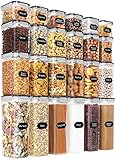
- Bundle Set: This kitchen & pantry organizers and storage set comes with 24 containers, they are inlaid together, so at first glance you may think there is only the same size, but when you take it apart, you will find FOUR different sizes. Includes 6 Large Tall Containers (2.5 quart /2.8 liters), 6 Large Containers (1.8 quart /2.0 liters), 6 Medium Containers ( 1.3 quart /1.4 liters), 6 Small Containers (0.7 quart /0.8 liters). Perfect for storing flour, sugar, spaghetti, rice, nuts, cereal, snacks, pasta, and more
- Sealing Safe: These flour and sugar containers are equipped with a silicone sealing strip and four locking lids to ensure that water and air cannot enter it, So as to better ensure the freshness and health of the ingredients in the clear storage containers for organizing and make the food very dry
- Well Organizer: These air tight sealable containers for food are designed to be superimposed, which is neat and saves space. Cereal containers storage set can be easily placed in cabinets and other places where you want to place them, They can be cleaned in the dishwasher (but not the lids), easy to use and convenient
- Premium Materials: You won't have to worry about the health of your family, as PRAKI airtight food storage containers for pantry set is made of premium plastic. These pasta storage containers for pantry make it easy to find the food item in the cabinet
- No Confusion: Except 24 PCS kitchen storage containers, you will also receive 40 pieces Labels and 1 Marker, which will help you never confuse flour with powdered sugar or baking powder with baking soda. The clear plastic let you see what is in the large pantry storage containers, you can get what you want easily
Choose a sealed crock for prepared food
Meals and pickled vegetables benefit directly from crock capacity and sealing. A sealed crock is also portable, so you can carry a complete four-portion meal without leaving it exposed as a loose stack. Put sealed crocks in the cellar when you are storing them for the long term.
Use both when your pantry contains different categories
A practical pantry can use storage vessels for bulk vegetables and grains, while sealed crocks hold cooked meals and pickles. Jam and fermented products can occupy the cool cellar space as their own processed-food reserve. This arrangement follows each container’s documented strength instead of assuming one container is optimal for everything.
Independent reader supportYour contribution helps us test, update, and keep practical guides available for everyone.Troubleshooting common spoilage problems
Food is spoiling quickly in an underground room
Being underground is not itself a preservation bonus. Check the block-information HUD, room temperature, sunlight, and openings. Reduce doors and trapdoors, block light, and verify that the room meets the 7×7×7 internal-size condition. If the modifier is not improving, inspect the exact block where the container sits rather than a nearby wall.
A fresh stack became old after I combined it
The game averages the perish times of the two stacks when they are combined. Separate batches by age and consume the older one first. Combining is convenient for inventory management but can sacrifice the freshness of the newer food.
Best Value

- 【Sturdy & Reusable】Made of premium thick plastic and strong construction, Dealusy meal prep containers with lids ensure no cracks for your take out meals. They can also be easily cleaned for reuse with hand wash or on the top rack of the dishwasher.
- 【Leakproof & Stackable】: These food prep containers come with tight sealed lids, you can easily stack them and won’t worry that the food would leaks or spills.
- 【Microware Safe & Freezer Safe】: Made of premium food grade plastic, these BPA-free disposable food containers can withstand a temperature from -4℉to 248℉, totally Microware Safe & Freezer Safe.
- 【Convenient Use】: With the pre-set volume of these disposable food containers, you can easily pack your healthy meals, vegetables and fruits without measuring your portions. Great for taking your meals out for school, work, gym or a camping trip.
- 【50 Value Package】: This value package includes 50 pack (100-Piece) 32 oz meal prep containers with easy open lids. They are the perfect choice for your daily meal preparation.
The meal was spoiled immediately after cooking
At least one ingredient was already partially spoiled. Discard or separately use compromised ingredients, then cook a new batch from fresh components. A cooking pot does not convert a spoiled input into a fresh meal.
My cellar has light and food still decays fast
Light can raise room temperature by up to 10°C. Cover openings, reduce windows, and recheck the temperature and HUD modifier after the change. A cellar that is structurally underground but warm or brightly lit may not provide the intended environment.
I processed food, but it feeds less
Longer shelf life has a cost: each processing step reduces satiety or nutrition. Preserve only the surplus that would otherwise spoil, and keep some fresh food for immediate meals when its higher nutritional value matters more than storage time.
A practical pantry plan for different time horizons
Food for the next day or two
Cook fresh ingredients in a pot and leave portions accessible for immediate eating. Do not spend preservation materials on food that will be consumed before normal decay becomes a problem.
Food for the next week
Prepare meals before ingredients become partially spoiled, then place portions in crocks. The six-day meal shelf life is a useful planning reference, but temperature and ingredient condition can shorten it. A cellar provides a safer buffer than an exposed room.
Seasonal or emergency reserves
Seal meal and pickle crocks, store them in the cellar, and use storage vessels for vegetable and grain stockpiles. Turn a berry surplus into jam, and ferment suitable fruit, berries, grains, or honey when the reduced nutrition is acceptable in exchange for a longer-lasting reserve.
Key numbers to remember
- Hot climate: decay can reach 2.5× normal.
- Very cold climate: decay can fall to 0.1× normal.
- Cellar condition: food is held at 5°C or colder when ambient temperature is lower.
- Cellar interior limit: 7×7×7 blocks.
- Sealed crock: decay reduced by a factor of 10.
- Crock capacity: up to four portions.
- Storage vessel: 75% decay reduction for vegetables and 50% for grains.
- Vegetable stew, meat stew, and soup: six-day shelf life.
- Jam: 45-day shelf life.
- Jam minimum: two berries and 1.2 L of honey.
- Juicing minimum: 16 fruit.
The strongest general strategy is not one item but a sequence: process fresh ingredients, select the container that matches the food category, seal prepared food, and verify a cool, dark cellar with the HUD. That combination prevents avoidable losses while preserving the option to keep some food fresh when nutrition is more important than maximum storage time.
Quick Recap
Product prices and availability are accurate as of the date/time indicated and are subject to change. Any price and availability information displayed on Amazon at the time of purchase will apply.

